

Thank Roosevelt for Football Weekends
December 20, 2013
By Rob Kaminski
MHSAA benchmarks editor
The next time you find yourself immersed in a tense crosstown football rivalry on a Friday night followed by a Saturday pilgrimage to the nearest college campus and a Sunday afternoon with a remote and your favorite snacks and beverages, take a moment to consider what the weekend would be like if it weren’t for Teddy Roosevelt.
The man who became our 26th President shortly after the turn of the 20th Century following the assassination of William McKinley in 1901 was a football fan like you. Maybe more so.
Today’s game of football has reached a critical crossroads. Player size and speed have increased across the board. Savage use of equipment as weapons rather than protective gear has been glorified on television networks and social media. Leaders of the game at all levels have recognized the need for change, employing new rules and widespread educational efforts to aid in preserving the sport.
History, as they say, is repeating itself.
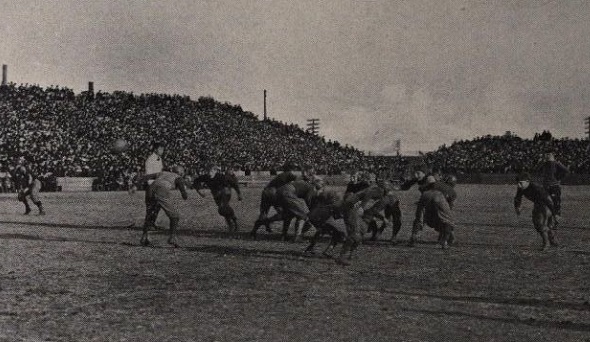
In an ironic twist, it was Roosevelt who saved the then-brutally violent game of football from itself more than 100 years ago. Yes, the same “Rough and Ready Teddy” who led the charge up San Juan Hill during the Spanish-American War and often sparred in the boxing ring while in office from 1901-09 opined that football was becoming so gruesome that he delivered an ultimatum: clean up the game or it would be outlawed.
The Chicago Tribune reported that in 1904 alone, there were 18 football deaths and 159 serious injuries, mostly among prep school players. Football deaths suffered by younger players were reported on a nearly weekly basis, as outraged citizens called on colleges and high schools to banish football outright.
In stepped Roosevelt, who called head coaches and representatives from Harvard, Yale and Princeton – college powers at the time – to the White House in 1905 urging them to eliminate excessive violence and set an example of fair play for the rest of the country. When the casualties actually rose by one during the ensuing season, Roosevelt reacted with greater resolve and convened leading football authorities for the purpose of authoring drastic rules changes. What emerged was an intercollegiate conference which was the predecessor of the NCAA.
Among the most effective changes for the 1906 season were the legalization of the forward pass, the elimination of mass formations, and the creation of a neutral zone. Football fatalities fell to 11 in each of the next two seasons, and severe injuries fell drastically.
Thanks to the introduction of protective equipment and ever-evolving rules changes, football during the 100-plus years to follow has become an exponentially safer game. Yet, the game’s leaders always will need to adjust and react to scrutiny that comes with the territory.
So, as the game once again undergoes rules modifications in the name of safety, give a tip of the cap to President Roosevelt while you enjoy college bowl season and the NFL playoffs and begin to think ahead to the first high school practice of 2014.
1st & Goal: 8-Player Finals Preview
By
Geoff Kimmerly
MHSAA.com senior editor
January 15, 2021
Four undefeated teams will be the first to play for championships to cap the longest football season in MHSAA history.
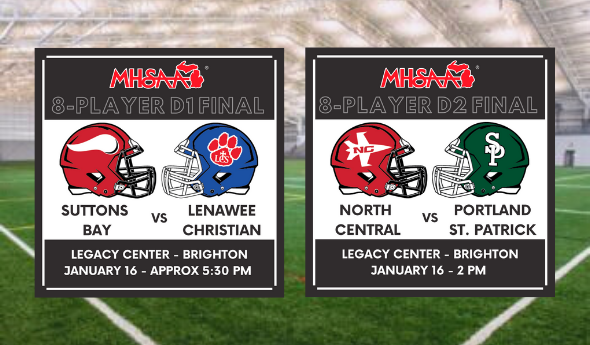
Adrian Lenawee Christian and Suttons Bay in Division 1 and Portland St. Patrick and Powers North Central in Division 2 will take the field at Brighton’s Legacy Center on Saturday with this season’s two 8-player titles on the line. They returned to action last week after a nearly two-month pause due to COVID-19.
Suttons Bay and Portland St. Patrick are the 2019 runners-up in Divisions 1 and 2, respectively. Adrian Lenawee Christian is new to the format this season and like Suttons Bay is playing for its first football title. North Central, meanwhile, is the only program to win multiple 8-player championships since the format was added in 2011, and the Jets are back at the Finals for the first time since their repeat run in 2016.
Kickoff for the Division 2 game is 2 p.m., with the Division 1 game following approximately 5:30 p.m. Spectators remain limited, but both games will be broadcast live on the FOX Sports Detroit Facebook page, and replayed on FOX Sports Detroit’s primary channel Jan. 21 beginning at 8 p.m. Audio of both games will be streamed live on MHSAANetwork.com.
Below is a look at all four finalists. Team “rankings” are based on their playoff-point averages heading into the postseason.
Division 1
ADRIAN LENAWEE CHRISTIAN
Record/rank: 10-0, No. 3
Coach: Bill Wilharms, eighth season (59-21)
League finish: First in Southern Central Athletic Association A
Championship history: Has never played in an MHSAA Final.
Best wins: 49-0 over No. 1 Morrice in Regional Final, 47-12 over No. 8 Martin in Semifinal, 78-14 over No. 4 Mayville in Regional Semifinal, 24-6 over Division 2 No. 5 Colon.
Players to watch: RB/LB Jameson Chesser, 5-10/170, sr. (1,179 yards/29 TDs rushing, 506 yards/4 TDs receiving); QB/CB Landon Gallant, 5-10/155, sr. (1,331 yards/23 TDs passing, 388 yards/6 TDs rushing); OG/NG Coby Kegerreis, 5-8/185, jr.; C/DE Joey Breckel, 6-1/240, sr.
Outlook: Lenawee Christian’s 8-player debut couldn’t have gone better on the field, as the Cougars have won only one game by fewer than 35 points. That was an 18-point victory over league foe Colon, last season’s Division 1 champion, and Saturday the Cougars can make it a repeat for the SCAA Division A. Chesser – who also has thrown for 178 yards and two touchdowns on 17 attempts – made the all-state first team and scored five times against Martin in the Semifinal. Kegerreis also made the all-state first team, as did junior kicker Clay Ayers (41 of 48 XP), and Breckel earned honorable mention. Those four and Gallant also start on a defense that’s given up only 46 points over 10 games.
SUTTONS BAY
Record/rank: 10-0, No. 1
Coach: Garrick Opie, third season (30-2)
League finish: Does not play in a league.
Championship history: 8-player Division 1 runner-up 2019, 11-player Division 6 runner-up 2004.
Best wins: 38-22 over No. 8 Gaylord St. Mary in Regional Final, 35-0 over Brethren, 39-20 and 44-0 (Regional Semifinal) over Whittemore-Prescott.
Players to watch: RB/DB Hugh Periard, 6-0/175, jr. (799 yards/13 TDs rushing, 217 yards/3 TDs receiving); QB/DB Nate Devol, 6-0/175, sr. (901 yards/15 TDs passing, 301 yards/2 TDs rushing, 4 interceptions on defense); RB/LB Shawn Bramer, 6-2/195, jr. (622 yards/11 TDs rushing, 60 yards/1 TD receiving); OL/LB Michael Wittman, 6-4/230, sr.
Outlook: Suttons Bay is returning to the Division 1 championship game after falling short in a 26-14 defeat to Colon in 2019. The Norsemen have won all of their games by double digits, with a defense giving up only 7.6 points per game and a rushing attack that has piled up 2,506 yards over nine games (last week’s Semifinal win was a forfeit by Indian River Inland Lakes). Wittman made the all-state first team as a linebacker. Starting tight ends Jake Murphy and Brayden Opie add another element to the attack – both have caught 15 passes, with Murphy scoring on five and Opie on six.
Division 2
PORTLAND ST. PATRICK
Record/rank: 10-0, No. 1
Coach: Patrick Russman, 13th season (96-39)
League finish: Does not play in the league.
Championship history: 8-player Division 2 runner-up 2019 and 2017, 11-player Class D champion 1992, runner-up 1997 and 1991.
Best wins: 44-34 over No. 5 Colon in Regional Final, 34-12 over No. 7 Kinde North Huron in Semifinal, 52-19 over No. 4 Burr Oak, 26-22 over Division 1 No. 6 Merrill.
Players to watch: QB/DB Connor Cross, 6-3/190, sr. (1,245 yards/21 TDs passing, 429 yards/9 TDs rushing, 4 interceptions on defense); RB/LB Derec Fedewa, 5-10/185, jr. (1,369 yards/19 TDs, 311 yards/5 TDs receiving); WR/LB Braxton Teachworth, 6-3/190, jr. (193 yards/3 TDs receiving); OL/DL Chase Fitzsimmons, 6-3/240, sr.
Outlook: The Shamrocks have come within a win of the Division 2 championship twice over the last four seasons, and will make a run at it again with an offense featuring all-state first teamers at quarterback and running back. Cross and Fedewa have piled up big numbers this fall, as has leading receiving Shane Cook (502 yards/9 TDs), for a team scoring 43.5 points per game. But the key Saturday could be an opportunistic defense that has taken advantage of 28 turnovers – including 19 fumble recoveries – and allowed conversions on only 19 percent of opponent third downs. Fitzsimmons and Teachworth earned all-state honorable mentions, Teachworth at linebacker.
POWERS NORTH CENTRAL
Record/rank: 10-0, No. 2
Coach: Leo Gorzinski, third season (28-3)
League finish: First in Great Lakes Eight Conference West
Championship history: 8-player champion 2016 and 2015.
Best wins: 55-8 over No. 3 Cedarville in Regional Final, 50-2 over No. 8 Marion in Semifinal, 50-8 over Stephenson, 52-8 over Lake Linden-Hubbell in Regional Semifinal.
Players to watch: QB/LB Luke Gorzinski, 5-9/170, soph. (1,163 yards/18 TDs passing, 909 yards/20 TDs rushing); WR/LB Ian Gorzinski, 5-11/165, sr. (362 yards/5 TDs receiving, 101 yards/3 TDs rushing); RB/LB Alex Naser, 5-8/165, jr. (312 yards/7 TDs rushing, 301 yards/7 TDs receiving, 2 TDs on kickoff returns); OL/DL Carter Eichmeier, 6-2/190, sr.
Outlook: The Jets will match St. Patrick’s all-state quarterback with the other all-state first-team signal-caller this season in Luke Gorzinski, who is coming off four touchdown runs and a scoring pass in the Semifinal. He keys an offense that has outscored opponents 280-8 in the first quarter alone and 539-60 in nine games overall (one win was a forfeit). Eichmeier also made the all-state first team as North Central won all but one of its games by more than 40 points. In addition to the sparse points given up, the Jets are allowing only 114 yards per game.