

Thank Roosevelt for Football Weekends
December 20, 2013
By Rob Kaminski
MHSAA benchmarks editor
The next time you find yourself immersed in a tense crosstown football rivalry on a Friday night followed by a Saturday pilgrimage to the nearest college campus and a Sunday afternoon with a remote and your favorite snacks and beverages, take a moment to consider what the weekend would be like if it weren’t for Teddy Roosevelt.
The man who became our 26th President shortly after the turn of the 20th Century following the assassination of William McKinley in 1901 was a football fan like you. Maybe more so.
Today’s game of football has reached a critical crossroads. Player size and speed have increased across the board. Savage use of equipment as weapons rather than protective gear has been glorified on television networks and social media. Leaders of the game at all levels have recognized the need for change, employing new rules and widespread educational efforts to aid in preserving the sport.
History, as they say, is repeating itself.
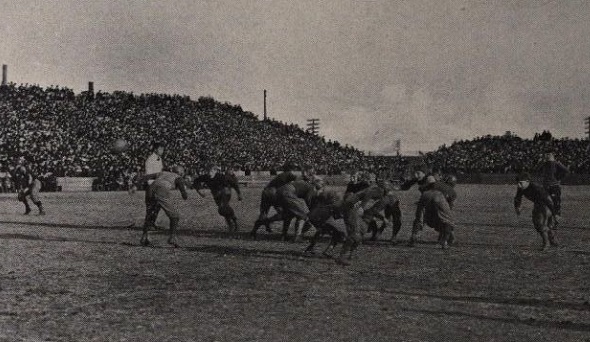
In an ironic twist, it was Roosevelt who saved the then-brutally violent game of football from itself more than 100 years ago. Yes, the same “Rough and Ready Teddy” who led the charge up San Juan Hill during the Spanish-American War and often sparred in the boxing ring while in office from 1901-09 opined that football was becoming so gruesome that he delivered an ultimatum: clean up the game or it would be outlawed.
The Chicago Tribune reported that in 1904 alone, there were 18 football deaths and 159 serious injuries, mostly among prep school players. Football deaths suffered by younger players were reported on a nearly weekly basis, as outraged citizens called on colleges and high schools to banish football outright.
In stepped Roosevelt, who called head coaches and representatives from Harvard, Yale and Princeton – college powers at the time – to the White House in 1905 urging them to eliminate excessive violence and set an example of fair play for the rest of the country. When the casualties actually rose by one during the ensuing season, Roosevelt reacted with greater resolve and convened leading football authorities for the purpose of authoring drastic rules changes. What emerged was an intercollegiate conference which was the predecessor of the NCAA.
Among the most effective changes for the 1906 season were the legalization of the forward pass, the elimination of mass formations, and the creation of a neutral zone. Football fatalities fell to 11 in each of the next two seasons, and severe injuries fell drastically.
Thanks to the introduction of protective equipment and ever-evolving rules changes, football during the 100-plus years to follow has become an exponentially safer game. Yet, the game’s leaders always will need to adjust and react to scrutiny that comes with the territory.
So, as the game once again undergoes rules modifications in the name of safety, give a tip of the cap to President Roosevelt while you enjoy college bowl season and the NFL playoffs and begin to think ahead to the first high school practice of 2014.
Kicker Steps Into Historic Moment
December 8, 2020
By Doug Donnelly
Special for Second Half
CLINTON – After what Jonathan Baughey has gone through, kicking a football through two yellow goal posts doesn’t seem like a very big deal.

But, when it came against an undefeated, state-ranked team on the last play of the Division 6 District championship game, it was just that.
“It was definitely a scary moment,” said Baughey, a junior from Clinton High School in Lenawee County.
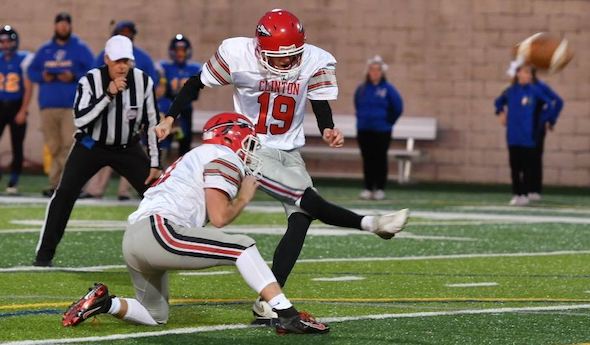
Baughey’s 22-yard field goal as time expired gave Clinton a 16-13 victory over Blissfield and sent his team into a Regional Final against Warren Michigan Collegiate.
It’s been a long road for Baughey, who thought that after a successful kidney transplant in 2015 that his football career was over. At the urging of a family friend and Clinton middle school coach, however, Baughey tried kicking. It was a good choice as he’s now etched his name into Clinton football lore by making probably the biggest field goal in school history.
 “He’s been through so much, and I couldn’t be happier for him,” said Clinton football coach Jeremy Fielder. “We had a lot confidence in him kicking in that situation. There was no hesitation.”
Baughey was born with one kidney functioning at 25 percent and the other at 75.
“From birth he always had kidney issues,” said his mother, Kelly Baughey. “We knew growing up he would need a transplant. They tested his father and I, and we were both matches. His dad (Kevin) decided that he wanted to do it for him. He was his donor.”
Kevin Baughey never hesitated.
“It wasn’t a decision at all,” he said. “I would have given him both if I needed to.”
For years, dealing with the kidney issue was just part of Jonathan’s life. He would tire easier than other kids, but he learned to cope with it.
“I was more of a tired kid,” Baughey said. “When I was younger, it wasn’t about contact, it was about how tired I would get. I couldn’t keep up with a lot of other kids. It was hard.”
He had a kidney removed in December of 2012. After that, he said, “it was a roller coaster.” The transplant didn’t come until June of 2015, soon after he finished the sixth grade.
It took roughly six weeks in the hospital for Baughey to recover from the transplant.
“As soon as I had the transplant, I started feeling better than I had felt,” he said. “I had more energy.”
Baughey played flag football as a kid and had started playing tackle football. But when he neared the time for a transplant, he figured his football days were done. That’s when family friend and Clinton middle school coach Keith Tschirhart suggested he try kicking for the Clinton middle school team.
“I had played soccer and thought it was something I could do, so I tried it,” Baughey said. “I went out with him to the football field to see how I would do. It was pretty rough at the beginning. It took some time.”
He didn’t get much practice that first season.
“We never really kicked extra points,” he said.
Baughey kept working at it though and made it through his eighth-grade season. As a freshman he figured he would continue kicking, most likely for the Clinton JV team. He went to the tryouts.
“I kicked my first football and the coach said I was on the varsity,” he said.
Fielder said Baughey made an immediate impact.
“We didn’t have a kicker,” he said. “We had no one. I even told the coaches, ‘What are we going to do?’ Then, I saw him kick the ball and it was like, ‘He’s our kicker.’”
 It was big adjustment for Baughey. Not only had he once thought he would never play football again – but he found himself suddenly on the varsity as a freshman, not knowing anyone on the team. And, being exclusively a kicker, meant he practiced mainly by himself.
“That was the struggle that I went through,” he said. “I didn’t know anyone. The only kids I knew were the snapper and the holder.”
Clinton grad Erik Bouse stepped in to help Baughey. Bouse had been a standout kicker for Clinton for three seasons before graduating in 2017.
“He was the one who I mainly worked with,” Baughey said. “He helped me a lot. He really started me out not creating bad habits and helped with the mental part of it.”
As a freshman, Baughey made 42 of his 50 extra-point attempts and a 21-yard field goal. As a sophomore he made 48 of 54 with a 19-yard field goal. This season he has made 29 of 37 extra-point attempts. The winning field goal against Blissfield was his only field goal of the season, on two tries.
Baughey is exclusively a kicker because of the potential risk of injury following the transplant. He wears a special pad on his stomach under his uniform because that is where doctors put his new kidney.
His mother said the no-contact rule causes some angst for her.
“He knows there is a chance he could get hit,” she said. “He wears a shield for padding. The transplant team has okayed him to play.”
Baughey practices every day, often by himself. He goes to the game field and starts at the extra point yardage and works his way back, making at least two kicks at each distance before moving on to the next level. He’ll use his cell phone to record himself, then watch the videos to make sure he is kicking correctly and not developing bad habits.
“The biggest part for me is to go out and know that I can do it,” he said. “You have to know you are going to kick it through the uprights, not just think you are going to. I like to pick out a small target, even a leaf or something, and just clear my mind and just kick the ball.”
When Clinton got the ball back with just over three minutes to go in the District Final against Blissfield, Baughey started thinking the game might come down to his foot.
“I went to the net and started kicking,” he said.
Clinton drove the ball inside the Blissfield 10-yard line, but did not reach the end zone. Fielder called a timeout on fourth down with only a few seconds left. Baughey jogged onto the field and lined up when Blissfield called a timeout.
“I remember walking to the sidelines and taking a deep breath,” he said. “People came up and talked to me and told me I could do it”
Baughey blocked everything out.
“I was really mentally focused,” he said. “After I made the kick, I started clapping. I turned around and all my teammates were jumping up and down. I ran to our coaches and everyone started hugging.”
His father, his donor, could not have been happier to see the ball go through the uprights.
“I was beside myself happy,” Kevin Baughey said. “Thinking about all of the time he spent working in the offseason, and then seeing the confidence his coaches showed with making the call to go for the field goal ... I was as proud as I could possibly be.”
 Doug Donnelly has served as a sports and news reporter and city editor over 25 years, writing for the Daily Chief-Union in Upper Sandusky, Ohio from 1992-1995, the Monroe Evening News from 1995-2012 and the Adrian Daily Telegram since 2013. He's also written a book on high school basketball in Monroe County and compiles record books for various schools in southeast Michigan. E-mail him at [email protected] with story ideas for Jackson, Washtenaw, Hillsdale, Lenawee and Monroe counties.
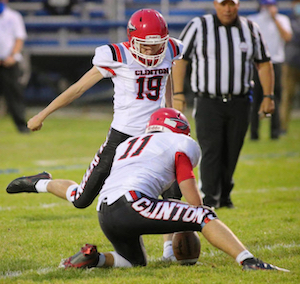
PHOTOS: (Top) Clinton's Jonathan Baughey connects on a kick. (Middle) Baughey, following through on another kick this season, clinched his team's District title with a game-winning field goal. (Photos courtesy of the Clinton football program.)