

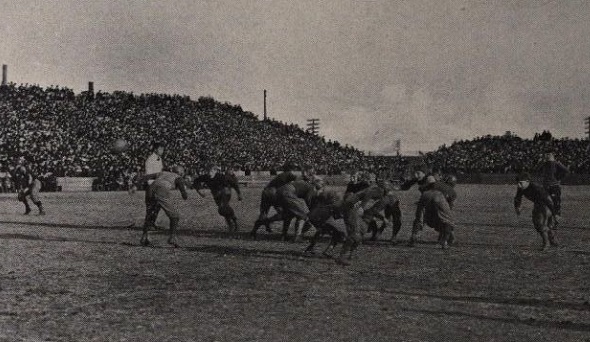
Thank Roosevelt for Football Weekends
December 20, 2013
By Rob Kaminski
MHSAA benchmarks editor
The next time you find yourself immersed in a tense crosstown football rivalry on a Friday night followed by a Saturday pilgrimage to the nearest college campus and a Sunday afternoon with a remote and your favorite snacks and beverages, take a moment to consider what the weekend would be like if it weren’t for Teddy Roosevelt.
The man who became our 26th President shortly after the turn of the 20th Century following the assassination of William McKinley in 1901 was a football fan like you. Maybe more so.
Today’s game of football has reached a critical crossroads. Player size and speed have increased across the board. Savage use of equipment as weapons rather than protective gear has been glorified on television networks and social media. Leaders of the game at all levels have recognized the need for change, employing new rules and widespread educational efforts to aid in preserving the sport.
History, as they say, is repeating itself.
In an ironic twist, it was Roosevelt who saved the then-brutally violent game of football from itself more than 100 years ago. Yes, the same “Rough and Ready Teddy” who led the charge up San Juan Hill during the Spanish-American War and often sparred in the boxing ring while in office from 1901-09 opined that football was becoming so gruesome that he delivered an ultimatum: clean up the game or it would be outlawed.
The Chicago Tribune reported that in 1904 alone, there were 18 football deaths and 159 serious injuries, mostly among prep school players. Football deaths suffered by younger players were reported on a nearly weekly basis, as outraged citizens called on colleges and high schools to banish football outright.
In stepped Roosevelt, who called head coaches and representatives from Harvard, Yale and Princeton – college powers at the time – to the White House in 1905 urging them to eliminate excessive violence and set an example of fair play for the rest of the country. When the casualties actually rose by one during the ensuing season, Roosevelt reacted with greater resolve and convened leading football authorities for the purpose of authoring drastic rules changes. What emerged was an intercollegiate conference which was the predecessor of the NCAA.
Among the most effective changes for the 1906 season were the legalization of the forward pass, the elimination of mass formations, and the creation of a neutral zone. Football fatalities fell to 11 in each of the next two seasons, and severe injuries fell drastically.
Thanks to the introduction of protective equipment and ever-evolving rules changes, football during the 100-plus years to follow has become an exponentially safer game. Yet, the game’s leaders always will need to adjust and react to scrutiny that comes with the territory.
So, as the game once again undergoes rules modifications in the name of safety, give a tip of the cap to President Roosevelt while you enjoy college bowl season and the NFL playoffs and begin to think ahead to the first high school practice of 2014.

Dundee Says Good-Bye to Longtime Home
October 25, 2019
By Doug Donnelly
Special for Second Half
DUNDEE – One more memory.
After 85 years of playing prep football in the same location, Dundee will close the doors on its stadium tonight with plans to move into a new athletic complex next fall. Vikings head coach Kyle McElvany called tonight’s game against undefeated and state-ranked Hillsdale one more chance for the Vikings to make an ever-lasting memory.
“There is so much tradition and history here over the course of 85-plus years,” McElvany said. “It’s humbling. We hope to go out and make our alumni and community proud.”
Dundee hasn’t been to the playoffs in seven years, but a victory over Hillsdale would make certain the Vikings are in the 256-team field when the 11-player tournament pairings are announced Sunday. It would make for a memorable way to close out the history of the stadium, too.
Late last month, school officials announced that 1969 Dundee alum John D. Craig, retired chairman, president and CEO of EnerSys, has donated $1 million to be used exclusively toward the creation of the John D. Craig and Family Athletic Complex. The school will begin next week discussing the new complex at a public meeting. The plan is to build the new stadium in time for the 2020 season opener against Romulus Summit Academy North.
The Vikings have been playing football for decades in the current stadium, located behind what once was the high school in the village of fewer than 4,000 people. The new athletic complex will be built on the northwest side of the new high school.
“Our administration has already started to work on the project from a development standpoint, and I hope to get involved as well once our season is wrapped up,” McElvany said.
The new stadium will have a total visitor seating for approximately 2,500, new stadium lights and a new engineered natural grass athletic field. The facility will be capable of hosting football games, track meets and band festivals, and also feature a new scoreboard, new permanent concessions and restroom facilities.
The old stadium has been home to several great memories for Vikings fans over the years. One of them came earlier this season when Dundee’s defense made a goal-line stand during the final seconds to hold on for a 15-14 win over Ida. It was Dundee’s first football win over Ida in six years.
“To see the crowd and community on the field embracing those kids after that game was very special,” McElvany said.
Over the years, Dundee has won championships, completed undefeated seasons and hosted playoff games in the old stadium. In 2011, Dundee was still recovering from a tornado that caused millions of dollars in damage in the community when its football team brought some solace to the area with an 8-3 record and the only playoff win in school history.
“The greatest game ever for us in that stadium was the 2011 District playoff game versus Brooklyn Columbia Central,” said Dylan Williams, a 2012 Dundee graduate. “The field was all torn up from the tornado still. We took the lead in the fourth quarter with about a minute to go and held them.”
The most successful era for Dundee came during the 1960s when the Vikings won both Huron League and Southeastern Conference championships. Dundee didn’t lose for more than three years from 1963-1966 (finishing a combined 32-0-3), an accomplishment that remains the longest unbeaten streak in Monroe County Region history.
“The undying friendship, teamwork and dedication to a goal learned on this field will be with us all forever,” said Bob Busz, who played for those teams and graduated in 1966.
Ted Rath, a 2002 Dundee graduate and current assistant coach with the Los Angeles Rams, recalled several great memories from his time at Dundee. He was a student manager in 1994 and 1995 when his brother was playing quarterback, and then played for the Vikings himself. He met his wife, Robin, on that field while she was attending cheerleading practice.
“So many memories come flooding to mind when I think of my football experiences on that field,” Rath said. “I have been blessed to travel this great country and the world because of the sport of football. I have been to places like Wembley Stadium in London and Lambeau Field in Green Bay and many places in between. When I think about all the places that this sport has taken me, I realize that none are as sweet as that field in Dundee, Michigan.
“If I could stand on that field this week and say one thing it would simply be thank you,” Rath wrote in an e-mail. “Thank you for the memories, thank you for the victories, but also thank you for the defeats. The lessons learned on that field have shaped my life and driven me to become a better Christian, husband, father and person.”
While the new athletic complex is a welcome addition to the district and community, former players and coaches can’t help but recall the great times they made in the old stadium. Thoughts of fans rushing onto the field, wins over rival Ida and simply lining up for the kickoff at games at the stadium will keep the facility alive for Vikings fans for years to come.
Tyler Anson, a 2006 graduate, said he used to find his favorite spot at every home game to quietly reflect right before kickoff.
“My favorite memory from the stadium was always standing in the back of the end zone right before the national anthem,” Anson said. “There was something about being under the lights, looking down the field seeing the crowd, and hearing the anthem knowing you’re about to go to war with your brothers. It’s a feeling that will always give me chills.”
Doug Donnelly has served as a sports and news reporter and city editor over 25 years, writing for the Daily Chief-Union in Upper Sandusky, Ohio from 1992-1995, the Monroe Evening News from 1995-2012 and the Adrian Daily Telegram since 2013. He's also written a book on high school basketball in Monroe County and compiles record books for various schools in southeast Michigan. E-mail him at [email protected] with story ideas for Jackson, Washtenaw, Hillsdale, Lenawee and Monroe counties.
PHOTOS: (Top) Dundee’s football stadium has hosted games for 85 years. (Middle) Vikings fans stretch into the hillside next to the bleachers during a game. (Top team and middle football photos courtesy of Kyle McElvany; press box and field photos by Doug Donnelly.)