

Thank Roosevelt for Football Weekends
December 20, 2013
By Rob Kaminski
MHSAA benchmarks editor
The next time you find yourself immersed in a tense crosstown football rivalry on a Friday night followed by a Saturday pilgrimage to the nearest college campus and a Sunday afternoon with a remote and your favorite snacks and beverages, take a moment to consider what the weekend would be like if it weren’t for Teddy Roosevelt.
The man who became our 26th President shortly after the turn of the 20th Century following the assassination of William McKinley in 1901 was a football fan like you. Maybe more so.
Today’s game of football has reached a critical crossroads. Player size and speed have increased across the board. Savage use of equipment as weapons rather than protective gear has been glorified on television networks and social media. Leaders of the game at all levels have recognized the need for change, employing new rules and widespread educational efforts to aid in preserving the sport.
History, as they say, is repeating itself.
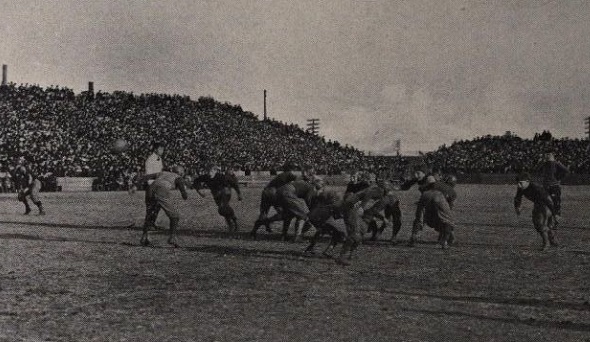
In an ironic twist, it was Roosevelt who saved the then-brutally violent game of football from itself more than 100 years ago. Yes, the same “Rough and Ready Teddy” who led the charge up San Juan Hill during the Spanish-American War and often sparred in the boxing ring while in office from 1901-09 opined that football was becoming so gruesome that he delivered an ultimatum: clean up the game or it would be outlawed.
The Chicago Tribune reported that in 1904 alone, there were 18 football deaths and 159 serious injuries, mostly among prep school players. Football deaths suffered by younger players were reported on a nearly weekly basis, as outraged citizens called on colleges and high schools to banish football outright.
In stepped Roosevelt, who called head coaches and representatives from Harvard, Yale and Princeton – college powers at the time – to the White House in 1905 urging them to eliminate excessive violence and set an example of fair play for the rest of the country. When the casualties actually rose by one during the ensuing season, Roosevelt reacted with greater resolve and convened leading football authorities for the purpose of authoring drastic rules changes. What emerged was an intercollegiate conference which was the predecessor of the NCAA.
Among the most effective changes for the 1906 season were the legalization of the forward pass, the elimination of mass formations, and the creation of a neutral zone. Football fatalities fell to 11 in each of the next two seasons, and severe injuries fell drastically.
Thanks to the introduction of protective equipment and ever-evolving rules changes, football during the 100-plus years to follow has become an exponentially safer game. Yet, the game’s leaders always will need to adjust and react to scrutiny that comes with the territory.
So, as the game once again undergoes rules modifications in the name of safety, give a tip of the cap to President Roosevelt while you enjoy college bowl season and the NFL playoffs and begin to think ahead to the first high school practice of 2014.
Record Runner Helps Revive Manistique
By
John Vrancic
Special for MHSAA.com
November 6, 2019
MANISTIQUE – Schyler Andersen had no idea what he had just accomplished.
 The senior running back may have known he rushed for 126 yards in Manistique's 54-21 loss in the regular-season finale at Lake Linden-Hubbell on Oct. 26.
What he didn't know right away is he had set the school's single-season rushing record at 1,491 yards, topping the previous-best by the late Ron Rubick (1,388) in 1959.
"I wasn't sure what the record was at the time," said Andersen, who also finished this season with 22 touchdowns for the 3-6 Emeralds. "When I found out later on, I was real happy about that. I'm very grateful for all the opportunities I had. The most satisfying part is we won some games."
Rubick, an Upper Peninsula Sports Hall of Fame member who went on to play at Michigan State University, set a U.P. scoring record as a senior with 29 TDs and 183 points on 103 carries for a 13.5-yard per carry average.
Andersen ran 233 times this season for a 6.4-yard average and was 26-of-62 passing for 409 yards, two TDs and two interceptions. He was a media All-U.P. Dream Team selection at running back and Offensive Player of the Year in the Western Peninsula Athletic Conference’s Iron Division.
"It's sad that I didn't get to meet Ron," said Andersen. "I would have liked to have gotten to know him. Obviously, I didn't know this was going to happen. Just having my name next to Ron Rubick is a real big honor. My teammates and coaches deserve all the credit. I couldn't have done this without them."
Manistique had fallen on hard times prior to this season, finishing 1-8 in three straight (2013-15), 0-9 in both 2016 and 2017 and playing just two games last year before cancelling the remainder of the season.
Then on Sept. 6, the Emeralds defeated Gwinn 28-8 for their first home victory since 2012.
 "That got the ball rolling for us," said Andersen. "We gained more confidence as the season went on. There was definitely a sense of relief after we won that game. The explosion (of fans) after the game was unbelievable. We played better here than anywhere else. All of our wins happened on our home field. Without the support of our hometown crowd, our season wouldn't have been what it was. I don't think our record shows how successful we really were."
Manistique also topped Munising 29-7 for Homecoming on Oct. 4 and Norway 19-14 on Oct. 18.
"A lot of teams looked down on us," said Andersen. "The Norway game was kind of a statement win, and our loss to Negaunee (24-22 on Sept. 20) was a little controversial in the end. We had a 14-0 lead after the first quarter against Negaunee and were pretty disappointed we didn't win, but I think we did a pretty good job overcoming that. I don't think our confidence ever really went down."
Andersen believes having more players made a significant difference for the Emeralds this year.
"This was the first season in a while in which we had more than 20 players," he said. "We had good depth to go to in case of injuries or sickness. We had a lot of young players. I think this is a step in the right direction."
Andersen, who plans to major in journalism after high school, hopes to continue playing football in college as well.
"Writing is one of my favorite things to do," he said. "Football is my favorite game for sure. It was great to see the other guys so happy this year, and I was happy to be part of it. I'm looking into playing at Northern or Central (Michigan University)."
 John Vrancic has covered high school sports in the Upper Peninsula since joining the Escanaba Daily Press staff in 1985. He is known most prominently across the peninsula for his extensive coverage of cross country and track & field that frequently appears in newspapers from the Wisconsin border to Lake Huron. He received the James Trethewey Award for Distinguished Service in 2015 from the Upper Peninsula Sportswriters and Sportscasters Association.
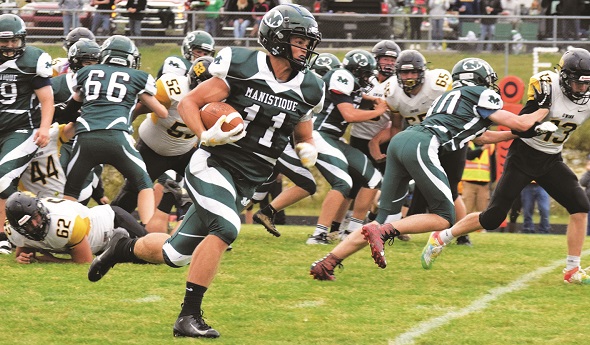
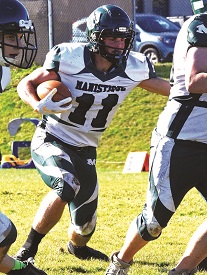
PHOTOS: Manistique's Schyler Andersen breaks through the line during a Sept. 6 win over Gwinn. (Middle) Andersen finds an opening during his school record-setting rush Oct. 26 against Lake Linden-Hubbell. (Photos courtesy of Faith Andersen.)