

Thank Roosevelt for Football Weekends
December 20, 2013
By Rob Kaminski
MHSAA benchmarks editor
The next time you find yourself immersed in a tense crosstown football rivalry on a Friday night followed by a Saturday pilgrimage to the nearest college campus and a Sunday afternoon with a remote and your favorite snacks and beverages, take a moment to consider what the weekend would be like if it weren’t for Teddy Roosevelt.
The man who became our 26th President shortly after the turn of the 20th Century following the assassination of William McKinley in 1901 was a football fan like you. Maybe more so.
Today’s game of football has reached a critical crossroads. Player size and speed have increased across the board. Savage use of equipment as weapons rather than protective gear has been glorified on television networks and social media. Leaders of the game at all levels have recognized the need for change, employing new rules and widespread educational efforts to aid in preserving the sport.
History, as they say, is repeating itself.
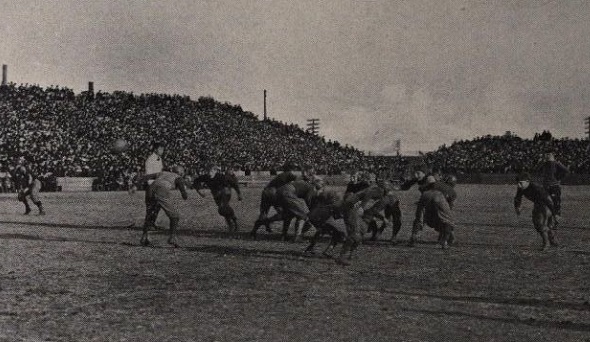
In an ironic twist, it was Roosevelt who saved the then-brutally violent game of football from itself more than 100 years ago. Yes, the same “Rough and Ready Teddy” who led the charge up San Juan Hill during the Spanish-American War and often sparred in the boxing ring while in office from 1901-09 opined that football was becoming so gruesome that he delivered an ultimatum: clean up the game or it would be outlawed.
The Chicago Tribune reported that in 1904 alone, there were 18 football deaths and 159 serious injuries, mostly among prep school players. Football deaths suffered by younger players were reported on a nearly weekly basis, as outraged citizens called on colleges and high schools to banish football outright.
In stepped Roosevelt, who called head coaches and representatives from Harvard, Yale and Princeton – college powers at the time – to the White House in 1905 urging them to eliminate excessive violence and set an example of fair play for the rest of the country. When the casualties actually rose by one during the ensuing season, Roosevelt reacted with greater resolve and convened leading football authorities for the purpose of authoring drastic rules changes. What emerged was an intercollegiate conference which was the predecessor of the NCAA.
Among the most effective changes for the 1906 season were the legalization of the forward pass, the elimination of mass formations, and the creation of a neutral zone. Football fatalities fell to 11 in each of the next two seasons, and severe injuries fell drastically.
Thanks to the introduction of protective equipment and ever-evolving rules changes, football during the 100-plus years to follow has become an exponentially safer game. Yet, the game’s leaders always will need to adjust and react to scrutiny that comes with the territory.
So, as the game once again undergoes rules modifications in the name of safety, give a tip of the cap to President Roosevelt while you enjoy college bowl season and the NFL playoffs and begin to think ahead to the first high school practice of 2014.
Adrian Madison's Isom Leads at All Levels
By
Geoff Kimmerly
MHSAA.com senior editor
February 21, 2019
Over more than three decades, Adrian Madison athletic director Kris Isom has taken on responsibilities not only in her league and regionally, but statewide as a member of the MHSAA Representative Council – in addition to her athletic department responsibilities at the high school and junior high.
And yet, she still teaches multiple classes and coaches at least one of the district’s teams every year, serving and building relationships at the most local level of her wide influence on educational athletics.
She’s made those relationships a priority, also serving as class advisor to Madison students through last year when her daughter Rachel graduated. One year during the 1990s, in fact, the graduating class even dedicated its yearbook to her.
 “I like being in the classroom and coaching because I still have a connection with kids, know who they are,” Isom said. “Being at a smaller school, you’re able to know who kids are, but at the middle school especially I don’t know a lot. Getting involved in coaching has helped me put a name with a face so I will know them coming up.”
She continues to impact students at Madison and beyond, and will be recognized for her many contributions with the 32nd Women In Sports Leadership Award during halftime of the Division 3 Girls Basketball Final on March 23 at Calvin College’s Van Noord Arena.
Each year, the Representative Council considers the achievements of women coaches, officials and athletic administrators affiliated with the MHSAA who show exemplary leadership capabilities and positive contributions to athletics.
Isom is in her 33rd year as athletic director at Adrian Madison, taking over athletics for the high school and junior high after serving as a teacher and coach for a year at Clinton. She has served as part of the MHSAA Representative Council since 2008, representing Class C and D schools from the state’s southeastern section.
“I’m very honored by this award, not only because it’s for women in leadership. I’ve been doing this 33 years and I’ve seen more and more women in this profession … that for all things considered is a man’s profession,” Isom said. “Having a daughter, who while she’s not following my footsteps, but getting her in the business world eventually, it’s a good feeling.”
Isom’s contributions to high school sports and its participants are many and at all levels. Within her district, she has coached basketball, volleyball, sideline cheer, track & field and softball – at least one sport every year, including as the eighth grade girls basketball coach this season.
At the league level, Isom has served as president of the Tri-County Conference since 2002 after previously serving as vice president and secretary/treasurer. Serving more of her neighboring districts, Isom has hosted numerous District, Regional and Quarterfinal competitions and MHSAA Coaches Advancement Program (CAP) sessions.
At the statewide level, Isom has provided her expertise as a member of the Representative Council and as a 33-year member of the Michigan Interscholastic Athletic Administrators Association and National Interscholastic Athletic Administrators Association. She also assists MHSAA staff annually in selecting members of the 16-student Student Advisory Council.
She was named the MIAAA’s Region 6 “Athletic Director of the Year” in 2000 and received the MHSAA’s Allen W. Bush Award in 2016 to recognize her many behind-the-scenes contributions.
“Kris Isom continues to provide a steadying presence on our Representative Council. She researches issues and really brings a voice of reason to the discussion – not only to the full Council, but to the Executive Committee as well,” MHSAA Executive Director Mark Uyl said. “She does a great job representing the southeastern corner of the state, bringing a small-school perspective to the table time after time. We’re thankful for her leadership and glad to present her with the Women In Sports Leadership Award.”
Part of leadership is being an example, and Isom has served as one for many. Of course that growing group included her daughter who this year left home to study in the dental hygiene program at Jackson College but has frequently been by Mom’s side for the many activities.
“Hopefully, (she learned) to be assertive, that she needs to be a good listener, and obviously you have to be a mediator,” Kris Isom said. “Hopefully seeing all those aspects, and dealing with situations and different issues, she’ll be a better problem solver, be more open (to the idea) that there is more than one side of a story.”
A graduate of Clinton High School, Isom received her bachelor’s degree in science and teaching certification in physical education and health in 1984 from Michigan State University. She earned her master’s in elementary education in 1986 from Eastern Michigan University and also has completed graduate courses from Fresno Pacific University.
In addition to the MIAAA and NIAAA, Isom is a member of the Michigan Association for Health, Physical Education, Recreation and Dance (MAHPERD) and the Michigan State University Alumni Association. She’s active with The Clinton United Church of Christ in various service projects, including an annual fundraiser for cancer research, and also participates in local Meals on Wheels, American Red Cross and Habitat for Humanity projects.
The first Women In Sports Leadership Award was presented in 1990.
Past recipients
1990 – Carol Seavoy, L’Anse
1991 – Diane Laffey, Harper Woods
1992 – Patricia Ashby, Scotts
1993 – Jo Lake, Grosse Pointe
1994 – Brenda Gatlin, Detroit
1995 – Jane Bennett, Ann Arbor
1996 – Cheryl Amos-Helmicki, Huntington Woods
1997 – Delores L. Elswick, Detroit
1998 – Karen S. Leinaar, Delton
1999 – Kathy McGee, Flint
2000 – Pat Richardson, Grass Lake
2001 – Suzanne Martin, East Lansing
2002 – Susan Barthold, Kentwood
2003 – Nancy Clark, Flint
2004 – Kathy Vruggink Westdorp, Grand Rapids
2005 – Barbara Redding, Capac
2006 – Melanie Miller, Lansing
2007 – Jan Sander, Warren Woods
2008 – Jane Bos, Grand Rapids
2009 – Gail Ganakas, Flint; Deb VanKuiken, Holly
2010 – Gina Mazzolini, Lansing
2011 – Ellen Pugh, West Branch; Patti Tibaldi, Traverse City
2012 – Janet Gillette, Comstock Park
2013 – Barbara Beckett, Traverse City
2014 – Teri Reyburn, DeWitt
2015 – Jean LaClair, Bronson
2016 – Betty Wroubel, Pontiac Notre Dame Prep
2017 – Dottie Davis, Ann Arbor Huron
2018 – Meg Seng, Ann Arbor Greenhills
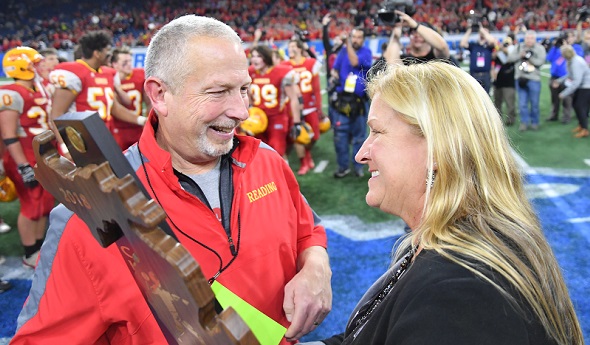
PHOTO: Adrian Madison athletic director Kris Isom, right, presents the Division 8 football championship trophy to Reading coach Rick Bailey in November at Ford Field.