

Thank Roosevelt for Football Weekends
December 20, 2013
By Rob Kaminski
MHSAA benchmarks editor
The next time you find yourself immersed in a tense crosstown football rivalry on a Friday night followed by a Saturday pilgrimage to the nearest college campus and a Sunday afternoon with a remote and your favorite snacks and beverages, take a moment to consider what the weekend would be like if it weren’t for Teddy Roosevelt.
The man who became our 26th President shortly after the turn of the 20th Century following the assassination of William McKinley in 1901 was a football fan like you. Maybe more so.
Today’s game of football has reached a critical crossroads. Player size and speed have increased across the board. Savage use of equipment as weapons rather than protective gear has been glorified on television networks and social media. Leaders of the game at all levels have recognized the need for change, employing new rules and widespread educational efforts to aid in preserving the sport.
History, as they say, is repeating itself.
In an ironic twist, it was Roosevelt who saved the then-brutally violent game of football from itself more than 100 years ago. Yes, the same “Rough and Ready Teddy” who led the charge up San Juan Hill during the Spanish-American War and often sparred in the boxing ring while in office from 1901-09 opined that football was becoming so gruesome that he delivered an ultimatum: clean up the game or it would be outlawed.
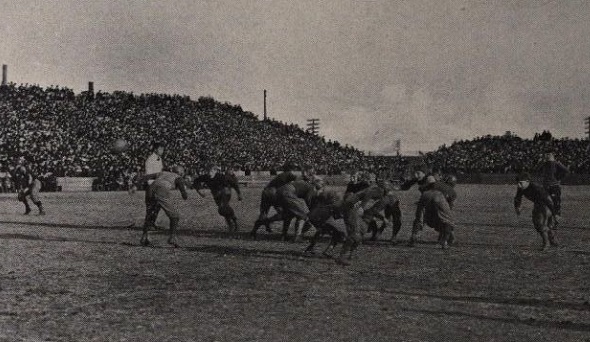
The Chicago Tribune reported that in 1904 alone, there were 18 football deaths and 159 serious injuries, mostly among prep school players. Football deaths suffered by younger players were reported on a nearly weekly basis, as outraged citizens called on colleges and high schools to banish football outright.
In stepped Roosevelt, who called head coaches and representatives from Harvard, Yale and Princeton – college powers at the time – to the White House in 1905 urging them to eliminate excessive violence and set an example of fair play for the rest of the country. When the casualties actually rose by one during the ensuing season, Roosevelt reacted with greater resolve and convened leading football authorities for the purpose of authoring drastic rules changes. What emerged was an intercollegiate conference which was the predecessor of the NCAA.
Among the most effective changes for the 1906 season were the legalization of the forward pass, the elimination of mass formations, and the creation of a neutral zone. Football fatalities fell to 11 in each of the next two seasons, and severe injuries fell drastically.
Thanks to the introduction of protective equipment and ever-evolving rules changes, football during the 100-plus years to follow has become an exponentially safer game. Yet, the game’s leaders always will need to adjust and react to scrutiny that comes with the territory.
So, as the game once again undergoes rules modifications in the name of safety, give a tip of the cap to President Roosevelt while you enjoy college bowl season and the NFL playoffs and begin to think ahead to the first high school practice of 2014.
2-Sport All-Stater Ringler Eyes Repeat
January 23, 2019
By Dean Holzwarth
Special for Second Half
CEDAR SPRINGS – Ryan Ringler’s wrestling journey has spanned nearly 14 years and included countless miles on the road traveling to tournaments, practices and college recruiting visits.
 These experiences came with costs, both social and monetary, and the Cedar Springs senior standout has done what he could to help fund his dream.
Mowing lawns, roofing, painting and installing sprinklers are some of the odd jobs Ringler picked up to earn money.
“I do whatever jobs I can get to raise money because these trips are very expensive,” Ringler said.
All of Ringler’s hard work on and off the mat was rewarded as he recently committed to wrestle at Central Michigan University.
A dream was finally realized, and it took the help of a small town community to make it a reality.
“I’m really happy for him and his whole family because it’s been a goal he’s had for a long time,” Cedar Springs wrestling coach Nick Emery said. “The goal was to get Ryan to a Division I school to see what he could do and to prove that all the hard work and time and money and his parents driving all over the country was worth it.
“Just everyone coming together, and going out of their way to raise money. A lot of people were involved, and it was a community project at times.”
Ringler’s passion for wrestling started at age 3 when he would go to practices with his older brother, Jordan.
He started competing himself shortly after and quickly developed into a young talent.
For Ringler, traveling to various tournaments is fun.
“I like to travel around, and just getting to know the different guys from different schools and getting to see different styles and techniques of wrestling intrigued me,” Ringler said. “That’s what made me fall in love with the sport.”
Ringler competed in MYWAY wrestling and earned five state championships on the circuit. He garnered attention the summer before his freshman year – he took part in several national tournaments, and went unbeaten at the prestigious Virginia Beach duals.
Ringler’s success continued at the high school level.
As a freshman making his first trip to the MHSAA Individual Finals, Ringler lost his first match but rallied to win the next five en route to a third-place finish.
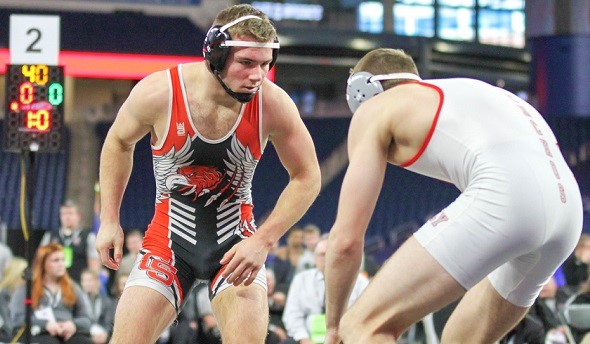
He also placed third as a sophomore, but broke through last season and won a Division 2 crown at 171 pounds with a 9-4 decision over Holly’s Cade Dallwitz to finish the winter a stellar 53-1.
 “I was really expecting to be at the top my sophomore year, but that loss really motivated me and I wanted to be at least a two-time state champion,” Ringler said.
As a senior, Ringler is eyeing a repeat performance at the Finals. He’s currently 31-0 and nearing 200 career wins.
“Right now it’s more about getting ready for college wrestling,” Ringler said. “As a senior it would be cool to win another state title to end my career.”
Ringler has another talented teammate beside him this season. Sage Serbenta, a junior, finished fifth at the Finals last season competing for Grand Rapids Christian and wrestles at 189 pounds.
“He’s gotten bigger and he’s pushing me with his speed and strength,” Ringler said. “It makes us both better with conditioning, and we push each other mentally and physically.”
Emery has high hopes for both wrestlers.
“Sage has pushed Ryan in practices, and I think both of those guys could win state titles at either 171 or 189 pounds,” Emery said. “They have as good a chance as anybody else.”
Ringler’s wrestling prowess matches his elite skills on the football field.
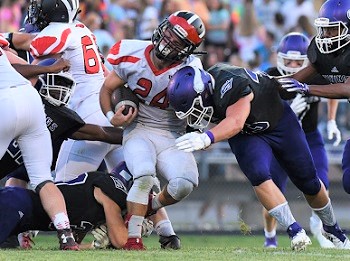
A four-year varsity football player, he helped lead the Red Hawks to a 10-2 record in the fall. As a fierce linebacker, he racked up 110 tackles while rushing for nearly 1,000 yards and 13 touchdowns. He received all-state honors to go along with his all-state accolades in wrestling.
“Ryan has been a very successful multi-sport athlete, and his success on the field and on the mat is not by accident,” Cedar Springs athletic director John Norton said. “He’s a tireless worker, always doing extra to gain the competitive edge. The most exciting thing is that he is showing a generation of athletes that it is possible to be a standout in multiple sports at the highest level and earn a college scholarship without specialization.”
Achieving all-state status in multiple sports is another level of accomplishment, and Ringler is humbled by the honors.
“It’s very unique, and a lot of people don’t get all-state in both wrestling and football,” he said. “It’s a tough thing to do in two very difficult sports. It’s a nice accomplishment, and something I can put on my wall when I’m older.”
 Dean Holzwarth covered primarily high school sports for the Grand Rapids Press and MLive for 16 years and more recently served as sports editor of the Ionia Sentinel and as a sports photojournalist for WZZM. Contact him at [email protected] with story ideas for Allegan, Kent and Ottawa counties.
PHOTOS: (Top) Cedar Springs’ Ryan Ringler prepares to make his first move during last season’s Division 2 championship match at 171 pounds at Ford Field. (Middle) Ringler (24) pushes ahead this fall against Saginaw Swan Valley. (Click to see more from HighSchoolSportsScene.com.)