

Thank Roosevelt for Football Weekends
December 20, 2013
By Rob Kaminski
MHSAA benchmarks editor
The next time you find yourself immersed in a tense crosstown football rivalry on a Friday night followed by a Saturday pilgrimage to the nearest college campus and a Sunday afternoon with a remote and your favorite snacks and beverages, take a moment to consider what the weekend would be like if it weren’t for Teddy Roosevelt.
The man who became our 26th President shortly after the turn of the 20th Century following the assassination of William McKinley in 1901 was a football fan like you. Maybe more so.
Today’s game of football has reached a critical crossroads. Player size and speed have increased across the board. Savage use of equipment as weapons rather than protective gear has been glorified on television networks and social media. Leaders of the game at all levels have recognized the need for change, employing new rules and widespread educational efforts to aid in preserving the sport.
History, as they say, is repeating itself.
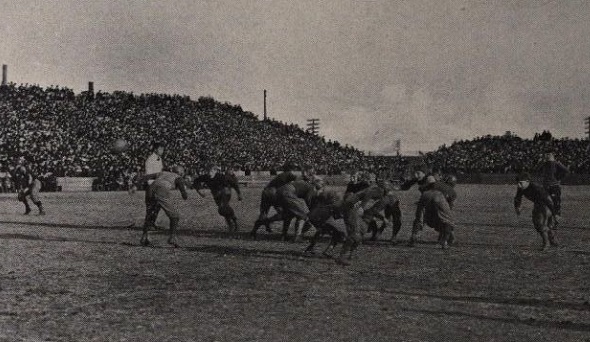
In an ironic twist, it was Roosevelt who saved the then-brutally violent game of football from itself more than 100 years ago. Yes, the same “Rough and Ready Teddy” who led the charge up San Juan Hill during the Spanish-American War and often sparred in the boxing ring while in office from 1901-09 opined that football was becoming so gruesome that he delivered an ultimatum: clean up the game or it would be outlawed.
The Chicago Tribune reported that in 1904 alone, there were 18 football deaths and 159 serious injuries, mostly among prep school players. Football deaths suffered by younger players were reported on a nearly weekly basis, as outraged citizens called on colleges and high schools to banish football outright.
In stepped Roosevelt, who called head coaches and representatives from Harvard, Yale and Princeton – college powers at the time – to the White House in 1905 urging them to eliminate excessive violence and set an example of fair play for the rest of the country. When the casualties actually rose by one during the ensuing season, Roosevelt reacted with greater resolve and convened leading football authorities for the purpose of authoring drastic rules changes. What emerged was an intercollegiate conference which was the predecessor of the NCAA.
Among the most effective changes for the 1906 season were the legalization of the forward pass, the elimination of mass formations, and the creation of a neutral zone. Football fatalities fell to 11 in each of the next two seasons, and severe injuries fell drastically.
Thanks to the introduction of protective equipment and ever-evolving rules changes, football during the 100-plus years to follow has become an exponentially safer game. Yet, the game’s leaders always will need to adjust and react to scrutiny that comes with the territory.
So, as the game once again undergoes rules modifications in the name of safety, give a tip of the cap to President Roosevelt while you enjoy college bowl season and the NFL playoffs and begin to think ahead to the first high school practice of 2014.
Rapid River Rumbles to History-Making Finish
November 17, 2018
By Geoff Kimmerly
Second Half editor
MARQUETTE – Since the opening kickoff of 8-Player Football Playoffs in 2011, Rapid River has been on the verge of winning its first MHSAA Finals championship in this sport.
In that first year’s title game, also at Northern Michigan University’s Superior Dome, the Rockets fell to Carsonville-Port Sanilac. The next year saw a Semifinal run. And then in 2013 at Greenville’s Legacy Field, another title game defeat, to Peck.
Four seasons of earlier-round playoff losses followed. But all of those are more distant memories after Saturday.
Rapid River hoisted its first championship trophy in football after a 30-18 win over Onekama back at the Superior Dome in the 8-Player Division 2 Final.
“It’s my senior year. Our coach has been here twice, but never won it. To get him one before he would retire … (we) did it for all the people on my team,” Rockets senior Gunner Larson said. “Just an amazing experience. Gotta go for the ride.”
Just a quick note: Rapid River coach Steven Ostrenga didn’t announce his retirement after his 20th season running the program came to a close. But Larson and his teammates know it will happen someday – but now without the “what if” of just missing out on a championship.
Rapid River and Onekama both earned their first trophies of 2018 during the playoffs after both finished third in their respective leagues, Onekama behind two contenders for the Division 1 title and Rapid River behind Division 1 runner-up Pickford and Engadine, which the Rockets then beat in the first round by two points after falling to the Eagles by 18 only two weeks prior.
And Rapid River certainly played like a champion Saturday, relying on its strengths especially up front to outgain Onekama 341-212 in yardage – but more importantly, hold onto the ball for 33½ minutes to the Portagers’ 14:30.
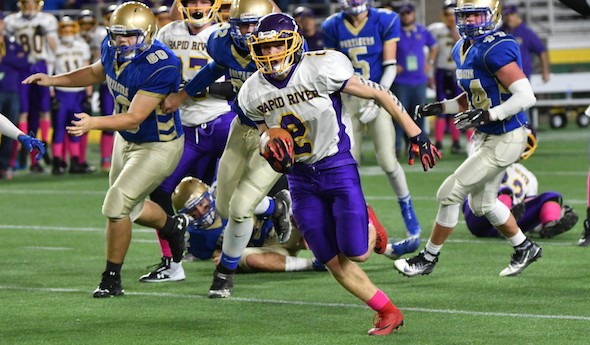
The Rockets ran 66 times for 305 yards as a team, with junior Tyler Sundling gaining 123 and scoring two touchdowns and Larson running for 107 and a score. Senior quarterback Brent Lundquist tossed a 14-yard touchdown pass to senior Nate Olson during a change of pace.
Rapid River carried a 22-8 lead into the fourth quarter and held on despite two Onekama scores over the final 12 minutes.
“We’ve never given up that many yards rushing and that many points,” said Onekama coach John Neph, whose defense was allowing only 8.1 points per game entering the day. “So I think that speaks to the quality of the Rapid River offensive line and their backs. They’re flying around and doing some good things defensively, and that was a huge difference.
“We never thought we were out of the game till maybe the last touchdown there that the Rockets had. We hung in and hung in, and the offense kinda left the defense out there way too long. (And) the conversions they could get on third and fourth down were just critical to keep the drives going.”
 Rapid River didn’t have a turnover and only six penalties. Onekama had five penalties but also lost two fumbles. And those Rockets conversions clearly were difference makers; Rapid River was 10 of 17 on third down and 4 of 6 on fourth, while Onekama was 4 of 10 on third downs and didn’t have a fourth down try.
“Every team that we have is unique. We had a lot of good football teams; other teams were just a little bit better than us in those games,” Ostrenga said of past playoff trips. “We made some mistakes today, but we were almost mistake-free. And that’s the key.”
He threw plenty of credit to his assistants for getting the team ready, to his linemen for their work up front, and to a host of other coaches – including one in basketball – who had influenced and taught him some things over the years. Ostrenga also has led his share of champions, including eight Upper Peninsula Finals winners in boys track & field.
And at the same time Saturday, it felt like Onekama could be following a similar path and only a few steps behind.
This championship game was the first in football for the Portagers, who are 19-5 over two seasons in 8-player after making the playoffs their last three seasons with 11 on the field.
Onekama will graduate some key contributors including running back/linebacker Ben Acton, who ran for 78 yards and a touchdown and also had a team-high 16 tackles including three for losses.
But the Portagers should also bring back 14 of 19 players next fall, including junior quarterback Luke Mauntler (188 yards, two touchdown passes Saturday) and junior tight end Wade Sedlar, who with senior tight end Rylan Clarke caught those scoring tosses.
Juniors Matthew Mallison and Taylor Bennett followed Acton with 15 and 13 tackles, respectively.
“We have five seniors, but we do have 11 juniors coming back,” Neph said. “So we’re hoping we can replicate this. It’s absolutely tasking on a team to repeat and get this far. There’s some outstanding teams we were able to overcome to get this far. We’d love to come here again, but it’s going to be a ton of hard work and effort moving forward.
“But again, this is an historic season for our program. The guys going to the state finals was just a dream come true for all of us.”
PHOTOS: (Top) Rapid River's Tyler Sundling (2) breaks several tackles and scores a touchdown Saturday. (Middle) Rapid River's Gunner Larson (33) is taken down by Onekama's Luke Mauntler (7) and Ben Johnson (12). (Photos by Cara Kamps.)