

Thank Roosevelt for Football Weekends
December 20, 2013
By Rob Kaminski
MHSAA benchmarks editor
The next time you find yourself immersed in a tense crosstown football rivalry on a Friday night followed by a Saturday pilgrimage to the nearest college campus and a Sunday afternoon with a remote and your favorite snacks and beverages, take a moment to consider what the weekend would be like if it weren’t for Teddy Roosevelt.
The man who became our 26th President shortly after the turn of the 20th Century following the assassination of William McKinley in 1901 was a football fan like you. Maybe more so.
Today’s game of football has reached a critical crossroads. Player size and speed have increased across the board. Savage use of equipment as weapons rather than protective gear has been glorified on television networks and social media. Leaders of the game at all levels have recognized the need for change, employing new rules and widespread educational efforts to aid in preserving the sport.
History, as they say, is repeating itself.
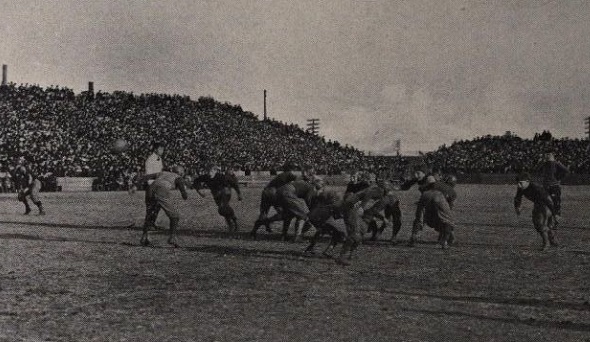
In an ironic twist, it was Roosevelt who saved the then-brutally violent game of football from itself more than 100 years ago. Yes, the same “Rough and Ready Teddy” who led the charge up San Juan Hill during the Spanish-American War and often sparred in the boxing ring while in office from 1901-09 opined that football was becoming so gruesome that he delivered an ultimatum: clean up the game or it would be outlawed.
The Chicago Tribune reported that in 1904 alone, there were 18 football deaths and 159 serious injuries, mostly among prep school players. Football deaths suffered by younger players were reported on a nearly weekly basis, as outraged citizens called on colleges and high schools to banish football outright.
In stepped Roosevelt, who called head coaches and representatives from Harvard, Yale and Princeton – college powers at the time – to the White House in 1905 urging them to eliminate excessive violence and set an example of fair play for the rest of the country. When the casualties actually rose by one during the ensuing season, Roosevelt reacted with greater resolve and convened leading football authorities for the purpose of authoring drastic rules changes. What emerged was an intercollegiate conference which was the predecessor of the NCAA.
Among the most effective changes for the 1906 season were the legalization of the forward pass, the elimination of mass formations, and the creation of a neutral zone. Football fatalities fell to 11 in each of the next two seasons, and severe injuries fell drastically.
Thanks to the introduction of protective equipment and ever-evolving rules changes, football during the 100-plus years to follow has become an exponentially safer game. Yet, the game’s leaders always will need to adjust and react to scrutiny that comes with the territory.
So, as the game once again undergoes rules modifications in the name of safety, give a tip of the cap to President Roosevelt while you enjoy college bowl season and the NFL playoffs and begin to think ahead to the first high school practice of 2014.
Drive for Detroit: Week 7 Preview
October 4, 2018
By Geoff Kimmerly
Second Half
We’re into October, and the drive continues on as we begin turning our attention toward the playoffs beginning at the end of this month.
 But let’s not be in too much of a rush.
Today we preview a number of matchups that could again end in league title celebrations – and mention a number of other neighborly clashes that may have nothing to do with league title and playoff pursuits, but will still be memorable.
That said, It just so happens that most of the nine games we glance at below include a mix of all of the above.
All games below are tonight unless noted. Check out the MHSAA Score Center for the full schedule and results as games are completed. MHSAA.tv will broadcast eight games including Frankenmuth/Millington mentioned below. Our “Drive for Detroit” previews are powered by MI Student Aid.
Bay & Thumb
Millington (5-1) at Frankenmuth (5-1)
The noticeable difference heading into the latest chapter of this annual showdown is both teams have a loss – Frankenmuth fell in Week 2 to Tri-Valley Conference Central leader Saginaw Swan Valley, and Millington fell in Week 1 by three points to Ohio’s Sylvania Southview. Otherwise, it’s business as usual with this TVC East finale deciding the league title for the seventh time in eight seasons – and with the Eagles on a three-game winning streak against their rival.
Others that caught my eye: FRIDAY Warren DeLaSalle (5-1) at Davison (6-0), Richmond (4-2) at Almont (6-0), Fenton (5-1) at Flushing (4-2), SATURDAY Lapeer (6-0) at Flint Carman-Ainsworth (3-3).
Greater Detroit
Dearborn Heights Robichaud (6-0) at Dearborn Heights Crestwood (6-0)
Both have plenty to celebrate. Robichaud was 1-8 just two years ago, rebounded to 6-3 last season but went 2-3 in the league, and now is facing Crestwood for the Western Wayne Athletic Conference title. Crestwood last week clinched its first playoff berth since 2005 and with a seventh win would have its most victories since 2000. After a four-year break, these teams met again last season with Robichaud a 34-26 winner – but Crestwood hasn’t given up more than 20 points in a game this fall.
Others that caught my eye: FRIDAY Detroit Mumford (5-1) at Detroit Cass Tech (6-0), Detroit Denby (5-1) at Detroit Martin Luther King (6-0), Waterford Our Lady (4-2) at Clarkston Everest Collegiate (6-0), Macomb Dakota (5-1) at Romeo (5-1).
Mid-Michigan
Breckenridge (6-0) at Carson City-Crystal (6-0)
Breckenridge football was reborn with its move to the Mid-State Activities Conference in 2016, and the Huskies are 18-0 in league games heading into this weekend’s MSAC finale. Two of those wins came against the Eagles, who formerly battled mostly Mount Pleasant Sacred Heart for league superiority. Breckenridge got the win in this matchup by just a point last fall, 27-26, and this season hasn’t given up a point since Week 1. Carson City-Crystal and its tough running game most likely will need to get on the board at least a few times if it’s to secure its first league championship since 2013.
Others that caught my eye: FRIDAY Lake Odessa Lakewood (5-1) at Olivet (6-0), Beaverton (5-1) at Clare (5-1), Dansville (5-1) at Pewamo-Westphalia (6-0), Mason (3-3) at Williamston (5-1).
Northern Lower Peninsula
Johannesburg-Lewiston (5-1) at Harbor Springs (6-0)
After losing by just seven points to Manton on opening night, Johannesburg-Lewiston has been biding its time to pounce in the league race. The Cardinals have given up only 35 points over the last five weeks and two weeks ago won big against Gaylord St. Mary, which beat them for the Northern Michigan Football League Legacy title a year ago. Harbor Springs has its most wins since going 6-4 in 2000, including an impressive one against Frankfort in Week 2 – but must avenge last year’s 50-8 loss to Johannesburg-Lewiston to secure that league title tonight.
Others that caught my eye: FRIDAY Muskegon Catholic Central (3-3) at Manistee (6-0), Elk Rapids (4-2) at Frankfort (4-2), Petoskey (3-3) at Gaylord (5-1), Kingsley (5-1) at Maple City Glen Lake (3-3).
Southeast & Border
Grass Lake (6-0) at Napoleon (5-1)
Grass Lake has shared or won outright four Cascades Conference championships this decade, but stepped back a year ago going 3-4 in the league and missing the playoffs for the first time since 2004. That’s almost a distant memory, as the Warriors need only 14 more points to outscore last year’s team and defensively are on pace for their best performance in more than a decade. Grass Lake defeated 2017 co-champions Addison and Michigan Center the last two weeks and now gets the third team that shared last year’s title – Napoleon, which has bounced back from an opening night loss to get back into the hunt and won last year’s meeting with the Warriors 45-8.
Others that caught my eye: FRIDAY Grosse Ile (6-0) at Milan (5-1), Hillsdale (6-0) at Ida (5-1), Pittsford (6-0) at Adrian Lenawee Christian (5-1), Ottawa Lake Whiteford (6-0) at Sand Creek (4-2).
Southwest Corridor
Three Rivers (6-0) at Edwardsburg (6-0)
These are the two best teams in Michigan we’ve barely mentioned this season – because in the Wolverine Conference, every team plays nine league games and these two have dominated the league thoroughly. Edwardsburg has scored at least 41 points every week this fall and given up 19 total; Three Rivers has been slightly less dominant offensively but given up only 35 points and only seven over the last four weeks. Three Rivers broke Edwardsburg’s 34-game league winning streak last season, although the Eddies did still go on to claim the conference title and then defeat the Wildcats in a District Final on the way to finishing Division 4 runner-up.
Others that caught my eye: FRIDAY Kalamazoo United (6-0) at Delton Kellogg (5-1), Hartford (4-2) at Cassopolis (6-0), Portage Northern (4-2) at Battle Creek Central (4-2), Fennville (5-1) at Lawton (3-3).
Upper Peninsula
Ishpeming (6-0) at Iron River West Iron County (5-1), Saturday
Three Western Peninsula Athletic Conference small-school division games remain for both of these teams, but this one very well could decide the league title. Only once this season have the Hematites had a game closer than 10 points. The Wykons took a tough Week 4 loss to West PAC large-school leader Calumet in Week 4, but minus that game have given up only 13 points over their other five. This is the first meeting of these teams since 2014, when Ishpeming ended West Iron’s season in the playoffs for the third time this decade.
Others that caught my eye: FRIDAY Houghton (3-3) at Calumet (6-0), Escanaba (4-2) at Gladstone (3-3), Gwinn (4-2) at Norway (3-3), Ishpeming Westwood (4-2) at L'Anse (3-3).
West Michigan
Montague (5-1) at Muskegon Oakridge (6-0)
This West Michigan Conference rivalry is alive and well, with the teams splitting the last four meetings and Montague winning the most recent 40-0 a year ago on the way to the league title. This likely will decide the championship as well; after losing to still-unbeaten Reed City on opening night, Montague has outscored its first five league opponents on average 58-7. Oakridge has outscored its league opponents only 57-12 on average.
Others that caught my eye: FRIDAY Spring Lake (5-1) at Grand Rapids Catholic Central (5-1), Middleville Thornapple Kellogg (5-1) at East Grand Rapids (4-2), Rockford (3-3) at Hudsonville (5-1), Holton (5-1) at Kent City (6-0).
8-Player
Mesick (3-3) at Brethren (4-2)
These two are relative newcomers to 8-player football, Brethren in its third season and Mesick in its second. But the headway made has been fast and impressive. Brethren can clinch a share of the West Michigan D League championship tonight and also tie its highest win total since 1990. Mesick made the playoffs for the first time last season since 1995, and with a win tonight can create a three-team tie at the top of the league standings with one WMDL game to play (Manistee Catholic Central would join them in first with a win over reigning champion Marion). Mesick won this meeting 30-14 a year ago.
Others that caught my eye: FRIDAY Morrice (6-0) at Genesee (4-2), Mayville (4-2) at Deckerville (4-2), New Haven Merritt (3-3) at Caseville (4-2), SATURDAY Bellevue (5-1) at Battle Creek St. Philip (4-2).
Second Half’s weekly “Drive for Detroit” previews and reviews are powered by MI Student Aid, a part of the Student Financial Services Bureau located within the Michigan Department of Treasury. MI Student Aid encourages students to pursue postsecondary education by providing access to student financial resources and information, including various student financial assistance programs to help make college more affordable for Michigan students. MI Student Aid administers the state’s 529 savings programs (MET/MESP) and eight additional aid programs within its Student Scholarships and Grants division. Click for more information and connect with MI Student Aid on Facebook and Twitter @mistudentaid.
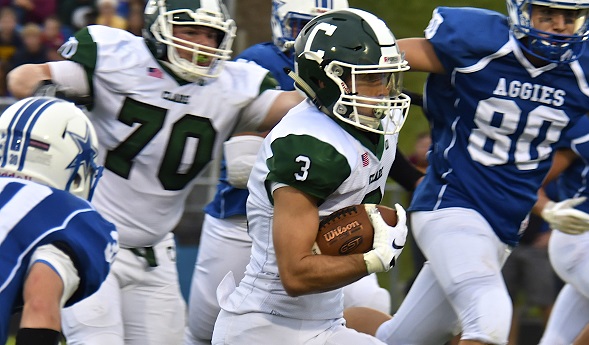
PHOTO: Clare, here against Beal City during a Week 1 win, is among teams chasing first place in their respective leagues this weekend. (Click for more from HighSchoolSportsScene.com.)