

Thank Roosevelt for Football Weekends
December 20, 2013
By Rob Kaminski
MHSAA benchmarks editor
The next time you find yourself immersed in a tense crosstown football rivalry on a Friday night followed by a Saturday pilgrimage to the nearest college campus and a Sunday afternoon with a remote and your favorite snacks and beverages, take a moment to consider what the weekend would be like if it weren’t for Teddy Roosevelt.
The man who became our 26th President shortly after the turn of the 20th Century following the assassination of William McKinley in 1901 was a football fan like you. Maybe more so.
Today’s game of football has reached a critical crossroads. Player size and speed have increased across the board. Savage use of equipment as weapons rather than protective gear has been glorified on television networks and social media. Leaders of the game at all levels have recognized the need for change, employing new rules and widespread educational efforts to aid in preserving the sport.
History, as they say, is repeating itself.
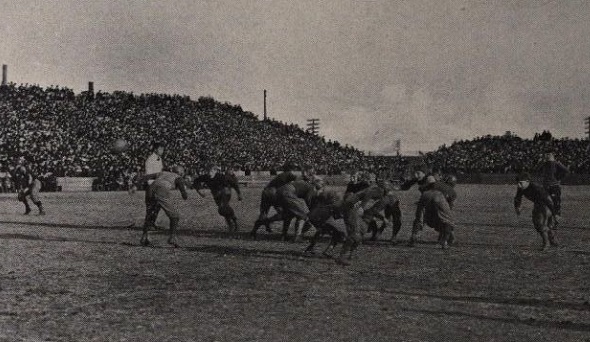
In an ironic twist, it was Roosevelt who saved the then-brutally violent game of football from itself more than 100 years ago. Yes, the same “Rough and Ready Teddy” who led the charge up San Juan Hill during the Spanish-American War and often sparred in the boxing ring while in office from 1901-09 opined that football was becoming so gruesome that he delivered an ultimatum: clean up the game or it would be outlawed.
The Chicago Tribune reported that in 1904 alone, there were 18 football deaths and 159 serious injuries, mostly among prep school players. Football deaths suffered by younger players were reported on a nearly weekly basis, as outraged citizens called on colleges and high schools to banish football outright.
In stepped Roosevelt, who called head coaches and representatives from Harvard, Yale and Princeton – college powers at the time – to the White House in 1905 urging them to eliminate excessive violence and set an example of fair play for the rest of the country. When the casualties actually rose by one during the ensuing season, Roosevelt reacted with greater resolve and convened leading football authorities for the purpose of authoring drastic rules changes. What emerged was an intercollegiate conference which was the predecessor of the NCAA.
Among the most effective changes for the 1906 season were the legalization of the forward pass, the elimination of mass formations, and the creation of a neutral zone. Football fatalities fell to 11 in each of the next two seasons, and severe injuries fell drastically.
Thanks to the introduction of protective equipment and ever-evolving rules changes, football during the 100-plus years to follow has become an exponentially safer game. Yet, the game’s leaders always will need to adjust and react to scrutiny that comes with the territory.
So, as the game once again undergoes rules modifications in the name of safety, give a tip of the cap to President Roosevelt while you enjoy college bowl season and the NFL playoffs and begin to think ahead to the first high school practice of 2014.
'Oakridge Family' True in Name & Purpose
October 3, 2018
By Tom Kendra
Special for Second Half
Every football team talks about being a family.
 But at Muskegon Oakridge, it’s more than just a motto.
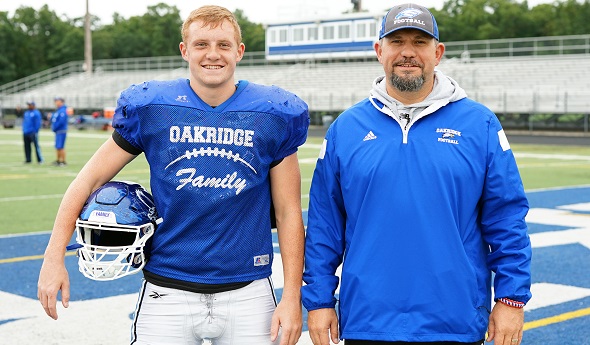
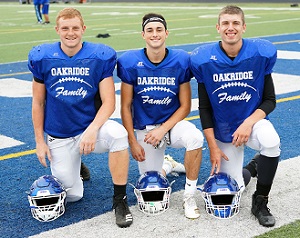
Three of the Oakridge varsity coaches have sons on the team, including head coach Cary Harger with two-way starting senior lineman Cole Harger.
“It does make it extra special, being a senior and playing for my dad,” said Cole Harger of the Eagles’ high-flying start, which has them 6-0 and ranked No. 3 in Division 5 in the latest Associated Press poll.
“The family thing is real out here. This is such a tight-knit community, and we’re just together all the time. We know each other so well and know how to push each other.”
Oakridge faces its toughest test of the season Friday when it hosts conference rival Montague (5-1), which comes in riding a five-game winning streak and ranked No. 10 in Division 5.
Oakridge has been the dominant team for almost 40 years in the West Michigan Conference, a league which has put 14 teams in MHSAA state championship games and celebrated nine Finals winners. Oakridge has made it five times, winning titles in 1997, 2005 and 2008.
Early on in that stretch, the Eagles’ main league rival was North Muskegon, and later Ravenna. In the 2000s, the most competitive rivalries shifted north to the White Lake area in Whitehall and Montague, particularly Montague.
Oakridge is 7-4 against Montague over the past 11 years, with many of those games classic back-and-forth battles that came down to the final minutes (and sometimes, seconds). But the only game that anyone at Oakridge seems to remember is from a year ago, when host Montague pounded Oakridge 40-0 – the most lopsided conference loss in school history.
“We have waited 51 weeks for the opportunity to erase that memory,” said senior linebacker Jaden Parker, whose father, Tim, is the Oakridge defensive coordinator. “We got shell-shocked last year and didn’t fight back. This year we have more seniors, and we won’t let that happen again.”
 This year’s matchup features two of Michigan’s top running backs. Montague senior Bryce Stark, a returning Associated Press all-stater, has gained 542 yards on 74 carries (7.3 per carry), despite being slowed early in the year with a knee injury. Oakridge counters with battering ram junior fullback Leroy Quinn (6-1, 216), the leading rusher in the Greater Muskegon area with 111 carries for 1,119 yards (10.1 average) and 19 touchdowns.
Coach Harger is quick to point out that Stark is just one of many weapons on this Montague team who worries his team.
“The first thing that strikes you about Montague is their athleticism and the number of quality athletes we have to focus on,” said Harger, a 1990 Oakridge graduate. “But they are also big up front, so you have to be concerned with that, as well. We need to play our best game.”
The final father-son connection on the Oakridge varsity staff is offensive coordinator Nate Danicek and his son, Jacob, a sophomore who starts at safety and plays slot receiver on offense when the Eagles break out of their full-house backfield and go with a spread look.
But the Oakridge football family goes far beyond just the coaching staff – it’s a way of life.
After a long practice Tuesday evening, Coach Harger and Coach Parker (whose fathers coached them on an Oakridge youth football team almost 40 years ago) went down the varsity roster and quickly pointed out all of the players whose fathers also played varsity football at Oakridge.
On that list is senior starting quarterback Koleman Wall (6-3, 197), whose father, Scott Wall, was the starting fullback on the 1990 team, the first Oakridge team to reach the MHSAA title game. Other father-son duos are starting running back and linebacker Blake Masterman (father Dan Masterman), starting center Mavrick McLouth (Dude McLouth), Jacob Barber (Nate Barber) and Sander Brott (David Brott).
Sander Brott is also a third-generation Eagle, as his grandfather, Mark Fazakerley, played on the first Oakridge varsity team in 1966.
“We are doing our best to carry on the tradition that Jack Schugars started out here,” said Coach Parker, referencing Schugars, who had a 262-78 record in 31 seasons at Oakridge from 1979 to 2010. “It’s a point of pride that these are all Oakridge kids. We don’t have schools of choice, so almost every one of these kids has been playing together since the youth leagues.”
The Oakridge youth league still boasts more than 150 players and is the starting point for one of the state’s most consistent programs.
 With its six consecutive wins to open the season, Oakridge has qualified for the playoffs for the 15th straight year and 23rd of the past 24. Many believe this team could be good enough to get all the way to Ford Field for the first time since 2008.
The Eagles have an experienced backfield led by Quinn, but also featuring speedy senior Masterman (359 yards) and multi-talented senior Jalen Hughes (315 yards). Wall provides a fourth running threat and has been efficient through the air, completing 28-of-43 passes for 516 yards and 10 touchdowns, with just one interception.
The defense is led by senior tackle Brandon Wilde (5-9, 212), who has 38 tackles on the season with half of those tackles in the backfield for negative yardage, including six sacks. Masterman leads the team with 40 tackles, and senior cornerback Jaxon Fri has three interceptions.
Oakridge could possibly play Montague a second time in the playoffs. Montague has traditionally been a Division 6 playoff team, but with its enrollment up 36 students from last year to 445, it could end up with Oakridge in Division 5.
Another possible Eagles rematch down the road is with top-ranked Saginaw Swan Valley, which beat Oakridge in last year’s MHSAA Regional Final, 48-14.
The “Oakridge family” isn’t looking near that far ahead, but is focused on proving itself after last year’s lopsided loss at Montague.
“The way we played in that game last year was our biggest motivation all offseason,” said Cole Harger. “That wasn’t Oakridge football. I think one of our biggest strengths this year is our togetherness as a team, and we have the opportunity to prove that on Friday night.”
 Tom Kendra worked 23 years at The Muskegon Chronicle, including five as assistant sports editor and the final six as sports editor through 2011. E-mail him at [email protected] with story ideas for Muskegon, Oceana, Mason, Lake, Oceola, Mecosta and Newaygo counties.
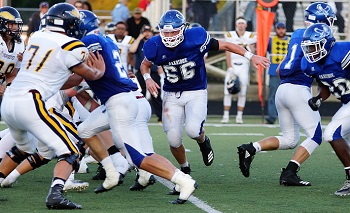
PHOTOS: (Top) Senior Cole Harger and Oakridge coach Cary Harger are one of three sets of fathers and sons on the varsity this season. (Middle) Harger (66), a two-way starting lineman, lines up his block during a Week 2 win over North Muskegon. (Below) Harger, with Jacob Danicek (middle) and Jaden Parker, whose fathers also are on the coaching staff. (Photos by Sherry Wahr.)