

Thank Roosevelt for Football Weekends
December 20, 2013
By Rob Kaminski
MHSAA benchmarks editor
The next time you find yourself immersed in a tense crosstown football rivalry on a Friday night followed by a Saturday pilgrimage to the nearest college campus and a Sunday afternoon with a remote and your favorite snacks and beverages, take a moment to consider what the weekend would be like if it weren’t for Teddy Roosevelt.
The man who became our 26th President shortly after the turn of the 20th Century following the assassination of William McKinley in 1901 was a football fan like you. Maybe more so.
Today’s game of football has reached a critical crossroads. Player size and speed have increased across the board. Savage use of equipment as weapons rather than protective gear has been glorified on television networks and social media. Leaders of the game at all levels have recognized the need for change, employing new rules and widespread educational efforts to aid in preserving the sport.
History, as they say, is repeating itself.
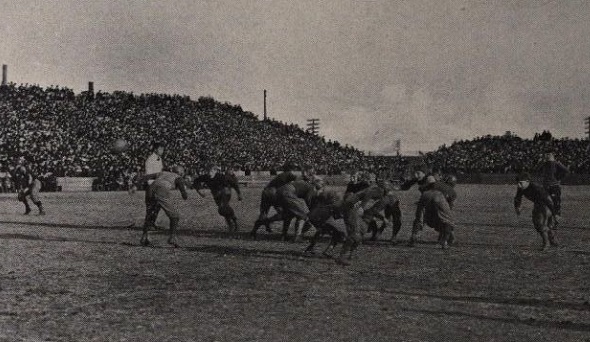
In an ironic twist, it was Roosevelt who saved the then-brutally violent game of football from itself more than 100 years ago. Yes, the same “Rough and Ready Teddy” who led the charge up San Juan Hill during the Spanish-American War and often sparred in the boxing ring while in office from 1901-09 opined that football was becoming so gruesome that he delivered an ultimatum: clean up the game or it would be outlawed.
The Chicago Tribune reported that in 1904 alone, there were 18 football deaths and 159 serious injuries, mostly among prep school players. Football deaths suffered by younger players were reported on a nearly weekly basis, as outraged citizens called on colleges and high schools to banish football outright.
In stepped Roosevelt, who called head coaches and representatives from Harvard, Yale and Princeton – college powers at the time – to the White House in 1905 urging them to eliminate excessive violence and set an example of fair play for the rest of the country. When the casualties actually rose by one during the ensuing season, Roosevelt reacted with greater resolve and convened leading football authorities for the purpose of authoring drastic rules changes. What emerged was an intercollegiate conference which was the predecessor of the NCAA.
Among the most effective changes for the 1906 season were the legalization of the forward pass, the elimination of mass formations, and the creation of a neutral zone. Football fatalities fell to 11 in each of the next two seasons, and severe injuries fell drastically.
Thanks to the introduction of protective equipment and ever-evolving rules changes, football during the 100-plus years to follow has become an exponentially safer game. Yet, the game’s leaders always will need to adjust and react to scrutiny that comes with the territory.
So, as the game once again undergoes rules modifications in the name of safety, give a tip of the cap to President Roosevelt while you enjoy college bowl season and the NFL playoffs and begin to think ahead to the first high school practice of 2014.
Hudson Paying 50-Year Tribute to Winning Streak Record-Setters, Supporters
By
Doug Donnelly
Special for MHSAA.com
October 14, 2025
It’s a little over two hours’ drive from Mount Pleasant to Hudson. But the November 1975 bus ride seemed to take forever.
The Hudson football team had just lost in the Class C state championship game to Ishpeming, ending a national record 72-game winning streak, and was on the way home.

“It was a really long ride,” said Ray Curran, an assistant coach for the Tigers. “A quiet ride.”
After the game, Hudson head coach Tom Saylor let his players know they had played hard and he was proud of them, but there were plenty of tears.
“We tried to tell them it wasn’t the end of the world,” Curran said.
For nearly everyone except maybe a few coaches, it was the first, and probably last, time they rode the bus home after a loss.
Hudson’s streak still stands today as the record for consecutive wins by a varsity football team in Michigan. From Week 2 of the 1968 season until the Class C Final in 1975, the Tigers never tasted defeat.
 As disappointing as it was to lose, what happened on that bus ride home had a huge impact on the program for years to come.
“When we got close to town, we started to see fire trucks and cars lining the streets,” Curran said. “We lost, but the fans still showed up for us. We had tremendous community support from parents and families and community members. I think that made a lot of the players feel like everything was going to be okay.”
Everything was okay. In fact, Hudson went 9-0 the next season, although the Tigers failed to qualify for the MHSAA Playoffs (which had a field of only four teams in each classification, 16 teams total, at the time).
To mark the end of that incredible 72-game win streak, Hudson is inviting back everyone who had a part in those undefeated teams during the 1960s and 1970s – players, coaches, cheerleaders, band and members of the flag corps are all expected to take part in the ceremony before Friday’s final home game of the regular season at Thompson Field in Hudson.
Bill Mullaly, who played for Hudson during that streak and has become a historian for the Tigers, said this celebration will be the last one.
“This is it,” Mullaly said. “It’s been 50 years, and this is the last one we are planning.”
Curran went to see Saylor a few weeks before he died, at the family’s request. Saylor had been in declining health and had dementia. Curran said when they got together, they talked football.
“We were talking about some of the games, some of the players,” he said. “He definitely remembered. It was a good visit.”
Hudson’s football team this season is undefeated, ranked No. 1 in Division 8 and gearing up for what the Tigers hope is another historic playoff run. Head coach Dan Rogers said the record streak remains an important piece of the community’s history, and the celebration Friday and recent passing of Saylor have brought it all back to the forefront.
“It’s definitely a big part of the community,” Rogers said. “I grew up here, and I’ve heard stories about it. You don’t live it, but you are part of it. I think it has helped mold our community, and it has been a way to identify the community. The streak is definitely alive and well.”
To commemorate this season, current Hudson players will be wearing a throwback uniform Friday – black and white jerseys with orange pants and the same design of socks the players in the 1970s wore. The helmet sticker will be the same one used during the streak.
“It’s all been very positive, all season,” Rogers said. “Some of the kids have grandpas that played in the streak, which is great. They weren’t around, but I think it’s my job to pass all of that along to a new generation. We have embraced it.”
Rogers said he’s gone back and talked to former players and coaches, and Hudson plans to pattern much of its pregame routine on the Tigers’ during Saylor’s regime.
 “We have people coming back who haven’t been to a Hudson football game since they played here,” Rogers said. “They had a lot of cool traditions back then. We want them to be proud.”
One of the current assistant coaches is Chris Luma, who played on that 1975 team. Luma was Hudson’s head coach before Rogers took over six years ago. He and Saylor were close. Luma will speak at Saylor’s memorial service later this month.
“It just seemed like with Tom you were learning life lessons along with how to win football games,” he said. “He installed discipline in all of us. What he had us go through was the things you needed to know to go through life.”
Mullaly also played for Saylor.
“He didn’t put Hudson on the map, but he took it to another level,” he said. “He was a great coach and a great man. His legacy is with Hudson football.”
Rogers said after Saylor died, more RSVPs started coming in for Friday’s event.
“It’s brought it to another level,” he said. “There are people flying in from all over the country to be a part of it. This is the final one. After this, it’s only the stories.”
 Doug Donnelly has served as a news and sports reporter at the Adrian Daily Telegram and the Monroe News for 30 years, including 10 years as city editor in Monroe. He's written a book on high school basketball in Monroe County and compiles record books for various schools in southeast Michigan. He is now publisher and editor of The Blissfield Advance, a weekly newspaper. E-mail him at [email protected] with story ideas for Jackson, Washtenaw, Hillsdale, Lenawee and Monroe counties.
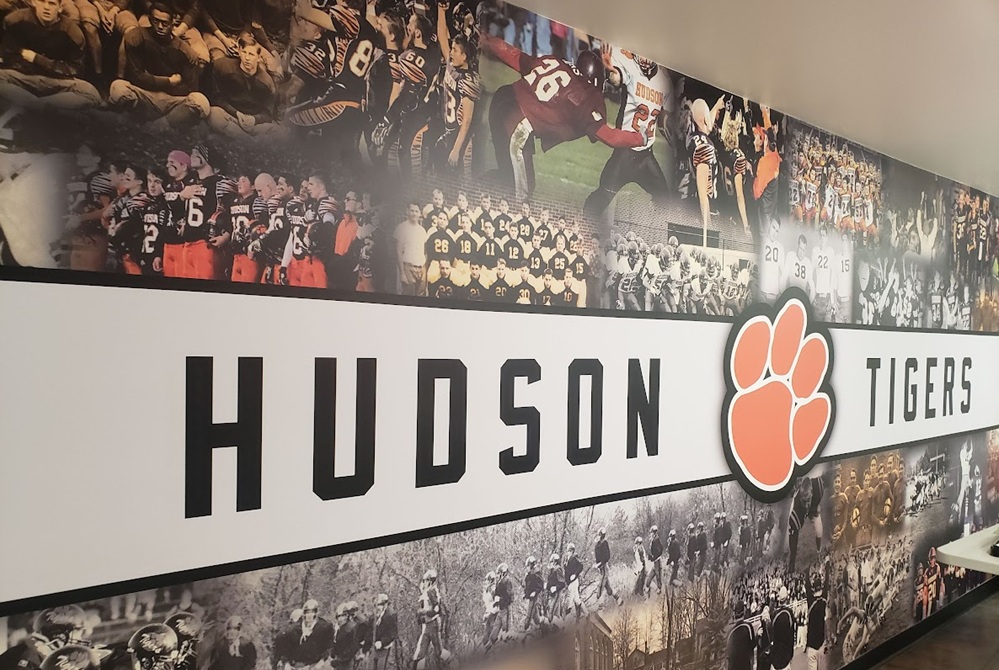
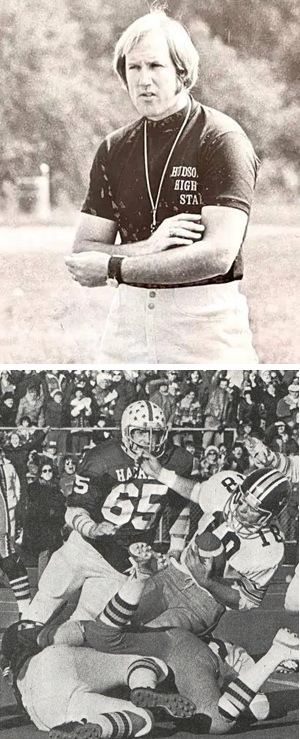
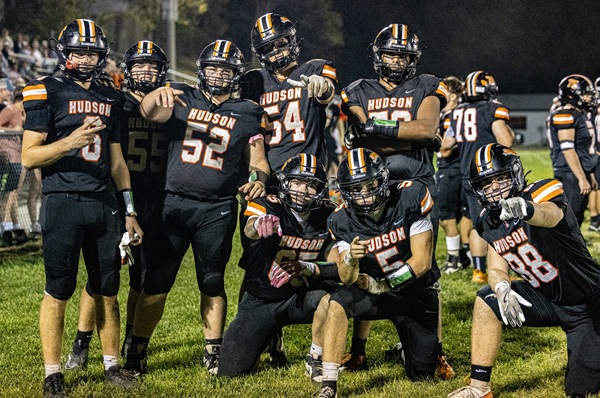
PHOTOS (Top) A wall in the Hudson press box tells of the football program’s rich history. (Middle) Tom Saylor, top, was the longtime coach of the Tigers dynasty, while Tim Decker (18) was among standouts during the streak. (Below) Hudson players come together for a quick photo on a game night this fall. (Wall photo by Doug Donnelly. Saylor photo courtesy of Todd Saylor; Decker photo courtesy of Jackson Citizen Patriot/Hudson Historical Museum. Current team photo by Rachel Stiverson.).