

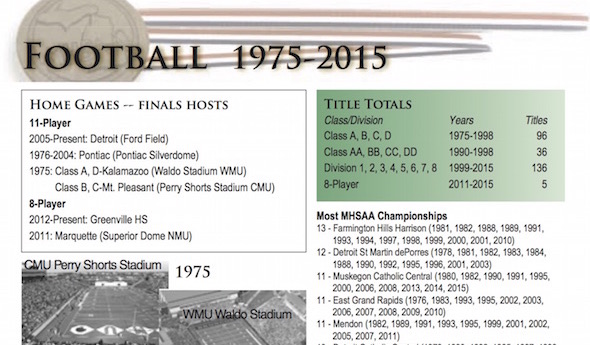
Through the Years: Football 1975-2015
By
Geoff Kimmerly
MHSAA.com senior editor
August 9, 2016
Another football season kicked off Monday with first practices across the state, so it's a perfect time to take a look back at what is annually our most attended MHSAA tournament series.
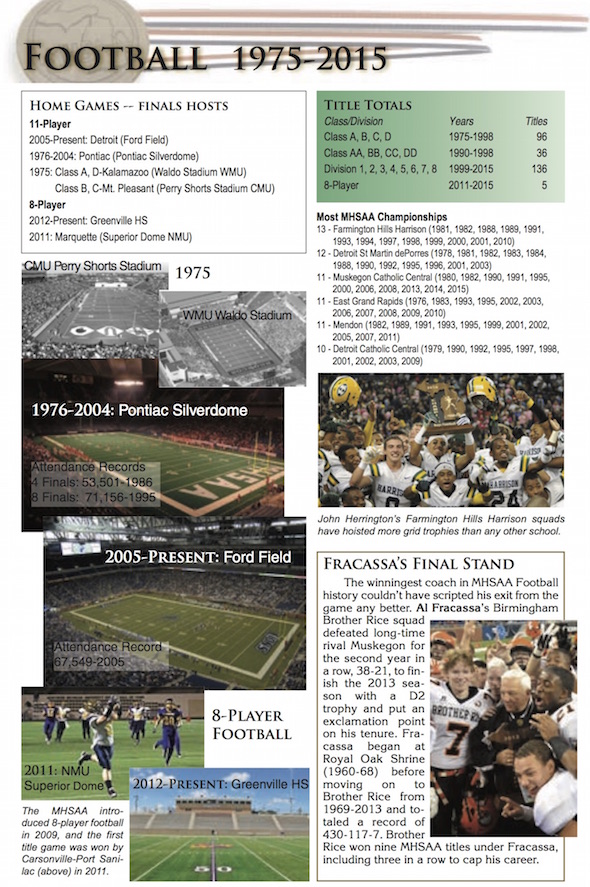
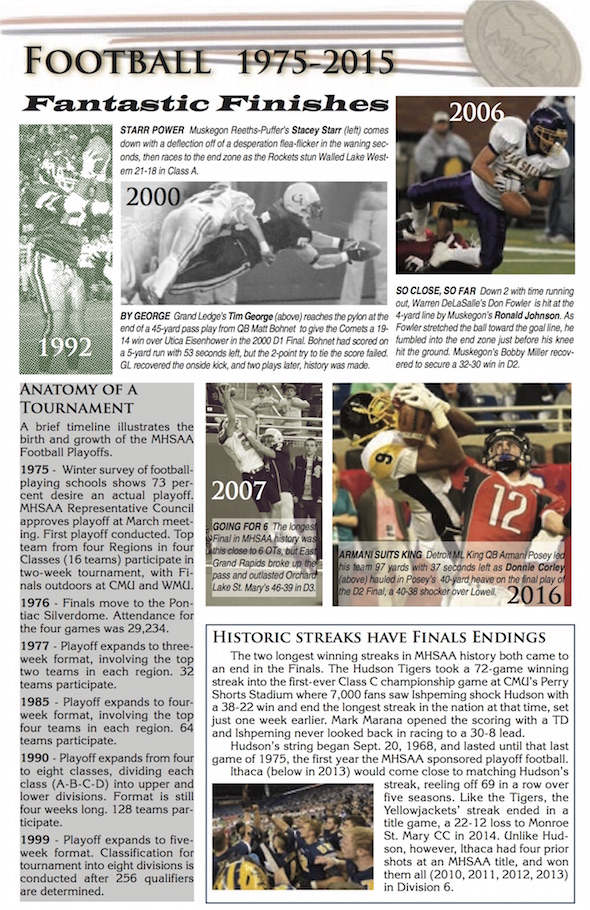
High schools in this state have played football for more than a century. The first MHSAA champions were awarded in 1975, and the playoffs have continued to evolve to now recognize a total of nine champions over two formats, 11 and 8-player.
This feature is from the spring issue of benchmarks, built and written by Rob Kaminski. Scroll to the bottom of the page for a link to our previous installments. We'll continue to look at more MHSAA postseason events every Tuesday and Friday this fall.
Previous installments
August 5: Girls Volleyball - Read
August 2: Boys Soccer - Read
July 30: Boys Cross Country - Read
July 26: Girls Cross Country - Read
July 22: Boys/Girls Lacrosse - Read
July 19: Boys/Girls Tennis - Read
July 15: Boys/Girls Golf - Read
July 12: Girls Soccer - Read
July 8: Boys Track & Field - Read
July 5: Girls Track & Field - Read
July 1: Baseball - Read
June 28: Softball - Read

Eight-Player Options
March 10, 2017
Put this in the category of “No good deed goes unpunished.”
In 2011, the MHSAA provided an additional playoff for Class D schools sponsoring 8-player football. This helped save football in some schools and helped return the game of football to other schools. But now that the number of 8-player programs has expanded from two dozen in 2011 to more than 60, there are complaints:
-
Some complaints come out of a sense of entitlement that all final games in both the 8-player and 11-player tournament deserve to be played at Ford Field.
-
Some complaints come from Class C schools whose enrollments are too large for the 8-player tournament. Class C schools which sponsor the 8-player game have no tournament at all in which to play, regardless of where the finals might be held.
-
Some complaints come from Class D schools which protest any suggestion that Class C schools – even the smallest – be allowed to play in the 8-player tournament.
There are now three scenarios emerging as the most likely future for 8-player football:
-
The original plan ... A five-week, 32-team tournament for Class D schools only, with the finals at a site to be determined, but probably not Ford Field.
-
Alternative #1 ... Reduce the 11-player tournament to seven divisions and make Division 8 the 8-player tournament with 32 Class D teams in a five-week tournament, ending at Ford Field.
-
Alternative #2 ... Conduct the 8-player tournament in two divisions of 16 Class D teams, competing in a four-week playoff ending in a double-header at the Superior Dome on the Saturday before Thanksgiving.
The pros and cons of these options are being widely discussed. Sometimes the discussions have a tone that is critical of the MHSAA, which comes from those who forget that it was the MHSAA itself which moved in 2011 to protect and promote football by adding the 8-player playoff tournament option for its smallest member schools. That Class D schools now feel entitled to the Ford Field opportunity and Class C schools want access to an 8-player tournament is not unexpected; but criticism of the MHSAA’s efforts is not deserved.