

Tradition-Filled Tri-County Conference Kicking Off Final Season of 11-Player Football
By
Doug Donnelly
Special for MHSAA.com
August 20, 2024
The bus driver went too fast.
 It was fall of 1979, and Ottawa Lake Whiteford football coach John Hoover had come up with a plan for his Bobcats to dress in their own locker room, warm up on their own field and arrive at the Petersburg Summerfield football field for a Tri-County Conference battle just moments before kickoff.
The plan was working, except the bus driver went a little too fast.
“I don’t remember when I decided we would do it,” Hoover said. “But the night before our game, I got in my car, and I drove about the speed that I thought the bus driver would take from Whiteford to Summerfield. I had a stopwatch to time it just right. I didn’t tell anybody.”
The ploy was meant to rattle the opponent, perhaps make the other team lose focus on the game at hand.
“It’s only like 20 minutes between schools, so warming up at Whiteford and driving was no different than warming up at Summerfield and walking out to the field and waiting through the national anthem and the coin toss,” Hoover thought.
The scheme was working to perfection, but when Hoover determined the arrival would be too soon, he had the bus driver pull over just outside of Petersburg. Finally, the bus made its final trek and arrived.
On the first play from scrimmage, Summerfield fumbled, Whiteford recovered and scored a few plays later – the only touchdown of the game in a 7-0 Bobcats win.
 “I don’t know if it worked,” Hoover said. “But, when the bus got near, when we were driving up the road where the Summerfield stadium was, the head coach (LeRoy Wood) was out in the middle of the street, looking down the road, looking for us. I knew right then that it probably worked. It wouldn’t have worked if we had cell phones like they do today.”
Summerfield and Whiteford have played some spirited games over the years as rivals in the Tri-County Conference. Unfortunately, the season that starts next week will be the last one for 11-player football in the TCC.
With the makeup of the league changing over the last decade or so and the move to 8-player football for three league schools, this is the final season for TCC football after 51 years of small-town competition.
The league has just three remaining schools playing 11-player football – Whiteford, Summerfield and Erie Mason. There is no TCC football schedule for 2025 and beyond, although the league itself will stay together for other sports.
“The 2024 season will be the last season that a TCC football champion is recognized in the current league format for football,” Britton Deerfield athletic director Erik Johnson said.
It will be the end of an era in southeast Michigan.
The league was formed in 1973 with schools from Washtenaw, Lenawee and Monroe Counties.
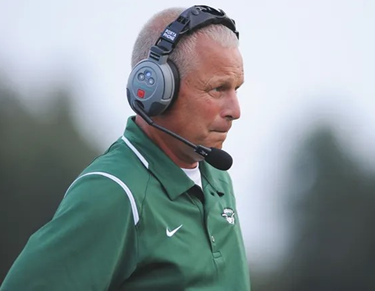
Several schools have taken turns at the top of the conference. Sand Creek has the most league championships, winning 15 between 1977 and 2011 – 14 of them under head coach Ernie Ayers. Morenci (9), Whiteford (7), Summerfield (7) and Clinton (7) have hoisted their fair share of league football trophies. Ayers is the winningest coach in league history, going 174-71 in league games over 38 seasons. Sand Creek left the TCC in football only after last season and will compete in the Big 8 Conference this season.
Whiteford is the only league school to win an MHSAA Finals football championship, but Sand Creek, Morenci and Clinton all have appeared in state championship games.
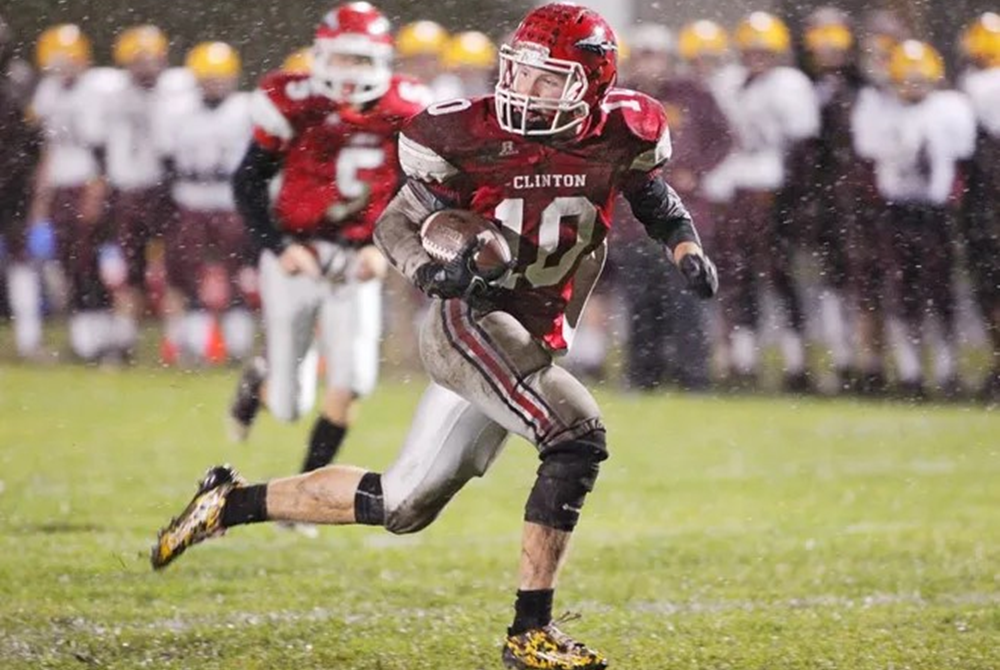
Both times Clinton played in Finals, Mathew Sexton was the star. Sexton would go on to play four years at Eastern Michigan University and has been in multiple NFL training camps and played in the XFL. He’s the league record holder for touchdowns and points scored.
 “I loved being in the TCC,” Sexton said. “It was great competition and was always a blast. Played with some great players, coaches and love the atmosphere each game would bring. Clinton and the TCC made me who I am today. I’m thankful for the experience it gave me.”
Summerfield graduate Jamie LaRocca was an all-state running back in the league, coached in the league and later watched his sons play football in the league as student-athletes at Whiteford.
“There were some great games, great battles,” LaRocca said. “Most of all, it was competitive. Sand Creek was good, Summerfield had good teams and Morenci had some great teams. Different teams always seemed to make their run.”
Britton and Deerfield were two charter members of the TCC, along with Ann Arbor St. Thomas (now known as Ann Arbor Father Gabriel Richard), Summerfield and Adrian Madison. During the 1990s, however, Britton and Deerfield formed a co-op and became Britton-Deerfield. They later officially combined high schools to become Britton Deerfield
BD had a dominating run on the football field in the late 1990s and early 2000s. Among the players who played for BD teams were Dan Musielewicz and Dustin Beurer. Beurer is now the head coach at Division II Northwood University while Musielewicz is head coach at Division III University of Olivet.
Beurer said he remembers as a high school student going to class with others from rivals Sand Creek or Madison at the Lenawee County Vocational Tech school all week, then playing against them on Friday nights.
“I get goosebumps thinking about those days,” he said. “It was small-town football at its finest back in the day.”
Brad Maska, now the head boys basketball coach at Onsted, was the BD quarterback when that team won multiple TCC titles.
“It is sad,” Maska said of the end of the TCC football era. “It truly was a great conference that produced a lot of great teams, coaches, and players throughout the years.
“The best part of the conference was the small-school pride from the communities. Friday night playing at Sand Creek or Whiteford when I was in school was always the only thing going on in town and the communities always got around us, and the atmosphere for small-school football was amazing.”
 Doug Donnelly has served as a sports and news reporter and city editor over 25 years, writing for the Daily Chief-Union in Upper Sandusky, Ohio from 1992-1995, the Monroe Evening News from 1995-2012 and the Adrian Daily Telegram since 2013. He's also written a book on high school basketball in Monroe County and compiles record books for various schools in southeast Michigan. E-mail him at [email protected] with story ideas for Jackson, Washtenaw, Hillsdale, Lenawee and Monroe counties.
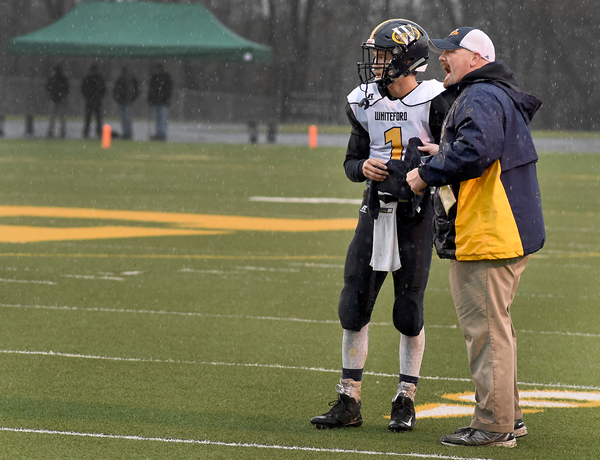
PHOTOS (Top) Clinton’s Mathew Sexton scored more touchdowns in Tri-County Conference games than any player in league history. (Middle) Thomas Eitniear was the quarterback and Jason Mensing head coach at Whiteford when the Bobcats became the first school in Tri-County Conference history to win an MHSAA Finals football championship. (Below) Ernie Ayers coached at Sand Creek for 38 years and won 14 Tri-County Conference championships. (Photos courtesy of the Adrian Daily Telegram and Monroe News.)
Beecher Becoming a Football School Too
November 14, 2012
By Bill Khan
Special to Second Half
FLINT — Basketball is a source of pride at Flint Beecher, with a tradition of excellence that includes four boys and two girls MHSAA championships.
Courtney Hawkins is as proud as anyone, having played on the 1984-85 and 1986-87 championship teams.
But hoops mania is also a source of frustration for Hawkins, the school's football coach and athletic director.
Where basketball is king, other athletic programs can sometimes suffer, as more and more kids are persuaded into specializing in one sport and playing in travel leagues outside of their high school season.
If you want to get Hawkins up on his soap box, ask him about the effect AAU basketball has had on the overall athletic program at Beecher.
Mr. Hawkins, the floor is yours ...
"It kills me to watch some kids who, you know just from the stuff they can do athletically, would be a heck of a football player or could contend for the state championship in the 100 meters or high jump," Hawkins said. "It's absolutely sickening. There are only so many basketball scholarships. They still haven't figured it out. Every year when basketball season is over, there are a number of kids who won't get scholarships, because there are so few. Every single year, there's a handful of boys -- every year -- who come to me and say, 'Coach Hawkins, I wish I would've played football and track.' It's happened seven years in a row and it will happen this year.
"AAU basketball is great. It makes everything seem so good. They get to travel across the country. AAU basketball is big business. It's not the best for every kid, especially when they tell these kids they're going to be the next LeBron James and the next year I see them at the store."
 Hawkins needs only to offer up himself as an example of how an athlete can have success beyond high school while still playing multiple sports as a prep. He was an all-stater in football, basketball, and track and field before focusing on football at Michigan State University. Hawkins went on to play nine seasons as a wide receiver in the NFL. He was a key member of MHSAA championship teams in basketball and track.
Beecher's reputation as a basketball school may finally be changing, albeit slowly.
Hawkins has only two members of last year's Class C championship basketball team on his football roster, but hopes that the team's first-ever run to the MHSAA Semifinals opens some eyes among hoopsters around school.
Beecher (8-4) will face Detroit Loyola (12-0) at 1 p.m. Saturday in a Division 7 Semifinal at Fenton High School. The Buccaneers get a Second Half High 5 this week after overcoming a 3-4 start to make the playoffs as an additional qualifier at 5-4 before winning three postseason games for the first time.
Beecher hopes to become only the fourth team with four losses to win an MHSAA championship. The Buccaneers can look to nearby Flint Powers Catholic, last year's Division 5 champion, for proof that it can be done.
"I didn't want to tell the team that, because they don't like other teams, but I looked at Powers coming in 5-4 and thought, 'Why can't we do the same thing?'" said senior Kermit Craig, a defensive end and tight end.
Beecher is in the playoffs for the sixth straight year, but this was the most unlikely team to advance this far. Beecher's other playoff teams won at least six games, including a 9-0 squad in 2009 that was bounced in the first round.
"Yeah, I'm surprised, but one thing we do is work hard every day," said senior Eric Cooper, a wide receiver and free safety. "I just came to practice every day motivating all the guys to work hard, keep their heads up, and we're going to get a blessing. That's what we got."
The Buccaneers squeaked out a 21-20 victory over Mt. Morris on Oct. 12 to begin their current five-game winning streak. Their crowning achievement so far was knocking off defending Division 7 champion Saginaw Nouvel in the Regional Final, 19-15. Now they're one victory away from a trip to Ford Field.
"I guess with the youth and the fact we snuck in at 5-4, it's surprising that we went this far," Hawkins said. "But with that being said, the way that they've worked and the way they've stayed committed, it's been one of my best groups from that standpoint. I've had some groups that had more success early in the season. This team has great senior leadership. We have some young kids who are just phenomenal in terms of following the senior leaders. They're very coachable, very good kids. This is my first year of having some kids who don't want to play basketball. My starting quarterback, (freshman) Marcus Wright, said, 'Coach, I'm a football player.' We don't get many of those here at Beecher."
There was a time when playoff appearances, let alone trips to the Semifinals, seemed more unlikely than what this 5-4 team has achieved in this postseason.
Hawkins returned to his alma mater in 2006 to take over a program that had 11 straight losing seasons. After a 2-7 inaugural season that saw considerable improvement, Beecher has gone 45-20 while playing as the smallest school in the Genesee Area Conference's Red Division.
"We had to change the attitude," Hawkins said. "There were a lot of people who were, 'We play basketball at Beecher.' That was the approach. Then there was the losing attitude throughout the whole football program. The first year, we were 2-7. We were in a lot of games, but you could see the losing attitude from being beat down all those years. We as a coaching staff stayed on them."
The fact that Hawkins would return to the community after an NFL career gives him considerable credibility with his players.
"That means a lot," Craig said. "Most people look up to him as a father. He came to build the program and led us to where we are now. I learned a lot from him. As a young man, I look up to him. If I have problems, I go to coach Hawkins and talk to him about it. He's more a man than a football coach. He leads you to the right way."
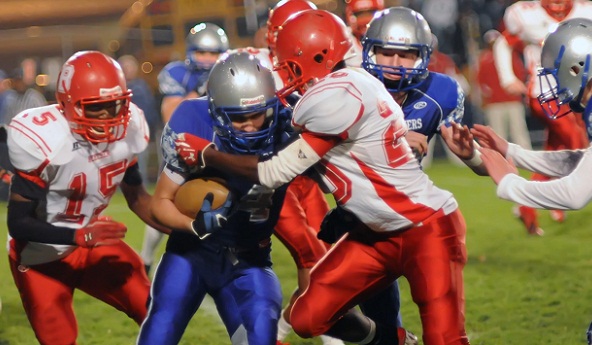
PHOTO: (Top) Beecher linebacker Tyrik Wicks (20) wraps up Saginaw Nouvel's Ryan Sullivan (4) as sophomore Mike Herd (15) also pursues during last weekend's Regional Final. (Middle) Flint Beecher coach Courtney Hawkins, who also played at Michigan State and in the NFL. (Click to see more from the Regional Final at HighSchoolSportsScene.com.)