


Travel Football
July 15, 2016
The University of Michigan will host a high school football game on Sept. 2, 2016. That would not make news, except that the game is between two out-of-state high school teams.
The teams are from New Jersey and Maryland, likely chosen to assist the Wolverines’ recruiting efforts in those states, and to help them make more waves in the college football world. Both high school teams are private schools, and each comes with heavy baggage.
Some public schools in New Jersey have boycotted playing the New Jersey school in football; the Maryland school is not a member of the MHSAA’s counterpart association in that state. One school is flaunting the rules; the other school has no rules to follow.
That major college football has been in an uncontrolled spiral of excess is not news; but its insidious damage to high school sports is finally making headlines.
NCAA rules have recently been robbing schools of winter and spring sports athletes as college coaches entice high school seniors to graduate at the end of their seventh semester and start practicing football with their future college teammates several months early. We are grateful to see Big 12 Commissioner Bob Bowlsby question the practice of enrolling players before their scheduled high school graduation.
Now, NCAA rules appear to invite universities to select high school football teams from anywhere there’s a great prospect or two, and transport the teams across the U.S. to compete in a nearly empty stadium, save for recruiting “gurus,” athletic apparel reps and a few media. We are hoping to see some college sports leaders step up to question this practice.
All of this leads to the rich getting richer – on both the college and school levels. All of which induces another updraft to the spiral of excess in what are supposed to be education-based programs.
A Game for Every Fan: Week 6
October 1, 2014
By Geoff Kimmerly
Second Half editor
We’ve reached October, and that means two things – league titles and lots of numbers.
We’ll cover the former by telling you which teams are winning what in our weekly Drive for Detroit reports posted each Monday. As for those piles of numbers, here are a few: Ishpeming is the first to qualify for the 2014 MHSAA playoffs because it started 5-0 and is playing eight games this season; 66 more teams have started 5-0 and can qualify with victories this weekend.
Below are some of the best games from every corner of the state, most of which will help define those league title races while giving us more numbers to crunch with playoff selection only four weeks away. (All games are Friday unless noted.)
Greater Detroit
Detroit East English (4-1) at Detroit Cass Tech (5-0), Saturday
All 16 Detroit Public School League football teams are playing in one division this season after being split into multiple the past many years. The top six contenders have begun to separate from the pack – with East English, Cass Tech and Martin Luther King the only three with perfect league records. Because of the way the schedule fell, neither East English nor Cass Tech plays King in a league game – so whichever wins this weekend’s matchup should receive a top seed in the PSL playoffs that begin Week 8. East English is a nine-point nonleague loss to Lansing Sexton from being undefeated, but hasn’t given up a point since that opening weekend defeat.
Others that caught my eye: Waterford Mott (4-1) at Walled Lake Central (4-1) on Thursday, Orchard Lake St. Mary's (5-0) at Birmingham Brother Rice (5-0), Morenci (5-0) at Clinton (5-0), Monroe (4-1) at Saline (4-1).
Mid-Michigan
DeWitt (5-0) at St. Johns (5-0)
This feels a lot like the rivals’ matchup in 2010, when DeWitt came into Week 9 undefeated and dominating everyone and left with a 49-35 loss (the Panthers went on to make the Division 3 Semifinals). Once again, the Panthers are likely considered heavy favorites despite the teams’ matching records – but St. Johns has enough speed to try to match DeWitt’s high-octane offensive attack. There’s another big difference from 2010– this time, both are in the same league, the Capital Area Activities Conference Red.
Others that caught my eye: Coldwater (5-0) at Jackson Lumen Christi (5-0) on Saturday, Stockbridge (4-1) at Olivet (4-1), Manchester (4-1) at Grass Lake (5-0), Portland (3-2) at Williamston (5-0).
Lower Up North
Ishpeming (5-0) vs. Beal City (5-0) at Gaylord
Although technically neither of these teams is from the counties of the northern Lower Peninsula, this game will be played in between them at Gaylord – and could be the most entertaining game of the weekend. Beal City has finished Division 8 runner-up the last two seasons and hasn’t given up a point in the last two games. Ishpeming has won the last two Division 7 championships and hasn’t allowed an opponent this season within 26 points.
Others that caught my eye: Gaylord (4-1) at Cadillac (5-0), Whittemore-Prescott (5-0) at Tawas (4-1), St. Ignace (5-0) at Mancelona (3-2), Petoskey (4-1) at Traverse City Central (4-1).
Southwest and Border
Niles (4-1) at Portage Central (3-1)
It’s time to give Niles a look and some credit for a solid turnaround; the Vikings are 4-1 after winning two games last season and no more than four since 2003. They did fall to Portage Northern two weeks ago – but can cement themselves as a probable playoff team and possible Southwest Michigan Athletic Conference West spoiler for some other contenders by beating reigning champion Portage Central.
Others that caught my eye: Portage Northern (4-1) at Stevensville Lakeshore (4-1), Paw Paw (3-2) at Berrien Springs (3-2), South Haven (2-3) at Edwardsburg (4-1), Buchanan (2-3) at Mendon (4-1).
West Michigan
Grand Rapids Christian (4-1) at Lowell (5-0)
The Ottawa-Kent Conference White includes these two plus a Caledonia (3-2) team that beat Rockford 42-0 last week, improved East Grand Rapids (3-2), and a Forest Hills Central team that is 1-4 but beat Caledonia and has losses to teams that are a combined 14-6. Lowell already has gotten EGR out of the way, and a win over the Eagles – 35-34 winners over the Red Arrows a year ago – would solidify its frontrunner status in arguably the state’s most competitive conference.
Others that caught my eye: East Kentwood (5-0) at Holland West Ottawa (4-1), Stanton Central Montcalm (3-2) at Remus Chippewa Hills (5-0), North Muskegon (3-2) at Ravenna (4-1), Holland Christian (2-3) at Holland (3-2).
Bay and Thumb
Saginaw Swan Valley (5-0) at Freeland (5-0)
Alex Grace is up to 994 yards rushing this fall and more than 6,100 for his three-year varsity career, and as such Swan Valley remains one of the scariest Class B teams in the state. But Freeland actually has outscored the Vikings by seven points this fall – although Swan Valley also has given up only 22 to Freeland’s 83. The last seven matchups between the two have been decided by 15 points or fewer, which could make a standout runner and his offensive line the difference-makers once again.
Others that caught my eye: Birch Run (5-0) at Frankenmuth (4-1), Warren Woods-Tower (5-0) at Marysville (3-2), Saginaw Michigan Lutheran Seminary (4-1) at St. Charles (3-2), Lake Fenton (2-3) at Flint Beecher (5-0).
Upper Peninsula
Crystal Falls Forest Park (3-1) at Felch North Dickinson (3-2)
While these two remain in different leagues, this remains one of the best annual matchups in the Upper Peninsula. Forest Park came back from a 2012 28-point loss to North Dickinson by sweeping the Nordics in two games in 2013, including 24-20 in a Regional Final. North Dickinson also is trying to avoid losing three regular-season games for the first time since 2008. Both are playing only eight games this fall, so both need only two more wins to qualify for the postseason and the potential to face off again.
Others that caught my eye: Iron River West Iron County (5-0) at Calumet (3-2), Gladstone (3-2) at Sault Ste. Marie (2-3), Marquette (4-1) at Kingsford (2-3), Rudyard (2-3) at Munising (4-1).
8-Player
Cedarville (5-0) at Rapid River (5-0)
Lawrence (5-0) at Deckerville (5-0) on Saturday
It’s impossible to separate these two – Friday’s game matches the top two 8-player programs in the Upper Peninsula, while Saturday’s matches arguably the two best from the Lower Peninsula not including reigning MHSAA champion Peck and last week’s 89-point scorer Battle Creek St. Philip. Needless to say, the results could mean a lot when playoffs are drawn up and home teams for Regionals are assigned at the end of this month.
Others that caught my eye: Battle Creek St. Philip (5-0) at Webberville (3-2), Peck (5-0) at Kingston (3-2).
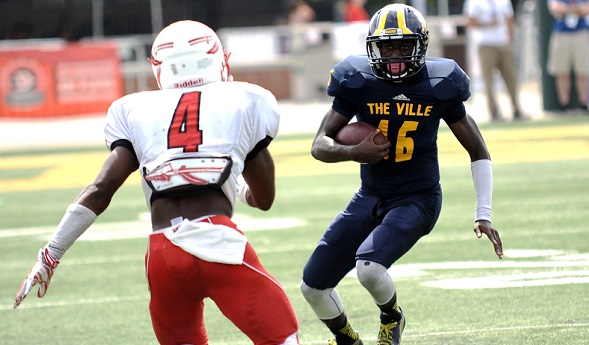
PHOTO: Detroit East English (in blue) fell to Lansing Sexton during opening weekend but hasn’t given up a point since that Saturday afternoon. (Click to see more from HighSchoolSportsScene.com).