


Travel Football
July 15, 2016
The University of Michigan will host a high school football game on Sept. 2, 2016. That would not make news, except that the game is between two out-of-state high school teams.
The teams are from New Jersey and Maryland, likely chosen to assist the Wolverines’ recruiting efforts in those states, and to help them make more waves in the college football world. Both high school teams are private schools, and each comes with heavy baggage.
Some public schools in New Jersey have boycotted playing the New Jersey school in football; the Maryland school is not a member of the MHSAA’s counterpart association in that state. One school is flaunting the rules; the other school has no rules to follow.
That major college football has been in an uncontrolled spiral of excess is not news; but its insidious damage to high school sports is finally making headlines.
NCAA rules have recently been robbing schools of winter and spring sports athletes as college coaches entice high school seniors to graduate at the end of their seventh semester and start practicing football with their future college teammates several months early. We are grateful to see Big 12 Commissioner Bob Bowlsby question the practice of enrolling players before their scheduled high school graduation.
Now, NCAA rules appear to invite universities to select high school football teams from anywhere there’s a great prospect or two, and transport the teams across the U.S. to compete in a nearly empty stadium, save for recruiting “gurus,” athletic apparel reps and a few media. We are hoping to see some college sports leaders step up to question this practice.
All of this leads to the rich getting richer – on both the college and school levels. All of which induces another updraft to the spiral of excess in what are supposed to be education-based programs.
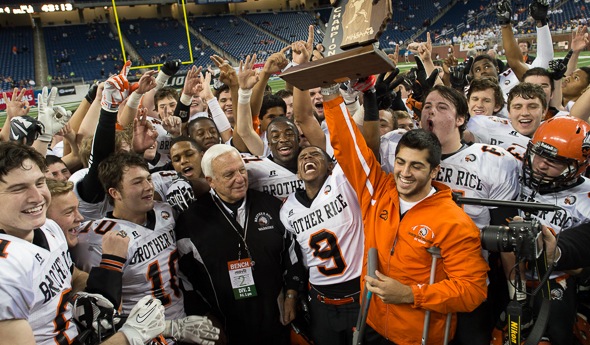
Rice Sends Out 'Coach' on Winning Note
November 29, 2013
By Bill Khan
Special to Second Half
DETROIT — What do you get the football coach who has everything?
How about a perfect 14-0 season?
Better yet, how about a third straight MHSAA championship as a nice going-away present?
Al Fracassa had accomplished just about everything during his legendary 45-year career at Birmingham Brother Rice, but his final three teams embraced the school's tradition and elevated it to an even higher level.
Brother Rice won its ninth MHSAA title — all under Fracassa — with a 38-21 victory in a rematch against Muskegon in the Division 2 championship game on Friday at Ford Field.
Before this current run, Brother Rice hadn't won back-to-back MHSAA championships. The school record for victories was set by the 2000 team, which went 13-1. The school's last undefeated team was in 1983. The Warriors' 23-game winning streak is one short of the school record set from 1976-78.
"I wish I was young enough to coach some more," said Fracassa, 81. "When you love something so much, it's very difficult to leave. I'm going to still love football; it's done a lot for me."
Fracassa finished his career with a 430-117-7 record, ranking first in Michigan history and sixth nationally in victories. That included eight seasons at Royal Oak Shrine before he was hired as Rice's head coach in 1969.
"I'm glad I made it," Fracassa said. "Now I can rest easy. I'll probably be very sad for awhile, and hopefully I'll be strong enough mentally to handle this."
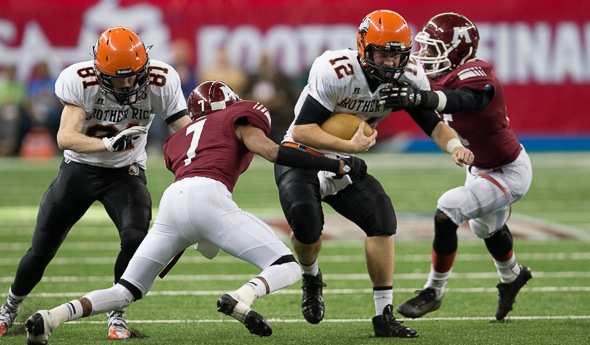 Friday's game was such a special occasion that even his wife, Phyllis, was in the stands.
"My wife never comes to games," Fracassa said. "She used to come, but she'd be so nervous that she'd beat everybody up next to her. Today, she came with my daughter, who flew in from Omaha. It was nice for her to see us play and have a great victory. I can't wait to see her."
Whoever takes over at Brother Rice has an excellent chance of extending the Warriors' championship and winning streaks.
Brother Rice will return junior quarterback Alex Malzone, who has been outstanding in two MHSAA Finals appearances. Malzone completed his first nine passes against Muskegon, finishing 20 for 24 for 263 yards and four touchdowns. In two title games, he is 28 for 34 for 430 yards, six touchdowns and no interceptions. Malzone was in a rotation last year with Cheyne Lacanaria.
Malzone also ran 17 yards as the holder on a fake field goal attempt with 4:33 left in the game.
"For him to go out with what we've done is an overall great feeling," Malzone said. "It's going to be different without him on the field every practice. He's the best coach I've ever had. I'm going to miss him a lot."
Corey Lacanaria caught 10 passes for 125 yards and a touchdown, while Grant Perry had five catches for 91 yards and two touchdowns.
The teams picked up where they left off in their wild finish in 2012, when a 91-yard kickoff return by Jason Alessi off a lateral gave Brother Rice a 35-28 victory.
Last year, they combined for 42 points during the final 13 minutes and 58 seconds after staging a defensive battle most of the way. On Friday, they scored on the first four possessions of the game, creating a 14-14 deadlock with 1:09 left in the first quarter. Going back to last year, that added up to 70 combined points in only 24:49 of playing time.
Malzone started out 9 for 9 for 125 yards and two touchdowns, hitting Damaris Woods with a 16-yard touchdown pass on the first series of the game and Perry on a one-handed 34-yard grab with 4:24 left in the first quarter.
Muskegon responded to each of those scores with touchdown runs by quarterback Deshaun Thrower, whose 6-yard run capped the Big Reds' first drive and whose 16-yarder tied the game at 14-14 on the next possession.
Perry's second touchdown catch, an 18-yard play with 1:07 left in the first half, gave Brother Rice a 21-14 halftime lead.
The key to the game was that Brother Rice shut down Muskegon's ground game after halftime. Thrower ran 12 times for 117 yards and two touchdowns in the first half, leading a rushing attack that piled up 216 yards on 21 carries. In the second half, Thrower was held to minus-18 yards on 10 carries. As a team, the Big Reds had minus-9 yards on 13 carries in the second half.
Muskegon didn't have the ball beyond its 36-yard line in the second half until 3:30 left in the game when Thrower hit Justin Foster with an 86-yard touchdown pass. But by then Brother Rice had extended its lead to 38-14 on a 21-yard touchdown pass from Malzone to Lacanaria and Malzone's 17-yard touchdown run on the fake field goal.
"They changed defenses in the second half," Thrower said. "A couple of missed opportunities set us back. We couldn't get in a rhythm again."
Muskegon has five MHSAA titles, but has been denied a sixth by Brother Rice two years in a row. The Big Reds last won the championship in 2008.
"I'm going to go back and evaluate what we're doing wrong in the championship game," Muskegon coach Shane Fairfield said. "It's my responsibility and my duty to put these kids in the right position and give them a better chance to win a state championship. It must be something I'm doing. These kids played a heck of a game. They fought through a lot. They're tough as nails. They played 28 games for our fans the last two years. There's going to be a winner and a loser. Unfortunately, the last two years we fell on the other end of it."
While Fairfield works on bringing a title back to the state's all-time winningest program, Fracassa will be a spectator while Brother Rice goes for a fourth consecutive MHSAA title in 2014.
"It's hit me the whole season when I'd go home every night," Fracassa said. "I couldn't believe it's going to be my last year. I try not to think about it. Football kept me busy, but it's here. It's time for someone else to take over. I'd like to mention my coaching staff. ... They did an outstanding job coaching my boys. I hate to take all the credit. They coached and did most of the coaching. I did most of the yelling."
PHOTOS: (Top) Brother Rice coach Al Fracassa celebrates one more MHSAA championship with his team Friday. (Middle) Warriors quarterback Alex Malzone tries to break away from Muskegon's Terry Copeland (5) and Jordan Waire (7). (Click to see more from Terry McNamara Photography.)