


Travel Football
July 15, 2016
The University of Michigan will host a high school football game on Sept. 2, 2016. That would not make news, except that the game is between two out-of-state high school teams.
The teams are from New Jersey and Maryland, likely chosen to assist the Wolverines’ recruiting efforts in those states, and to help them make more waves in the college football world. Both high school teams are private schools, and each comes with heavy baggage.
Some public schools in New Jersey have boycotted playing the New Jersey school in football; the Maryland school is not a member of the MHSAA’s counterpart association in that state. One school is flaunting the rules; the other school has no rules to follow.
That major college football has been in an uncontrolled spiral of excess is not news; but its insidious damage to high school sports is finally making headlines.
NCAA rules have recently been robbing schools of winter and spring sports athletes as college coaches entice high school seniors to graduate at the end of their seventh semester and start practicing football with their future college teammates several months early. We are grateful to see Big 12 Commissioner Bob Bowlsby question the practice of enrolling players before their scheduled high school graduation.
Now, NCAA rules appear to invite universities to select high school football teams from anywhere there’s a great prospect or two, and transport the teams across the U.S. to compete in a nearly empty stadium, save for recruiting “gurus,” athletic apparel reps and a few media. We are hoping to see some college sports leaders step up to question this practice.
All of this leads to the rich getting richer – on both the college and school levels. All of which induces another updraft to the spiral of excess in what are supposed to be education-based programs.
Drive for Detroit: 11-Player Semis Preview
November 16, 2017
By Geoff Kimmerly
Second Half editor
A week from today, Michigan’s best 11-player football teams will be playing, or preparing to play, in MHSAA Finals at Ford Field.
 That’s how close we are to dreams coming true for athletes, coaches and communities all over Michigan, many in this way for the first time.
Below is a look at all 16 of this weekend’s Semifinals. All are Saturday except the Division 8 game noted. All 16 will be broadcast either on the FOX Sports Detroit Prep Zone or MHSAA.tv – click for the schedule. The MHSAA Playoffs are sponsored by the Michigan Army National Guard, and “Drive for Detroit” is sponsored by MI Student Aid.
Division 1
Clarkston (10-2) vs. Detroit Catholic Central (8-4) at Walled Lake Western
Last season’s Division 1 runner-up Detroit Catholic Central is attempting to reach the Finals for the second straight season and sixth time in nine years, riding the productive running of senior back Cam Ryan (1,602 yards/17 TDs rushing). Clarkston last reached Ford Field in 2014, when it went on to win Division 1, and also has a standout back in senior Josh Cantu (1,383 yards/22 TDs rushing).
West Bloomfield (10-2) vs. Detroit Cass Tech (9-2) at Troy Athens
Reigning Division 1 champion Cass Tech is hoping to get back to Ford Field for the fifth time in seven seasons and third straight, but West Bloomfield has won its last 10 games as it seeks to get to the Finals for the first time. The Technicians are loaded with the usual collection of college prospects, led by junior running back Jaren Mangham and senior receiver Brandon Gray. West Bloomfield is driven by Division I quarterback recruit Bryce Veasley (3,208 yards/24 TDs passing) and three receivers with at least 800 yards through the air.
Division 2
Grand Rapids Forest Hills Central (12-0) vs. Livonia Franklin (10-2) at Grand Ledge
One of these two is going to make its first MHSAA Final in more than two decades. If it’s Forest Hills Central, it could be because of another shutdown performance by a defense giving up only 12.4 points per game in part because it's taken away 37 turnovers. The Rangers will have to stand up against a Franklin offense that has grown up substantially over the last three months. Two of the Patriots’ five games where they scored at least 30 points have come during the playoffs, and four of the five have come over the last five weeks.
Detroit Martin Luther King (11-1) vs. Warren DeLaSalle (10-2) at Hazel Park
King is two wins from a third straight Division 2 title and statistically might have its most impressive defense of the last three seasons. The Crusaders have given up only 45 points over the last five weeks in Detroit Public School League and MHSAA playoff games. Warren DeLaSalle was the last team before King to win Division 2, claiming the title in 2014. Senior quarterback Luke Pfromm jumps out most from an offense that’s gained more than 3,800 yards. He’s thrown 12 touchdown passes and run for 10 scores.
Division 3
Muskegon (12-0) vs. Battle Creek Harper Creek (12-0) at East Kentwood
Muskegon’s aura of invincibility got another boost last week with a 49-0 defeat of previously one-loss DeWitt. Senior quarterback La’darius Jefferson (1,163 yards/20 TDs passing, 1,678 yards/25 TDs rushing) is a player fans statewide are eager to see. Harper Creek, meanwhile, has tied its finest start and single-season record for wins. An offense with more than 3,200 yards on the ground can help the defense too; senior quarterback Jackson Malone and junior running back Jalonty Hervey have combined to run for 1,898 yards and 18 touchdowns.
Riverview (11-1) vs. Farmington Hills Harrison (9-3) at Rochester
The Hawks are doing their best to add to a proud legacy before the school closes in two years, as they’re aiming this weekend to make their first MHSAA Final since 2010. Junior running back Roderick Heard has run for 1,321 yards and 22 touchdowns and also is among the team’s leading receivers. The Pirates’ story just keeps getting better too – 2-7 last year, now playing in their first Semifinal since 2002. With 4,333 rushing yards and only 317 through the air, there’s no secret how Riverview will attack; seniors Cameron Rogers (1,310 yards/18 TDs) and Zach Guthrie (1,133 yards/11 TDs) both average more than seven yards per carry.
Division 4
Grand Rapids Catholic Central (12-0) vs. Escanaba (10-2) at Traverse City Thirlby Field
Escanaba’s first Semifinal run since 1981 has it now facing the reigning champion Cougars for the second straight season; GRCC won their Regional Final 34-0 last fall. Both feature battering backs. Senior Logan Carroll has carried a load for the Eskymos, and three of Escanaba’s five most productive offensive games have come in the playoffs. Meanwhile, senior Nolan Fugate has put up some incredible rushing totals for GRCC including 477 yards and five touchdowns rushing in a regular-season win over Comstock Park.
Edwardsburg (11-1) vs. River Rouge (10-2) at Jackson
Edwardsburg will play in its fourth Semifinal in eight seasons looking to break through with its first MHSAA championship game berth. Senior Nick Bradley leads a rushing attack that’s gained 4,700 yards with 1,210 and 12 touchdowns. Standing in the way is River Rouge, which has played in this round two years in a row and was Division 5 runner-up in 2015. The Panthers have given up only 30 points during the playoffs, with senior safety Reggie Pearson among standouts.
Division 5
Saginaw Swan Valley (11-1) vs. Reed City (11-1) at Greenville
Swan Valley is another program looking to break through to the final weekend for the first time, playing in its fourth Semifinal in 12 seasons and first since 2012. Junior quarterback Alex Fries (1,176 yards/16 TDs passing) starred last week as Swan Valley’s leading rusher missed his second straight game. Reed City is looking to extend its longest playoff run – the Regional title was its first. The Coyotes outlasted one of their toughest defensive challenges last week in winning 46-34 over 2016 Division 5 runner-up Menominee.
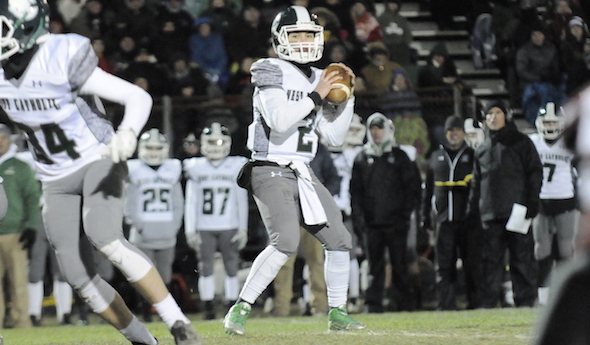
Frankenmuth (12-0) vs. Grand Rapids West Catholic (10-2) at Fenton
The Eagles’ path to play in a championship game for the first time must go through four-time reigning champ West Catholic. The Falcons follow an experienced leader in senior quarterback Gaetano Vallone, who has thrown for 2,332 yards and 29 touchdowns and also is the team’s leading rusher with 781 yards and 12 scores. Frankenmuth senior quarterback Zach Jacobs is similarly resourceful. He’s thrown for 1,019 yards and 15 touchdowns on only 88 attempts, and he’s also the leading rusher with 973 yards and 20 touchdowns on the ground.
Division 6
Ithaca (12-0) vs. Traverse City St. Francis (11-1) at Mount Pleasant
The Yellowjackets has return to the Finals for the seventh time in eight seasons. Senior Joey Bentley is the latest in a line of stellar Ithaca quarterbacks – he’s thrown for 1,876 yards and 27 touchdowns and run for 1,418 yards and 24 scores. St. Francis knows this stage of the game as well; the Gladiators are playing to make their first Final since 2009 but have won three Regional titles over the last seven seasons. They’ve given up only 96 points this season and also can grind clock with a rushing game led by senior Joey Muzljakovich (882 yards/15 TDs).
Warren Michigan Collegiate (12-0) vs. Jackson Lumen Christi (10-1) at Chelsea
The reigning champion Titans graduated a 2,600-yard rusher after last season and are right back in the Semifinals this time following senior Sebastian Toland (1,815 yards/21 TDs rushing). Michigan Collegiate is playing in its second Semifinal in 10 seasons as a program and first Semifinal since 2010. The Cougars outlasted another impressive offense from Detroit Central 38-34 in the District Final and haven’t allowed any other opponent to score more than 21 points.
Division 7
Lake City (12-0) vs. Pewamo-Westphalia (11-1) at Clare
Reigning champion P-W graduated one of the leading rushers in MHSAA history in the spring and is back in the Semifinals without a 1,000-yard rusher. But senior quarterback Jimmy Lehman has taken on a starring role in a little bit different way, running for 576 yards and 13 touchdowns but also throwing for 1,430 yards and 18 scores. Lake City is playing in its first Semifinal only a season after finishing 2-7, and of course has set a program record for wins along the way. Junior quarterback Matt Holt (1,821 yards/21 TDs) and senior running back Zack Noren (1,405 yards/23 TDs rushing, 577 yards/8 TDs receiving) key a balanced attack.
Madison Heights Madison (12-0) vs. Saugatuck (9-3) at Lansing Catholic
Both of these programs have been driving for this opportunity for a few seasons. Madison has played in six Regional Finals since last reaching an MHSAA championship game in 2006, but this will be its second Semifinal of that string. Saugatuck played in the Division 8 Final in 2010, but since has experienced first losses of a season in the playoffs three times. Madison is paced by junior quarterback Austin Brown (2,572 yards/31 TDs passing), while Saugatuck junior running back Bradley Dunn has run for 904 yards and 10 touchdowns and caught a team-high 31 passes for 550 yards and eight scores.
Division 8
Saginaw Nouvel (12-0) vs. Iron River West Iron County (11-1), Friday at the Superior Dome
Nouvel will play in its first Semifinal since its perfect season of 2011, when it won the Division 7 title. Senior quarterback Tate Hausbeck can hurt defenses multiple ways; he’s thrown for 2,377 yards and 25 touchdowns and is the team’s leading rusher with 584 yards and 13 scores on the ground. West Iron has broken through to earn its first Semifinal appearance since 1977. The Wykons’ 11-game win streak is the result in part of a rushing attack approaching 3,000 yards this season. Senior Jayce Brockhagen has run for 1,348 yards and 19 touchdowns.
Mendon (12-0) vs. Ottawa Lake Whiteford (12-0) at Howell
A common past opponent gives this matchup extra intrigue. Mendon eliminated four-time reigning champion Muskegon Catholic Central two weeks ago, then just got past rival Climax-Scotts 14-6 in the Regional Final. Whiteford lost to MCC in last year’s championship game and has surged back seeking a return to Detroit. Both run over opponents. Mendon has 3,940 yards on the ground and just 346 passing, with senior Wyatt Cool and sophomore Austin Rensi combining for 2,399 yards and 40 touchdowns on the ground. Whiteford has gained 4,572 yards on the ground versus 1,150 through the air; junior Logan Murphy has run for 1,599 yards and 23 touchdowns, and senior quarterback Thomas Eitniear is back with 1,150 yards and 14 touchdowns passing and 785 yards and 13 scores on the ground.
Second Half’s weekly “Drive for Detroit” previews and reviews are powered by MI Student Aid, a part of the Student Financial Services Bureau located within the Michigan Department of Treasury. MI Student Aid encourages students to pursue postsecondary education by providing access to student financial resources and information, including various student financial assistance programs to help make college more affordable for Michigan students. MI Student Aid administers the state’s 529 savings programs (MET/MESP) and eight additional aid programs within its Student Scholarships and Grants division. Click for more information and connect with MI Student Aid on Facebook and Twitter @mistudentaid.
PHOTO: Grand Rapids West Catholic's Gaetano Vallone scans the field during last week's Regional Final win over Portland. (Click to see more from HighSchoolSportsScene.com.)