

Trojans Standout Back from Basic Training
September 20, 2019
By Chris Dobrowolski
Special for Second Half
It seemed appropriate that the first game T.J. Schultz played his senior season for the Central Lake/Ellsworth football team was also the program’s fourth annual Veterans and First Responders Appreciation Night.
 Schultz, a starting linebacker and running back in his third year with the Trojans, had the beginning of his final year on the gridiron delayed until the third week of the 2019 campaign — the game that paid homage to those who have served in the military — as he was completing basic training for the National Guard.
Enlisting in the Split Training Option program gave Schultz the opportunity to do basic training during the summer before his senior year. He reported to Fort Sill in Oklahoma on June 25 and spent the next 10 weeks going through the rigors of the military. It’s part of an eight-year contract with the National Guard that includes six years of active service, followed by two more years of inactive duty.
“It just gave me a head start, instead of graduating and then doing basic,” said Schultz. “The advantage of doing split op is I can come back and finish high school and take a little break, then go back down.”
Schultz quickly found out how demanding the military can be for a new recruit during basic training.
“They give you near-impossible tasks and if you can’t do them, you do push-ups or exercises,” he said. “Sometimes you’d have to go upstairs and change into a new uniform in less than 30 seconds. If you can’t do that, you’re coming downstairs and doing push-ups.”
To make matters even more challenging, the 240-member unit did the brunt of their training in the heat of the southern Oklahoma summer, where temperatures often reached into triple digits.
“They said it was one of the hottest summers there in a long time,” said Schultz. “We had to wear Kevlar helmet, bulletproof vest. They added 30 pounds to us. We were out there in the heat. It was just insane. We didn’t have (air conditioning). What we had were these big fans that sprayed mists of water. They were big, powerful fans, but unless you were really close to them they didn’t work very well.”
Not only did Schultz manage to make it through those hardships that he faced during basic training, but he came out of graduation with high praise from his drill sergeant.
 “His drill sergeant had nothing but good things to say about him,” said Schultz’s mother, Mary Drenth, also a veteran of the National Guard. “He did great on everything. He was one of six in the whole unit to shoot expert on the rifle range. He was second. There was one kid who got 38 out of 40, and he got 37 out of 40. We’re incredibly proud.
“We have four boys. When we found out he was graduating a week into school, we chose to let the kids all miss that first week of school and took a trip out to Oklahoma. So, they all got to witness their brother graduate. That was an amazing experience. It was really, really cool.”
Like his first experience in the military, Schultz also can hold his own on the football field, where he has been a fixture at linebacker since taking over a starting spot as a sophomore in 2017 — the year the Trojans went 13-0 and captured the MHSAA 8-player Division 1 championship. It was his first season playing football after moving from Cheboygan the previous year.
“It was funny because I was thinking of doing football in Cheboygan and I never really committed to it because I was hockey, hockey, hockey. I love hockey,” said Schultz, who started playing hockey as a 4-year-old. “Then I came here and thought, ‘I’ll give football a try. Might as well.’ I love those guys. It was just so fun. Everyone was so confident. Going into a game we didn’t expect to lose. We were just going out there and having fun.”
Central Lake/Ellsworth defensive assistant coach Jarod Steenwyk has come to rely on Schultz’s toughness and tenacity at the heart of the Trojans’ defense for the past couple years, so he was excited to finally have Schultz return from basic training. Schultz also is getting an increased role at running back this season after serving as a backup at that position the last two years.
“He brings some size at linebacker for us and having that other running back,” said Steenwyk. “He’s got some speed, but he’s willing to hit somebody — lower the shoulder.”
“He started for us on the state championship team and even in that (championship game) he made some pretty big plays. He really came through for us.”
Steenwyk has noticed that Schultz seems to be more focused in the short time he’s been back with the team. Drenth, likewise, said the experience of basic training changed her son in a good way.
“It was good for him,” she said. “He’s definitely matured a lot. He has the self-discipline. He’s a different kid now.”
After Schultz finishes the school year in the spring, he will return to the National Guard for Advanced Individual Training — eight weeks of hands-on instruction at Fort Leavenworth in Kansas with a Military Occupational Specialty as a construction equipment repairman.
“Right after high school I’ll go to AIT, finish up there and then come back with some good certificates that will get me a head start, and it will look good on my resume,” said Schultz. “So far I’m not regretting anything.”
 Chris Dobrowolski has covered northern Lower Peninsula sports since 1999 at the Ogemaw County Herald, Alpena News, Traverse City Record-Eagle and currently as sports editor at the Antrim Kalkaska Review since 2016. He can be reached at [email protected] with story ideas for Manistee, Wexford, Missaukee, Roscommon, Ogemaw, Iosco, Alcona, Oscoda, Crawford, Kalkaska, Grand Traverse, Benzie, Leelanau, Antrim, Otsego, Montmorency, Alpena, Presque Isle, Cheboygan, Charlevoix and Emmet counties.
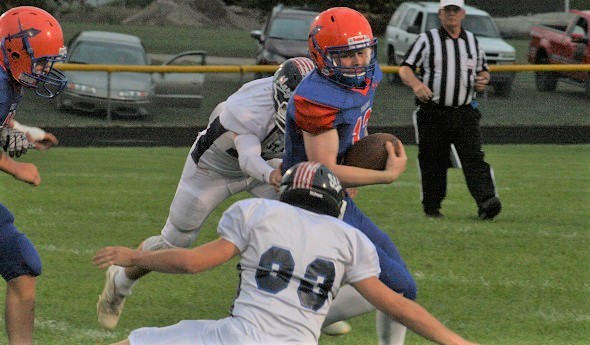
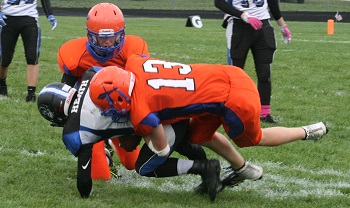
PHOTOS: Central Lake/Ellsworth’s T.J. Schultz tries to cut past a Gaylord St. Mary defender during their Week 3 meeting. (Middle) Schultz takes down a Wyoming Tri-unity Christian ball carrier. (Photos courtesy of the Antrim County Review.)
Harris Flies Like a Record-Setting Eagle
By
Geoff Kimmerly
MHSAA.com senior editor
November 30, 2012
Drake Harris may not have expected the full force of the performance he put up Saturday to cap an incredible junior season for Grand Rapids Christian.
But he had a pretty good idea at the start that it could turn into a special night.
When Orchard Lake St. Mary’s attempted to cover him with just one player – and continued to do so frequently throughout the Division 3 Final at Ford Field – the 6-foot-4, 180-pound Harris found himself in a dream come true.
“I kinda figured they would come out like that and play me like that. My coach knew that, and he just put me in the right position to make plays,” Harris said. “And I was happy they came out like that.
“I’m not the type to brag on myself. But when I see that, man-to-man coverage, that’s my dream. I love when people go man, and no safety over the top. It’s just me and the DB. The better man wins.”
Harris gets a Second Half High 5 this week after probably the most victorious day in his young career.
He grabbed eight passes for an MHSAA Finals record 243 yards and a touchdown as the Eagles beat St. Mary’s 40-37 in overtime to claim their first football championship.
Saturday’s numbers gave him, unofficially, 91 catches for 2,015 yards and 25 scores this fall. While those totals still must be confirmed for record book purposes, the yardage will be the most in MHSAA history for one season and rank 12thnationally. His yards per game this fall will rank fourth nationally and his yards per catch sixth. His catches will rank fourth in MHSAA history and his touchdown catches second.
Harris has committed to sign next fall with Michigan State for basketball and then the following February for football too. He’s expected to do big things again this winter for a Grand Rapids Christian basketball team that advanced to the Class A Quarterfinals last season.
Hoops always was his sport – he wasn't sure at one point that he’d even play football in high school. But Harris said Spartans men’s basketball coach Tom Izzo told him he loves players who are on their football teams as well. And Harris said he is starting to realize his football future might be the brighter of the two.
Saturday couldn't have hurt that observation.
Harris caught passes of 49 and 22 yards before hauling in a 74-yard scoring strike early in the second quarter. He had an 85-yarder called back during the third quarter, but caught passes of 24 and 38 yards to set up a touchdown early in the fourth. He then caught his final three passes during the team’s final possession of regulation, gaining a total of 36 yards in helping to set up Joel Schipper’s 28-yard game-tying field goal with four seconds left.
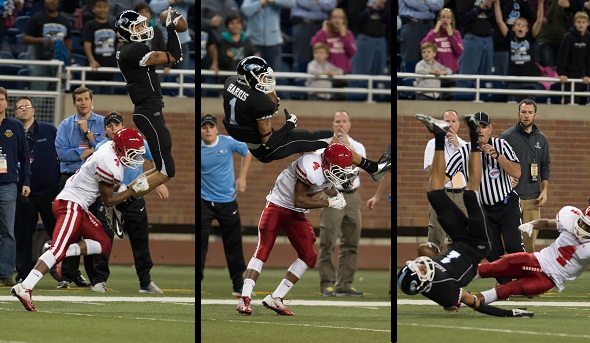
One catch will live on in Finals memory for years to come. In the fourth quarter, Harris went so high as to nearly jump over his defensive back. The defender tackled his legs mid-air, dumping Harris back-first into the turf. But Harris held on, and the Eagles continued to move.
After gaining more than 1,000 yards receiving as a sophomore too, Harris will need only 609 as a senior to set that MHSAA career record. He needs 66 catches and four for touchdowns to tie those records. And if a record was kept for highlight-reel catches, he might already be the holder.
“People don’t necessarily think he’s tough or something. But to have a guy go up 3-4 feet in the air and get flipped, catch the ball and land on his back or head; that’s pretty tough in my book,” Grand Rapids Christian senior quarterback Alex VanDeVusse said. “I’d take him on my team every single day. He’s amazing.”
PHOTO: Drake Harris went high to make this grab during the fourth quarter of Saturday's Division 3 Final against Orchard Lake St. Mary's. (Click for more from Terry McNamara Photography.)