

Trojans Standout Back from Basic Training
September 20, 2019
By Chris Dobrowolski
Special for Second Half
It seemed appropriate that the first game T.J. Schultz played his senior season for the Central Lake/Ellsworth football team was also the program’s fourth annual Veterans and First Responders Appreciation Night.
 Schultz, a starting linebacker and running back in his third year with the Trojans, had the beginning of his final year on the gridiron delayed until the third week of the 2019 campaign — the game that paid homage to those who have served in the military — as he was completing basic training for the National Guard.
Enlisting in the Split Training Option program gave Schultz the opportunity to do basic training during the summer before his senior year. He reported to Fort Sill in Oklahoma on June 25 and spent the next 10 weeks going through the rigors of the military. It’s part of an eight-year contract with the National Guard that includes six years of active service, followed by two more years of inactive duty.
“It just gave me a head start, instead of graduating and then doing basic,” said Schultz. “The advantage of doing split op is I can come back and finish high school and take a little break, then go back down.”
Schultz quickly found out how demanding the military can be for a new recruit during basic training.
“They give you near-impossible tasks and if you can’t do them, you do push-ups or exercises,” he said. “Sometimes you’d have to go upstairs and change into a new uniform in less than 30 seconds. If you can’t do that, you’re coming downstairs and doing push-ups.”
To make matters even more challenging, the 240-member unit did the brunt of their training in the heat of the southern Oklahoma summer, where temperatures often reached into triple digits.
“They said it was one of the hottest summers there in a long time,” said Schultz. “We had to wear Kevlar helmet, bulletproof vest. They added 30 pounds to us. We were out there in the heat. It was just insane. We didn’t have (air conditioning). What we had were these big fans that sprayed mists of water. They were big, powerful fans, but unless you were really close to them they didn’t work very well.”
Not only did Schultz manage to make it through those hardships that he faced during basic training, but he came out of graduation with high praise from his drill sergeant.
 “His drill sergeant had nothing but good things to say about him,” said Schultz’s mother, Mary Drenth, also a veteran of the National Guard. “He did great on everything. He was one of six in the whole unit to shoot expert on the rifle range. He was second. There was one kid who got 38 out of 40, and he got 37 out of 40. We’re incredibly proud.
“We have four boys. When we found out he was graduating a week into school, we chose to let the kids all miss that first week of school and took a trip out to Oklahoma. So, they all got to witness their brother graduate. That was an amazing experience. It was really, really cool.”
Like his first experience in the military, Schultz also can hold his own on the football field, where he has been a fixture at linebacker since taking over a starting spot as a sophomore in 2017 — the year the Trojans went 13-0 and captured the MHSAA 8-player Division 1 championship. It was his first season playing football after moving from Cheboygan the previous year.
“It was funny because I was thinking of doing football in Cheboygan and I never really committed to it because I was hockey, hockey, hockey. I love hockey,” said Schultz, who started playing hockey as a 4-year-old. “Then I came here and thought, ‘I’ll give football a try. Might as well.’ I love those guys. It was just so fun. Everyone was so confident. Going into a game we didn’t expect to lose. We were just going out there and having fun.”
Central Lake/Ellsworth defensive assistant coach Jarod Steenwyk has come to rely on Schultz’s toughness and tenacity at the heart of the Trojans’ defense for the past couple years, so he was excited to finally have Schultz return from basic training. Schultz also is getting an increased role at running back this season after serving as a backup at that position the last two years.
“He brings some size at linebacker for us and having that other running back,” said Steenwyk. “He’s got some speed, but he’s willing to hit somebody — lower the shoulder.”
“He started for us on the state championship team and even in that (championship game) he made some pretty big plays. He really came through for us.”
Steenwyk has noticed that Schultz seems to be more focused in the short time he’s been back with the team. Drenth, likewise, said the experience of basic training changed her son in a good way.
“It was good for him,” she said. “He’s definitely matured a lot. He has the self-discipline. He’s a different kid now.”
After Schultz finishes the school year in the spring, he will return to the National Guard for Advanced Individual Training — eight weeks of hands-on instruction at Fort Leavenworth in Kansas with a Military Occupational Specialty as a construction equipment repairman.
“Right after high school I’ll go to AIT, finish up there and then come back with some good certificates that will get me a head start, and it will look good on my resume,” said Schultz. “So far I’m not regretting anything.”
 Chris Dobrowolski has covered northern Lower Peninsula sports since 1999 at the Ogemaw County Herald, Alpena News, Traverse City Record-Eagle and currently as sports editor at the Antrim Kalkaska Review since 2016. He can be reached at [email protected] with story ideas for Manistee, Wexford, Missaukee, Roscommon, Ogemaw, Iosco, Alcona, Oscoda, Crawford, Kalkaska, Grand Traverse, Benzie, Leelanau, Antrim, Otsego, Montmorency, Alpena, Presque Isle, Cheboygan, Charlevoix and Emmet counties.
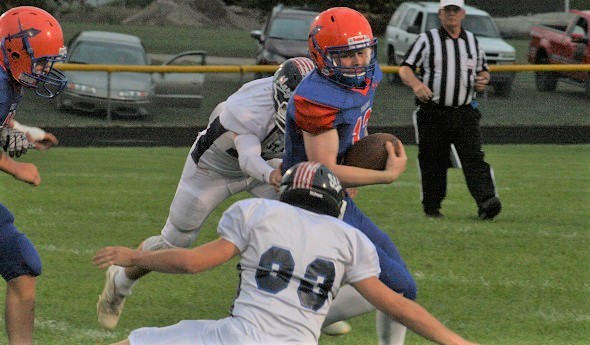
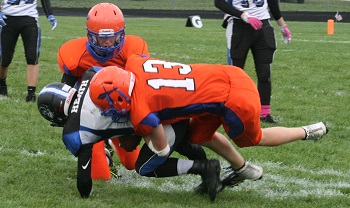
PHOTOS: Central Lake/Ellsworth’s T.J. Schultz tries to cut past a Gaylord St. Mary defender during their Week 3 meeting. (Middle) Schultz takes down a Wyoming Tri-unity Christian ball carrier. (Photos courtesy of the Antrim County Review.)
Gorham Rewriting Record Book as Mendon Pursues Superior Dome Return
By
Scott Hassinger
Special for MHSAA.com
November 4, 2025
MENDON – Mendon football star Owen Gorham finds enjoyment in being a mentor for younger kids in his community – so much so that he one day aspires to have his own classroom and pursue a career as an elementary teacher.
 If his success on the football field the last four years is any indication, the 5-foot-10, 180-pound senior tailback should be a smashing hit in the education field as well.
Gorham has made a significant impact in 8-Player Division 2 football as top-ranked Mendon (10-0) prepares to travel and face No. 3 Portland St. Patrick this weekend in a Regional championship matchup.
The three-sport athlete already owns MHSAA 8-player career records for scoring with 696 points and touchdowns with 97. Both records were previously held by Bridgman's Reid Haskins (2019-22).
Gorham broke Haskins' career scoring mark in Mendon's 62-0 win over Battle Creek St. Philip in Week 7 before adding the TD record to his resume in a 76-43 victory over Adrian Lenawee Christian to end the regular season.
"I was able to put up pretty good numbers last year as a junior thanks to a good offensive line and a really good team,” said Gorham, who also has lettered in basketball and track & field. “I feel my speed is one of my biggest strengths. Reaching some of these records was among my goals when this season started. I couldn't have done it though without the support of my family, my twin brother Ryder at quarterback, JT Lux my fullback and the guys on my offensive line.”
Owen Gorham has run 471 times for 4,905 career yards and needs just 122 more yards to surpass Haskins as the state's all-time leading rusher. As a senior, Gorham has churned out 1,569 yards – 13.53 per carry – with 27 rushing TDs and two more on receptions.
"Owen works his tail off. We never question his work ethic. I always tell him he's his own worst critic. The time that he puts into the game, like watching film and lifting weights, makes him the player he is," said Mendon head coach Bobby Kretschman, an all-state linebacker during his playing days at Mendon and currently the high school’s principal as well.
 "What you see out of Owen on Friday nights is just a small part of what he does. He's got good speed, power, makes good cuts and choices on the field. He's carried the ball close to 500 times for us in his career. That's a testament to his durability to be able to run for that much yardage. Defensively, he has a good nose for the football and his speed allows him to post up on tight ends and cover well out in space. That's huge in 8-man football because of the multiple offenses you see out of opposing teams.”
Mendon has scored 502 points this fall, an average of 55.8 per game. A great deal of that production has come on the ground, where the Hornets have rolled up 3,439 yards – 11.2 yards per carry and 382.1 per contest.
Directing Mendon's offense is Owen's twin brother Ryder, the Hornets' three-year starting quarterback, with Owen at halfback and Lux at fullback. Halfback Xavior Zinsmaster has 32 carries for 512 yards and seven TDs.
"Ryder is my biggest influence. We're twins so we do everything together, and he pushes me in everything I do and I try to do the same for him," Owen Gorham said.
Lux has run for 444 yards on 60 carries, with eight TDs.
"I think Owen and I bring two different types of running styles to the game and complement each other well. You have Owen's speed and my strength. I love blocking for him, and our offense has been very explosive this year," Lux said.
Senior tight end Brayden Crites (6-3, 200) is Mendon's top receiver with 10 catches for 249 yards and seven TDs.
Mendon's standouts on the offensive line, along with Crites, include seniors Adain McCall and Jayden Haigh, big sophomore center Jorden Palmer (5-10, 260) and junior guard Tristan Wood.
"Adain and Brayden do a lot of the dirty work for us. Our offensive line was a big question mark coming in this season. But the kids up there understand their roles well and do a good job staying on blocks for the most part.” Kretschman said. “Ryder runs the offense smoothly and is a good coverage kid, along with Xavior on defense."
Ryder Gorham is Mendon's third-leading rusher with 38 carries for 372 yards and seven TDs, while completing 21-of-43 passes worth 445 yards and eight TDs with just two interceptions. He's also a starter in the Hornets' secondary, where he has 23 tackles and one interception.
Defensively, Mendon is led in tackles by junior linebacker Zak Iobe (5-10, 165) with 77, followed by Zinsmaster and Wood with 57 stops apiece. Lux (5-10, 195) has 16 tackles, a sack and one fumble recovery at defensive tackle.
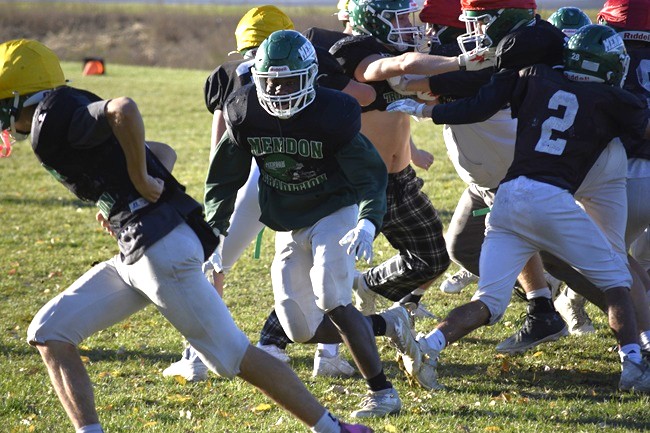 Mendon's seven seniors and their teammates are primed for the biggest game of their careers after receiving a 1-0 forfeit win over No. 7-ranked Grand Rapids Sacred Heart last week.
Mendon won 12 state championships during its era in 11-Player football, including 10 titles under legendary coach John Schwartz.
Mendon lost 66-26 to Powers North Central in the 2022 8-Player Division 1 championship game, which concluded the Hornets’ second season playing the new format. They look to return to the Finals this month at the Superior Dome in Marquette after losing 49-32 to eventual champion Deckerville in a Division 1 Semifinal last season.
Deckerville also is in Division 2 this season and a possible opponent if Mendon wins this week.
"That game didn't go as well as we wanted. Our goal is to get another shot at them and hopefully we do," Owen Gorham said.
He said he and his Mendon teammates spent the offseason working to achieve bigger things this fall.
"We were out here three days a week in the summer lifting weights, running and doing agility drills. During the season we lift on Wednesday and Saturdays and watch film,” Gorham said. “We never stop working hard to keep our season going. We all want it really bad. Losing to Deckerville last year just gave us more fire coming into this season.”
He also feels a great sense of pride whenever he steps onto the field.
Dan Kennedy, Owen's grandfather, was an all-state player at Mendon during the mid-1970s, and cousins Greg Bingaman and Clint Wagner both played on Hornets teams that claimed state titles.
"It's a tremendous honor to put on the Green and White jersey. I've had many family members who have played at Mendon on state title teams. I just feel honored to have a chance to repeat history with what they've done here in the past," Gorham said.
A starter at outside linebacker as well, he also plays a critical role on a Hornets' defensive unit that has allowed just 14.7 points per contest. He has 32 tackles, including four for loss of yardage, to go with 3.5 sacks, one interception and one caused fumble. Rarely does Gorham leave the field as he is also Mendon's punter, averaging 42 yards per attempt.
While Gorham's success has generated interest from college coaches, he has already made a decision to end his football career after Mendon's final game this season.
"I thought about playing college football but decided not to. I want to go to Western Michigan and study elementary education,” Gorham said. “Every Friday I go to our elementary school and help mentor kids. I love volunteering to help little kids get a good future just like where I'm at right now. That has really sparked my interest in having my own classroom some day and helping kids.”
 Scott Hassinger is a contributing sportswriter for Leader Publications and previously served as the sports editor for the Three Rivers Commercial-News from 1994-2022. He can be reached at [email protected] with story ideas for Berrien, Cass, St. Joseph and Branch counties.
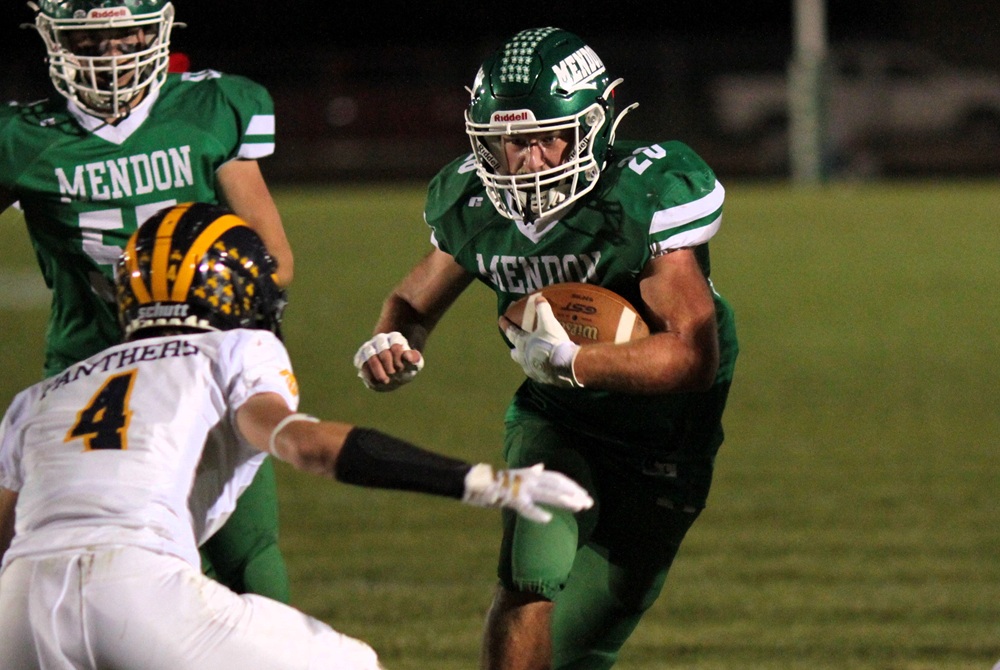
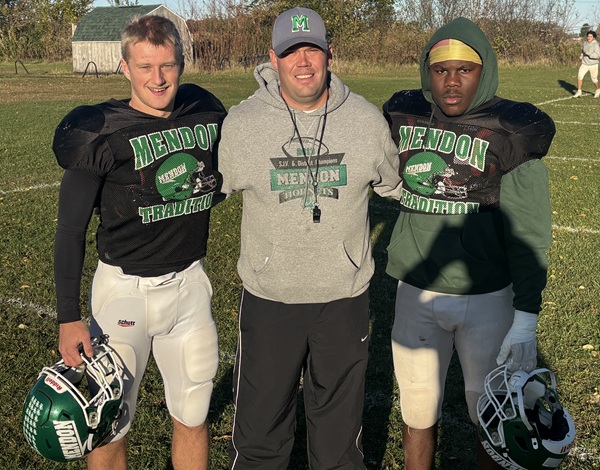
PHOTOS (Top) Mendon senior tailback Owen Gorham (20) nears the end zone during a 46-20 win over Climax-Scotts this fall. (Middle) Pictured at practice last week, from left: Gorham, Mendon head coach Bobby Kretschman and JT Lux. (Below) Lux (23) pursues a ballcarrier during a practice drill. (Top photo by Brandon Watson/Sturgis Journal. Practice photos by Scott Hassinger.)