

Trojans Standout Back from Basic Training
September 20, 2019
By Chris Dobrowolski
Special for Second Half
It seemed appropriate that the first game T.J. Schultz played his senior season for the Central Lake/Ellsworth football team was also the program’s fourth annual Veterans and First Responders Appreciation Night.
 Schultz, a starting linebacker and running back in his third year with the Trojans, had the beginning of his final year on the gridiron delayed until the third week of the 2019 campaign — the game that paid homage to those who have served in the military — as he was completing basic training for the National Guard.
Enlisting in the Split Training Option program gave Schultz the opportunity to do basic training during the summer before his senior year. He reported to Fort Sill in Oklahoma on June 25 and spent the next 10 weeks going through the rigors of the military. It’s part of an eight-year contract with the National Guard that includes six years of active service, followed by two more years of inactive duty.
“It just gave me a head start, instead of graduating and then doing basic,” said Schultz. “The advantage of doing split op is I can come back and finish high school and take a little break, then go back down.”
Schultz quickly found out how demanding the military can be for a new recruit during basic training.
“They give you near-impossible tasks and if you can’t do them, you do push-ups or exercises,” he said. “Sometimes you’d have to go upstairs and change into a new uniform in less than 30 seconds. If you can’t do that, you’re coming downstairs and doing push-ups.”
To make matters even more challenging, the 240-member unit did the brunt of their training in the heat of the southern Oklahoma summer, where temperatures often reached into triple digits.
“They said it was one of the hottest summers there in a long time,” said Schultz. “We had to wear Kevlar helmet, bulletproof vest. They added 30 pounds to us. We were out there in the heat. It was just insane. We didn’t have (air conditioning). What we had were these big fans that sprayed mists of water. They were big, powerful fans, but unless you were really close to them they didn’t work very well.”
Not only did Schultz manage to make it through those hardships that he faced during basic training, but he came out of graduation with high praise from his drill sergeant.
 “His drill sergeant had nothing but good things to say about him,” said Schultz’s mother, Mary Drenth, also a veteran of the National Guard. “He did great on everything. He was one of six in the whole unit to shoot expert on the rifle range. He was second. There was one kid who got 38 out of 40, and he got 37 out of 40. We’re incredibly proud.
“We have four boys. When we found out he was graduating a week into school, we chose to let the kids all miss that first week of school and took a trip out to Oklahoma. So, they all got to witness their brother graduate. That was an amazing experience. It was really, really cool.”
Like his first experience in the military, Schultz also can hold his own on the football field, where he has been a fixture at linebacker since taking over a starting spot as a sophomore in 2017 — the year the Trojans went 13-0 and captured the MHSAA 8-player Division 1 championship. It was his first season playing football after moving from Cheboygan the previous year.
“It was funny because I was thinking of doing football in Cheboygan and I never really committed to it because I was hockey, hockey, hockey. I love hockey,” said Schultz, who started playing hockey as a 4-year-old. “Then I came here and thought, ‘I’ll give football a try. Might as well.’ I love those guys. It was just so fun. Everyone was so confident. Going into a game we didn’t expect to lose. We were just going out there and having fun.”
Central Lake/Ellsworth defensive assistant coach Jarod Steenwyk has come to rely on Schultz’s toughness and tenacity at the heart of the Trojans’ defense for the past couple years, so he was excited to finally have Schultz return from basic training. Schultz also is getting an increased role at running back this season after serving as a backup at that position the last two years.
“He brings some size at linebacker for us and having that other running back,” said Steenwyk. “He’s got some speed, but he’s willing to hit somebody — lower the shoulder.”
“He started for us on the state championship team and even in that (championship game) he made some pretty big plays. He really came through for us.”
Steenwyk has noticed that Schultz seems to be more focused in the short time he’s been back with the team. Drenth, likewise, said the experience of basic training changed her son in a good way.
“It was good for him,” she said. “He’s definitely matured a lot. He has the self-discipline. He’s a different kid now.”
After Schultz finishes the school year in the spring, he will return to the National Guard for Advanced Individual Training — eight weeks of hands-on instruction at Fort Leavenworth in Kansas with a Military Occupational Specialty as a construction equipment repairman.
“Right after high school I’ll go to AIT, finish up there and then come back with some good certificates that will get me a head start, and it will look good on my resume,” said Schultz. “So far I’m not regretting anything.”
 Chris Dobrowolski has covered northern Lower Peninsula sports since 1999 at the Ogemaw County Herald, Alpena News, Traverse City Record-Eagle and currently as sports editor at the Antrim Kalkaska Review since 2016. He can be reached at [email protected] with story ideas for Manistee, Wexford, Missaukee, Roscommon, Ogemaw, Iosco, Alcona, Oscoda, Crawford, Kalkaska, Grand Traverse, Benzie, Leelanau, Antrim, Otsego, Montmorency, Alpena, Presque Isle, Cheboygan, Charlevoix and Emmet counties.
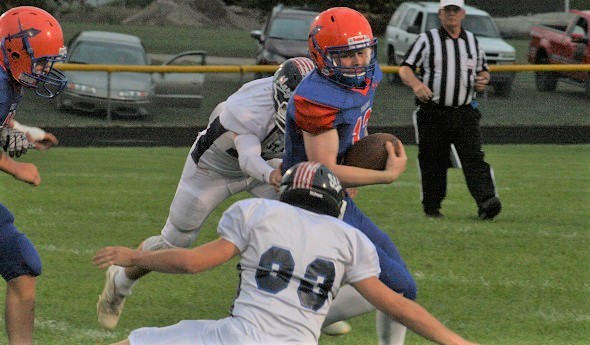
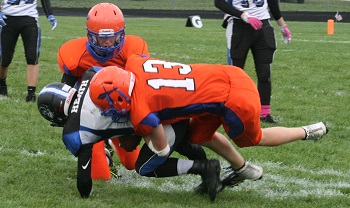
PHOTOS: Central Lake/Ellsworth’s T.J. Schultz tries to cut past a Gaylord St. Mary defender during their Week 3 meeting. (Middle) Schultz takes down a Wyoming Tri-unity Christian ball carrier. (Photos courtesy of the Antrim County Review.)
Drive for Detroit: Semifinals in Review
November 21, 2016
By Geoff Kimmerly
Second Half editor
After nearly four months, this drive for Detroit is nearly complete.
Sixteen teams remain for this weekend's eight MHSAA 11-Player Finals at Ford Field in Detroit. Below is a glance at how all 16 earned their end-of-season trips, with a number of them frequent visitors to the season's final days.
Division 1
Detroit Catholic Central 17, Romeo 0
The Shamrocks eliminated the reigning Division 1 champion in a matchup of last season’s Regional Final, a 40-29 Romeo win. Detroit Catholic Central (13-0) is on course for its best defensive season since 2011 and a win away from its first undefeated season since 2009. For Romeo (9-4), the loss ends a two-season run that saw the Bulldogs play in their second and third Semifinals ever (and first since 1992) while earning their first MHSAA team title and finishing a combined 22-5. Click for more from the Observer & Eccentric.
Detroit Cass Tech 32, Utica Eisenhower 28
Cass Tech standout receiver Donovan Peoples-Jones caught a 20-yard touchdown pass from quarterback Rodney Hall with only 24 seconds to play to push the Technicians (13-0) ahead of Eisenhower and soon after back into the Division 1 Final for the second straight season and fourth time this decade. The reigning runner-up in this division won its second straight nail-biter after downing Saline by one in the Regional Final, handing Eisenhower (12-1) its first loss after doing the same to the Hornets the week before. Click for more from the Detroit Free Press.
Division 2
Walled Lake Western 37, Lowell 34
The Red Arrows (12-1), last season’s Division 2 runners-up, found themselves in a comeback quest for the second week in a row but couldn’t come all the way back in this rematch of a 2015 Semifinal. Walled Lake Western (12-1) led 31-14 at halftime and held Lowell off for the final 7:46 to advance to its first championship game since 1999. The Warriors had lost to Lowell 49-34 in the meeting a year ago. Click for more from the Oakland Press.
Detroit Martin Luther King 14, Birmingham Groves 7
King earned a chance to repeat as Division 2 champion with a defensive stand after heading into halftime up 14-0. The Crusaders (11-2) hadn’t scored fewer than 18 points since Week 1 of 2015, but were able to ride out the final two quarters relying on a defense that has given up only 35 points over four playoff games. Groves finished its first Semifinal run 11-2, setting a program record for wins for the second straight season after finishing 10-1 in 2015. Click for more from the Detroit News.
Division 3
Muskegon 19, Edwardsburg 8
This defensive standoff saw both teams easily score their fewest points this season – but Muskegon advance to its fourth championship game in five years while keeping Edwardsburg from advancing to the MHSAA Finals for the first time. The Big Reds (12-1) increased their school record points total to 653 and locked down an Eddies team that hadn’t scored fewer than 30. Edwardsburg finished 12-1, setting a program record for victories in one season. Click for more from the Muskegon Chronicle.
Orchard Lake St. Mary’s 49, Dearborn Divine Child 7
St. Mary’s will play for its third straight Division 3 championship and in its seventh MHSAA Final over the last eight seasons. Divine Child (10-3) was one of the surprises of the playoffs and finished with its most wins since 1985, but couldn’t come back after the Eaglets scored three times during the first quarter and three more times during the second. Click for more from the Oakland Press.
Division 4
Grand Rapids Catholic Central 31, Hudsonville Unity Christian 3
The Cougars (12-1) will play for a championship for the first time since 2010 after ending Unity Christian’s longest playoff run with another impressive defensive performance. GRCC has given up 10 points total over four playoff games and with Grand Rapids West Catholic in Division 5 gives the Ottawa-Kent Conference Blue two finalists this weekend. Unity Christian finished 10-3, two wins better than any season since the program began in 2003. Click for more from the Grand Rapids Press.
Detroit Country Day 20, River Rouge 14
After two straight Semifinal misses, Country Day will play in its second championship game in five seasons after eliminating last year’s Division 5 runner-up. River Rouge (11-2) held the Yellowjackets to their fewest points since opening night, but also scored its fewest since a 2014 Regional Final loss. Country Day (13-0) didn’t score during the second half, but Rouge didn't find the end zone again after scoring on its first possession of the third quarter. Click for more from State Champs! Sports Network.
Division 5
Menominee 23, Frankenmuth 20
Sam Larsen’s 1-yard touchdown blast up the middle with 9:27 to play stood as the winning points in a back-and-forth contest at the Superior Dome. Playing in its seventh Semifinal over the last 11 seasons, Menominee (12-1) earned its fourth championship game of this run and first since 2013. Frankenmuth (11-2) gave the Maroons their second-closest game of this season – the other was a loss to DeWitt in Week 8 – and tied its school record for wins with the most since the program’s last Semifinal run in 1997. Click for more from the Marinette (Wis.) Eagle Herald.
Grand Rapids West Catholic 17, Algonac 0
Reigning Division 5 champion West Catholic (11-2) completed an impressive even if not altogether unexpected run through three road games and a neutral-site semi to return to Ford Field. Defense has been the story for the Falcons this season, and they added a shutout after holding their first three playoff opponents to a combined 20 points. Algonac, in its first Semifinal appearance, held West Catholic to the latter’s second fewest points this season. But the Muskrats (11-2) failed to get on the board for the first time since Week 3 of 2014. Click for more from the Grand Rapids Press.
Division 6
Maple City Glen Lake 34, Leroy Pine River 20
Glen Lake’s earned it first trip to the Finals in football since 1996 on the success of a run game that was able to navigate the snowy conditions at Thirlby Field in Traverse City. Pine River (9-4), playing in its first Semifinal, had given up only 33 points total over the first three playoff games. Glen Lake (11-2), with the win, tied for its most in a season also since that 1996 run. Click for more from the Traverse City Record-Eagle.
Jackson Lumen Christi 27, Millington 7
Lumen Christi (11-2) is headed back to Ford Field for its first championship game since 2009 thanks in part to a second-straight single-digit performance by its defense. After holding Napoleon to only six points in the Regional Final, the Titans kept Millington to its fewest this fall (Millington also had scored only seven against Frankenmuth in Week 5). The Semifinal was the first for the Cardinals (11-1) since back-to-back trips in 2009 and 2010. Click for more from the Jackson Citizen-Patriot.
Division 7
Pewamo-Westphalia 34, Ubly 16
The Pirates (13-0) will return to the Division 7 Final after finishing runner-up a year ago. And they booked the trip by downing an undefeated team for the third straight week, handing Ubly (12-1) a first loss after doing the same to Traverse City St. Francis in the Regional Final and Saugatuck in the District championship game. After missing 100 yards rushing last week for the first time in three seasons, Pirates running back Jared Smith came back with 119 yards and two scores on 17 carries. Click for more from the Lansing State Journal.
Detroit Loyola 54, Cassopolis 22
Loyola will play in its fourth championship game in five seasons seeking to add to its 2014 title after continuing a playoff run that has seen the Bulldogs beat four league title winners and all by at least 23 points. Cassopolis (11-2), champion of the Berrien-Cass-St. Joseph Conference Red, was playing in its first Semifinal and set a program record this fall for victories. But the usually defense-strong Rangers couldn’t stop a Loyola attack that scored its second-most points this season. Click for more from State Champs! Sports Network.
Division 8
Muskegon Catholic Central 35, St. Ignace 0
The Crusaders (13-0) will play for a fourth straight Division 8 championship after improving on a Week 2 win over the Saints. MCC had beaten St. Ignace 21-6 in that first meeting, and led this one 21-0 by the end of its first possession of the second half. The shutout was the Crusaders’ third straight, and they’ve given up only seven points total over four playoff games. MCC also defeated the Saints (11-2) in a Semifinal last season. Click for more from the Muskegon Chronicle.
Ottawa Lake Whiteford 40, Saginaw Michigan Lutheran Seminary 21
Whiteford (13-0) has been building for years toward what will be its first championship game , and broke through after also playing but falling in a Semifinal a year ago. Jesse Kiefer ran for 183 yards and three touchdowns as the team piled up 526 yards of total offense, and the defense held mostly tight despite 152 yards rushing and two scores by MLS’s Casey Williams on only eight carries. The Cardinals finished 10-3 after reaching their second Semifinal in three seasons. Click for more from the Saginaw News.
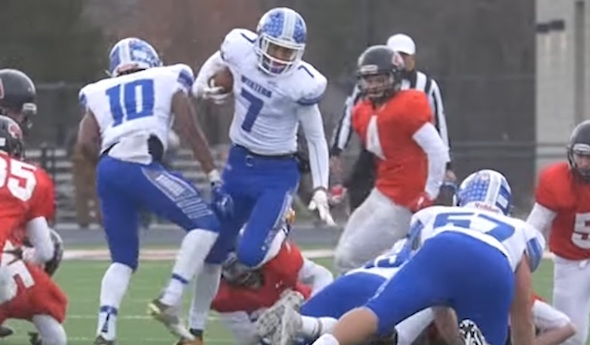
PHOTO: Walled Lake Western's Cody White breaks through the line against Lowell in their Division 2 Semifinal on Saturday. (Photo courtesy of State Champs! Sports Network.)