

Undefeated Cassopolis Continues to Climb
By
Wes Morgan
Special for MHSAA.com
October 5, 2017
By Wes Morgan
Special for Second Half
Getting to the postseason wasn’t the issue for the Cassopolis varsity football program, which is currently ranked No. 6 in the latest Associated Press Division 7 poll and has earned playoff berths 11 times since 2000.
 It was taking that next step.
Now in his fifth year guiding the program, head coach Dan Purlee, a Cassopolis graduate, former athlete and longtime assistant coach, helped push the school past that barrier. And 2016 was the program’s banner year.
The Rangers ripped through all their opponents last season except for a talented Buchanan squad in Week 5. Throughout their 8-1 run during the regular season, the Rangers were on the right side of a 365-130 scoring differential. They went on to outscore their first three playoff foes 141-49.
Cassopolis, which also boasted a 4-0 mark to win the Berrien-Cass-St. Joseph Conference Red championship, finished last year 11-2 with a 54-22 loss to Detroit Loyola in the Division 7 Semifinals.
Just a year earlier, Cassopolis recorded a 9-3 record in 2015, falling to Pewamo-Westphalia in the Regional round. The Rangers’ 48-14 victory against Bridgman that fall earned the program its first District championship.
“We’ve put together a few good years here,” said Purlee, whose team, led by six returning seniors, is 6-0 heading into Friday’s game against Southwest 10 Conference opponent Hartford. “We’re playing pretty good football, but you always feel like there’s room for improvement, and there is. But we like where we’re at this year, and we’re proud of our success and accomplishments over the previous few years.”
Purlee doesn’t easily accept the credit. He promptly shifted the focus to the student-athletes and his astute assistants, including Michigan High School Football Coaches Association Hall of Fame inductee Jim Myers, who has 42 years of coaching under his belt and previously was the head coach at Niles Brandywine. And there’s also Steve Green, who has been coaching alongside Purlee at Cassopolis the last 18 years.
“We’ve done it together,” Purlee said. “Your coaching buddies — it goes beyond coaching. They’re like your brothers.”
Cassopolis athletics director Matt Brawley had high praise for Purlee.
“He’s a professional,” Brawley said. “He’s extremely detailed and has a game plan for every situation. He’s very impressive to watch.”
Brawley also pointed out that, with a current team grade-point average of 3.40, a second consecutive academic all-state award is on the horizon.
Running the full house T formation offense, no one player has had to carry the load. Statistical information was only available through the Rangers’ first five games, but senior Brandon Anderson and junior Tyrese Hunt-Thompson had combined for nearly 500 rushing yards and 14 touchdowns. Senior quarterback Xander Smith had rushed for more than 250 yards with a couple passing touchdowns as well.
Junior Hunter Parsons had rushed for 266 yards through five contests, and quarterback Dylan Green has been responsible for four passing TDs. Keep in mind, most of the starters have watched the second half from the sideline most of the year with games well in hand.
 “We have the ability to run a little shotgun spread,” Purlee said. “We’re pretty diverse offensively. Teams were really loading up the box on us and we’re not traditionally very big up front, so we realized we were going to need to counter that with spreading the field a little bit.
“We’ve just had a stretch here where we’ve had some kids who are extremely athletic and can catch the ball and quarterbacks that can throw the ball. We can pound it up the middle and also spread you out.”
Defensively, freshman outside linebacker Ahsan Hart boasts 33 tackles and a pair of sacks, senior Kyjuan Lanier, a captain at middle linebacker, has 29 tackles, two sacks and two fumble recoveries; and junior defensive end Skyler McKee has recorded 28 tackles with two sacks.
“We’re all comfortable with each other,” Lanier, a three-year varsity player, said. “It’s trust. I feel like if I don’t make a play, I’ve got Hunter Parsons right next to me coming up to make the tackle. Our secondary likes to come up and make plays. Our lines are disciplined.
“When I was younger, it was more coming downhill, filling holes and blitzing. As I’ve gotten older, it is recognizing where the ball is going, watching linemen, seeing what they’re doing, watching a pulling guard … getting smarter rather than just running to the play.”
The Rangers, who have given up only 28 points all year, pin their ears back and keep the pressure on every snap.
“I think there are several factors,” Purlee said of his program’s building success. “We’ve had some really good players over the past few years, and we have some athletic and tough kids. When you have that, you can put together a pretty good football team. I feel like our coaches have done a great job in helping instill discipline. It’s a team that executes in all phases of the game. We work hard, and we’re well prepared. It’s a collaborative effort between good players, good coaches and the right type of kids.”
Instead of being content, having tasted this kind of success has only intensified the team’s appetite.
“They have been a committed group. They’re extremely focused,” Purlee added. “Obviously, we’re proud of what we’ve done the last two years, but we want to go further. We’re not going to limit our goals. The next step for us is to play in Ford Fieldhouse.
 Wes Morgan has reported for the Kalamazoo Gazette, ESPN and ESPNChicago.com, 247Sports and Blue & Gold Illustrated over the last 12 years and is the publisher of JoeInsider.com. He can be reached at [email protected] with story ideas for Berrien, Cass, St. Joseph and Branch counties.
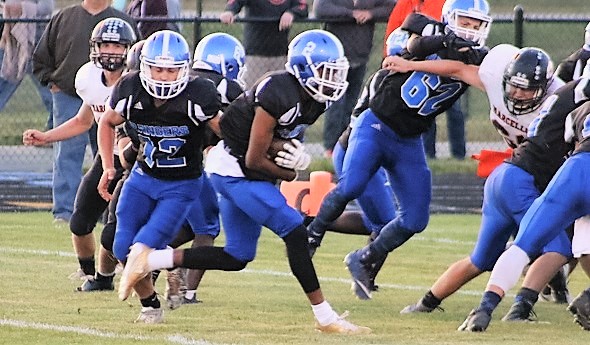
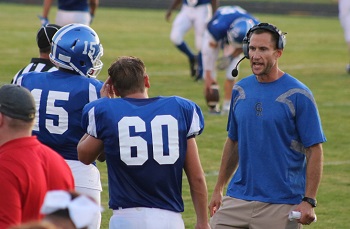
PHOTOS: (Top) Casspolis' Tyrese Hunt-Thompson (2) follows his blockers into the line against Marcellus last week. (Middle) Rangers coach Dan Purlee confers with one of his linemen on the sideline. (Photos by Billie Austin.)
Talking Practice: Texas, Illinois Revise Policies
December 20, 2013
By Rob Kaminski
MHSAA benchmarks editor
Coaches and players in Texas and Illinois adapted to new football practice limitations this fall, with the Texas policy focusing on contact, and the Illinois regulation emphasizing length of preseason practices.
Following are the main changes those states put in place heading into the 2013-14 season:
The University Interscholastic League, which governs school sports in Texas, put into writing that, “During the regular season and postseason, no football player is allowed to participate in more than ninety (90) minutes of full contact practice per week,” effective with the first day of practice this fall.
The complete policy follows:
For the purposes of the of rule, "full contact" is defined as football drills or live game simulations where "live action" occurs. Live action, as defined by USA Football, is contact at game speed where players execute full tackles at a competitive pace taking players to the ground. A team may continue to dress in full pads for practice, but may only participate in live action drills and game time simulations no more than ninety minutes per athlete per week. It is assumed that when players are in shells (shorts, shoulder pads, and helmets) no live action drills or simulations will occur. This rule is intended to limit live action drills and simulations and not the number of practices a team may participate in full pads. A team may participate in "air," "bags," "wrap," and "thud" drills and simulations at any point. These contact levels are defined below:
• Air - Players should run unopposed without bags or any opposition
• Bags - activity is executed against a bag, shield or pad to allow for a soft-contact surface, with or without the resistance of a teammate or coach standing behind the bag.
• Wrap - Drills run at full speed until contact, which is above the waist with the players remaining on their feet.
• Thud - Same as wrap but tempo is competitive with no pre-determined winner and the players are not tackling to the ground.
 The rule came to the UIL Legislative Council as a recommendation from the UIL Medical Advisory Committee, a permanent advisory committee to the Legislative Council which meets twice each year to discuss and review safety policies for UIL participants. The committee, which is made up of leading medical professionals in various specialties and includes representatives from the Texas High School Coaches Association, the Texas Girls Coaches Association, and the Texas State Athletic Trainer Association, unanimously recommended this limitation in full-contact football practice.
The rule formulates into a formal policy the existing actions of the majority of coaches across Texas, and most coaches have had to make few adjustments, if any. In fact, according to a story on statesman.com, the proposal caused more of an uproar on social media than from coaches.
“It’s not going to affect us in anyway,” Vandegrift HS coach Drew Sanders said in the story. “Most good coaches were way below that 90-minute amount already. Prior to legislation we still monitored it ourselves – the only change is now we have to keep up a log more publicly.”
Illinois put standards in place for its first 14 days of football practices, known as the state’s Preseason Football Acclimatization Practice Period. At the core of the policy is a three-hour practice limit for the first five days, during which teams can also conduct a one-hour walk-through.
 Teams must observe a minimum two hours rest between the practices and walk-throughs. Players may wear helmets only on the first two days, then helmets and shoulder pads for the next three. From days seven through 14 of the acclimatization period, schools may practice for a maximum of five hours per day, as long as that day is followed by a three-hour day, or an off day. During the five-hour days, no session can last more than three hours and must include a two-hour break between practices. Full pads may be worn for the final seven dates leading up to the first contest.
“This policy was the result of a collaborative effort between the IHSA Sports Medicine Advisory Committee and the Football Advisory Committee,” said SMAC committee member and University of Illinois Associate Professor of Orthopedic Surgery Dr. Preston M. Wolin. “The guidelines are based on the most recent scientific evidence, as well as the expertise of the coaches who will help implement them. Both committees believe the guidelines represent a significant positive contribution to the health of our athletes.”
“This new policy undoubtedly changes the way we, as coaches, approach preseason practice,” said Metamora HS coach Pat Ryan, who is a member of the FAC and a past President of the Illinois High School Football Coaches Association. “Coaches have to get more creative with when and how they schedule practices, as well what they do with their time. The proposals were strongly supported by both committees. It is a crucial final step to the process of being able to effectively prepare our teams in a safe manner. Change is always difficult, but the game is changing and we need to adapt to continue to put the safety of our players first.”
The IHSA offered multiple interactive online webinar meetings for high school coaches leading up to the start of practice where questions were answered, along with further clarifications on the policy and the science behind it.
“I think most coaches understood that changes were on the horizon,” said IHSA Executive Director Marty Hickman. “We wanted to be in a position to give our coaches as much information as possible to make sure they are comfortable with the new policy. Their input will be critical moving forward as we develop educational materials, like a best practices presentation. I commend our committees on a policy that is supported by medical experts, football coaches and school administrators.”