

Undefeated Contenders Make Claims as 1925 High School Football Champion
By
Ron Pesch
MHSAA historian
November 14, 2025
It was another football season without an official postseason, just as they all were prior to 1975 in Michigan.
Well – that’s not exactly true – but we will detail that story on another day.
In the Great Lakes State, the 1925 prep season – now 100 years ago - provides a beautiful illustration of the fun, fascination, and frustration in proclaiming gridiron championships in Michigan before the arrival of the MHSAA playoffs.
“The Roaring Twenties” – built in the age of prosperity that followed the end of World War I – were an age of excess, an era of more, and a time where anything seemed possible.
The Twenties are also known as the Golden Age of College Football, and excitement for the sport certainly trickled down to the high school level. The need or desire to open or break ground on impressively bigger and better stadiums hit schools around the nation. The 1925 season marked the opening of the University of Pittsburgh’s Pitt Stadium, with potential seating for 70,000. In Michigan, just upriver on Saginaw Bay in Bay City, the town’s Central High School unveiled a facility with a capacity of 7,100. That season marked the end of college careers for University of Illinois’ legend Harold “Red” Grange, Dartmouth’s Andy Oberlander, and Stanford’s Ernie Nevers. It was also the first varsity season at University of Michigan for Muskegon High School’s Bennie Oosterbaan, who became the school’s first three-time football All-American.
With a lack of lighted fields in Michigan, prep contests were mostly played on Saturdays, and the kickoff to seasons began around mid-September. Scheduled games generally ended in late November, with a few schools around the state closing their slate with a traditional Thanksgiving Day game.
Call it what you will – bragging rights, statewide acclaim, untethered validation, or an unsatisfied heart – but the regular season did not end the fascination and desire to name a state champion. While the state’s governing body did not sponsor championships, that did not stop cities, schools, the media, and the fan base from attempts to assign bragging rights to teams with unbeaten records. That was pretty much the case since the start of the prep game, dating back to 1888.
The era was often filled with “post season” challenges for games between teams to crystalize a claim on a championship. In general, they seldom came to fruition.
The MHSAA
The recently-created Michigan High School Athletic Association established three classes based on hard student enrollment numbers, with Class A – comprised of the state’s largest schools, each with a minimum of 500 students – Class B with between 175 and 499 enrolled, and Class C for schools with fewer than 175 pupils. Back then, the classifications were not segmented with an equal number of schools in each Class, as they are in today’s Division format. Rather, there were many more schools that fell into Class B and Class C than Class A. (Additional subdividing, adding Class D, and Class E, would come later).
Spurred on by fans and sportswriters, schools who wanted a share of the spotlight saw those classifications conveniently offering a means to segment claims on a state title. Acknowledging that they could seldom compete successfully against the larger schools in football, there was nothing to stop unbeaten teams from declaring themselves Class B or Class C gridiron champions.
The Fall of '25
Following the results of mid-November games across the state, just two prep teams in Michigan’s emerged as possible claimants to the title in Class A. Both Flint Central and Grand Rapids Union were unbeaten and untied. Flint would play Bay City Central at home on Saturday, Nov. 21, then square off for a Thanksgiving game with Ann Arbor in the university city.
Union would complete its regular season in a showdown with crosstown rival Grand Rapids South on Nov. 21. Unbeaten in 1924, South had shared that season’s mythical state title with Flint Central.
Just days before kickoff however, a third school emerged, making lots of noise.
 Port Huron Times-Herald reporter Ray Bouslog penned an article that appeared in the Tuesday, Nov. 17 edition.
“Comparing Port Huron with the other two undefeated teams, the locals appear to have just as good a record as their rivals,” he noted. Comparing scores of games among the three schools against common opponents, and opponent’s common opponents – a common practice among fans and sportswriters then and now – he felt the local school was among the state’s best regardless of class.
Two days later, in the same paper, Port Huron’s athletic director and head coach Melvin J. Myers, acknowledging they had two more games on their schedule, was quoted by Bouslog:
“Having gone through the schedule unbeaten, untied, and unscored on, we consider that we have as much a claim (on the state title) as either Grand Rapids Union or Flint Central. But unlike the situation in former years, when the teams were unable to agree on terms of the post season battle, we are willing to play either of these schools at home or away.”
It was a bold statement. Port Huron was classified as a Class B school by the MHSAA. Five of its eight wins had come against Class B or Class C competition. While its goal line had not been crossed, Port Huron had scored 151 points – an average of just under 19 per contest.
Port Huron also had scheduled a Turkey Day game with Richmond, a Class C opponent. Myers considered the contest “only a workout for the team,” with victory by a large margin expected. But Saturday’s contest was on the road against a University of Detroit High School squad – no pushover. Port Huron, of course, would fall out of the race with a defeat in either contest.
On Friday, the Flint Daily Journal, in an Extra edition, acknowledged the Myers’ challenge: “(T)he recognized leader in Class B having no blemish on her record ... Port Huron is willing to step out of her class (and) has hurled challenges at both Flint and Union, provided they are untied and unbeaten.”
Since Union did not have a scheduled Thanksgiving Day contest, Myers stated he was willing to reschedule the Richmond game and meet Union, in Grand Rapids, on the holiday. The move would set up a “playoff” for an undisputed championship.
Union coach John Truesdale responded in the Grand Rapids Press, stating “This is no time to talk such stuff. The proper time for serious entertainment of such ideas is after the South game is played. If we win Saturday we talk. If we lose, and that is not impossible, then we will be in a position to consider such things.”
 Union brushed off Coach Myers’ desire for a game on Thanksgiving. Truesdale indicated he was willing to listen to proposals from either Flint or Port Huron – not Thanksgiving Day – but on Saturday, Nov. 28, and no later.
Flint coach Charles Bassett was blunt with his response to the talk: “It is absolutely out of the question for Flint to even think of playing Union or any other team on Nov 28. We have a regularly scheduled game with Ann Arbor only two days before that time. It would be physically impossible for the boys to play two games in three days.”
Emphasizing that his two remaining games had been scheduled over a year ago, he stated, “Union knows our schedule and so does every other school in Michigan. I have no intention whatever of trying to change it. … If Union or Port Huron desire to play at some later date, after my boys have had a suitable rest, I shall be glad to listen to their proposals.”
Stage is Nearly Set
All three schools won their game on Saturday, Nov. 21. Rocky Parsaca nailed three out of four drop-kicks as Union topped South, 9-0, while Port Huron slipped past U of D High, 6-0, on a fourth-quarter TD by senior fullback Cecil Turner. Flint crushed Bay City Central, 32-0, to set the stage.
With that win, on the Wednesday before Thanksgiving, Bassett told the Journal, “If Central is successful against Ann Arbor tomorrow, we stand ready and willing to play either Port Huron or Grand Rapids Union for the undisputed state championship. This should settle all doubts as to our sincerity in believing we have the best team in the state. We are willing to test it on any neutral field.”
By then, however, negotiations for a three-way series involving Union had broken down and the news had reached the paper. In the same edition, it was noted that Union had packed up for the fall. Without a game on Thanksgiving or the Saturday following, Truesdale stated Union could not carry its squad for two full weeks without a game. On Monday, Nov. 24, the Press had announced that Union had closed out its football season and was now focused on basketball.
With that bit of news, the Flint paper stated, “It is probable that Flint and Port Huron will arrange a game for Saturday, Dec 5.”
Thanksgiving
Played on Ann Arbor’s high school field, located just three blocks from University of Michigan’s Ferry Field, Flint had its hands full, downing the hosts, 6-3, on a second-quarter touchdown by senior captain Lloyd Brazil, before 5,000 fans. A future star, and later head coach at the University of Detroit, Brazil intercepted an Ann Arbor pass during the closing minutes, capping a scoreless second half and sealing the win.
As expected, Port Huron trounced Richmond, 55-0.
Talk about a game with Flint to be played at Michigan State College at the new State stadium hit the papers. But discussions failed, and by the weekend, Port Huron and Flint Central also closed out their seasons.
With that, multiple schools laid claim to the crown proving, once again, football championships from the era are valid, but “mythical.”
Check back next week for a second installment on the 1925 football “championship” race.
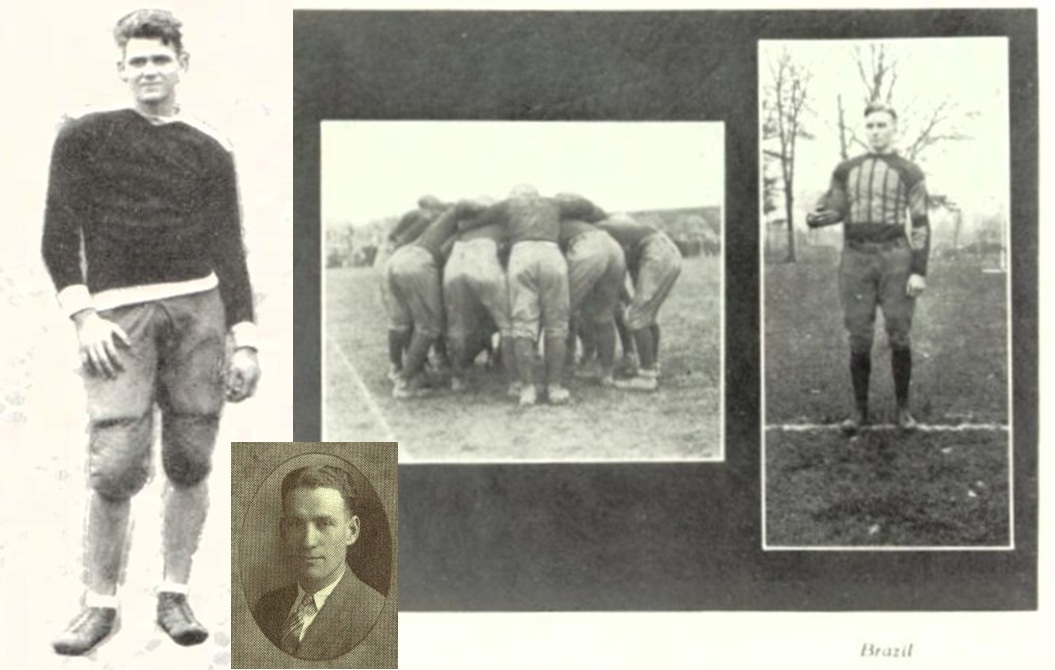
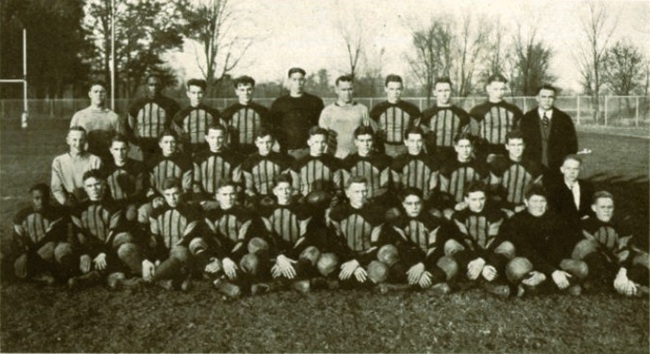
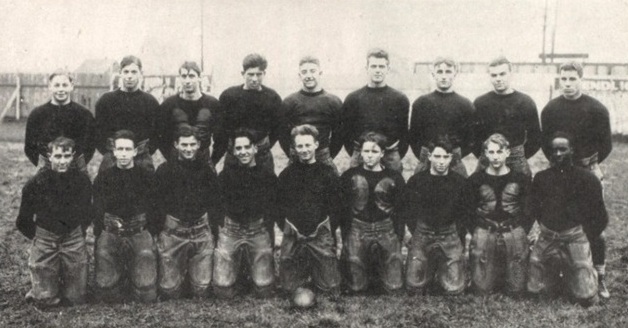
PHOTOS (Top) From left, Port Huron standout Cecil Turner, Grand Rapids Union football coach John Truesdale, Flint Central players huddling and Central’s Lloyd Brazil. (Middle) The 1925 Flint Central team. (Below) The 1925 Port Huron team. (Photos gathered by Ron Pesch.)
Drive for Detroit: Week 7 Preview
October 5, 2017
By Geoff Kimmerly
Second Half editor
Week 7 has a couple of contrasting meanings in the grand scheme of Michigan high school football.
 On one hand, we're drawing to a close of the regular season. On the other, we're just reaching the midpoint of the 14-week drive that carries us through the MHSAA Finals.
So here's where we sit. Fifty-one 11-player teams have qualified for the 11-player Playoffs. Another 94 are on the verge, needing one more victory. League titles will be decided all over Michigan again this weekend, and pairs of the best in all of the Upper Peninsula face off in both 11 and 8-player games.
Keep an eye on the statewide scene by following the MHSAA Score Center for scores as they come in tonight and Saturday, and check out MHSAA.tv for six live broadcasts – click here for the schedule. Drive for Detroit is powered by MI Student Aid.
Sidenote: With a win tonight against Oak Park (5-1) by his Hawks (4-2), Farmington Hills Harrison coach John Herrington would tie retired Birmingham Brother Rice coach Al Fracassa for the MHSAA record with 430 wins. Stay tuned.
Bay & Thumb
Frankenmuth (6-0) at Millington (6-0), Friday
This is the game, again, in the Tri-Valley Conference East as Frankenmuth has won 22 straight in the league dating to a loss to Millington in 2014. That season was the first of what is now four straight that these two have entered their annual meeting both undefeated. Coincidentally this time, both have scored 246 points this year, with Millington giving up 112 and Frankenmuth 102. And it gets closer still: In a projected Division 5 playoff field, Frankenmuth is third in playoff point average, with Millington next trailing by a mere 1.600. It’s fair to say a league title and possible home District Final are on the line.
Others that caught my eye: FRIDAY Flushing (5-1) at Fenton (6-0), Lapeer (5-1) at Davison (5-1), Ortonville Brandon (4-2) at Linden (5-1), Elkton-Pigeon-Bay Port Laker (5-1) at Unionville-Sebewaing (4-2).
Greater Detroit
Detroit Central (5-1) at Detroit Martin Luther King (5-1), Friday
Detroit Central is much smaller than even a decade ago when it had more than 1,000 students; the Trail Blazers played in the Division 6 playoffs last season. But they’ve got a chance to take a share of the Detroit Public School League Black division title from King, which has three times as many students these days and is the two-time reigning Division 2 champion. Both have talented offenses, but defense may reign; King has given up six points total over four league games, Central just 25. King is coming off a 27-6 win over previously-undefeated Denby, which handed Central its lone loss, 12-6, in Week 3.
Others that caught my eye: FRIDAY Ann Arbor Gabriel Richard (6-0) at Dearborn Divine Child (5-1), Warren Fitzgerald (5-1) at Madison Heights Madison (6-0), Clarkston Everest Collegiate (5-1) at Waterford Our Lady (4-1), Clarkston (5-1) at Rochester Adams (5-1).
Mid-Michigan
DeWitt (5-1) at Haslett (5-1), Friday
For the first time in a decade, one of this region’s most heated rivalries is relevant again, as the Capital Area Activities Conference Red title is on the line. That’s hardly all. Six of these teams’ first 11 meetings this century were decided by seven or fewer points; only two of the last 10 have been that close, and DeWitt has won 16 straight. But Haslett is 5-1 for the first time since 2007 and already has one more win than all of last season, and DeWitt moves to the CAAC Blue next fall – making this the most significant regular-season meeting these two might enjoy against each other for a while.
Others that caught my eye: FRIDAY Wyoming Godwin Heights (5-1) at Belding (5-1), Lansing Sexton (4-2) at Holt (3-3), Lake Fenton (5-1) at Corunna (3-3), Carrollton (5-1) at Alma (6-0).
Northern Lower Peninsula
Johannesburg-Lewiston (4-2) at Gaylord St. Mary (6-0), Friday
Despite a couple of nonleague losses, Johannesburg-Lewiston has bounced back nicely from last season’s 4-5 finish, which was its first below .500 since 2007. Although Harbor Springs could figure into the mix – both the Cardinals and St. Mary face the Rams over the final two weeks of the regular season – tonight’s matchup could go a long way in deciding the Northern Michigan Football Conference Legacy champ. St. Mary is enjoying that opportunity after starting 2016 5-0 and finishing it 1-4. But that one win was over Johannesburg-Lewiston and by 28 points, perhaps a bit of a confidence builder with these two now the main contenders.
Others that caught my eye: FRIDAY Elk Rapids (5-1) at Grayling (4-2), Beal City (4-2) at McBain (5-1), Hillman (3-3) at Oscoda (4-2), Cheboygan (3-3) at Traverse City St. Francis (6-0).
Southeast & Border
Hudson (6-0) at Ida (5-1), Friday
The Tigers are looking to run through the Lenawee County Athletic Association schedule undefeated for the fifth time in nine seasons, but 2015 league champion Ida is standing in the way after both teams also shared last season’s title – Ida fell to Hudson by a point (and Hudson fell to Hillsdale). After a pair of impressive nonleague wins, the Tigers have won every LCAA game so far by at least 22. The Bluestreaks took an eight-point loss to Brooklyn Columbia Central two weeks ago and surely won’t mind sharing the title again as a result of handing Hudson its first defeat tonight.
Others that caught my eye: FRIDAY Ann Arbor Pioneer (3-3) at Saline (5-1), Athens (5-1) at Pittsford (5-1), Parma Western (4-2) at Jackson Lumen Christi (5-1), Grass Lake (4-2) at Addison (5-1).
Southwest Corridor
Edwardsburg (6-0) at Three Rivers (5-1), Friday
Edwardsburg’s 34-game Wolverine B Conference winning streak just keeps growing, but a few challengers are lined up. Three Rivers fell to the Eddies 38-0 just a year ago, but already has avenged its other 2016 league loss this season, flipping a 29-point defeat to Plainwell into a 20-point win on opening night. Granted, the Wildcats followed that with a 14-point loss to Dowagiac, which fell to the Eddies by eight two weeks later in giving them their first significant league challenge in two years. But if nothing else, this should be closer than a year ago – and Vicksburg (5-1) will be waiting for Edwardsburg in Week 8.
Others that caught my eye: FRIDAY Coldwater (4-2) at Battle Creek Harper Creek (6-0), Schoolcraft (5-1) at Coloma (4-2), Cassopolis (6-0) at Hartford (5-1), Decatur (4-2) at Mendon (6-0).
Upper Peninsula
Gladstone (6-0) at Escanaba (5-1), Friday
It’s an interesting coincidence that the season these two are considered arguably the best teams in the Upper Peninsula is also the first time they aren’t in the same league since the mid-1980s, but that hardly lessens the significance of this matchup. The Eskymos are laying claim to the top spot after doubling up annual top U.P. team Menominee last week. Gladstone is staring down its best season since at least 2008 – and it can only get better with this opportunity against its old Great Northern Conference foe.
Others that caught my eye: FIRDAY Newberry (3-2) at Norway (6-0), Calumet (3-3) at L'Anse (4-2), Charlevoix (2-4) at Munising (3-3), Bark River-Harris (3-3) at Bessemer Gogebic (2-4).
West Michigan
Rockford (4-2) at Holland West Ottawa (5-1)
Pick a league, any league, on the west side and it seems like there is a game that will determine a league champion either this week or eventually. These are the best from the elite Ottawa-Kent Conference Red; Rockford is 3-0 in the league and West Ottawa is 4-0. The Panthers especially have to be thinking historically; they haven’t beaten the Rams since 2002. But West Ottawa also has more wins this fall than the last two seasons combined and has yet to give up more than seven points in a league game – an impressive enough feat to make this look like a much closer matchup than last year’s 51-14 Rockford win.
Others that caught my eye: FRIDAY Lowell (4-2) at Grand Rapids Forest Hills Central (6-0), Comstock Park (4-2) at Grand Rapids Catholic Central (6-0), Wyoming Kelloggsville (6-0) at Grand Rapids NorthPointe Christian (5-1), Muskegon Oakridge (5-1) at Montague (6-0).
8-Player
Stephenson (6-0) at Rapid River (6-0)
Similar to Powers North Central and Crystal Falls Forest Park in 2016, these two have an argument that they are the best in all of 8-player football even as relative neighbors. But only one (most likely) will finish as champion of the Western Eight Conference – although at this point, both could have a chance to finish as MHSAA champions as they project to play in different playoff divisions. Stephenson has two straight wins over the Rockets and hasn’t allowed an opponent closer than 24 points this season. Rapid River certainly has more experience in close games – with three wins by eight or fewer – and that could pay off.
Others that caught my eye: FRIDAY Engadine (4-2) at Cedarville (6-0), Marion (5-1) at Manistee Catholic Central (2-3), Kingston (4-2) at Morrice (6-0), Pickford (6-0) at Onaway (3-3).
Second Half’s weekly “Drive for Detroit” previews are powered by MI Student Aid, a part of the Student Financial Services Bureau located within the Michigan Department of Treasury. MI Student Aid encourages students to pursue postsecondary education by providing access to student financial resources and information, including various student financial assistance programs to help make college more affordable for Michigan students. MI Student Aid administers the state’s 529 savings programs (MET/MESP) and eight additional aid programs within its Student Scholarships and Grants division. Click for more information and connect with MI Student Aid on Facebook and Twitter @mistudentaid.
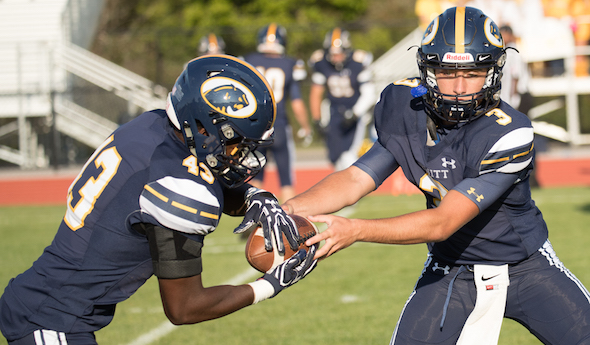
PHOTO: DeWitt, here against Grand Ledge in Week 2, will try to win its 17th straight over rival Haslett. (Click for more from HighSchoolSportsScene.com.)