


'Unknown' Suits Whitmore Lake Well
October 11, 2019
By Doug Donnelly
Special for Second Half
WHITMORE LAKE – The move to a new athletic conference has put some renewed energy into the Whitmore Lake football team and has the Trojans thinking playoffs for the first time in years.
 Whitmore Lake, a Class C school on the northern edge of Washtenaw County, moved to the Michigan Independent Athletic Conference this season after 46 years in the Tri-County Conference. It was a big move for the school, which hoped to inject some enthusiasm into its student-athletes, including a football program that was lagging in numbers and had made the playoffs just once during the last decade.
“I feel pretty good about the buzz and excitement that is going on,” said fourth-year Whitmore Lake head coach Brian Boron. “There’s definitely a resurgence with a lot of new things.”
Four-year starting offensive tackle Alex Williams noticed the change soon after Whitmore Lake announced the move from the TCC to the MIAC after last football season.
“I feel like interest in football picked up a lot more,” said Williams. “Being a captain, you see it in school. The eighth graders will come up to you and talk about football. We had more people in our weight room all winter. The culture has definitely changed.”
The first year in a new conference has brought all sorts of new experiences to the football team, both for players, coaches and fans.
“Do we miss the TCC? Absolutely. We were one of the founding teams,” Boron said. “We miss being part of that history and tradition.
“From a win-loss standpoint, things are going well. But this year I also have 12 seniors on the team, by far the most of any team I’ve had in my four years here. Are we competitive more because of that, or because of the new league? I don’t know.”
Whitmore Lake beat Auburn Hills Oakland Christian 62-33 last Friday to improve to 4-2 on the season. Its only losses were nonleague games to undefeated and state-ranked Royal Oak Shrine Catholic and Ann Arbor Father Gabriel Richard. Against Shrine, the Trojans fumbled three times; and against Richard, Whitmore Lake thought it had tied the game late in the contest, but a 2-point conversion was called back and the Trojans didn’t convert on the next attempt.
Several teams on Whitmore Lake’s schedule are first-time opponents, including Sterling Heights Parkway Christian, Auburn Hills Oakland Christian and Friday’s opponent, Southfield Christian.
Senior running back Evan Romeo, a 1,000-yard rusher as a sophomore, is enjoying a big senior season as well.
“Evan is having a great year,” Boron said. “Last year he missed five games with a hamstring pull.”
Logan Kurth, Cole Henning and Evan Vaughn are other backfield mates, and the quarterback is Zach Brady.
“He doesn’t get a lot of credit, but he’s the architect of the whole thing,” Boron said of Brady. “He makes it go. Every game we have a referee or member of the chain gang come tell us that they can’t find the ball because Zach is doing such a great job with his fakes.”
Whitmore Lake’s biggest win this season came against Oakland Christian, which came into the game 4-1. The Trojans appear to be on a league title-deciding collision course with Week 9 opponent Livonia Clarenceville, also undefeated in the MIAC. Whitmore Lake’s last league championship in football came in 2002.
“In this league, we are playing against teams with 18 or 19 kids on the varsity, just like us,” Boron said. “When I took the program over, we had maybe 17 kids in the entire program. They aren’t great numbers, but now we are closer to 30. I’m hoping to add more.”
In making the move last fall, Whitmore Lake Superintendent Tom DeKeyser said it had become apparent that, at least in some sports, the Trojans were not competing at the same level as other TCC schools.
“We have built a lot of great relationships in the TCC,” DeKeyser said. “But our coaches and athletes are excited to try something different.”
Everyone in Trojans camp hopes that “different” translates into more student-athletes.
“We had 10 or 12 freshmen come out this year, some who had never played football before,” Boron said. “That’s been a good thing. We’re not sure about next year, how many kids we’ll get up from our youth program. We’ll have to see. The team having success, I believe, will help that.”
One thing Boron has found is that the move is demanding on the coaching staff, which has a whole new set of opponents for which to prepare. It used to be one or two new teams would join the schedule. This year, nearly all of the Trojans’ opponents are new.
“No other team in our league runs the ‘T’ which means we don’t see how anyone is going to defend it on film,” Boron said. “We kind of rep everything because we don’t know how they are going to line up against us. We’re still getting a feel for these other teams. It’s fun. As coaches, we watch a lot of film. We have to be able to adjust and be ready for just about anything.”
The Trojans already have scored more points than any team it has fielded since 2008, which is the last time Whitmore Lake finished with a winning record. The 2013 team made the playoffs but finished 5-5 after a first-round loss. That 2008 season capped the greatest football era in school history, when Whitmore Lake made the playoffs seven times during an eight-year span.
Boron isn’t making predictions for Whitmore Lake’s future just yet. There are still a lot of unknowns.
“Everybody is still trying to figure things out,” he said. “We will sometimes get to a school a half-hour or 45 minutes early because we are unsure of the traffic patterns still. Teams get to our school way early some weeks for the same reason.
“I think it’s a good thing for the future of football at Whitmore Lake. The unknown is exciting.”
 Doug Donnelly has served as a sports and news reporter and city editor over 25 years, writing for the Daily Chief-Union in Upper Sandusky, Ohio from 1992-1995, the Monroe Evening News from 1995-2012 and the Adrian Daily Telegram since 2013. He's also written a book on high school basketball in Monroe County and compiles record books for various schools in southeast Michigan. E-mail him at [email protected] with story ideas for Jackson, Washtenaw, Hillsdale, Lenawee and Monroe counties.
PHOTO: Whitmore Lake now-senior running back Evan Romeo breaks into the open. (Photo courtesy of the Whitmore Lake football program.)
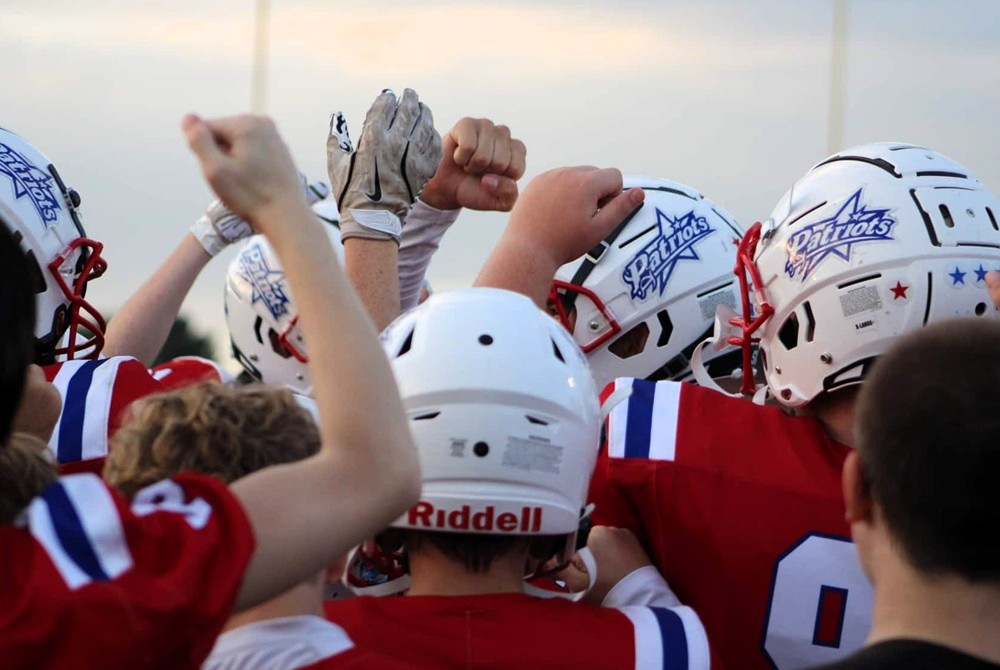
Heston Football Celebrates 1st League Title as Seniors Cap Extraordinary Rise
By
Tom Spencer
Special for MHSAA.com
November 5, 2025
St. Helen Charlton Heston Academy finished this football season with a five-game winning streak and in possession of a trophy representing the school’s first North Star League Big Dipper championship in any sport.
 The feat is especially incredible considering where the Patriots’ football program stood just four years ago.
Those Patriots welcomed a new assistant coach who would soon take over the program, but also five freshmen – Dylan Chichowski, Owen Romancky, Corbin Greenless, Desyln Klumpp and Tiernan Hinmon – in the starting lineup.
“If you rewind the clock, and go back to, like 2022, we went four straight games without even scoring a point,” said third-year head coach Matt Whelchel, who joined the staff that fall. “So to come from that and fast forward to this year, those (five) have been assistant coaches almost to me. They've really led this program to where it is right now.”
Those five seniors were part of a team than snapped a 43-game program losing streak as sophomores. They then led the Patriots to a 4-5 finish last year and 6-2 overall record this fall – with an undefeated run through league play. Heston was not eligible for the MHSAA Playoffs in 8-player because its enrollment exceeds the 215-student maximum to compete in the postseason. But Whelchel noted that the school remains ecstatic about what the team accomplished.
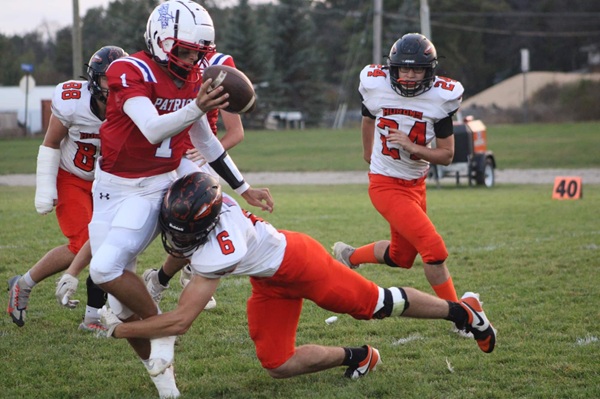 Before turning the program around last year, the Patriots found wearing jerseys to school on game days more than a little difficult.
“We would not get made fun of, but when we talked about having a football game or had our jerseys on and we were in that losing situation, it wasn't a very prideful thing,” noted Klumpp, the team’s kicker, running back and receiver. “You're wearing a football jersey, and everyone else thinks that you're just a joke because we never win.
“And being able to turn that around, people, you know, just mentioning how fun the football games have been to watch. It's also been something we had to fight through.”
Klumpp, Greenless, Romancky and Chichowski also experienced a winless season as eighth-graders as Whelchel served the school as the middle school head coach and varsity assistant. Whelchel took over the varsity program in 2023.
The players credit Whelchel with instilling an offseason work ethic. The focus on studying film, spending time in the weight room and dedication to maintaining mental and physical health were also among keys to the Patriots’ turnaround.
“Our senior class had it extra hard starting out from middle school,” said Romancky, who played on both the offensive and defensive lines. “I think after our freshman year, once we lost every game, the drive to win the first one just became very apparent and we really took that step forward.”
Whelchel is quick to point out the school had had a good deal of talent over its 11 years of football history. Dedication, though, is at an all-time high for the Patriots.
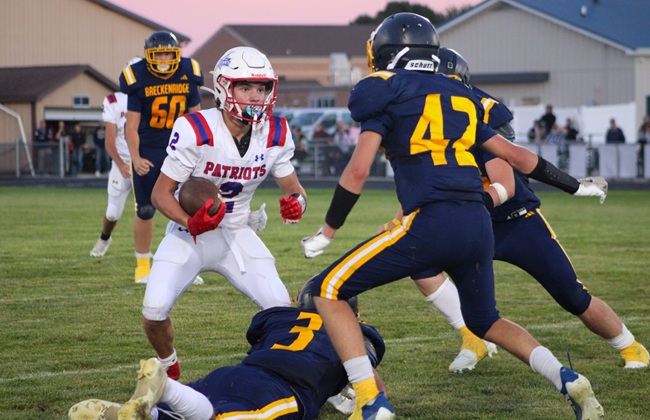 “I have no doubts in my mind that we had players in the past that wanted to win, but you've got to have more than that,” said Whelchel, who also serves as an elementary physical education teacher. “We had talent sometimes – we just didn't have the drive. You've got to have more than the will to win. You got to spend time in the weight room and keep grades up – and it takes a lot of dedication.”
Whelchel also credits his coaching staff for much of the Patriots’ success. The assistant coaches are Jory Klumpp, Graham Church, Liam McKeage and Nathaniel Snyder.
Heston always has found community support for football, but things are a little different nowadays. The varsity players are often asked for autographs from youth football kids.
“The community has always had our back — even last year, coming into some of our home games without a winning season — we always had our stands full and stuff,” said Chichowski, the team’s quarterback. “And this year, as I work out of school during the day, everybody who comes in is asking about the game, when it starts, and just telling us that they're going to be there and stuff. It's awesome.”
Chichowski racked up 1,076 passing yards and threw 12 touchdown passes. He also had four rushing TDs and 308 yards rushing for 1,384 total offensive yards. He was named to the Big Dipper’s all-conference team, as was Klumpp, Romancky, Tiernan Hinmon and Corbin Greenless.
Greenless, a senior lineman, led team in tackles with 114 plus six sacks. He added defensive touchdowns via a blocked punt and an interception.
Hinmon, also a senior, led the team in touchdowns scored with 18. Twelve were on the ground, where he compiled 780 rushing yards. He also came through with a pick six against Au Gres-Sims in the fourth quarter of Heston’s 43-6 season-concluding victory.
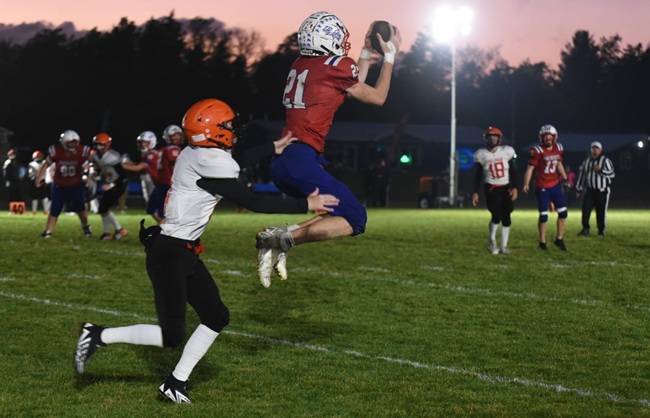 Romancky, who also had interception return touchdowns against Hillman and Whittemore-Prescott, admitted losing wore on the Patriots.
“I think all the losing left a bad taste in the mouth, and we just wanted to like clear it out and get that winning feeling,” he said. “All the losses that piled up fueled the drive to win.”
The Patriots had eight seniors this fall, but Whelchel is not at all thinking about a rebuilding year in 2026.
“We're going to lose a lot of talent for sure. But we had some really talented sophomores this year, and the only reason they didn't see the field a lot is because we had a lot of those guys playing ahead of them,” Whelchel said. “The seniors obviously had talent on the field, but they're leaders off the field too. And so they've set an example for next year’s seniors and juniors. I think we'll pick up – maybe not exactly where we left off – it might take some growing pains.”
Hinmon believes these seniors have paved the way for future Patriots football players to keep the winning tradition alive.
“Everybody used to call us the pity-party Patriots,” Hinmon indicated. “They never thought we were good, and now this season, we really proved ourselves. We worked hard. I think our next season, the younger ones are going to have a great season.”
“I think it's a thing of standards,” Klumpp added. “It just sets at the bar even higher for everyone else that's going to go through this program.”
 Tom Spencer is a longtime MHSAA-registered basketball and soccer official, and former softball and baseball official, and he also has coached in the northern Lower Peninsula area. He previously has written for the Saginaw News, Bay County Sports Page and Midland Daily News. He can be reached at [email protected] with story ideas for Manistee, Wexford, Missaukee, Roscommon, Ogemaw, Iosco, Alcona, Oscoda, Crawford, Kalkaska, Grand Traverse, Benzie, Leelanau, Antrim, Otsego, Montmorency, Alpena, Presque Isle, Cheboygan, Charlevoix and Emmet counties.
PHOTOS (Top) St. Helen Charlton Heston players huddle on a game day this season. (2) Patriots quarterback Dylan Chichowski works to elude a Rogers City defender. (3) Owen Romancky (21) leaps to haul in a pass against Hillman. (4) Tiernan Hinmon sets up to make his move while carrying the ball against Breckenridge. (Owen Romancky photo by Ashley Patti/Houghton Lake Resorter. All other photos submitted by Jessica Romancky.)