

VanderVelde Officiating Tree Branches Into 2nd Generation, Top-Tier College Football
By
Steve Vedder
Special for MHSAA.com
February 28, 2025
Mike VanderVelde always knew the apple wasn't going to fall far from the tree.
The longtime West Michigan football and basketball official correctly guessed that his son, Michael, who had accompanied his father to countless Friday night football games before he was even out of elementary school, would eventually pick up the family mantle of officiating. VanderVelde said he saw in his young son many of the key attributes an official must possess: a keen eye for details, an overwhelming desire to improve, patience and a love of sports.
Put it all together, and VanderVelde has seen his son evolve into one of the nation's top NCAA football officials.
"I think it was just like with any kid, he liked the competition," said Mike VanderVelde, who retired three years ago at the age of 78 after officiating in the Grand Rapids area for 61. "I guess it would be crazy to say now, but even then there was something about Michael that was going to make him a good official. It wasn't (following) me."
Michael, a Grandville High School and Hope College graduate, has gone from working middle school football games to make extra money in college to officiating eight college bowl games, including this year's Sugar Bowl national quarterfinal Jan. 2 in New Orleans and the semifinal Jan. 9 at the Orange Bowl in Miami. VanderVelde's first bowl game was the 2017 Bahamas Bowl, and he also officiated the 2024 Rose Bowl, the national semifinal between eventual champion Michigan and Alabama.
 Before reaching those heights, Michael said some of his earliest sporting moments came when he was a ball boy jogging along the sideline while his father was working on the field. VanderVelde figures he was barely 8 years old, but he remembers being taught by his father to pay attention to detail. He also considers his father a major influence in his decision to pursue football officiating at the highest level.
"I'd buy that, absolutely. I loved spending time with my dad on Friday nights. That was definitely a common bonding time,” Michael VanderVelde said. “I'd see the smile on his face and see his passion for football. I'd see subtle little hints, and I'd pick up on that. The seed was definitely planted.”
Even as a youngster who was yet to see middle school, Michael said he understood the necessity of being where he was supposed to be as a ball boy. It was one of his first lessons in accepting responsibility and that actions had consequences.
"I would hand the ball to the umpire and pay attention to the game, and do what they needed me to do," he said. "And then I'd hang out with the crew after the games. Just being around the game and watching and being close to it, I loved it."
Both VanderVeldes entered officiating on the ground floor. Mike began doing YMCA fifth and sixth grade and church league basketball games at Grand Rapids' Franklin Park during the 1950s. He eventually graduated to working about 75 high school football and basketball games a year along with officiating Great Lakes Intercollegiate Athletic Conference and Michigan Intercollegiate Athletic Association football games. VanderVelde also coached football, tennis and junior high basketball at Wyoming Kelloggsville High School for 30 years.
"I've always been involved with athletics; I've really enjoyed it," Mike said. "I always thought of (officiating) as a challenge. I wanted to see what I could do. It intrigued me, trying something new. It just clicked with me, and I kept going and I never really stopped."
The younger VanderVelde also started at the youngest levels, officiating fourth through sixth-grade football games before he graduated from high school in 2003. Then to make extra money while in college, VanderVelde took on freshman, junior varsity and his first varsity football game at Saranac. He eventually worked high school basketball games before moving to Colorado and doing Southland Conference games for three years beginning in 2013. VanderVelde went on to work for three years in the Mountain West Conference and now officiates Big 12 games while living in Louisiana.
While many fans often fail to grasp the pressures an official faces while working major college football bowl games, VanderVelde said he's thrilled to reach that elite level of officiating.
 "It's a blast," he said. "To be there with other officials and doing things like working with the replays, getting the calls correct, 11 on 11 football and being on the biggest stage, I love it."
As for the recently completed college season, VanderVelde was honored that the NCAA – in a rare break from tradition – chose his crew to work back-to-back Notre Dame games in the Sugar and Rose Bowls. The NCAA typically will not assign the same crew to the same team two weeks in a row. It was an extraordinary gesture signaling the high esteem in which the crew is held, not only by the NCAA but with the blessing of all teams involved.
"It's tough to work back-to-back games like that, but I think the crew did an excellent job," he said. "There was no controversy, and I think we felt comfortable being assigned those games."
Considering his officiating success, VanderVelde said there is one step yet to take, one more hurdle to leap: the NFL. VanderVelde. who works United Football League games in the spring, has been part of the league's Mackie Development Program for the last two years. He's already worked Hula Bowl games and would gladly consider moving along to working on Sundays.
"I'd love to have that opportunity if it was ever presented to me," he said. "It'd be cool, but there are no guarantees. You know that snap by snap, you're only as good as your last game. But it's something I'd like to do some day.
"In football all you can do is look at your next assignment and try to do it well. It's exciting, but you're always trying to go on to the next game without a hitch."
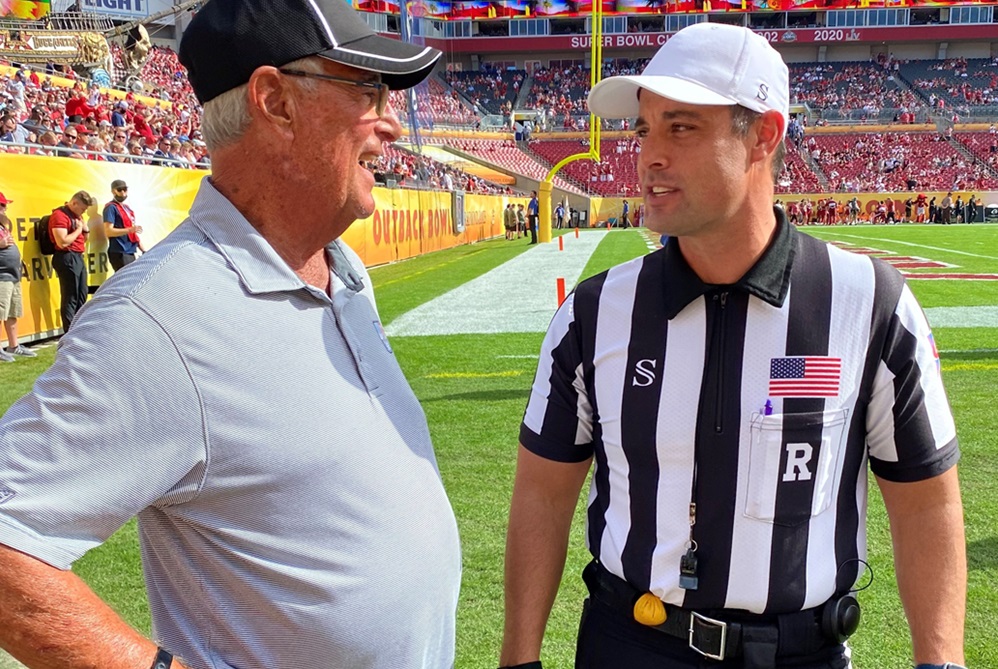
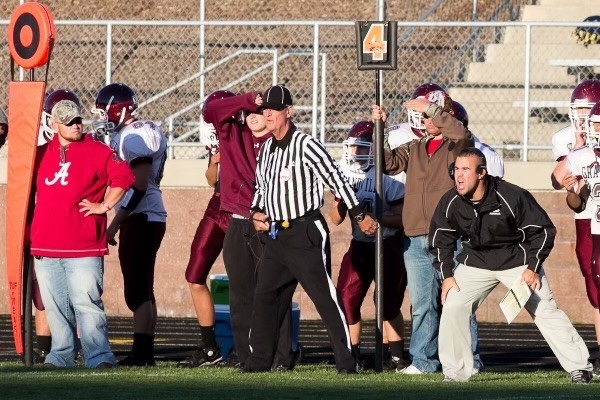
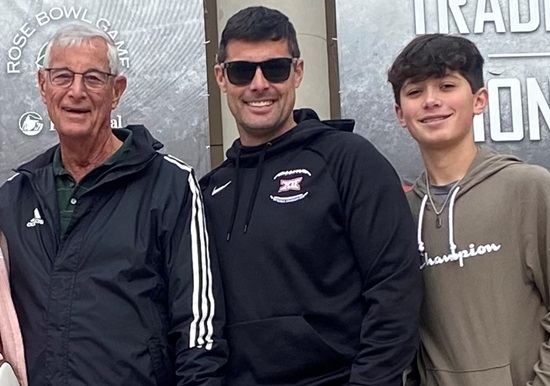
PHOTOS (Top) Longtime MHSAA official Mike VanderVelde, left, and son Michael share a moment during Michael’s officiating assignment at the 2021 Outback Bowl in Tampa Bay, Fla. (Middle) Mike VanderVelde officiates a Grandville High school game. (Below) From left: Mike VanderVelde, Michael VanderVelde, and Michael’s son Hayden. (Photos provided by the VanderVelde family.)
1st & Goal: 2024 Week 1 Preview
By
Geoff Kimmerly
MHSAA.com senior editor
August 29, 2024
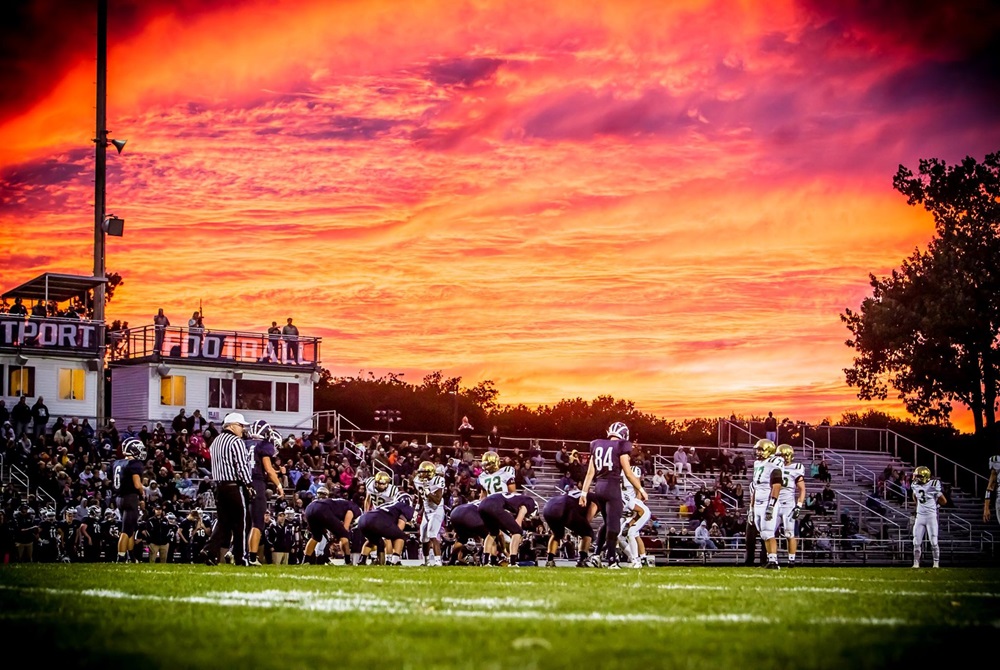
The captivating West Michigan sunset seen through the camera lens above is characteristic of the first few weeks of Michigan high school football season, when games begin in daylight before “Friday Night Lights” bring a later-night glow to communities all over both peninsulas.
 That enchantment returns this weekend with 249 season openers tonight, 58 more Friday and one Saturday for the 603 varsity football teams set to play in our state this season.
More than 225 of those varsity games are scheduled to be broadcast this weekend on MHSAA.tv, including all four being played at Wayne State as part of the Xenith Prep Kickoff Classic and all four of the Vehicle City Gridiron Classic being played at Grand Blanc High School today or Kettering University on Friday. Click the names of the events for specific broadcast landing pages for those showcases.
As you’ll find at the start of every football weekend, below are glances at several matchups across the state that are most intriguing. All games are tonight unless noted, and follow the MHSAA Scores page all weekend for scores as they’re submitted.
Bay & Thumb
Goodrich (11-2) at Frankenmuth (11-2) WATCH
This is a rematch of last season’s 14-8 Goodrich win, clinched on a score with 18 seconds to play. It was Frankenmuth’s only loss until the Division 5 Semifinals, and the Martians went on to make the Semifinals in Division 4. Big things are expected of both again, as both are ranked No. 3 in their respective divisions in preseason polls by the Michigan High School Football Coaches Association.
Keep an eye on these THURSDAY Harbor Beach (9-2) at Cass City (8-3) WATCH, Ogemaw Heights (9-2) at Ubly (14-0) WATCH, Muskegon Mona Shores (7-4) vs. Grand Blanc (6-5) WATCH, Almont (12-2) at Marysville (8-3).
Greater Detroit
Warren De La Salle Collegiate (11-3) vs. Davison (12-1) at Wayne State WATCH
This is another rematch from a year ago and the premier clash at the Xenith Prep Kickoff Classic. Last time, Davison trailed 14-0 at halftime before winning 31-26 – and the Cardinals weren’t stopped until the Division 1 Semifinals. De La Salle bounced back to take its season even farther, finishing at Ford Field for the fourth straight and this time as Division 2 runner-up. The Pilots are the favorites in the MHSFCA Division 2 poll, and Davison is ranked No. 5 in Division 1.
Keep an eye on these THURSDAY Clinton Township Chippewa Valley (9-3) at West Bloomfield (10-3) WATCH. FRIDAY Belleville (13-1) vs. Clarkston (6-6) at Wayne State WATCH, Redford Union (7-3) at Harper Woods (11-3), Dexter (7-4) at Livonia Franklin (6-4) WATCH.
Mid-Michigan
North Muskegon (12-1) at Pewamo-Westphalia (10-2) WATCH
North Muskegon set the tone for its winningest season all-time last fall with a 17-14 win over the Pirates in the opener, and the Norsemen set the record with a 28-27 victory over P-W in a Division 7 Regional Final rematch before ending their run the next week. Those, of course, were the Pirates’ only losses of 2023, and they enter this fall No. 3 in Division 7 while North Muskegon is unranked.
Keep an eye on these THURSDAY Portage Central (8-2) at East Lansing (10-3) WATCH, Hudson (8-3) at Fowler (8-2), Lansing Sexton (8-2) at Lansing Everett (5-5) WATCH, DeWitt (7-3) at Haslett (8-4).
Northern Lower Peninsula
Reed City (9-4) at Kingsley (12-2)
Kingsley started its 2023 season with a 46-12 win over Reed City and ended the fall as Division 6 champion – a week after defeating Reed City again in a Semifinal 37-7. That alone should have the Coyotes revved for a big start this time, and after also closing last year with eight wins over their last nine games. Kingsley is ranked No. 2 and Reed City No. 8 heading into this meeting.
Keep an eye on these THURSDAY Gaylord (11-1) at Traverse City West (4-5) WATCH, Manistee (8-3) at Kalkaska (4-5). FRIDAY Elk Rapids (4-5) at Benzie Central (5-5), Charlevoix (9-2) at Traverse City St. Francis (4-5) WATCH.
Southeast & Border
Gibraltar Carlson (10-2) at Carleton Airport (10-2)
After losing to Airport 31-10 in their season opener a year ago, Carlson went on to win its next 10 games and set a program record for victories to go with league and District titles. Airport’s finish, meanwhile, was its best since 2003 and included a District title as well. The winner tonight could attract some attention quickly; both enter this fall unranked by the MHSFCA.
Keep an eye on these THURSDAY Adrian (6-4) at Ann Arbor Pioneer (6-4) WATCH, Monroe St. Mary Catholic Central (6-5) at Clinton (10-2), Michigan Center (7-3) at Jackson Lumen Christi (13-1), Brighton (5-5) at Saline (9-2) WATCH.
Southwest Corridor
Niles (10-2) at St. Joseph (6-4), Friday WATCH
The Vikings’ 55-0 win over St. Joseph to begin last season set the pace for a record-setting run as well as they reached double-digit wins for the first time – and with their lone losses of 2023 by a combined eight points. Niles enters this season No. 6 in Division 4, but the unranked Bears no doubt would love to spoil things after rebounding from last year’s defeat to extend their playoff streak to nine straight seasons.
Keep an eye on these THURSDAY Battle Creek Harper Creek (6-4) at Battle Creek Lakeview (3-6) WATCH, Saugatuck (8-3) at Buchanan (7-4) WATCH, Union City (6-4) at Centreville (5-5) WATCH, Berrien Springs (6-4) at Kalamazoo Hackett Catholic Prep (5-5).
Upper Peninsula
Gladstone (9-3) at Marquette (5-4)
These longtime past Great Northern Conference foes went their separate ways again a year ago, but met for a nonconference opener won by Gladstone 36-7 – and that gave Gladstone back-to-back wins in the near-annual series for the first time since 2008 and 2009. Although neither is ranked at the start of this season, both always are expected to be near the top in the Upper Peninsula.
Keep an eye on these THURSDAY Ishpeming Westwood (1-8) at Bark River-Harris (5-4) WATCH, Escanaba (2-7) at Kingsford (10-2) WATCH, Iron Mountain (11-1) at Houghton (3-6). FRIDAY Marinette, Wis. (3-6) at Menominee (11-3).
West Michigan
Detroit Cass Tech (7-4) at Rockford (11-1) WATCH
This is another of the most anticipated matchups statewide this week, and this is the first time these teams will meet despite both being Division I championship contenders most of the last two decades. Rockford is ranked No. 2 in Division 1 after suffering its only loss last season against Davison in a Regional Final. Cass Tech is ranked No. 4 after ending last year’s run with a District Final loss to eventual champion Southfield Arts & Technology.
Keep an eye on these THURSDAY Paw Paw (9-2) at Big Rapids (10-2) WATCH, East Grand Rapids (7-3) at Lowell (6-4) WATCH, Muskegon Reeths-Puffer (7-3) at Grand Rapids Forest Hills Central (13-1). FRIDAY Zeeland West (9-4) at Muskegon (12-2).
8-Player
Au Gres-Sims (7-3) at Alcona (8-2) WATCH
Alcona ended a two-game losing streak against the Wolverines last season while in the midst of a perfect run to the North Star League Big Dipper title. On the other sideline, that 42-12 loss was Au Gres-Sims’ first of the fall and started a 1-3 run to close the Wolverines’ season as they finished second in the NSL Little Dipper. They remain in different divisions and could both emerge as league champions over the next two months.
Keep an eye on these THURSDAY Gobles (8-3) at Colon (4-5), Gaylord St. Mary (6-3) at Rudyard (6-4), Climax-Scotts (10-1) at Grand Rapids NorthPointe Christian (6-3). FRIDAY Crystal Falls Forest Park (7-3) at Newberry (7-3).
MHSAA.com's weekly “1st & Goal” previews and reviews are powered by MI Student Aid, a division within the Department of Lifelong Education, Advancement, and Potential (MiLEAP). MI Student Aid encourages students to pursue postsecondary education by providing access to student financial resources and information. MI Student Aid administers the state’s scholarship and grant programs that help make college Accessible, Affordable and Attainable for you. Click to connect with MI Student Aid and find more information on Facebook and Twitter @mistudentaid.
(PHOTO by Tim Reilly.)