

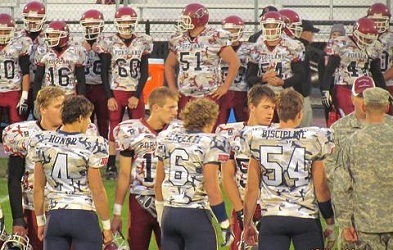
(VIDEO) Wounded Warrior Project: DeWitt vs Portland
October 13, 2011
DEWITT -- The meeting of two state-ranked teams always will ratchet up a typical football night. Both communities, naturally, want to see which is better on the field.
But during the hour before the opening kickoff Oct. 14 of DeWitt’s game against Portland, those teams and their supporters together recognized a grander cause. The night was dedicated to the Wounded Warrior Project, which aids U.S. soldiers (and their families) who have suffered service-related injuries and illnesses.
Rain washed out some planned attractions, but the evening certainly was memorable. Both teams wore camouflage jerseys and each sent its captains to the pre-game coin toss with an honorary captain representing the military. A number of other service personnel were involved – including a local color guard that presented a 30-foot flag for the national anthem.
It’s understandable if people’s visions of wars and our military are focused an ocean away. But connections hit close to home. DeWitt’s honorary captain, Lansing’s U.S. Army Spc. Jacob Shumway, recently returned from a deployment and has been in the service for two and a half years. He’s a 2003 Lansing Everett graduate, and his mother Susan Land is the principal at Lansing Eastern. His cousins Ethan and Collin Rennaker start for DeWitt, and he walked alongside them for the pregame flip. Shumway plans to attend Lansing Community College and study digital graphic design.
Both teams are considered contenders for their respective state titles next month; DeWitt is ranked No. 7 in Division 3, while Portland is No. 4 in Division 5. And they played like it – Portland prevailed 22-20 in overtime.
A great game, no question. But similarly significant was a preliminary figure of more than $11,000 raised for the WWP.
For more about the Wounded Warrior Project visit http://www.woundedwarriorproject.org.

Attending to Football
November 29, 2013
The interscholastic football season comes to an end this weekend with the MHSAA Finals at Ford Field, but the most talked about sport in high schools today will continue to make headlines for many months into the future.
Some of the headlines will introduce topics that are merely footnotes compared to what is really most important, that being the efforts to keep school-sponsored football the safest and sanest brand of football in America.
At the center of these efforts has been a task force appointed by the MHSAA to work throughout 2013 to advance these two objectives: “To promote the value of interscholastic football and to probe for ways to make the sport safer in Michigan.”
The tangible results of the task force’s four meetings are these:
-
- A proposal to the MHSAA Representative Council to revise football practice policies to improve acclimatization of players and to reduce head trauma. The proposal goes to the Representative Council Dec. 6 for discussion, then to the Michigan High School Football Coaches Association and MHSAA Football Committee in January and to the MHSAA League/Conference meeting in February, before returning to the Representative Council for action on March 22.
-
Three proposals to the NFHS Football Rules Committee to modify playing rules to promote player safety.
- A variety of print, online and broadcast promotions on behalf of the value of interscholastic football and its safety record and to encourage healthier out-of-season activities by students in all sports.
MHSAA research informs us that participation in 11- or 8-player football in member high schools this fall was down 3.0 percent compared to 2012, and down 7.63 percent since the 2008 season. The biggest reasons cited by those surveyed are, in declining order, safety issues, declining enrollment, athletes playing other school or non-school sports, cultural changes and pay-to-participate.
It is important to note that participation is not declining everywhere, not even everywhere where enrollments are down and participation fees are up. It is important to note also that some other sports are in much greater decline than football in terms of high school participation.
It is difficult for me to imagine my life without football as a part of it. It’s difficult to imagine schools and communities without football. I very much doubt that the absence of football would have improved my life or the schools and communities I’ve been a part of. It’s a sport that needs our attention, not its extinction.