

Wassink, Sailors Take Back Championship
November 28, 2014
By Geoff Kimmerly
Second Half editor
DETROIT – The first time Jon Wassink led Grand Rapids South Christian to Ford Field, he spent the 2012 MHSAA Division 4 Final on the sideline with a broken collarbone as his back-up took the team the rest of the way to a title.
Wassink brought the Sailors back to Detroit in 2013 – but they couldn’t keep pace with Marine City despite his three touchdown passes and two scoring runs.
Friday night against Lansing Sexton was Wassink’s last chance to be part of an MHSAA football champion – and play a physical part in a championship game win.
And he didn’t let it slip by. The Sailors' senior quarterback threw for 179 yards and three touchdowns and ran for 122 and another score as South Christian edged Sexton 28-27 for its second Division 4 title in three seasons.
Oh, and Wassink also had four tackles and an interception from his defensive back spot and averaged 39.8 yards on six punts.
“Two years ago when we won it, I was just happy for the team and the community. Part of me obviously wanted to play too, so that was really disappointing but (I was) really happy at the same time,” said Wassink, who was injured in the Semifinal win that season.
“(Last year) was the driving force behind our whole season. We just didn’t want to end our season like we did last year.”
But Sexton came so close to sending Wassink to Western Michigan University with another runner-up finish instead.
The Big Reds (13-1), undefeated on the way to their first MHSAA Final appearance, scored on the game’s opening drive, 2 minutes and 22 seconds into the first quarter.
South Christian (12-2) scored the next two touchdowns, and Sexton then answered. The Sailors took a 21-13 lead into halftime after a Wassink touchdown pass with seven seconds to go before the break and extended the advantage on his 68-yard touchdown run 13 seconds into the third quarter. But the Big Reds battled back with two more scores to pull within a point of the lead with 10:43 to play.
“They’re a scary team. They have all of those great athletes and big bodies,” South Christian coach Mark Tamminga said. “We knew going in they scored a lot of points during the second half and wear you down with all of those big bodies. Our kids just stepped up and made plays when they had to.”
 The first set of offensive plays didn’t result in a score – but burned 5:16 off the clock to give the Big Reds only 5:25 to work with as it drove to take the lead.
The second set of difference-making maneuvers actually came on the same play – and on defense. Sexton had a new set of downs at its 38-yard line when senior linebacker Sam Heyboer burst into the Big Reds' backfield for a 12-year sack. In the process he helped cause a fumble that was recovered by another senior linebacker, Nick Bosch.
But again, South Christian didn’t score – yet took an additional 2:13 off the clock before Wassink was stopped short on a fourth down run by Big Reds senior lineman Isaiah Brown. Only 1:35 remained, and Sexton could advance only 32 yards to its 39-yard-line before the clock ran out.
“Our defense had a heck of a goalline stand down there, and I’m proud of my kids. They fought hard against a really good football team,” Sexton coach Dan Boggan said. “We’re an outstanding football team ourselves, and it could’ve gone either way. I’m disappointed, but I’m not broken.”
Sexton allowed only 63 more second-half yards after Wassink’s long scoring run during the first half-minute of the third quarter. But Sexton also had three turnovers total, while the Sailors never turned over the ball, and missed an extra point after its final touchdown that would’ve tied the score. The Sailors also held a Sexton rushing attack featuring two 1,000-yard rushers to only 101.
Big Reds quarterback Malik Mack finished an outstanding varsity career with 224 yards and two touchdowns passing and another score on the ground. Both of his touchdown passes went to sophomore tight end Kahari Foy-Walton, and senior Rayshawn Wilborn added eight catches for 84 yards and eight tackles at linebacker.
Junior lineman Marshaun Blake had a game-high nine tackles and his teammates combined for six tackles for losses and three sacks. “They were one of the best, if not the best we played all year,” Wassink said. “Fast, physical, just really tough.”
Heyboer finished with two of his team’s three sacks and also caught one of Wassink’s three touchdown passes. Seniors Ryan Veenstra and Eric VanVoorst caught the others, and senior Geff Plasman finished his career with 80 more rushing yards to end up with 1,300 for this fall.
Wassink’s final numbers for his final season set the bar high for those who follow. Adding in his Ford Field heroics, Wassink finished with 1,426 yards and 18 touchdowns rushing and 2,494 yards and 28 touchdowns passing.
And he'll graduate as a two-time MHSAA champion – this time having had something to say about the final result.
“He’s been driven all year. This is what he wanted,” Tamminga said. “He felt he didn’t play the best here last year, and he wanted to go out with a state championship.
“What a tremendous athlete.”
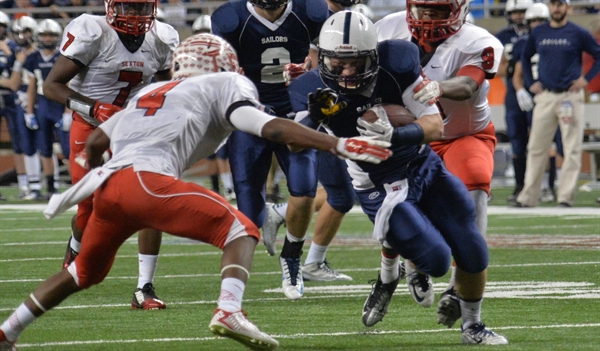
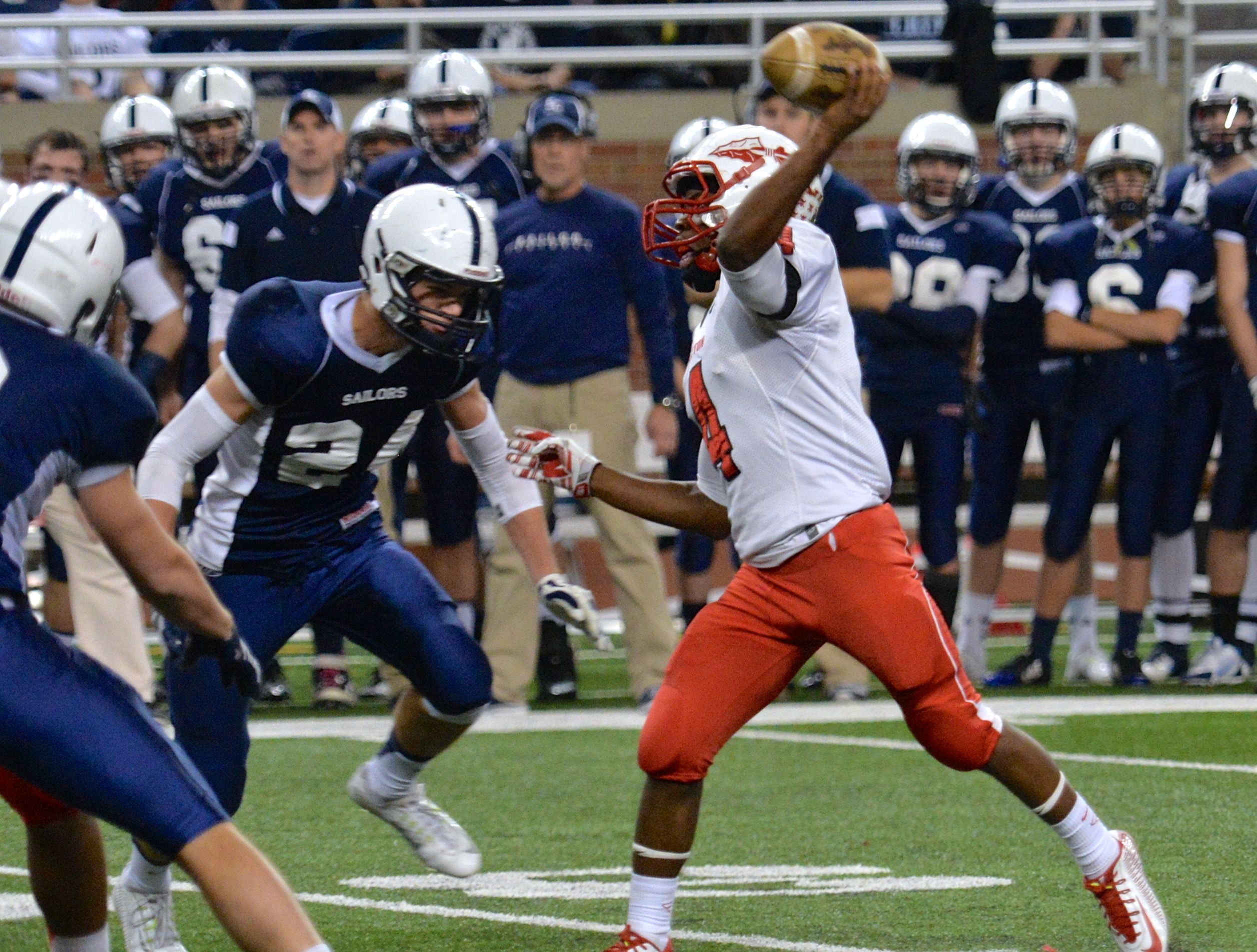
PHOTOS: (Top) Lansing Sexton’s Malik Mack (4) and Ardis Davis (9) work to wrap up a South Christian ball carrier Friday night. (Middle) Mack prepares to unload a pass with the Sailors’ Jake Wierenga applying pressure. (Click for action photos and team photos from Hockey Weekly Action Photos.)
VIDEO HIGHLIGHTS:
WASSINK'S OFF TO THE RACES - Grand Rapids South Christian scored touchdowns on its last possession of the first half and its first of the second half against Lansing Sexton. Here's the second TD, a 68-yard run by quarterback Jon Wassink. The TD and extra point that followed turned out to be the winning scoring sequence in a 28-27 Sailors win.
SEXTON TIGHTENS IT UP - Early in the fourth period, Lansing Sexton pulled within a point of Grand Rapids South Christian on a 29-yard pitch/catch/run play from Malik Mack to Kahari Foy-Walton. It was the second time the duo connected for a score in the game.
Watch the entire game and order DVDs by Clicking Here.
March to Marquette: 8-Player Preview
November 22, 2019
By Geoff Kimmerly
Second Half editor
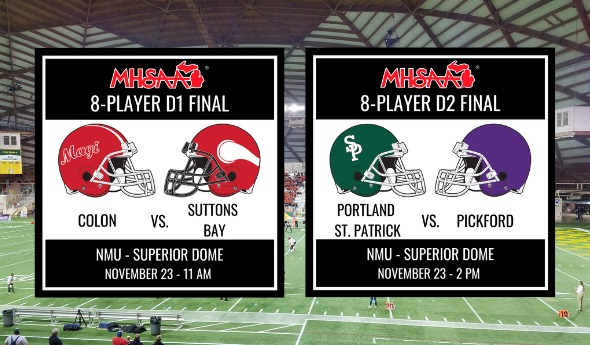
For the second straight season, the majority of teams making the trip to the 8-Player Finals at Northern Michigan University’s Superior Dome will come seeking their first MHSAA football championship.
Colon, Suttons Bay and Pickford will be first-time title hopefuls Saturday. Portland St. Patrick is seeking its first football title since 1992, long before any of these current players was born.
Kickoff for the Division 1 game is 11 a.m., with the Division 2 game following at 2 p.m. Tickets cost $10 and one is good for admittance to both games. Both games also will be broadcast live on FOXSportsDetroit.com and the FOX Sports app, and replayed on FOX Sports Detroit’s primary channel on Nov. 26 – Division 1 at 8 p.m. and Division 2 at 11 p.m. Audio of both games will be streamed live on MHSAANetwork.com.
Below is a look at all four finalists. Team “rankings” are based on their playoff-point averages heading into the postseason.
 Division 1
COLON
Record/rank: 12-0, No. 2
Coach: Robbie Hattan, fourth season (28-13)
League finish: First in Southern Central Athletic Association A
Championship history: Has never played in an MHSAA Final.
Best wins: 27-8 over No. 6 Morrice in Semifinal, 56-12 over No. 3 Martin in Regional Final, 60-12 (Pre-Regional) and 55-0 over No. 13 Camden-Frontier, 43-8 over No. 11 Bellevue, 42-0 over Division 2 No. 5 Climax-Scotts.
Players to watch: RB/DL Brandon Crawford, 6-2/240, jr. (1,491 yards/22 TDs rushing); SL/DB/P Jonathan West, 6-2/160, sr. (653 yards/7 TDs rushing, 498 yards/12 TDs receiving); QB/DB Phillip Alva, 5-9/140, sr. (954 yards/19 TDs passing, 903 yards/17 TDs rushing).
Outlook: Colon moved to 8-player before the 2018 season after a nice recent run in 11-player that had included eight playoff appearances over the previous 14 seasons. But the Magi have succeeded at a higher level since making the switch, putting up double-digit wins last season for the first time and again this fall. Last season’s champion Morrice was the first opponent to hold Colon to under 34 points and also the first to come within 34 of catching the Magi this fall. Crawford and West both earned all-state honorable mentions in 2018, and 6-4 junior Brayden Ireland gives Alva another big target in the passing game. West also has scored off interceptions and punt and kickoff returns this season.
SUTTONS BAY
Record/rank: 12-0, No. 4
Coach: Garrick Opie, second season (21-2)
League finish: First in Midwest Central Michigan Conference West
Championship history: Division 6 runner-up 2004 (11-player).
Best wins: 45-14 over No. 8 Kingston in Semifinal, 36-30 over No. 14 Gaylord St. Mary in Regional Final, 36-14 over No. 16 Brimley in Pre-Regional, 20-14 and 29-18 over Division 2 No. 9 Onekama.
Players to watch: RB/DB Lucas Mikesell, 5-11/175, sr. (1,259 yards/29 TDs rushing, 501 yards/9 TDs receiving), QB/DB Bryce Opie, 6-4/194, sr. (1,167 yards/15 TDs passing, 692 yards/13 TDs rushing); OG/DT Gavyn Shananaquet, 6-0/230, sr.
Outlook: Suttons Bay has run its record over three seasons of 8-player to a combined 28-6 after being forced to end its final 11-player season early in 2016. The Norsemen had only three games decided by single digits this fall. The first was a six-point win over Onekama, and Suttons Bay won the rematch by 11, and the other two were against Gaylord St. Mary – a one-point loss on the field that became a forfeit win and a six-point win in the Regional Final. The defense has been especially impressive, giving up 16.7 points per game on the season but more than 18 only twice (both times to St. Mary). Bryce Opie also has five interceptions, and the team had a 23-14 turnover advantage heading into last week’s Semifinal.
 Division 2
PORTLAND ST. PATRICK
Record/rank: 12-0, No. 3
Coach: Patrick Russman, 13th season (88-48)
League finish: Does not play in a league.
Championship history: Division 2 runner-up 2017 (8-player), Class D champion 1992, runner-up 1991 and 1997 (11-player).
Best wins: 49-6 over No. 5 Climax-Scotts in Semifinal, 51-16 over No. 11 Kinde North Huron in Regional Final, 45-0 over No. 16 Bay City All-Saints in Pre-Regional, 42-24 over No. 9 Onekama.
Players to watch: RB/DL Ned Smith, 5-10/195, sr. (1,510 yards/24 TDs rushing); QB/DB Connor Cross, 6-2/175, jr. (1,688 yards/36 TDs passing); WR/DB Zach Spitzley, 6-2/180, sr. (1,133 yards/19 TDs receiving).
Outlook: The Shamrocks have made at least the Semifinals the last three seasons and four times since switching to 8-player in 2012, and this has been their most successful run of all four. St. Patrick has won all of its games by at least 18 points (not counting a 2-0 forfeit in Week 3) and by an average score of 52-10. Senior linebacker Alex Kissane, sophomore linebacker Derec Fedewa, senior defensive back Riley Kissane and senior lineman Jeff Davlin are among leaders of a defense that has given up more than 16 points only twice and a combined 22 points over three playoff games.
PICKFORD
Record/rank: 11-1, T-No. 1
Coach: Josh Rader, 16th season (110-55)
League finish: First in Great Lakes Eight Conference East
Championship history: Division 1 runner-up 2018 (8-player).
Best wins: 22-14 over T-No. 1 Powers North Central in Regional Finals, 40-8 over No. 4 Hillman in Semifinal, 57-12 (Pre-Regional) and 58-15 over No. 6 Engadine, 48-16 over No. 7 Crystal Falls Forest Park, 64-20 over No. 12 Cedarville, 46-23 over Division 1 No. 14 Gaylord St. Mary.
Players to watch: QB/LB Jimmy Storey, 6-0/185, sr. (1,400 yards/19 TDs passing, 1,809 yards/24 TDs rushing); TE/DE Nick Edington, 6-7/220, sr. (307 yards/3 TDs receiving); RB/DB Stephen Lamothe, 5-10/175, sr. (752 yards/11 TDs rushing, 813 yards/11 TDs receiving).
Outlook: After reaching last season’s Division 1 championship game with a junior-heavy roster, Pickford is back playing for its first Finals championship with many of the same standouts. Edington, Storey and senior lineman Isaiah May all made the all-state team last season, and Storey was the statewide Player of the Year for 8-player by The Associated Press. The team’s only loss this fall came in Week 3, by six points, to Powers North Central – and the Panthers avenged the defeat in the Regional Final. The Jets also were the only team able to hold Pickford under 40 points this fall. Senior running back Isaac Brown provides another valuable option on offense with 613 yards and 12 touchdowns rushing.