

Wassink, Sailors Take Back Championship
November 28, 2014
By Geoff Kimmerly
Second Half editor
DETROIT – The first time Jon Wassink led Grand Rapids South Christian to Ford Field, he spent the 2012 MHSAA Division 4 Final on the sideline with a broken collarbone as his back-up took the team the rest of the way to a title.
Wassink brought the Sailors back to Detroit in 2013 – but they couldn’t keep pace with Marine City despite his three touchdown passes and two scoring runs.
Friday night against Lansing Sexton was Wassink’s last chance to be part of an MHSAA football champion – and play a physical part in a championship game win.
And he didn’t let it slip by. The Sailors' senior quarterback threw for 179 yards and three touchdowns and ran for 122 and another score as South Christian edged Sexton 28-27 for its second Division 4 title in three seasons.
Oh, and Wassink also had four tackles and an interception from his defensive back spot and averaged 39.8 yards on six punts.
“Two years ago when we won it, I was just happy for the team and the community. Part of me obviously wanted to play too, so that was really disappointing but (I was) really happy at the same time,” said Wassink, who was injured in the Semifinal win that season.
“(Last year) was the driving force behind our whole season. We just didn’t want to end our season like we did last year.”
But Sexton came so close to sending Wassink to Western Michigan University with another runner-up finish instead.
The Big Reds (13-1), undefeated on the way to their first MHSAA Final appearance, scored on the game’s opening drive, 2 minutes and 22 seconds into the first quarter.
South Christian (12-2) scored the next two touchdowns, and Sexton then answered. The Sailors took a 21-13 lead into halftime after a Wassink touchdown pass with seven seconds to go before the break and extended the advantage on his 68-yard touchdown run 13 seconds into the third quarter. But the Big Reds battled back with two more scores to pull within a point of the lead with 10:43 to play.
“They’re a scary team. They have all of those great athletes and big bodies,” South Christian coach Mark Tamminga said. “We knew going in they scored a lot of points during the second half and wear you down with all of those big bodies. Our kids just stepped up and made plays when they had to.”
 The first set of offensive plays didn’t result in a score – but burned 5:16 off the clock to give the Big Reds only 5:25 to work with as it drove to take the lead.
The second set of difference-making maneuvers actually came on the same play – and on defense. Sexton had a new set of downs at its 38-yard line when senior linebacker Sam Heyboer burst into the Big Reds' backfield for a 12-year sack. In the process he helped cause a fumble that was recovered by another senior linebacker, Nick Bosch.
But again, South Christian didn’t score – yet took an additional 2:13 off the clock before Wassink was stopped short on a fourth down run by Big Reds senior lineman Isaiah Brown. Only 1:35 remained, and Sexton could advance only 32 yards to its 39-yard-line before the clock ran out.
“Our defense had a heck of a goalline stand down there, and I’m proud of my kids. They fought hard against a really good football team,” Sexton coach Dan Boggan said. “We’re an outstanding football team ourselves, and it could’ve gone either way. I’m disappointed, but I’m not broken.”
Sexton allowed only 63 more second-half yards after Wassink’s long scoring run during the first half-minute of the third quarter. But Sexton also had three turnovers total, while the Sailors never turned over the ball, and missed an extra point after its final touchdown that would’ve tied the score. The Sailors also held a Sexton rushing attack featuring two 1,000-yard rushers to only 101.
Big Reds quarterback Malik Mack finished an outstanding varsity career with 224 yards and two touchdowns passing and another score on the ground. Both of his touchdown passes went to sophomore tight end Kahari Foy-Walton, and senior Rayshawn Wilborn added eight catches for 84 yards and eight tackles at linebacker.
Junior lineman Marshaun Blake had a game-high nine tackles and his teammates combined for six tackles for losses and three sacks. “They were one of the best, if not the best we played all year,” Wassink said. “Fast, physical, just really tough.”
Heyboer finished with two of his team’s three sacks and also caught one of Wassink’s three touchdown passes. Seniors Ryan Veenstra and Eric VanVoorst caught the others, and senior Geff Plasman finished his career with 80 more rushing yards to end up with 1,300 for this fall.
Wassink’s final numbers for his final season set the bar high for those who follow. Adding in his Ford Field heroics, Wassink finished with 1,426 yards and 18 touchdowns rushing and 2,494 yards and 28 touchdowns passing.
And he'll graduate as a two-time MHSAA champion – this time having had something to say about the final result.
“He’s been driven all year. This is what he wanted,” Tamminga said. “He felt he didn’t play the best here last year, and he wanted to go out with a state championship.
“What a tremendous athlete.”
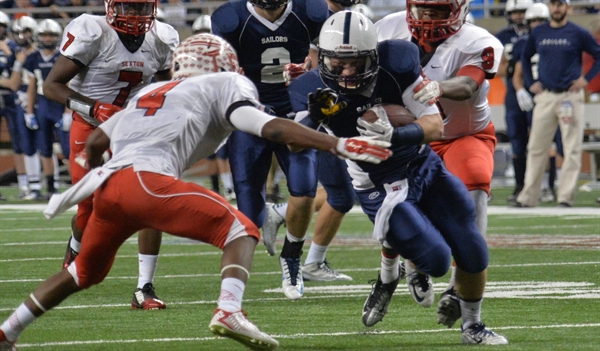
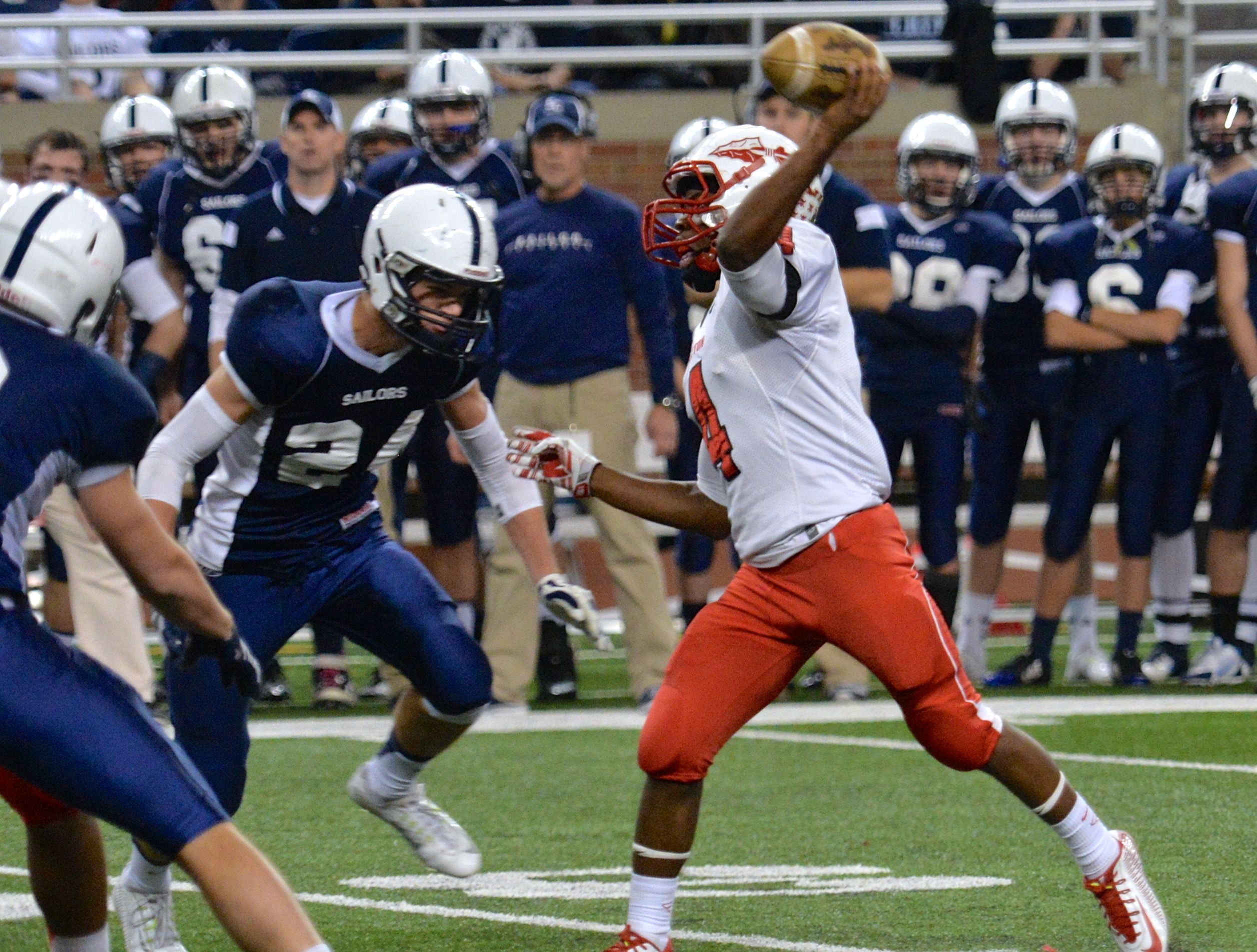
PHOTOS: (Top) Lansing Sexton’s Malik Mack (4) and Ardis Davis (9) work to wrap up a South Christian ball carrier Friday night. (Middle) Mack prepares to unload a pass with the Sailors’ Jake Wierenga applying pressure. (Click for action photos and team photos from Hockey Weekly Action Photos.)
VIDEO HIGHLIGHTS:
WASSINK'S OFF TO THE RACES - Grand Rapids South Christian scored touchdowns on its last possession of the first half and its first of the second half against Lansing Sexton. Here's the second TD, a 68-yard run by quarterback Jon Wassink. The TD and extra point that followed turned out to be the winning scoring sequence in a 28-27 Sailors win.
SEXTON TIGHTENS IT UP - Early in the fourth period, Lansing Sexton pulled within a point of Grand Rapids South Christian on a 29-yard pitch/catch/run play from Malik Mack to Kahari Foy-Walton. It was the second time the duo connected for a score in the game.
Watch the entire game and order DVDs by Clicking Here.
1st & Goal: 2025 Playoffs Week 1 Review
By
Geoff Kimmerly
MHSAA.com senior editor
November 4, 2025
The phrase is “survive and advance” for a reason.
 For high school football teams this time of year, the next game always is earned. And that was especially evident as the 51st MHSAA Playoffs began over the weekend.
A total of 32 games – out of 143 total – were decided by seven points of fewer. Nine of those matchups were decided by a single point.
We glance at several of those below as we move on this week to District Finals in 11-player and 8-player Regional championship games.
11-Player Division 1
HEADLINER Brownstown Woodhaven 30, Belleville 29 Marquez McAdoo ran for two touchdowns and Woodhaven (8-2) blocked a late extra-point try to secure the program’s first playoff win since 2021 – and after missing the postseason the last two years. The Tigers’ run ended at 7-3.
🚨 UPSET ALERT! 🚨 Woodhaven stuns Belleville in the Division 1 @MHSAA District Semifinal, 30-29!
Senior Andrew Pridemore came up clutch, blocking the potential game-tying extra point late in the 4th quarter to seal the win. The victory marks Woodhaven’s first playoff win since… pic.twitter.com/pWsyGaxA4v— STATE CHAMPS! Michigan (@statechampsmich) November 1, 2025
District Digest East Kentwood 49, Grand Ledge 15 The Falcons (8-2) earned their first playoff win since 2019, slowing down a Comets attack that had scored 30 or more points seven times in finishing 7-3. Clarkston 52, Davison 14 The Wolves (9-1) opened the playoffs with arguably their most impressive win of a season with several, as Davison (8-2) was averaging nearly 44 points per game the night. Macomb Dakota 6, Utica 3 The Cougars (7-3) bounced back from a 26-17 loss to Utica (7-3) from Week 8.
11-Player Division 2
HEADLINER Traverse City Central 15, Traverse City West 13 Just a week after West won their Patriot Game rivalry game 21-20, these two returned to the same field but with Central (6-4) advancing with its first win over the Titans (5-5) since 2022 – and first playoff victory over any opponent since 2021. Click for more from the Traverse City Record-Eagle.
District Digest Grosse Pointe South 28, Roseville 27 These Macomb Area Conference White rivals met for a second time after South (9-1) won the first 47-25 in Week 5 – and after the Blue Devils also defeated Roseville (4-6) by just a point to open the 2024 playoffs. East Lansing 26, White Lake Lakeland 20 The Trojans (5-5) made the playoffs in part because of an incredible strength of schedule, and they showed they belong in extending their winning streak to four while ending the Eagles’ season at 7-3. Warren Cousino 28, Birmingham Seaholm 7 The Patriots (7-3) – after missing the postseason a year ago – claimed their first playoff win since 2007, ending the Maples’ run at 5-5.
11-Player Division 3
HEADLINER Zeeland West 30, Niles 21 The reigning champion Dux (7-3) sent a wave through the Division 3 bracket, handing Niles (9-1) its only loss of the season as the Vikings also aspired to get back to Ford Field after finishing Division 4 runners-up a year ago. West’s 30 points were the most Niles gave up in a game all fall. Click for more from the South Bend Tribune.
District Digest Middleville Thornapple Kellogg 28, Hastings 20 The Trojans (7-3) earned their first playoff win since 2020 and continued to impress after winning a combined eight games over the last four seasons – and opening this one with a 31-29 loss to Hastings (7-3). Warren De La Salle Collegiate 56, Warren Fitzgerald 34 De La Salle (4-6) was another qualifier that played a powerful schedule this fall, and the Pilots added to it with this win over the MAC Gold champion Spartans (8-2). Gaylord 38, Marquette 34 The Blue Devils’ 10-0 season has included now seven wins by seven points or fewer, and they kept it alive with the go-ahead score during the final minute to get past the Sentinels (6-4).
11-Player Division 4
HEADLINER Big Rapids 32, Ludington 31 Big Rapids opened the playoffs with a win over Ludington for the second-straight postseason, but this time handed the Orioles (9-1) their lone defeat as well – also with a go-ahead touchdown coming during the final minute. The Cardinals (9-1) additionally reached nine wins for the third straight season. Click for more from the Big Rapids Pioneer.
District Digest Portland 42, Grand Rapids South Christian 41 (OT) The Raiders (10-0) hadn’t had a game closer than 24 points all season, but emerged from this first matchup with South Christian since falling to the Sailors (4-6) in a 2023 Semifinal. Madison Heights Lamphere 7, Redford Union 6 Another one-pointer saw Lamphere (7-3) earn its first playoff win since 2022 and set up a rematch with Dearborn Divine Child, which eliminated the Rams a year ago. Impressive sidenote: After allowing 40 in its opener this fall, Union (7-3) gave up only 41 total over its final nine games. Three Rivers 21, Paw Paw 14 Just two weeks prior, Paw Paw (6-4) had defeated Three Rivers (6-4) in league play 43-0. The Wildcats are in the playoffs for the first time since 2022.
11-Player Division 5
HEADLINER Ogemaw Heights 29, Negaunee 28 (OT) The Falcons (9-1) advanced to a District Final for the third-straight season, advancing from their toughest challenge since a Week 2 loss to Traverse City St. Francis. The Miners ended their run at 6-4. Click for more from the Bay City Times.
District Digest Berrien Springs 34, Dowagiac 20 These Lakeland Conference rivals met for a second time for the second season in a row, and this time after sharing the league title. Berrien Springs (7-2) had won the first matchup as well. Dowagiac finished 5-4. Detroit Denby 18, Detroit Southeastern 16 Denby (8-2) ran its winning streak to eight with its first playoff victory since 2020, ending Southeastern’s season at 6-4. Richmond 14, Armada 10 These Blue Water Area Conference rivals met for the second time this season and it was nearly as close as the first, as Richmond (9-1) held on after also claiming the Week 4 matchup 24-17 – and after Armada (6-4) won regular-season and playoff games over the Blue Devils a year ago.
11-Player Division 6
HEADINER Kent City 28, Olivet 22 Kent City added its first playoff victory since 2019 to its first 10-0 start since 2017 as it went on the road to defeat the Eagles (8-2). Olivet’s only losses this season came to teams still undefeated. Click for more from Local Sports Journal.
District Digest Traverse City St. Francis 55, Boyne City 35 The Gladiators (7-2) added a second win this season over Boyne City (6-4) after winning the first 20-13, and with this one earned another rematch this week, against rival Kingsley. Durand 32, Flint Hamady 22 The Railroaders (8-2) will play in a District Final for the first time since 2009, and after missing the playoffs the last two years. Hamady finished 6-4. Napoleon 26, Buchanan 20 The Pirates (7-3) advanced with this win over Lakeland Conference co-champion Buchanan (6-4).
11-Player Division 7
HEADLINER Ithaca 24, Saginaw Valley Lutheran 12 A signature win during Saginaw Valley Lutheran’s historic fall was a 23-22 Week 6 victory over the Yellowjackets as the Chargers (9-1) went on to complete a perfect regular season. But Ithaca (7-3) got its revenge to open its 17th-straight playoff run. Click for more from the Saginaw News.
District Digest McBain 28, Charlevoix 27 The Ramblers (8-2) stopped a 2-point conversion attempt for the win after Charlevoix (8-2) scored with less than a minute to play. Clinton 36, Ottawa Lake Whiteford 20 Clinton (8-2) has lost only once more since falling opening night to Monroe St. Mary Catholic Central, and earned a rematch this week with the Falcons by defeating Whiteford (8-2) in a playoff opener for the second-straight season. Shelby 20, LeRoy Pine River 2 Shelby qualified for the playoffs for the first time since 2013 (not counting COVID-shortened 2020, when nearly all teams made the field), and followed that by winning a playoff game for the first time since reaching the Division 6 Semifinals 12 years ago.
11-Player Division 8
HEADLINER White Pigeon 22, Decatur 20 (OT) White Pigeon’s Week 8 loss to Decatur was its first to the Raiders since 2022, but the Chiefs (8-2) held on in overtime to avenge and earn a District title opportunity against undefeated Hudson this week. Decatur finished 7-3. Click for more from the Sturgis Journal.
District Digest Saginaw Nouvel Catholic Central 34, Saginaw Michigan Lutheran Seminary 28 These rivals met a second time in the playoffs for the second-straight season, but this time Nouvel (8-2) finished the sweep after MLS (6-4) won by a point in their 2024 playoff matchup. Riverview Gabriel Richard 34, Melvindale Academy for Business & Tech 6 Gabriel Richard started this season 1-3 after finishing Division 8 runner-up a year ago, but that early tough competition may have paid off again as the Pioneers (5-5) handed ABT (9-1) the lone defeat of its winningest season all-time. New Lothrop 19, Fowler 14 After a rare playoff miss a year ago, the Hornets (7-3) got off to the right start by getting past an Eagles team (6-4) that made last season’s Semifinals.
8-Player Division 1
HEADLINER Pickford 30, Indian River Inland Lakes 26 Reigning Division 1 runner-up Pickford (8-1) opened these playoffs on the road, but came home with one of the weekend’s most notable wins after handing Inland Lakes (9-1) its only loss this fall. The pair had split Semifinals matchups the last two seasons. Click for more from the Cheboygan Daily Tribune.
Regional Roundup Climax-Scotts 72, Gobles 62 These two produced not only for one of the highest-scoring games this season, but their combined 134 points will rank high on the all-time MHSAA 8-player list. Gobles (7-3) had won their opening-night meeting 54-32, but Climax-Scotts (8-2) has lost only once more. Capac 40, Brown City 38 Capac (8-2) kicked off its first playoffs since 2011 by avenging a 61-22 Week 3 loss to the Green Devils (7-3). Kingston 22, Bay City All Saints 14 Kingston (9-1) navigated its closest win this season to earn a rematch with Capac. All Saints finished 7-3, its defeats by a combined 15 points to teams that are a combined 28-2.
8-Player Division 2
HEADLINER Deckerville 27, Morrice 26 This looked incredible on paper, but might have been even better than advertised as Deckerville emerged from a matchup of teams that both reached championship games a year ago. The reigning Division 1 champion Eagles (9-1) opened a 20-point lead by halftime but had to hold off the Orioles (8-2), last year’s Division 2 runner-up. Click for more from the Huron Daily Tribune.
Regional Roundup Gaylord St. Mary 84, Mio 48 This will also make the all-time single-game scoring list, St. Mary’s 84 points its most since the 2020 playoffs as the Snowbirds moved to 8-2. Mio finished 8-2 as well, its best record since 2019. Lake Linden-Hubbell 50, Powers North Central 28 The Lakes (8-2) made this nearly a repeat of their 52-34 win over the Jets (7-3) in Week 6. North Central’s only other loss this fall came to undefeated Norway. Felch North Dickinson 40, St. Ignace 22 The Nordics (10-0) opened their first playoffs since 2016 by adding to their perfect run, downing the Saints (6-4) to earn a rematch with opening-night opponent Lake Linden-Hubbell – which gave North Dickinson its only single-digit game this fall.
MHSAA.com's weekly “1st & Goal” previews and reviews are powered by MI Student Aid, a division within the Department of Lifelong Education, Advancement, and Potential (MiLEAP). MI Student Aid encourages students to pursue postsecondary education by providing access to student financial resources and information. MI Student Aid administers the state’s scholarship and grant programs that help make college Accessible, Affordable and Attainable for you. Click to connect with MI Student Aid and find more information on Facebook and Twitter @mistudentaid.
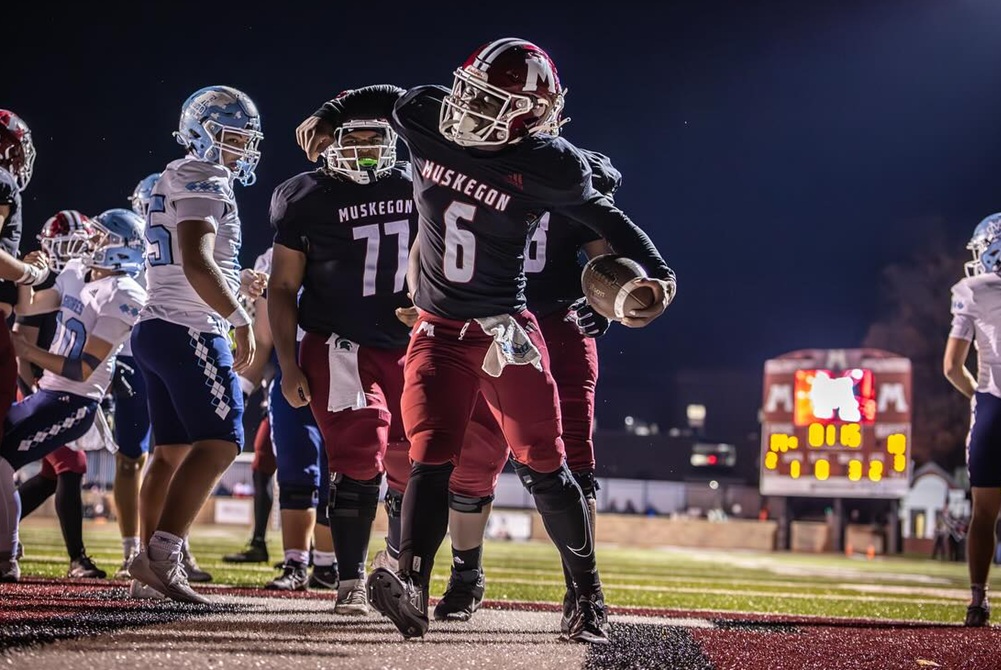
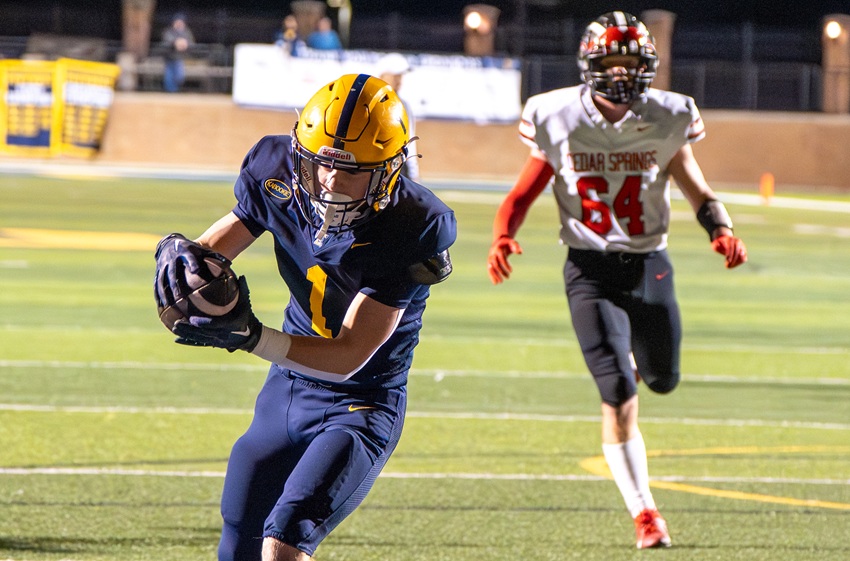
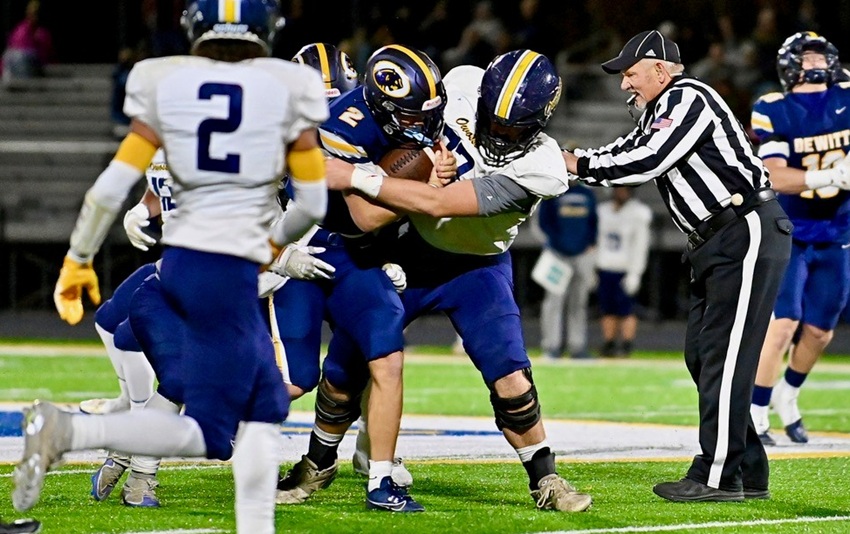
PHOTOS (Top) Muskegon's Lamar Bradford celebrates his touchdown run during the Big Reds' 39-34 win over Mona Shores on Friday. (Middle) East Grand Rapids' Tyler Blake (1) reaches the end zone as a Cedar Springs defender pursues during the Pioneers' 23-21 victory. (Below) An Owosso defender wraps up DeWitt's Trav Moore (2) during the Panthers' 70-13 win. (Muskegon/Mona Shores photo by Tim Reilly. EGR/Cedar Springs photo by Michigan Sports Photo. DeWitt/Owosso photo by Terry Lyons.)