


We’ve Got This Right
March 1, 2013
This year's Super Bowl was an occasion for an unusual amount of commentary on the state of football safety, especially concussions.
One group called on state high school associations and football coaches associations to eliminate contact outside the defined interscholastic season. That would mean spring football practice, and during summer leagues and camps, and at all-star games.
Michigan is one of a large majority of states where schools do not allow spring football practice. Michigan is one of a minority of states where schools do not allow contact at summer camps, for which we are often criticized by out-of-state camp promoters. And Michigan is one of a smaller minority of states where schools prohibit students, coaches, officials and administrators from being involved in all-star games involving undergraduates.
While we are well ahead of the curve on out-of-season contact policies, we are in the mainstream of state high school associations studying what the appropriate limits should be on contact during early season football practice and throughout the remainder of the season. We have a task force that appears headed toward recommending that the Representative Council prescribe only one contact session per day during early season practice and only two contact practices per week after games begin.
There will be other ideas percolating and then simmering with these before any are proposed to the MHSAA Football Committee and Representative Council.
Drive for Detroit: Week 5 in Review
September 28, 2015
By Geoff Kimmerly
Second Half editor
This weekend was "why they play the games" all over the state of Michigan.
That cliche is thrown around often, of course. But rarely do we see this many upsets as we cross the midway points of the regular season.
We touch on many of them below in this week's "Drive for Detroit" report.
Bay & Thumb
Almont 30, Richmond 29 (2 OT)
The game that has decided the Blue Water Area Conference champion the last two seasons might have done so again Friday, with Almont (5-0) dealing the Blue Devils (4-1) their first loss after both made field goals to send the game to a second overtime. Richmond scored the most points Almont had given up since these teams met in 2013 – but Almont held on in a game that was knotted at multiple points during regulation. Click for more from the Port Huron Times-Herald.
Also noted:
Frankenmuth 28, Millington 7 – The Eagles (5-0) made it three of the last four over the rival Cardinals (4-1) in a game that could again decide the Tri-Valley Conference East title.
Lapeer 35, Mount Pleasant 14 – The Lightning (5-0) remains perfect during the regular season over its first two as a program after a test against another Saginaw Valley League Red contender in Mount Pleasant (3-2).
Midland Dow 35, Flint Powers Catholic 30 – Midland (4-1) earned the upper hand in the SVL Blue again after beating Powers (3-2) for the title last season.
Corunna 20, Flint Beecher 8 – This may turn out to be the Cavaliers’ most significant win in more than a decade; Corunna (4-1) is the Genesee Area Conference Red favorite now after handing reigning champion Beecher (4-1) its first regular-season loss since Week 7 of 2013.
Greater Detroit
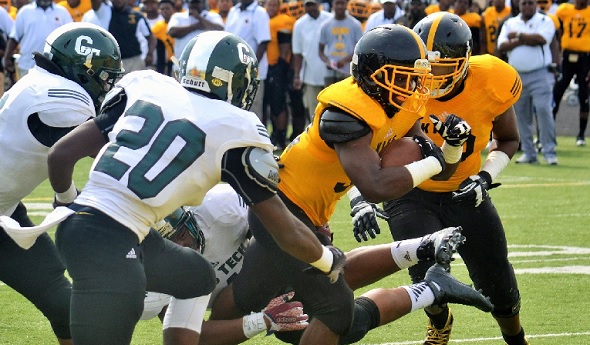
Detroit Martin Luther King 31, Detroit Cass Tech 28 (OT)
The match up of the city’s two best teams unfolded like a game of that magnitude should, ending on an 18-yard field goal by kicker Anwar Miah, who missed an extra point earlier in Saturday’s contest. King (5-0) held on for its third victory this season by a touchdown or less and first win over Cass Tech since the 2012 Detroit Public School League championship game. That also was Cass Tech’s last regular-season loss before Saturday; the Technicians (4-1) could see King in the PSL final again next month. Click for more from the Detroit Free Press.
Also noted:
Farmington Hills Harrison 17, Southfield 14 – If this ends up as the final season of Harrison football, it looks like the Hawks (4-1) will end with an Oakland Activities Association White title after downing former co-leader Southfield (3-2).
Warren DeLaSalle 31, Orchard Lake St. Mary's 8 – Reigning Division 2 title winner DeLaSalle (4-1) won this Catholic League Central battle of MHSAA champions big over reigning Division 3 winner St. Mary’s (4-1).
Belleville 23, Dearborn Heights Robichaud 20 – The Tigers (4-1) continued their bounce-back from last season’s 3-6 finish and are the Western Wayne Blue frontrunners after handing Robichaud (4-1) its first loss.
Clinton Township Chippewa Valley 34, Warren Mott 30 – The Macomb Area Conference Red race is a mish-mash now that Chippewa Valley (4-1) beat Mott (4-1), which beat Macomb Dakota, which beat Chippewa Valley, which handed Sterling Heights Stevenson its only loss.
Mid-Michigan
Lake Odessa Lakewood 27, Olivet 14
The Vikings' best start since the perfect season of 1974 continues, and Lakewood (5-0) looks really good to claim its first league title since 1980 after beating the reigning Greater Lansing Activities Conference champion Eagles (3-2). The win also guaranteed Lakewood its first winning regular season since 2005. Click for more from Fox 17 in Grand Rapids.
Also noted:
Holt 35, East Lansing 20 – New coach Chad Fulk’s turnaround effort is gaining steam, with Holt (3-2) equaling last season’s win total while handing a first Capital Area Activities Conference Blue loss to also-improved East Lansing (2-3).
Dansville 21, Fowler 19 – Just when it looked like the Aggies (4-1) were out of the Central Michigan Athletic Conference race after a 57-point loss to Pewamo-Westphalia in Week 3, they storm back to edge the reigning champion Eagles (4-1).
Grand Ledge 35, Jackson 16 – This sets the Comets (5-0) up nicely to win the CAAC Blue, while making the playoff push just a little tougher for Jackson (3-2) as it pursues its first berth since 2009.
Mount Pleasant Sacred Heart 16, Carson City-Crystal 14 – The Irish (2-3) needed this one as they look to repeat in the Mid-State Activities Conference with Vestaburg also standing in the way in Week 7; the Eagles (2-3) also could still figure into the conversation playing Vestaburg in Week 8.
Northern Lower Peninsula
Traverse City St. Francis 32, Boyne City 13
The last three seasons of this rivalry belonged to Boyne City, but St. Francis added to a fall already full of highlights by beating the Ramblers (4-1) big to take an early step forward in the Northern Michigan Football Conference Leaders division. Boyne City had beaten St. Francis (5-0) by a point, 28-27, a year ago. But the Gladiators’ defense continues to shine and has given up only 25 points over five games. Click for more from the Traverse City Record-Eagle.
Also noted:
Traverse City Central 34, Gaylord 27 – The Trojans (5-0) got a needed big start on a tough string of Big North Conference games to finish the season, with Gaylord (4-1) still on track for its best since at least 2005.
Maple City Glen Lake 12, Onekama 7 – Glen Lake (4-1) continued its rebound from last season by handing Onekama (4-1) its first loss and scoring the first points the Portagers have given up this fall.
Whittemore-Prescott 14, Lincoln Alcona 8 – The Cardinals (2-3) must win out to guarantee a ninth straight playoff appearance, and this week that meant handing a first loss to Alcona (4-1).
McBain 26, Manton 24 – The Ramblers (4-1) held on to set up this week’s Highland Conference battle with favorite Beal City by downing Manton (2-3) by two points for the second time in three seasons.
Southeast & Border
Clinton 42, Morenci 22
Morenci has risen to Tri-County Conference power over the last two seasons, but league supremacy still belongs to Clinton (5-0) after it extended its regular-season winning streak to 32 and beat the Bulldogs (4-1) for the fourth straight time. Running back Mathew Sexton ran for 262 yards and six touchdowns as Clinton also set a conference record with 24 straight victories in the league; its last league defeat was to Sand Creek in Week 9 of 2011. Click for more from the Adrian Daily Telegram.
Also noted:
Ann Arbor Pioneer 20, Monroe 12 – Pioneer’s first 5-0 start since 1991 has it lined up to play Saline this week for a share of the Southeastern Conference Red title, with Monroe (3-2) also potentially still in the mix as it faces Saline in Week 7.
Vandercook Lake 44, Grass Lake 26 – This is already the best season for Vandercook Lake (5-0) since 1997 with its best start since 1996, while Grass Lake (2-3) must now win out to guarantee a playoff berth for the 11th straight season.
Dundee 29, Hudson 20 – The Vikings (3-2) have gone from 0-9 a year ago to an impact team in the Lenawee County Athletic Association with this win over reigning champion Hudson (2-3).
Ida 40, Brooklyn Columbia Central 0 – The Bluestreaks (5-0) have four straight games against LCAA contenders but got past the first by handing Columbia Central (4-1) its first loss.
Southwest Corridor
Marshall 21, Jackson Lumen Christi 14
The Redhawks (4-1) have struggled to sub-.500 records four of the last five seasons, but this definitely was their most monumental win since the MHSAA Division 4 championship game in 2009. Marshall lost to Lumen Christi (4-1) by 28 in last season’s first matchup as members of the Interstate Eight Conference, but now has the best chance of earning a share of the league title this fall if Coldwater (which beat Marshall 9-7 in Week 2) trips up. Click for more from the Battle Creek Enquirer.
Also noted:
Battle Creek Lakeview 27, Stevensville Lakeshore 22 – The opening slate has been loaded for Lakeview (3-2), but beating Lakeshore (3-2) for the second straight year is a great way to start the season’s second half.
Sturgis 12, Vicksburg 8 – The Trojans (4-1) look like favorite Edwardsburg’s toughest obstacle in the Wolverine B Conference after avenging last season’s 42-20 loss to Vicksburg (3-2).
Edwardsburg 22, Dowagiac 12 – The Eddies (5-0) ran their league winning streak to 15 against the last team to beat them in a conference game, Dowagiac (3-2) in 2012.
Berrien Springs 31, Bridgman 21 – The Shamrocks (5-0) continued their best start since 2011 by handing Bridgman (4-1) its first loss, but not before the Bees scored the most points Berrien Springs has given up.
Upper Peninsula
St. Ignace 27, Johannesburg-Lewiston 21
The Saints (5-0) haven’t lost a league game since 2009, combining 23 straight in the Ski Valley Conference with its final six as a member of the Straits Area Conference for football. Johannesburg-Lewiston’s only Ski Valley losses of the last two seasons have come to St. Ignace, although this one was much closer than the 28-0 defeat of a year ago. The Cardinals (4-1) led by eight early in the fourth quarter before the Saints prevailed. Click for more from WWTV 9&10 News.
Also noted:
Houghton 44, Iron River West Iron County 22 – The Gremlins’ first win over West Iron (1-4) since 2001 puts them one game away at 2-3 from equaling last season’s win total.
Lake Linden-Hubbell 51, L'Anse 14 – The Lakes (5-0) have made it two straight against L’Anse since falling to the Purple Hornets (3-2) in their playoff opener in 2013.
Menominee 27, Kingsford 24 – The Maroons (5-0) haven’t lost a regular-season game since Week 5 in 2012, when Kingsford (3-2) also gave Menominee its most recent close game in the Great Northern Upper Peninsula Conference before this one.
Crystal Falls Forest Park 44, Newberry 24 – The Trojans (3-2) are battling with a smaller team than usual, but beating Newberry (3-2) keeps them among the elite small schools in the U.P.
West Michigan
Hudsonville 31, Grand Rapids Christian 24
While this meant nothing toward a league title for either team, it should give Hudsonville (4-1) plenty of momentum heading into the meat of its Ottawa-Kent Red schedule. The Eagles fell to Grand Rapids Christian 35-34 a year ago and then just made the playoffs at 5-4, but now Christian (3-2) has to be careful with a tough slate ahead and three wins needed to guarantee a spot in the postseason. Click for more from the Grand Rapids Press.
Also noted:
Rockford 46, Caledonia 20 – Rockford coach Ralph Munger joined the top 10 all-time winningest MHSAA football coaches with his 301st win, and the Rams got a key victory over Caledonia (2-3) as they look to keep a 20-year playoff streak alive.
Montague 29, Whitehall 28 – The resurgence continues for the Wildcats (5-0), who are setting up well for a Week 8 West Michigan Conference title decider against Muskegon Oakridge now that they’ve given Whitehall (3-2) a first league loss.
Jenison 28, East Kentwood 7 – The Wildcats (3-2) hadn’t won more than two games in a season since 2005, but look dangerous in the O-K White after handing East Kentwood (4-1) its first loss.
Saugatuck 50, Decatur 20 – The Indians (5-0) can clinch a share of the Southwestern Athletic Conference Division 3 title after downing former co-leader Decatur (3-2) and winning five games total a year ago.
8-Player
Engadine 62, Rapid River 30
This might be the biggest upset during the short history of MHSAA 8-player football. Engadine (3-2) has had success with three playoff appearances over the last four seasons. But Rapid River is an annual contender for the MHSAA title and has beaten the Eagles 46-26, 58-18, 50-21, 56-28, 60-40 and 50-32 in their 8-player games over the last five years. Rapid River (4-1) hadn’t lost a regular-season game since 2012. Click for more from the Escanaba Daily Press.
Also noted:
Waldron 46, Webberville 14 – Waldron (5-0) may have joined the state’s elite this fall by handing Webberville (4-1) its first loss and holding the Spartans under 30 points for the first time.
Morrice 55, Kingston 6 – Season two of 8-player is going well for the Orioles (4-1), who have outscored four opponents 222-12 since falling to Battle Creek St. Philip on opening night.
PHOTO: Detroit Martin Luther King, with ball, charged past rival Detroit Cass Tech in one of the state's most anticipated games this weekend. (Photo courtesy of the Detroit Public School League.)