


We’ve Got This Right
March 1, 2013
This year's Super Bowl was an occasion for an unusual amount of commentary on the state of football safety, especially concussions.
One group called on state high school associations and football coaches associations to eliminate contact outside the defined interscholastic season. That would mean spring football practice, and during summer leagues and camps, and at all-star games.
Michigan is one of a large majority of states where schools do not allow spring football practice. Michigan is one of a minority of states where schools do not allow contact at summer camps, for which we are often criticized by out-of-state camp promoters. And Michigan is one of a smaller minority of states where schools prohibit students, coaches, officials and administrators from being involved in all-star games involving undergraduates.
While we are well ahead of the curve on out-of-season contact policies, we are in the mainstream of state high school associations studying what the appropriate limits should be on contact during early season football practice and throughout the remainder of the season. We have a task force that appears headed toward recommending that the Representative Council prescribe only one contact session per day during early season practice and only two contact practices per week after games begin.
There will be other ideas percolating and then simmering with these before any are proposed to the MHSAA Football Committee and Representative Council.
A Game for Every Fan: Week 7
October 9, 2014
By Geoff Kimmerly
Second Half editor
League champions will celebrate this weekend. And 88 teams have the opportunity to clinch playoff berths, joining 54 that already have qualified.
But a similar pressure rests on the 117 teams that enter this weekend 3-3 – and needing to win out to earn automatic tickets to the postseason.
It’s a group that includes Detroit Catholic Central, Lake Orion, Grand Rapids Catholic Central and Saginaw Nouvel – teams which advanced to Ford Field championship games over the last five years.
Keep that in mind when checking out the games to watch in the three weeks to come, including those listed below. As those coaches will tell you, for many the playoff begin now.
Mid-Michigan
Williamston (6-0) at Lansing Catholic (6-0)
Most would bill this as a game between a pair of talented quarterbacks – Lansing Catholic’s 6-foot-6 Tony Poljan vs. Williamston’s speedy pass/run threat Chaz Moore. But the Capital Area Activities Conference White championship could be decided tonight as well by a Cougars defense giving up only 11 points per game or a Williamston defense a smidge better on paper at 9.8 ppg.
Others that caught my eye: Grand Blanc (5-1) at Hartland (5-1), Grand Ledge (4-2) at Lansing Everett (4-2), Laingsburg (4-2) at Pewamo-Westphalia (5-1), Reed City (5-1) at Stanton Central Montcalm (4-2).
West Michigan
Whitehall (6-0) at Muskegon Oakridge (5-1)
After back-to-back losing seasons – including a 1-8 finish in 2013 – there are probably a few people surprised to be talking about Whitehall football this fall. But the Vikings can clinch their best record since 2006 and a share of the West Michigan Conference title with a win tonight. That would be an improvement on 2006, actually – Whitehall finished 9-2 that fall, but lost to Oakridge 14-6 to finish league runner-up.
Others that caught my eye: Cedar Springs (5-1) at Grand Rapids Forest Hills Northern (6-0), Hudsonville (4-2) at East Kentwood (5-1), Muskegon Catholic Central (6-0) at Muskegon Orchard View (4-2), Caledonia (4-2) at East Grand Rapids (4-2).
Greater Detroit
Walled Lake Western (5-1) at Walled Lake Central (5-1)
These two have played each other annually – and a few seasons twice – dating to 1969. But this should be the next in a latest series of high-impact matchups. Walled Lake Central can claim the Kensington Lakes Activities Association North title outright, or share with Western and potentially Waterford Mott if the Warriors win. Western was victorious in 2011, beating Central 18-11 in the league finale to win the North title after Central did the same to Western in 2010.
Others that caught my eye: Plymouth (5-1) at Canton (5-1), Wyandotte Roosevelt (5-1) at Brownstown Woodhaven (6-0), Ida (6-0) at Hudson (5-1), Grosse Pointe Woods University Liggett (5-1) at Lutheran Westland (5-1) on Saturday.
Upper Peninsula
Ishpeming (6-0) at Negaunee (4-2)
These two dominated the Mid-Peninsula Athletic Conference the last two seasons – Negaunee winning the league title in 2012 and Ishpeming last fall – but the Miners are already trailing the Hematites by a win thanks to the re-emergence this fall of Iron Mountain (the Mountaineers beat Negaunee 20-17 in Week 4). Negaunee will have to break Ishpeming’s 27-game winning streak tonight to create a possible three-team shared title.
Others that caught my eye: Munising (5-1) at Bark River-Harris (5-1), Constantine (6-0) at Marquette (5-1) on Saturday, L'Anse (4-2) at Calumet (3-3), Ishpeming Westwood (4-2) at Norway (3-3).
Southwest and Border
Three Rivers (4-2) at Plainwell (5-1)
All three remaining games for Wolverine B Conference teams are league games, and the East race is down to three teams – this pair and Sturgis, with all three opening the league schedule 2-0. Three Rivers and Plainwell didn’t play in the same division of the league the last two seasons, but kept a long-standing rivalry alive with a couple of nonleague tilts won by the Trojans by eight and seven points. Plainwell’s only loss this fall is a two-pointer to Edwardsburg – which also beat Three Rivers by two on opening night.
Others that caught my eye: Saugatuck (4-2) at Fennville (4-2), Edwardsburg (5-1) at Dowagiac (3-3), Battle Creek Harper Creek (4-2) at Coldwater (5-1), Portage Central (4-1) at Portage Northern (4-2).
Lower Up North
Petoskey (5-1) at Gaylord (4-2)
The good news is Petoskey already has Big North Conference leader Cadillac out of the way – the Northmen fell in their Week 3 game, 27-7. The bad news is Petoskey now has to wait and hope either Traverse City West this week or Traverse City Central in Week 9 beats Cadillac so Petoskey can earn a share of the league title. But Petoskey also must be careful – Gaylord lost to Cadillac and Central the last two weeks by a combined 19 points and is seeking its first playoff berth since 2005.
Others that caught my eye: Kingsley (4-2) at Suttons Bay (5-1), Cadillac (6-0) at Traverse City West (3-3), Grayling (3-3) at Elk Rapids (3-3), Indian River Inland Lakes (5-1) at Central Lake (4-2).
Bay and Thumb
Harrison (6-0) at Beaverton (4-2)
Harrison already will post its best finish since 1999 and first winning record since 2000 – and is in best position to end Clare’s seven-season run atop the Jack Pine Conference. But the Hornets must be careful to not look ahead to that Week 8 matchup; Beaverton is one of three teams tied for third place and needs just one more victory to guarantee its first winning season since 2000 as well.
Others that caught my eye: Midland (3-3) at Lapeer (6-0), Romeo (3-3) at Port Huron (5-1), Carrollton (3-3) at Saginaw Michigan Lutheran Seminary (5-1), Flint Powers Catholic (4-2) at Flint Southwestern Academy (3-3).
8-Player
Battle Creek St. Philip (6-0) at Waldron (5-1)
The Southern Central 8-Man Football League championship is on the line. St. Philip outscored Waldron by a combined 110-6 in two games last season and has scored, 55, 56, 89 and 72 points over the last four weeks, respectively. But this is a much better Waldron team than in 2013 – its lone loss is to undefeated Portland St. Patrick, and the Spartans look good to win seven games for the first time since 2007.
Others that caught my eye: Engadine (3-3) at Bellaire (6-0), Owendale-Gagetown (6-0) at Kingston (3-3).
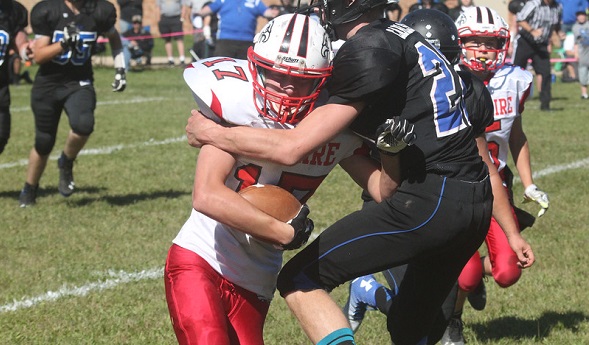
PHOTO: Bellaire, running against Eben Junction Superior Central last week, is one of seven undefeated teams in 8-player football. Superior Central is in a tight race for the final playoff spot and must climb six to make the field of 16. (Photo courtesy of Paul Gerard.)