

Whiteford's Mensing Bringing Successful System to Westland John Glenn
By
Doug Donnelly
Special for MHSAA.com
April 26, 2022
Jason Mensing insists that when he showed up at Ottawa Lake Whiteford a decade ago he had thoughts of a state championship on his mind.
 It seemed a tall task. The Bobcats had enjoyed pockets of success throughout school history but had just won just five playoff games and one conference football championship over the previous 45 years.
Still, the Tecumseh native and former Adrian College football player was determined.
“We believed if we could imprint our system and develop a strength program and teach the fundamentals and continue to grow, we’d have success,” Mensing said.
The formula was magic. Whiteford went 8-2 that first season under Mensing and tied a school record with nine wins in Year 2. By 2015, the Bobcats were in the MHSAA Semifinals for the first time. In 2016, Whiteford played at Ford Field for the first time. In 2017, Whiteford won a Division 8 championship. The Bobcats were a combined 93-24 during his decade running the program, including 11-2 this past fall.
“The reality is we do believe in our system,” Mensing said.
After 10 years, Mensing announced this week that he would be taking his system elsewhere. He will become the next head football coach at Westland John Glenn, a Class A school west of Detroit. The Rockets haven’t had much success in recent years, but school officials are excited to have Mensing on board.
“I’m excited to see what Jason can bring to our school and our program,” said John Glenn Principal Eric McCalla. “He is a culture builder. That’s one of the things we need here.”
McCalla is very familiar with Mensing. McCalla coached football for 16 years at Grass Lake and Manchester. At Grass Lake, McCalla’s team scrimmaged against Mensing’s for several years.
“It was definitely a great hire for us,” McCalla said. “We needed a different direction, and we feel confident that he is the right person for the job.”
Mensing, who will step down as athletic director and director of student advancement at Whiteford at the end of the school year, planned on meeting the John Glenn football players and parents this week. He will start immediately to build a coaching staff and relationships.
“They’ve struggled the last couple of years, but there is a solid history there,” Mensing said. “The first thing is I want is to bring stability and consistency to the program. They’ve had three football coaches in four years. We have to create an atmosphere where playing football is fun, create a culture where kids are excited about being part of the program.”
John Glenn has known football success. During the 1990s, John Glenn made several deep runs in the playoffs, reaching the Finals in 1993 and the Semifinals two more times.
The Rockets open the season Aug. 25 against Hartland in a nonleague game and play a challenging schedule in the always-tough Kensington Lakes Activities Association. They finished 2-7 last season and are seeking their first winning finish since 2014.
 “There’s no doubt that we play a tough schedule,” McCalla said. “In any given year we play one if not two or even three teams ranked in the top five or top 10. It’s a tough football conference.
“I think the first thing he can do is instill confidence in our kids. That is an important first step – and not just the kids, but the parents and the community. Having confidence in our program.”
Mensing was an academic All-American at Adrian College, where his father Henry Mensing coached and served as athletic director. Jason Mensing has made four other coaching stops during his 19-year career and picked up a lot of playoff appearances and coach of the year awards, and a built a lot of relationships.
He led Addison to the playoffs in his first season as varsity coach. He spent one year at Grayling, and won an Associated Press Class B Coach of the Year award during his three years at Owosso. He returned to Lenawee County to coach Tecumseh during the mid-2000s. In his one year away from high school football, he coached at Siena Heights University.
Whiteford lured him from the college level in 2012.
It wasn’t long before the milestone games and victories began piling up. Ironically, two Bobcats playoff losses were important steps in the team’s ascension. The first was a 2013 loss to New Lothrop in the Division 8 Regional Final. The Bobcats had beaten Sterling Heights Parkway Christian 59-6 and Detroit Allen Academy 61-20 in two home District games, then went on the road to face the Hornets, a powerhouse program.
“That loss was really big,” he said. “It showed us how far away we were but showed us what we needed to do to get there.”
Whiteford won seven games the following year, and in 2015 the Bobcats won three playoff games for the first time in school history, including a victory over a strong Climax-Scotts team. They lost the following week to Waterford Our Lady of the Lakes, but again, Mensing said, it was a loss that showed them the way.
“It was the moment we knew we belonged,” he said.
The Bobcats have ‘belonged’ ever since, proving not to be a one-and-done type program.
The 2017 team scored an incredible 737 points and punted just twice all season. The closest any opponent came was 16 points. Whiteford defeated Mendon in the Semifinals and Saginaw Nouvel in the Division 8 championship game.
Even in 2019 when the Bobcats went just 5-5, they upset a powerful Sand Creek team. Last year Whiteford reached the Division 8 Semifinals and led Hudson 22-0 at halftime before losing to the eventual champion, 28-22.
“There were some ups and downs,” Mensing said. “There were times we implemented things that didn’t necessarily work. Overall, though, we kept growing.
“When I look back at those years, the focus we started on growth and getting better year after year worked. We had 10 years of consistent growth. I do feel we are significantly more mature and better of a program than we were when I got here in 2012.”
Now, Mensing turns his attention to John Glenn, a school six times the size of Whiteford. He believes in the system he’s bringing with him and in the students at John Glenn.
“He’s a kid guy,” McCalla said. “We need people who are going to be there for our kids, not just football players, but all of our students. It’s not just about football, but life lessons.”
 Doug Donnelly has served as a sports and news reporter and city editor over 25 years, writing for the Daily Chief-Union in Upper Sandusky, Ohio from 1992-1995, the Monroe Evening News from 1995-2012 and the Adrian Daily Telegram since 2013. He's also written a book on high school basketball in Monroe County and compiles record books for various schools in southeast Michigan. E-mail him at [email protected] with story ideas for Jackson, Washtenaw, Hillsdale, Lenawee and Monroe counties.
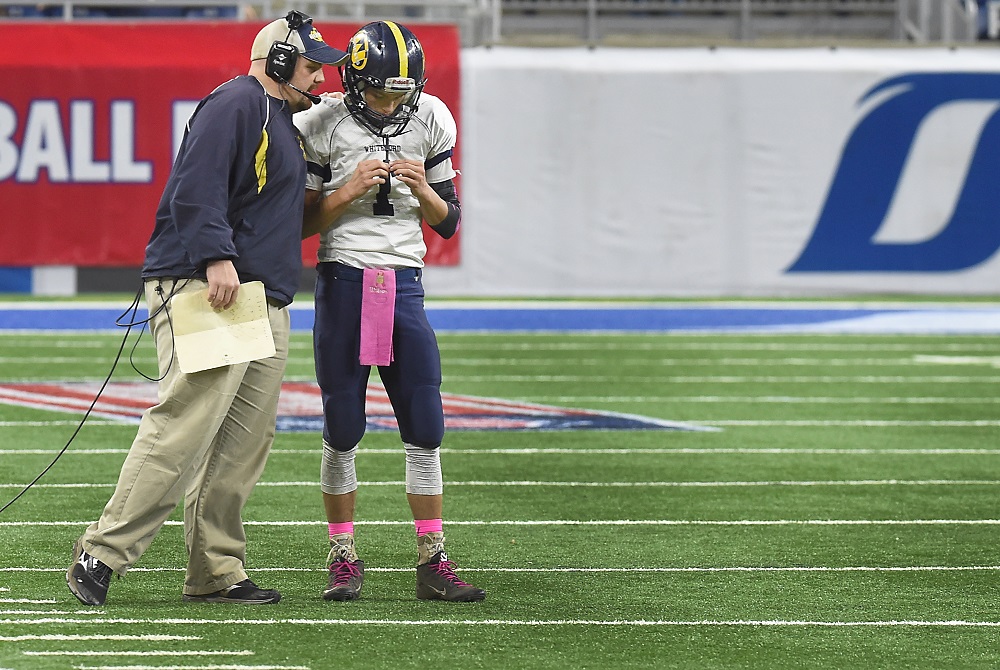
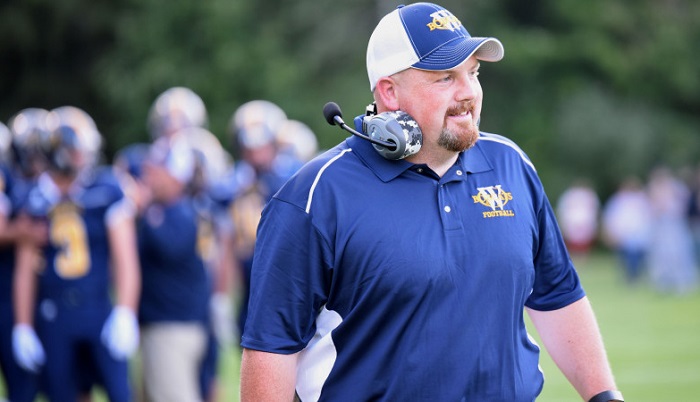
PHOTOS (Top) Coach Jason Mensing confers with a Whiteford player during one of the team’s two runs to Ford Field. (Middle) Mensing will be leaving the program after 10 seasons with the Bobcats. (Top photo by Tom Hawley/Monroe News; middle by Cari Hayes.)
Reading is Believing for 1st-Time Champ
November 23, 2018
By Geoff Kimmerly
Second Half editor
DETROIT – Alex Price’s 11 words – or rather, 56 characters – last Nov. 25 spoke volumes.
And he and his teammates made them count during Friday morning’s Division 8 Final at Ford Field.
Two days shy of a year ago, the Reading now-senior quarterback tweeted that his team would be making the trip to Detroit this weekend. It was quite a prediction. The Rangers had just finished 8-3 – but hadn’t reached a Semifinal since 2008 and had never played in an MHSAA football championship game.
Well, Reading is believing. Breckenridge scored first Friday, but the Rangers popped back up and broke away for a 39-20 win and their first Finals championship in this sport.
The win actually capped a three-year run that saw three freshmen and seven sophomores join the varsity in 2016, boosting that team from 11 to 21 players even as the overall level of experience fell dramatically. Reading finished only 3-6 that season, but set the stage for the team to play on the state’s biggest.
“What’s special is the kids,” Reading coach Rick Bailey said. “Basically we played that (2016) year with a junior varsity team at the varsity level. We went 3-6, but we competed in every game. They decided back then they were going to make it happen.”
can’t say I wasn’t wrong... https://t.co/cQQ3uMCrTH
— alex (@alex_price2035) November 17, 2018
Friday morning was going to be filled with firsts, regardless of the winner. Breckenridge also was making its first MHSAA Finals appearance in football, and both teams were undefeated heading into the day.
Reading (13-0) rarely had been stopped this season – even the local police escorted the Rangers through a few red lights early Friday as part of an escort kicking off the morning march.
But they knew they were in for some challenges right away. First, Breckenridge stopped Reading on a fourth down play at the Rangers’ 32-yard-line just four minutes into the game. The Huskies followed up by scoring the game’s first touchdown, converting two fourth downs on the way to the end zone.
Reading had been giving up only 7.2 points per game, and Breckenridge suddenly led 6-0. Game on. But the Rangers’ defense – one of the most impressive in any division this fall – brought things back to even with a Finals first.
With just over a minute left in the first quarter, senior Caleb Miller’s 42-yard punt pinned the Huskies on their 1-yard-line. On the next play, Miller got a sack and the ball came loose, and junior Elijah Strine ended up with it in the end zone – the first fumble recovery for a touchdown in MHSAA championship game history. Senior
Ethan LoPresto’s 2-point conversion run put the Rangers ahead, to stay, just 14 seconds after one of the few times they trailed this fall.
“We were down when they scored first – we’re not use to that. We’re not used to teams scoring much on us at all,” Miller said. “That got the momentum up and really helped us out.”
Bailey said Breckenridge (12-1) had the toughest defense his team had seen this season. And the Huskies didn’t let up despite the disappointing and historic turn of events. But Reading began to grind, adding a touchdown on a drive of 5 minutes, 10 seconds, midway through the second quarter and extending the lead to 24-6 on a Price score to cap a 5:39 drive to start the third period.
 Breckenridge still didn’t go away, and that was saying a lot against a Reading defense that also had given up just a little more than 500 rushing yards total and only rushing touchdown over the first 13 weeks.
The Rangers held the Huskies to just 21 yards rushing for this game – but Breckenridge did get a touchdown on the ground and two through the air from senior quarterback Carter Staley to senior running back Hunter Collins, who also had the rushing score.
“I was just extremely proud of everyone on our team, pushing ourselves and pushing each other and not giving up on one another,” Staley said. “That’s just what got us here.”
LoPresto led the Reading offensive effort with 123 yards on 16 carries. Junior Hunter Midtgard had the most memorable play, breaking free in the fourth quarter off a block from junior Ben Affholter for a 57-yard score. Strine also ran for a touchdown.
No player had more than five tackles for the Rangers – but as a unit they had 10 for losses and three sacks.
Staley finished 14 of 19 passing for 177 yards and the two scores, and Collins caught six passes for 55 yards while junior back Lukas Ebright caught four for 55.
Breckenridge had a similar back story to Reading – the Huskies went 0-9 in 2015 when a handful of this team’s leaders were learning on the fly as freshmen. Four years later, 11 seniors are done but next season’s returnees have played up to another full season with extra games during the last three playoff runs.
“We’ve got a plan, and we stick to it,” Breckenridge coach Kris Robinson said. “It’s good athletes coming through, but we’ve also got a process. We’ve learned as a coaching staff, and I’m hoping we can move forward from here.”
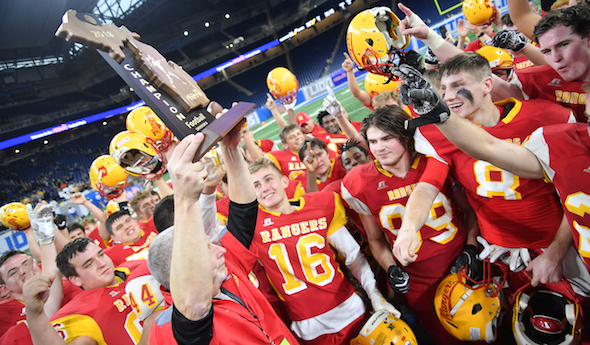
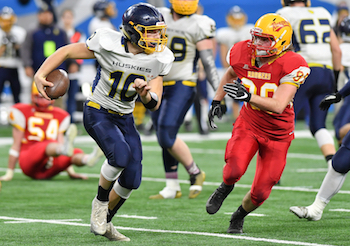
PHOTOS: (Top) Reading celebrates its first MHSAA football championship Friday. (Middle) The Rangers’ Caleb Miller, right, chases Breckenridge quarterback Carter Staley.