


The Whole Body of Work
June 27, 2016
From time to time over the years, criticism has been leveled at the Michigan High School Athletic Association because an MHSAA publication cover lacked a certain number of photos of females or minorities, or a certain balance of large schools or small schools or nonpublic schools ...
My response has always been, “Don’t base your opinion on one cover. Look at the whole body of work. Look at the covers across all sports and an entire year.”
So, when there was recent criticism that our football practice policy wasn’t progressive enough, that it allows (in theory only) too much time for contact drills, my response is: Look at the entire body of work.
The MHSAA was one of the first states in the nation to limit contact in football practice, both preseason and regular season. Some states still do not.
Some of the states which appear to have more restrictive practice policies in the fall also allow football practice in the spring, which actually increases exposure to injury. Michigan does not.
Some states which appear to have more restrictive practice policies in the fall also allow contact at out-of-season football camps, which actually increases exposure to injury. Michigan does not – never has allowed its players to participate in contact drills at football camps, a policy to which some states are returning because of the safety concerns we’ve always had in Michigan.
Some states allow students to participate in five, six or even eight quarters of football games in a single week. In Michigan, students can play in one game only during any five day period, never two, and never part or all of a JV game one day and part or all of a varsity game another day during the same week. That’s been Michigan’s rule for decades, and some states are finally moving in that direction.
-
The MHSAA is the first and only state to provide concussion care gap insurance at its own cost to assure all students have prompt and professional medical attention without the worry of unpaid medical expenses. This is for all students in all levels of all sports, practice and competition, grades 6 through 12.
-
The MHSAA conducts the nation’s largest high school association managed sideline concussion detection pilot program.
-
The MHSAA conducts the nation’s broadest and deepest high school association managed concussion reporting system.
There is still more to the whole body of work – but the point is made. Criticism of the MHSAA for lack of attention to participant safety – in football or any other sport – is wholly unjustified.
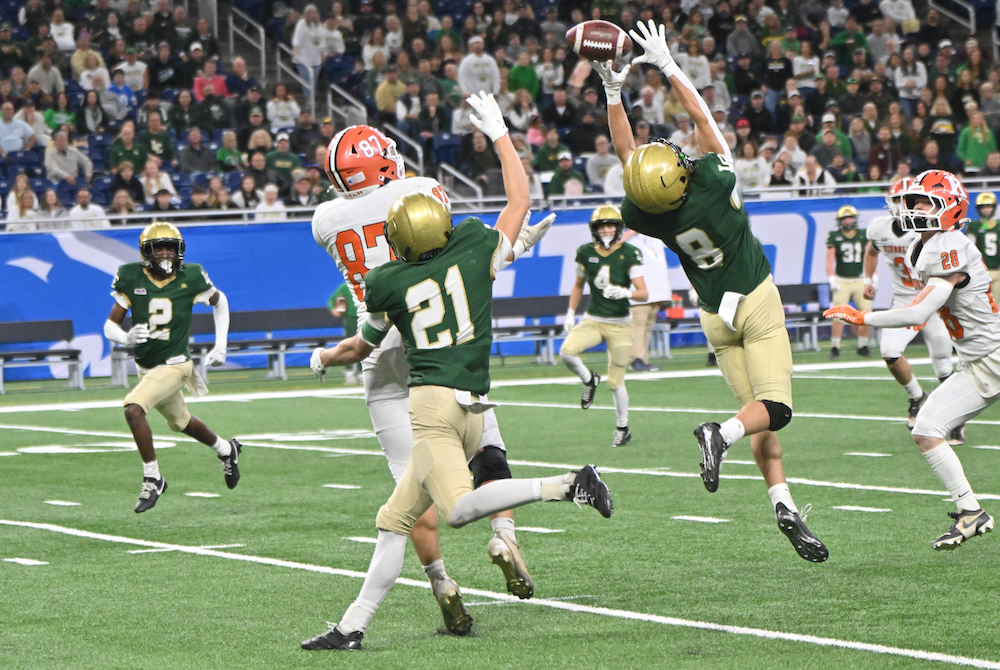
Lumen Christi Accomplishes Program First with 4th-Straight Finals Title
By
Paul Costanzo
Special for MHSAA.com
November 28, 2025
DETROIT – As Jackson Lumen Christi lined up to exchange postgame handshakes with Kingsley following its fourth-straight victory in a football Final, Foreigner’s “Feels Like the First Time” rang out through the Ford Field speakers.
The 28-14 victory in Friday’s Division 6 Final was actually the record 15th time for the Titans, and 14th for coach Herb Brogan.
But as far as he was concerned, only this one mattered in the moment. So, good call, Ford Field DJ.
“(Winning a fourth straight) is important, but what’s most important is the accomplishments of this team, this year,” Brogan said. “Every team is different. But, the fact that we had never won four (in a row), we had one opportunity and didn’t take advantage of it, that was certainly in our conversation all year long. Something we kind of stressed to the kids that we’ve done some great things, but nobody has ever done this. Our slogan was ‘Leave Your Mark,’ and their mark is they were able to do something no other team has been able to do before.”
Friday marked the second-straight Division 6 title for the Titans, who had won in Division 7 in 2022 and 2023. Lumen Christi previously had won three straight championships one other time, from 2016-18.
While it was a tight game that was in doubt into the fourth quarter, for Brogan it was won with actions taken just days after the 2024 title win.
 “I think the formula is pretty simple, and that’s to work hard,” Brogan said. “At the conclusion of the game last week, I pulled out my phone and showed the kids two pictures of two kids on this year’s team leaning out the back doors of the weight room last year throwing up. What makes that special is not what they were doing, because that happens all over the state. What makes that special is that was taken on the Monday after our state championship game.”
A fourth-quarter surge from Lumen Christi was what won the game on the field, as the Titans offense awoke from a Kingsley-induced two-quarter slumber to find its footing.
It started with a blocked 34-yard field goal attempt by Jake Contat with the game tied at 14.
That was followed by an eight-play, 72-yard drive which took up 4 minutes, 38 seconds of game time and was finished with a 23-yard touchdown pass from Benny Gaston to Johnny Walters.
With Kingsley driving near midfield on the next possession, Walters came up big again, this time with an interception.
“There was just a lot of energy, we were real excited,” Walters said. “But we knew it wasn’t over yet, and we had to keep going.”
The Titans did keep going, putting the game away with a 34-yard touchdown run by Sean Walicki with 2:20 to play. A fumble recovery on Kingsley’s next offensive play made it official.
“I have great respect for Kingsley, the players and the coaching staff. I thought they were really well-prepared and played really hard,” Brogan said. “... In the fourth quarter, I thought our offensive line really took over and controlled the line of scrimmage and allowed us to move the football.”
The end of the game was much like the beginning for the Titans (11-3), who jumped out to a 14-0 lead midway through the first quarter as Ayden Gatewood scored on a 25-yard run and Walicki broke off a 60-yard score.
But Kingsley (11-3) was unfazed, answering Walicki’s score with a 10-play, 62-yard drive that ended with a one-yard run by Andrew George.
It looked as though the Titans would take that 14-7 lead into the half, but Kingsley downed a punt on the one-yard line with 21 seconds left, and forced and recovered a fumble as the Titans attempted to run the clock out on the half.
 Nolan Hodges came away with the ball at the 3, and while it was originally ruled that the Lumen Christi runner was down, review overturned the call.
One play later, Tucker Dreves found Gavin Lewis in the corner of the endzone for a touchdown, and the game entered the half tied at 14.
“I think the first thing that we always say about our kids is that we have fighters,” Kingsley co-coach Jason Morrow said. “We obviously didn’t play well in the first six minutes of that game, and you can’t take a team as talented and as well-coached as they are and spot them 14 points. But, incredibly proud of our kids. We go into the fourth quarter and it’s 14-14 and we had an opportunity because we have fighters.”
Those fighters really showed up on defense, as Kingsley held Lumen Christi to just 40 yards of offense between that second drive and the two game-changing fourth quarter drives.
Colton Goethals, Lewis and Hodges each had six tackles to lead that defensive effort. Lewis added 117 yards rushing to lead the Kingsley offense.
Walicki had a massive defensive effort to match his big day on offense, recording a game-high 17 tackles. On the other side of the ball, he rushed 11 times for 142 yards and the two touchdowns.
Gaston finished the day 8-of-13 passing for 111 yards and the touchdown to Walters. Antwon Baker and Brennan Brogan each added eight tackles for the Titans.
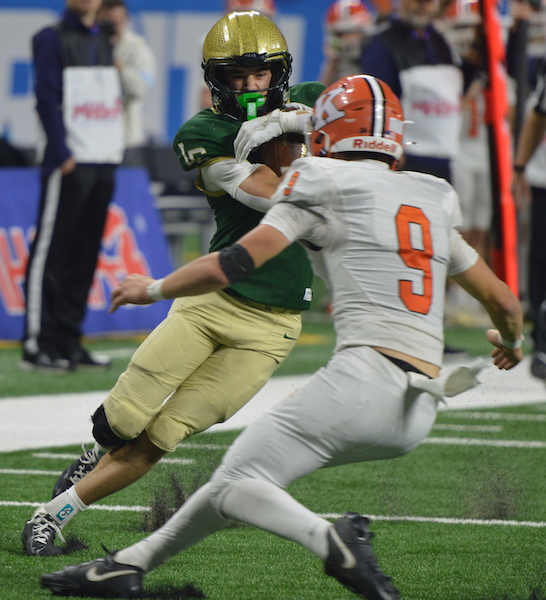
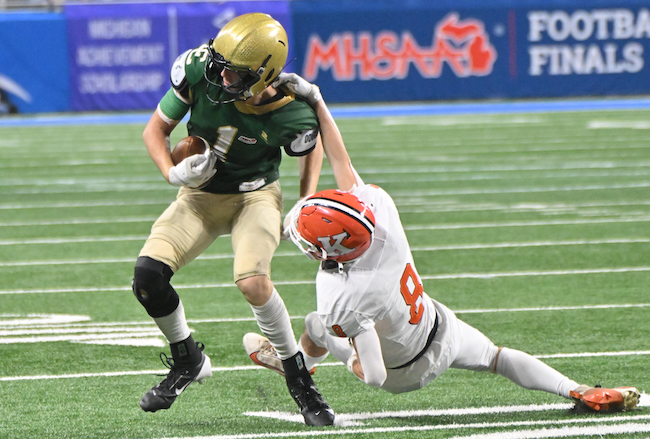
PHOTOS (Top) Lumen Christi’s Johnny Walters (8) and Nolan Huff (21) break up a pass intended for Kingsley’s Alex Figueroa (87) on Friday at Ford Field. (Middle) The Stags’ Tucker Dreves (9) closes in on a Titans ball carrier. (Below) Kingsley’s Andrew George (8) works to bring down Wes Learned.