


The Whole Body of Work
June 27, 2016
From time to time over the years, criticism has been leveled at the Michigan High School Athletic Association because an MHSAA publication cover lacked a certain number of photos of females or minorities, or a certain balance of large schools or small schools or nonpublic schools ...
My response has always been, “Don’t base your opinion on one cover. Look at the whole body of work. Look at the covers across all sports and an entire year.”
So, when there was recent criticism that our football practice policy wasn’t progressive enough, that it allows (in theory only) too much time for contact drills, my response is: Look at the entire body of work.
The MHSAA was one of the first states in the nation to limit contact in football practice, both preseason and regular season. Some states still do not.
Some of the states which appear to have more restrictive practice policies in the fall also allow football practice in the spring, which actually increases exposure to injury. Michigan does not.
Some states which appear to have more restrictive practice policies in the fall also allow contact at out-of-season football camps, which actually increases exposure to injury. Michigan does not – never has allowed its players to participate in contact drills at football camps, a policy to which some states are returning because of the safety concerns we’ve always had in Michigan.
Some states allow students to participate in five, six or even eight quarters of football games in a single week. In Michigan, students can play in one game only during any five day period, never two, and never part or all of a JV game one day and part or all of a varsity game another day during the same week. That’s been Michigan’s rule for decades, and some states are finally moving in that direction.
-
The MHSAA is the first and only state to provide concussion care gap insurance at its own cost to assure all students have prompt and professional medical attention without the worry of unpaid medical expenses. This is for all students in all levels of all sports, practice and competition, grades 6 through 12.
-
The MHSAA conducts the nation’s largest high school association managed sideline concussion detection pilot program.
-
The MHSAA conducts the nation’s broadest and deepest high school association managed concussion reporting system.
There is still more to the whole body of work – but the point is made. Criticism of the MHSAA for lack of attention to participant safety – in football or any other sport – is wholly unjustified.
Bush Legacy: Culture of Opportunity
By
Doug Donnelly
Special for MHSAA.com
April 6, 2018
By Doug Donnelly
Special for Second Half
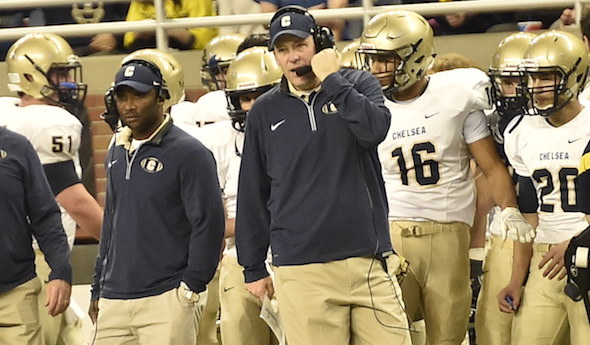
CHELSEA – For the first time as Chelsea High School athletic director, Brad Bush has to hire a football coach.
 What’s more, he has the unenviable task of replacing himself.
“I would say that nobody cares more about Chelsea football than I do,” Bush said. “It’s important to me that we find the very best person we can.”
Bush has coached the Bulldogs for 21 seasons. But, his coaching background goes much deeper than that.
He played at Ypsilanti High School for Hall of Fame coach Bill Giarmo, graduating in 1988. After playing quarterback at Cornell University in the Ivy League, he returned to Michigan, graduating from Eastern Michigan University, and started coaching for Bill Kohn, another inductee to the Michigan High School Football Coaches Association Hall of Fame. Bush then went to East Kentwood to coach with Giarmo.
Through his own playing days, coaching with those legends of the game and absorbing everything he could from afar, Bush has developed an impressive culture at Chelsea.
“Friday nights in Chelsea are a big deal,” he said. “We want to keep that tradition.”
Bush became the varsity head coach at Chelsea in 1997. At the time, Chelsea had only two playoff appearances. Bush’s Bulldogs went 3-6 that first season. After that, Chelsea didn’t have a sub-.500 finish for 15 years. The Bulldogs have been kept out of the playoffs only once since 1998.
Chelsea has had only three head coaches since 1965.
“I’m fortunate,” Bush said. “I went for a few more years than the other guys. It’s a great place to coach.”
Temperance Bedford head coach Jeff Wood was an assistant with Bush at Ypsilanti during the 1990s and said he thought then that Bush was going to develop into a great head coach.
“We knew he was going to accomplish greatness, not only as a football coach, but as a father, husband and professional in education,” Wood said. “Brad has always won and lost with great class and dignity. He’s a true Hall of Famer.”
If Bush never coaches at Chelsea again, his lasting legacy might be that culture surrounding the Bulldogs program. It’s known for its large number of football players, from middle school through the varsity, and a system that ensures every student athlete on every team leading to the varsity will play in every game. Teams at the middle school, freshman and junior varsity levels all start 22 players each game – with no two-way starters. For a Class B/Division 3 school, that isn’t the norm.
“We’ve had the same philosophy for 20 years,” he said. “Everybody plays in every middle school, freshman and junior varsity game. That’s how we do it. We start 22 kids on every level. Our kids know they will have the opportunity to play.
“Every kid on every level is going to play in every game. On most nights, we play more kids than the other team has players.”
While every school loses some athletes, or potential athletes, along the way, Bush said this system helps maintain a student’s interest in the sport. Often, he said, a player who may not necessarily be a starter as a freshman will learn the game, develop and turn into a starter by senior year.
“We feel that, over time, with repetition and practice, a kid will become an expert at his position,” he said. “For us, this is a big piece. … That was my thing here. I didn’t invent it. I absorbed it, watched it at other places.”
It’s tough to argue with the results. Chelsea won or shared Southeastern Conference championships in 1999, 2000, 2001, 2003, 2004, 2006, 2007, 2008, 2011, 2012, 2015, 2016 and 2017. The Bulldogs won seven District championships during the Bush era and played in the 2015 Division 3 championship game, falling to Orchard Lake St. Mary’s at Ford Field
He said he learned how to build a program from Giarmo and how to coach a football team under Kohn. Bush was quick to credit his assistant coaches who have remained with the program for years and helped build the culture. He said the program has sacrificed win-at-all-cost at the lower levels with the goal of developing varsity football players.
“You have to manage it,” he said. “That’s why you need a great staff. We have been lucky here with a great, dedicated group of guys. They always have the ultimate goal in mind.”
Bush said he won’t hamstring the next coach into running his system, but anticipates whoever is hired will buy into the culture after seeing what it’s about.
“The next coach has to run it the way he wants to run it, but I do believe we have created a culture here and we’d like to maintain that. You want to hire the right person who is going to handle the kids the right way.”
In addition to coaching at Chelsea and leading the entire athletic program, Bush also is heavily involved in the Michigan High School Football Coaches Association as a past president, serves on the Michigan High School Athletic Association football committee and has served on the National Federation football rules committee. He’s coached in all-star games and is a true believer in high school sports.
His record at Chelsea is 169-60.
“I have great energy,” Bush said. “I love coaching. I have a great passion for it, but I also know when you need to do certain things. I felt this was just the right time for the athletic department and the football team. It wasn’t one thing that led me to this.
“I love the game. I’m going to be very much involved.”
 Doug Donnelly has served as a sports and news reporter and city editor over 25 years, writing for the Daily Chief-Union in Upper Sandusky, Ohio from 1992-1995, the Monroe Evening News from 1995-2012 and the Adrian Daily Telegram since 2013. He's also written a book on high school basketball in Monroe County and compiles record books for various schools in southeast Michigan. E-mail him at [email protected] with story ideas for Jackson, Washtenaw, Hillsdale, Lenawee and Monroe counties.
PHOTO: Chelsea's Brad Bush coaches his team during the 2015 Division 3 Final at Ford Field.