


The Whole Body of Work
June 27, 2016
From time to time over the years, criticism has been leveled at the Michigan High School Athletic Association because an MHSAA publication cover lacked a certain number of photos of females or minorities, or a certain balance of large schools or small schools or nonpublic schools ...
My response has always been, “Don’t base your opinion on one cover. Look at the whole body of work. Look at the covers across all sports and an entire year.”
So, when there was recent criticism that our football practice policy wasn’t progressive enough, that it allows (in theory only) too much time for contact drills, my response is: Look at the entire body of work.
The MHSAA was one of the first states in the nation to limit contact in football practice, both preseason and regular season. Some states still do not.
Some of the states which appear to have more restrictive practice policies in the fall also allow football practice in the spring, which actually increases exposure to injury. Michigan does not.
Some states which appear to have more restrictive practice policies in the fall also allow contact at out-of-season football camps, which actually increases exposure to injury. Michigan does not – never has allowed its players to participate in contact drills at football camps, a policy to which some states are returning because of the safety concerns we’ve always had in Michigan.
Some states allow students to participate in five, six or even eight quarters of football games in a single week. In Michigan, students can play in one game only during any five day period, never two, and never part or all of a JV game one day and part or all of a varsity game another day during the same week. That’s been Michigan’s rule for decades, and some states are finally moving in that direction.
-
The MHSAA is the first and only state to provide concussion care gap insurance at its own cost to assure all students have prompt and professional medical attention without the worry of unpaid medical expenses. This is for all students in all levels of all sports, practice and competition, grades 6 through 12.
-
The MHSAA conducts the nation’s largest high school association managed sideline concussion detection pilot program.
-
The MHSAA conducts the nation’s broadest and deepest high school association managed concussion reporting system.
There is still more to the whole body of work – but the point is made. Criticism of the MHSAA for lack of attention to participant safety – in football or any other sport – is wholly unjustified.
'Next Up' Help P-W to Next Championship
November 25, 2017
By Geoff Kimmerly
Second Half editor
DETROIT – The Pewamo-Westphalia football program finished a second straight season hoisting a championship trophy at Ford Field on Saturday, thanks to the “next man up” … and the next man … and the next man after that.
 It was easy to credit the Pirates’ first MHSAA football title ever, won last year, on the state’s all-time second leading rusher Jared Smith. But he graduated in the spring.
They got back to Ford Field in large part on the running and passing skills of senior quarterback Jimmy Lehman. And then Lehman potentially broke his left hand in the second quarter and didn’t play the final two.
In both instances, and a few more this fall, someone stepped right in. This time, the Pirates weathered the loss of Lehman and stood strong as Saugatuck’s offense caught stride to close with a 21-0 win that proved once more P-W’s teams of the last two seasons were even better than the sum of some truly elite parts.
“We had a lot of people that just really felt like they had to step up,” Lehman said. “We lost our first game (28-21 to Monroe St. Mary Catholic Central) and that was some of the adversity we had to go through all year – how were we going to respond from that? We just made sure we took every day and made it the best we could, and just improve from there.”
That loss to the Falcons was P-W’s only defeat of the last two seasons, and they improved to 40-3 over the last three years after also finishing Division 7 runner-up in 2015.
The “next man up” success sort of began in last season’s championship game, when Smith served as a tremendous decoy running for 48 of his 8,182 career yards while Lehman and others starred in a 28-14 win over Detroit Loyola.
Lehman took the reins fulltime this fall and threw for 1,627 yards and 20 touchdowns, running for 728 yards and 16 scores – and while starting as a forceful 6-foot-4, 215-pound defensive end as well.
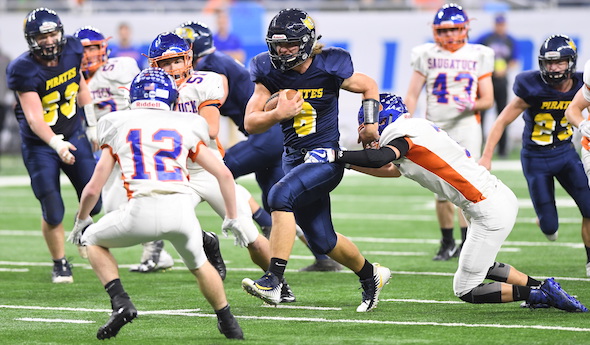
His late first quarter touchdown run from 12 yards out said it all as Lehman broke two tackles and dragged three more defenders into the end zone. He stayed in the game at first after injuring the hand on P-W’s final possession of the first half, throwing a 12-yard touchdown pass to senior Peyton Heckman to finish his day.
The Pirates threw only one pass during a scoreless second half. Junior Noah Spitzley stepped in and helped that effort on the defensive side, tying for third on the team with six tackles.
“It says a lot about the other guys on the team, the other guys in the program that are just continually working and waiting for an opportunity,” P-W coach Jeremy Miller said. “Cameron Wirth started for us all year at fullback and linebacker, and we lost him on the opening kickoff of the Semifinal. Justin Pohl, who hadn’t played a whole lot, stepped in and did a great job at fullback for us today. So we always have the ‘next man up’ mentality, and these guys are constantly ready. And I think it says a lot about them.”
Saugatuck’s run this fall said plenty as well. The Indians this spring graduated Blake Dunn, the eighth-leading rusher in MHSAA career history. But they made it to Ford Field for the first time since finishing Division 8 runner-up in 2010, ironically after seeing perfect seasons end against P-W in District Finals the last two years in losses of 10 and six points.
“It’s been our dream forever to get here, and the first thing yesterday when we first walked in here, it was amazing – it just opened up,” Saugatuck senior linebacker Reece Schreckengust said. “It’s a great stadium, a great atmosphere. Losing hurts, but to get all the way here, it was a great season. I’m proud of every one of my teammates, my coaches, and myself and everyone else in our community for getting here. … To go out at Ford Field is probably the second best, besides winning it.”
 After struggling during the first half, Saugatuck (10-4) took its shots at making it close during the second.
The Indians drove to P-W’s 18-yard line on their second possession of the third quarter, but sophomore linebacker Jacob Pung ended that rally with an interception at the 11.
Saugatuck then drove to the Pirates’ 3-yard line early in the fourth quarter, before having first and second-down runs stopped for a one-yard loss and no gain, respectively, seeing a third-down pass fall incomplete and getting sacked on fourth down for a 16-yard loss by Spitzley and senior Damon Schneider.
Total, P-W (13-1) held Saugatuck to 147 yards of offense. The shutout was the Pirates’ second of the playoffs and sixth this season, not including a 2-0 forfeit win in Week 7.
“They’re just a big, physical, fast team,” Saugatuck senior quarterback Jackson Shriver said. “That’s what makes a great defense. They follow their system and play hard. They have a great team, and it was hard to play against them.”
Saugatuck’s defense deserved praise as well. The Pirates’ 21 points were their fewest since that opening-night loss.
“We had our moments when we could’ve come back, and unfortunately it didn’t happen,” Indians coach Bill Dunn said. “To hold a team like that to 21 is a good credit. A couple of those came off miscues either offensively, or a turnover. Our defense was exceptional considering the opponent. They were just a little bit better today.”
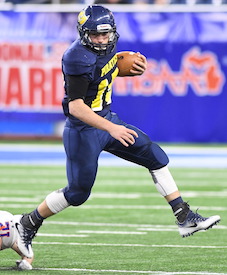
Senior Bryce Thelen added 92 yards rushing on 14 carries and scored P-W’s first touchdown midway through the first quarter. Schneider paced the defense with eight tackles including two sacks.
Schreckengust, who will graduate as Saugatuck’s career tackles record holder, had nine more, as did senior Connor Carper.
“They always play hard, and so respectful,” Thelen said of what’s become an annual meeting between the programs. “It’s always a hard-nosed game, always close, always super physical. They’re just fun games to play in that come down to a couple plays throughout the game that tilt the game one way or the other.”
The MHSAA Playoffs are sponsored by the Michigan Army National Guard.
PHOTOS: (Top) P-W quarterback Jimmy Lehman charges upfield during the Division 7 championship game. (Middle) Bryce Thelen eludes the grasp of a Saugatuck defender.