

Wooer Leads Kingsley's Return to Power
November 1, 2018
By Chris Dobrowolski
Special for Second Half
KINGSLEY — Tim Wooer does not have the ability to wave a wand and make victories on the football field appear out of thin air.
 The Kingsley football program is certainly grateful for the magic Wooer has brought back to the gridiron in no time at all, however.
After going 1-8 at year ago, Kingsley has had a remarkable turnaround in the first year of Wooer’s second tenure as Stags varsity head coach, going 9-1, including last week’s 62-22 Division 6 District playoff win over Tawas.
“The bottom line is — people have asked me how did this happen? I can only give you one answer, and it is the kids,” said Wooer.
It’s a group of players who have endured a lot the past few seasons. The once-proud program had fallen on hard times, seeing a decline in wins after a 6-4 playoff season in 2014. The Stags went 5-4, 5-4, 3-6 and bottomed out with one win during a tumultuous 2017 campaign that saw the previous head coach placed on administrative leave in the middle of the season before he later resigned. Interim coach Jamie Mullen finished out the fall. Needless to say, Kingsley’s players didn’t find many good, positive memories from the season.
“I didn’t even want to play anymore. I was just happy for (the season) to be over,” said Kingsley senior captain Dylan Case.
Wooer noticed the apathy, lack of energy and complacency that seemed to be common among many of the male athletes at his alma mater not long after he came on as a long-term substitute teacher at Kingsley just months after retiring from education. He also was in his 10th year as the head coach at Traverse City West and was enjoying his best year yet with the Titans, who finished 9-2 and won their first playoff game since Wooer arrived in 2008.
But while he was subbing, Wooer was able to drive his two daughters, Lauren and Sarah, to school every morning. He realized then how precious the moments with them and his son, Tyler, had become. So, when Wooer was approached about taking over the Stags in January, he didn’t need much time to make a decision.
“From a football standpoint it was a very poor decision at the time,” said Wooer. “We thought we had things going at West. We were 8-1, had a good nucleus coming back. Our numbers at the middle school were great. It was really kind of self-sustaining at that point. We had a really good thing going. But all the other factors made it a quite simple decision. It was family and obviously my love for Kingsley and the community of Kingsley.”
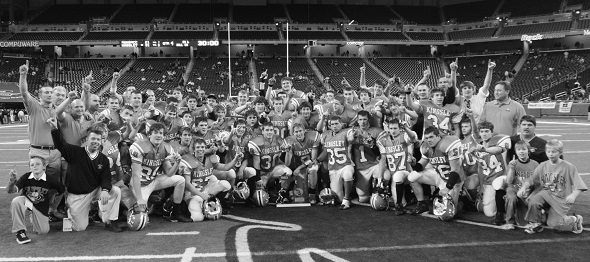
There was good reason for people in Kingsley to yearn for Wooer to come back. When he left after nine years, he had compiled a record of 68-29 and, most notably, guided the Stags to the 2005 Division 6 championship. A few of the oldest players on Kingsley’s current team were in kindergarten during that season. Many others had not started school. But many knew of Wooer. Parents, older siblings, cousins and community members alike had talked fondly of the 2005 title team, and a picture documenting the championship hangs prominently in the school. It gave Wooer instant credibility.
“He led Kingsley to a state championship,” said Case. “We knew he knew what he was talking about and that he wanted what was best for us.”
Coming off a 1-8 season, the players were more than willing to buy in to what Wooer was selling — winning football.
“You don’t really question it because we went 1-8,” said senior Jake Radtke, another senior captain. “We were like, ‘OK, this doesn’t work.’ Just trust the process and believe what he’s saying and buy in. He bleeds Black and Orange, and I love it. He knows we bleed Black and Orange, and he’s part of our family.”
Wooer surrounded himself with a staff of coaches who are mostly Kingsley alums and former players. Dan Goethels played on the team in 1997. Al Olds, Ryan Zenner and Dave Zenner all played for Wooer on the 2002 Kingsley squad. Mullin and Ron Hessem were three years behind Wooer in school in the late ‘80s. Ray Fisher, whose son Jake plays for the Cincinnati Bengals after starring for Wooer at West, has followed Wooer from Kingsley, to West, and now is back with the Stags.
 “We’ve surrounded ourselves with some really good people who have a love for Kingsley and understand the system and what we want to do,” Wooer said of his assistants.
Wooer laid down the law at his first meeting with the team last winter. He talked about bringing discipline to the program and set his expectations for players in preparation for the season, particularly getting better participation in the weight room. More than 40 players in the high school took that to heart and had perfect attendance in lifting over the summer.
“There were lots of expectations,” said senior lineman Nathan Ames. “You could tell from his speech that it was going to be a lot of work. From the first second of team camp everybody bought in. After team camp, I definitely knew what was going to happen.”
Wooer still might not have been so sure how much success he would have with the Stags right away. He thought his team played poorly in its first preseason scrimmage at Manton. Even after an improved showing against the likes of Harrison, North Muskegon and Mason County Central in a second scrimmage, Wooer still wasn’t convinced his team was ready to compete when it met McBain in the first week of the regular season.
“I can still remember driving down to McBain — I was terrified,” said Wooer. “I’m on the bus thinking we are so unprepared. We couldn’t make an adjustment outside of a timeout. It was timeouts and quarters where you had to throw as much information at them as you could, hoping they could make those adjustments. It took two or three weeks before we could. We were making adjustments on the fly. I was yelling stuff out on the field.”
The Stags ended up pulling out a 24-20 victory over a good McBain squad. People were already half-joking that the team had equaled its win total from the previous season.
“That was a huge turnaround,” said Ames. “We all just kind of looked at each other after that win and said this is it.”
Wins over Ogemaw Heights and Grayling followed. Though the Stags fell to Traverse City St. Francis in the fourth week, they rebounded with five straight victories to finish the regular season.
With the wins have also come some individual accolades. Six players were named to the all-Northern Michigan Football League Legends division first team — running back Ayden Mullin, who was the league’s Offensive Player of the Year, along with Ames at defensive tackle, Radtke at guard, tight end Ian Sousa, outside linebacker Devon Hager and defensive back Owen Graves.
“It was very refreshing to have kids who want to be coached and want to be pushed,” said Wooer. “That’s not common in today’s world.
“It has not been an easy process. There were some chewings and some tough times, but they didn’t flinch once. Once they saw the success they received for their efforts, and everything did work as it was planned, it kind of fell into place. I just can’t say enough about the kids. It’s all about every one of the kids in our program.”
 Chris Dobrowolski has covered northern Lower Peninsula sports since 1999 at the Ogemaw County Herald, Alpena News, Traverse City Record-Eagle and currently as sports editor at the Antrim Kalkaska Review since 2016. He can be reached at [email protected] with story ideas for Manistee, Wexford, Missaukee, Roscommon, Ogemaw, Iosco, Alcona, Oscoda, Crawford, Kalkaska, Grand Traverse, Benzie, Leelanau, Antrim, Otsego, Montmorency, Alpena, Presque Isle, Cheboygan, Charlevoix and Emmet counties.
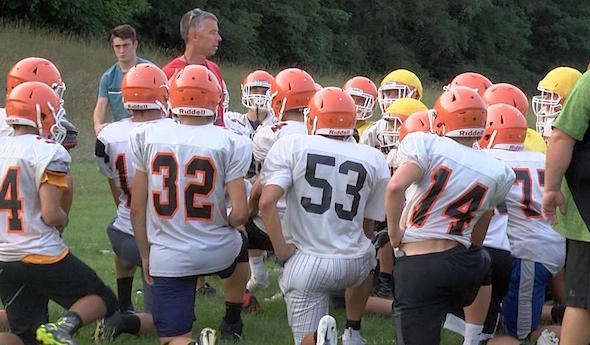
PHOTOS: (Top) Kingsley football coach Tim Wooer addresses his team during practice this fall. (Middle) Wooer, bottom left, celebrates with his team after the Stags won the 2005 Division 6 title at Pontiac Silverdome. (Top photo courtesy of WPBN.)
Harris Flies Like a Record-Setting Eagle
By
Geoff Kimmerly
MHSAA.com senior editor
November 30, 2012
Drake Harris may not have expected the full force of the performance he put up Saturday to cap an incredible junior season for Grand Rapids Christian.
But he had a pretty good idea at the start that it could turn into a special night.
When Orchard Lake St. Mary’s attempted to cover him with just one player – and continued to do so frequently throughout the Division 3 Final at Ford Field – the 6-foot-4, 180-pound Harris found himself in a dream come true.
“I kinda figured they would come out like that and play me like that. My coach knew that, and he just put me in the right position to make plays,” Harris said. “And I was happy they came out like that.
“I’m not the type to brag on myself. But when I see that, man-to-man coverage, that’s my dream. I love when people go man, and no safety over the top. It’s just me and the DB. The better man wins.”
Harris gets a Second Half High 5 this week after probably the most victorious day in his young career.
He grabbed eight passes for an MHSAA Finals record 243 yards and a touchdown as the Eagles beat St. Mary’s 40-37 in overtime to claim their first football championship.
Saturday’s numbers gave him, unofficially, 91 catches for 2,015 yards and 25 scores this fall. While those totals still must be confirmed for record book purposes, the yardage will be the most in MHSAA history for one season and rank 12thnationally. His yards per game this fall will rank fourth nationally and his yards per catch sixth. His catches will rank fourth in MHSAA history and his touchdown catches second.
Harris has committed to sign next fall with Michigan State for basketball and then the following February for football too. He’s expected to do big things again this winter for a Grand Rapids Christian basketball team that advanced to the Class A Quarterfinals last season.
Hoops always was his sport – he wasn't sure at one point that he’d even play football in high school. But Harris said Spartans men’s basketball coach Tom Izzo told him he loves players who are on their football teams as well. And Harris said he is starting to realize his football future might be the brighter of the two.
Saturday couldn't have hurt that observation.
Harris caught passes of 49 and 22 yards before hauling in a 74-yard scoring strike early in the second quarter. He had an 85-yarder called back during the third quarter, but caught passes of 24 and 38 yards to set up a touchdown early in the fourth. He then caught his final three passes during the team’s final possession of regulation, gaining a total of 36 yards in helping to set up Joel Schipper’s 28-yard game-tying field goal with four seconds left.
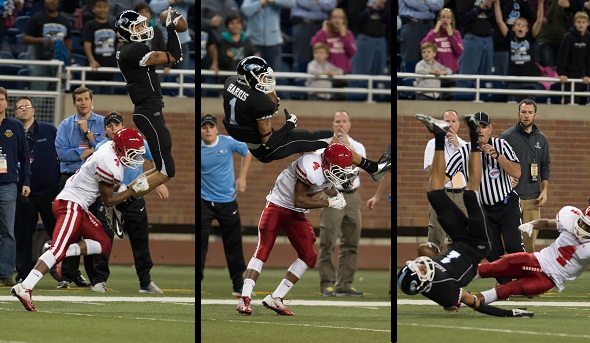
One catch will live on in Finals memory for years to come. In the fourth quarter, Harris went so high as to nearly jump over his defensive back. The defender tackled his legs mid-air, dumping Harris back-first into the turf. But Harris held on, and the Eagles continued to move.
After gaining more than 1,000 yards receiving as a sophomore too, Harris will need only 609 as a senior to set that MHSAA career record. He needs 66 catches and four for touchdowns to tie those records. And if a record was kept for highlight-reel catches, he might already be the holder.
“People don’t necessarily think he’s tough or something. But to have a guy go up 3-4 feet in the air and get flipped, catch the ball and land on his back or head; that’s pretty tough in my book,” Grand Rapids Christian senior quarterback Alex VanDeVusse said. “I’d take him on my team every single day. He’s amazing.”
PHOTO: Drake Harris went high to make this grab during the fourth quarter of Saturday's Division 3 Final against Orchard Lake St. Mary's. (Click for more from Terry McNamara Photography.)