

Writer-Turned-Coach Enjoys Debut
November 3, 2016
By Dennis Grall
Special for Second Half
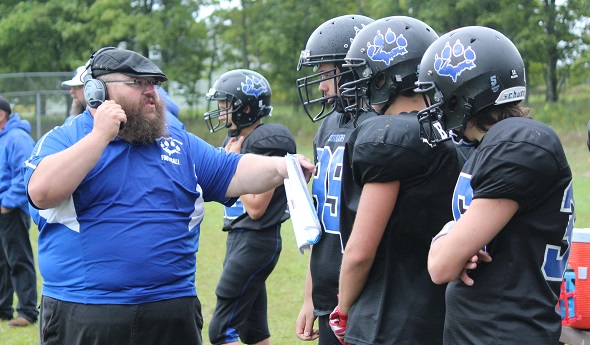
ESCANABA — Sam Eggleston has seen high school football from two drastically different viewpoints. Now, even though he is an unpaid volunteer, he enjoys being on the sideline as a coach.
 Eggleston just completed his first season as a high school head coach, with Eben Superior Central winning its final three games to finish 4-5 in 8-player football. The Cougars were among the first teams in the state to join the 8-player format in 2010, their first year of football.
Eggleston was a sportswriter before becoming a coach, giving him different perspectives to watching the same event.
The 1998 Rock Mid Peninsula High School graduate worked at newspapers in Escanaba, Kenai, Alaska; Northville and Novi, and Marquette before becoming a freelance writer and website blog editor in 2008. He started the writing phase of his career in 2000 with the Daily Press in Escanaba, under my direction.
He served as a volunteer assistant football coach in Northville, then moved back to the Upper Peninsula and became a volunteer coach at his alma mater in 2011 when the Wolverines went to 8-player football. He joined Superior Central in 2014 and spent two seasons as a volunteer aide until landing the head job just two weeks before the 2016 preseason began.
“In both careers … you took a shot on me and I ran with it, and the same with coaching; they gave me a shot and I’ve run with it as best I can,” he said.
In addition to his unpaid position at Superior Central, in rural Alger County, Eggleston is responsible for fundraising for the self-funded football program, a major priority for his offseason.
“My coaching is over (for the season) now and the majority of my time will be spent on raising funds so we can get new helmets, get new pads to replace ones that are broke, spending money we don’t have so we’ve got to make that up now,” he said. “We have to win now to have successful fundraisers.”
As a sportswriter, Eggleston would simply switch gears and move on to coverage of the next athletic season, for instance once fall sports moved into winter. He also never had to worry about how coaches managed off-field X’s and O’s once their seasons concluded.
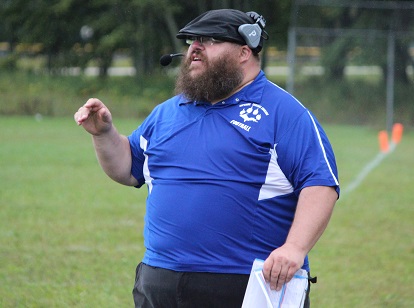
Life was totally different as a reporter. “I had a different approach, different viewpoint, different mindset to a game as a writer,” said Eggleston, who still has the heft of when he was a lineman but now looks like a lumberjack with his bushy beard and build.
“Now I have to worry about every kid and every position,” he said. “Sometimes I don’t even see the end result of the play because I’m watching the line play. I don’t even know how well my running back did until I see where they moved the stick.”
He may also be working on an injured player while the game goes on, trying to make play calls and other decisions at the same time.
As a sportswriter, he would be jotting down notes between plays or perhaps checking the result of a picture he took of the previous snap, totally unaware the coach was monitoring several assignments.
“I look back at the writer I was and as a coach now, and I would hate the type of writer I was,” he said.
Eggleston would analyze why a coach would switch to running a sweep rather than the counter that had been working, all while the coach may be working on an injured player that caused a change in offensive plans.
“As a writer I never had the insight to see everything. I just saw the overall game and kept track of every yard,” he said. “As a coach I can’t even tell if the play went five yards because I have three plays stacked up as the game goes on.”
While he was writing sports in the metro Detroit area, his weekly paper often covered games also being covered by the Detroit Free Press or the Oakland Press, with those stories appearing the next day. Eggleston’s story would appear maybe five days later, after everyone knew what happened.
 “I had to come in with a different angle. I tried to be a little more analytical and focus on strategy versus the flourish and try to get the meat of the game rather than get to the flowery parts,” he recalled. “I tried to take a different approach and make my stuff more interesting.”
His style apparently worked as the paper received several journalism awards and subscriptions remained strong.
Writing also provided some interesting backdrops. He had to use small charter planes to see some games in Alaska, or get to Nome to handle features about the Iditarod sled dog race.
He recalls covering a high school hockey game on an outdoor rink in Alaska and said “it was the first time I saw wind shear affect a hockey game.”
Eggleston also covered a football game where a kicker booted the ball off the uprights, then off a fence, and it bounced into the ocean in Homer.
He reported on a murder trial at that paper, where he would work the news desk in the morning, take time off and then handle sports at night. “It was super stressful,” he said.
Now walking the sidelines as a coach, he said “it definitely does feel like I’ve seen both sides of the coin, and I understand both sides of them better.”
He remembers just giving “little more rounded answers and (to) give both sides of the story” in postgame interviews. “A lot of coaches give canned answers. I try to be a little more in-depth and help try to write the story.”
In his early days as a sportswriter, he said “I would see the game unfold and see the pressures and why a coach would make a decision to go for it (on fourth down). I was a bit more critical of the coach and their decision,” he said, adding “I would probably have been a little more biting about it when I wrote the story.”
He admits in those days “I thought I knew everything there was to know about football. I played it,” he said. “I always approached the game like I was the professional and knew everything about the game. Now as a coach there are a host of responsibilities during every game. I am in completely different waters now. The hardest thing is keeping the kids pointed in the right direction as things go wrong.
“You’ve got the entire team and you’ve got to keep moving in a positive direction, keep the focus going forward. Forget the last play and work on the next one and get the kids to buy into that philosophy.”
He also compares his first writing assignment at the Daily Press with his first game this season at Ontonagon. “I did a (men’s baseball) story about the Escanaba Polecats, and you read my first line and said, ‘Did Yoda write this?’ I thought, oh my God, I don’t know what I’m doing.”
The Cougars lost their opener this fall 36-8, and Eggleston said “after being an assistant for four years, I still wasn’t prepared going into that Ontonagon game. We lost, and as I look back, if we played them right now I think we would beat them.
“I had no clue coming into that first game and didn’t have any idea how to get us back on track.”
He eventually figured enough out to finish 4-5 and found plenty of ways to enjoy being a coach.
Eggleston tries to eat lunch with his players every day, and he pays for his own meal.
“I want a family environment there; we all sit at the same table,” he said. “What I get back is relationships I never had before. I feel like I have 21 kids, and I love every minute of it.”
 Denny Grall retired in 2012 after 39 years at the Escanaba Daily Press and four at the Green Bay Press-Gazette, plus 15 months for WLST radio in Escanaba; he served as the Daily Press sports editor from 1970-80 and again from 1984-2012. Grall was inducted into the Upper Peninsula Sports Hall of Fame in 2002 and serves as its executive secretary. E-mail him at [email protected] with story ideas for the Upper Peninsula.
PHOTOS: (Top) Eben Junction Superior Central football coach Sam Eggleston speaks with some of his players during a game this season. (Middle) Eggleston monitors the action on the field. (Photos by Dennis Grall.)
Undefeated, Unscored-Upon Ironwood Journeys Downstate to Complete 1925 Run
By
Ron Pesch
MHSAA historian
November 20, 2025
Port Huron’s bold challenge of Flint Central and Grand Rapids Union for acclaim as “Michigan’s best high school football team” during the fall of 1925 meant an unexpected opportunity in Michigan’s Upper Peninsula.
During the first fall season of school sports under Michigan High School Athletic Association leadership – and half-century before the MHSAA Football Playoffs were introduced – small towns with schools possessing smaller enrollments also cried for recognition and aimed to join in the fun.
For schools, fans, and newspapers, MHSAA classifications conveniently offered a means to subdivide claims on the state title. Acknowledging that they could seldom compete successfully against the larger schools in football, that certainly couldn’t stop them from declaring themselves Class B or Class C gridiron champs.
Undefeated in contests since the middle of the 1923 season, Ironwood High – located in the Upper Peninsula in Michigan’s western-most city – ran through final preparations for the upcoming season with a game against the local alumni. A common practice at many schools, the preseason matchup gave head coaches like Ironwood’s veteran Robert O. ‘Bob’ Black a peek at his squad’s potential against a “friendly” opponent. The preps downed the “Old Timers,” 19-6.
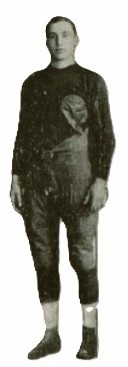
Among Black’s weapons was his team captain, John ‘Cutz’ Cavosie, a 6-foot-1, 190-pound senior with impressive skills in all aspects of the game.
“Capt. Cavosie was true to the form of the last two seasons and gives indications of coming through this season with even greater flying colors than he did a year ago,” noted the Ironwood Daily Globe in coverage of the contest. “He punished the alumni with his driving attack.”
The Red Devils officially opened their 1925 slate with a game at Superior, Wis., on Friday, Sept. 25. Missing from the roster, however, was Cavosie. While the news was, no doubt, gossiped about on the streets of town, there was no explanation in the Globe.
 Meanwhile, seven miles away on the front page of the local newspaper, The Bessemer Herald, readers learned some detail:
“John Cavosie, captain and star fullback of the Ironwood high school football team, left the squad this week after an altercation with the coach and has turned in his uniform.”
His absence from the team was apparent.
According to the hometown Globe, “Neither team showed anything but early season football,” but the Superior Evening Telegram’s coverage told another story:
“A field goal missed by inches cost Superior Central High school victory in the opening game of the season here yesterday and the two teams struggled to a scoreless tie.”
“Superior’s attempt to score … came in the final quarter after the two teams had battled on even terms through 45 minutes of play.”
With the ball on Ironwood’s 20-yard line, the Superior quarterback stepped back for a dropkick, but the ball sailed just left of the left upright.
According to Evening Telegram coverage, late in the second quarter, Ironwood had overlooked a prime chance to dropkick a field goal inside Superior’s 25, opting instead for an end run that failed: “That was Ironwood’s one and only chance to score. … Never again did (they) get within striking distance of the Superior goal.” An earlier attempt at a placement kick had gone wide. Cavosie’s absence was likely the reason for the dismal showing by the Red Devils. His importance to the team would soon be vividly illustrated.
A Legend is Born
While no details of mended fences appeared in print, according to the Globe, “the ‘Red’ Grange of the Upper Peninsula” was back for the team’s second game of the season against Menominee, two weeks later. Cavosie put on a show, notching four touchdowns on the afternoon including on runs of 42, 51, and 67 yards. Late in the game, facing a third-and-25 from just beyond the 50, Cavosie took a pass from center, “stepped back, apparently to punt,” but instead booted a stunning 55-yard dropkick for the game’s final three points in a 41-0 win. The news of the kick, which tied a national record for distance, would travel far beyond the Peninsula.
Next up were shutouts of Hurley, Wis., 47-0, and Hancock, 19-0.
Proud of the local team’s accomplishment, in early November, George Haggerson – president of the University of Michigan Alumni Club of the Gogebic Range – contacted state director of athletics Alden W. “Tommy” Thompson. Seeking broader recognition for Ironwood, he inquired about the possibility of the Red Devils playing a worthy opponent in a season-ending contest. Thompson suggested contact with Detroit, Jackson, Flint, or Grand Rapids high schools.
Ashland, Wis., was defeated 24-0 on Saturday, Nov. 7. Ironwood then squared off with Norway on Armistice Day. Expecting a tight matchup, an outstanding crowd turned out at Oliver Field in Ironwood for the game. Instead, Ironwood trounced the visitors, 34-0.
 Ironwood was unbeaten and unscored upon, and three days later the Globe announced a firm date for a game downstate. Coach Black’s team would play Redford High School at Northwestern Field in Detroit on Thanksgiving Day.
The choice to travel to the Lower Peninsula to seek out statewide recognition would be an expensive one. Donations to cover the trip – approximately $1,200 – came from local businesses and professional men. They included a donation from a Menominee resident. In a long-distance phone call from the head of a large wholesaling house, Frank St. Peter wanted to relay a specific message to Haggerson, some 200 miles away:
“The Ironwood team will be representing more than Ironwood when it goes to Lower Michigan on Thanksgiving. I consider she will be representing the entire Peninsula. Put me down for $50 to help cover the expenses.”
The trip to Detroit
This was a historic trip – the first for an Ironwood gridiron team to the Lower Peninsula. For locals, train travel would be from Ironwood to Chicago, then after a brief wait, to Ann Arbor, where they stayed Wednesday night. On Thursday morning, the team would head to Detroit by bus.
Among those traveling to Detroit for the game was Haggerson. Many other current residents, as well as former Gogebic Range citizens “living in Detroit, Lansing and Ann Arbor” were expected to make the trip. A crowd of 1,500 was at Ironwood’s Chicago and Northwestern railway station Tuesday night for a rousing sendoff for the 18 members of the team, Coach Black, assistant Max Newcomb, and various school personnel.
According to the Detroit News, Redford had “lost its first game of the season to Detroit Northeastern, 12-6, but since then has been unbeaten in nine games,” with a scoreless tie against Birmingham. Redford had scored 203 points against 24 for its opponents, with Northeastern and Detroit Southwestern “the only schools to score on the suburban eleven.”
“The only record that surpasses that boasted by Redford is the achievement of Ironwood,” stated Thursday morning’s Detroit Free Press, “and the meeting of these two teams should be one of the outstanding high school games in the state.”
The contest was to determine the Class B championship of Michigan.
Back in the U.P.
Those staying in Ironwood could get game detail at the Ironwood Memorial building. A crowd of 1,800 to 2,000 were on hand as returns were relayed by telephone from the Globe office, where Associated Press play-by-play bulletins would arrive quarterly by telegraph, instead of as the game progressed.
“The students gave their cheers the same as they did on the field at games here this season,” stated the Globe, “and the audience was keyed up to high pitch throughout the game.”
 The exploits of Cavosie were on the lips of everyone.
Newspaper reports claimed Ironwood supporters said he was as great as the immortal George Gipp – an All-American on Knute Rockne’s famous undefeated 1920 Notre Dame team – when “The Gipper” played in the Peninsula at Calumet High School.
Quoting Detroit Times reports on the game, the Globe reported the crowd was so large, “that the supply of tickets gave out, and many fans were admitted without the necessary pasteboards, fully 6,000 witnessing the contest.”
Weather conditions were ideal. According to A.P. reports, “overcast sky and southerly wind combined” with “solid underfooting to assure a snappy contest” – with “no alibis for the loser.”
Cavosie lived up to the hype. Pregame, the A.P. stated he wowed the crowd during warm-ups “toeing numerous punts against the wind. Many of them drove 55 yards against the breeze.”
Ironwood scored on its opening drive but was held at bay for the remainder of the first half. The second half was a different story.
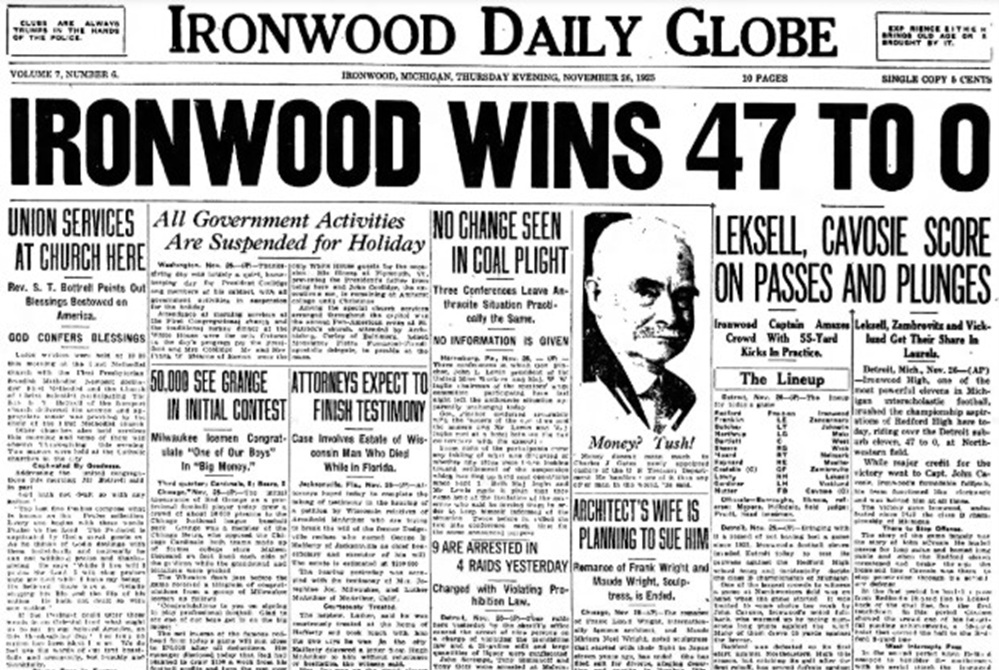
A long touchdown pass from Cavosie started the scoring. The Red Devils scored four times during the fourth quarter, twice the results of intercepted passes. In the end, Ironwood destroyed Detroit Redford, 47-0.
“The story of the game is largely a story of John Cavosie,” stated the Free Press. “He hurled passes from any angle and almost any kind of a formation for long gains and was instrumental in every score credited to his team.”
“Cavosie can run and plunge. He can kick and pass. He can tackle and block,” stated the A.P. reporter, “… his kicking was a revelation to the fans. One time standing on the six-yard line he kicked over the safety man’s head at the 40-yard line and the ball rolled dead on the one-yard strip. His passes were accurate and well timed.
“The team it showed Redford at Northwestern field, Detroit yesterday deserves consideration as one of the best in Michigan in any class.”
At the end, Ironwood claimed the Class B state championship of Michigan with a 6-0-1 mark, outscoring opponents 212-0. A new standard for the school’s athletic teams was set.
 Ironwood’s share of receipts for the game totaled $681.90. “The small quota,” according to the Globe, “was due to the fact that the game was played on municipal property and a charge could not be made on the property itself. A shortage of tickets further accounted for the small gate receipts.”
Upon its return home, the team was honored across multiple receptions. Details not captured in game reports were shared with classmates, former Red Devils athletes, and local fans, as the town celebrated its football heroes. A special focus was shone upon the linemen by A.D. Chishom, a member of the board of education, in his speech honoring the team. Praise for Coach Black and Assistant Newcomb flowed freely.
Come December, George M. Lawton named Cavosie to the Detroit Times first-team all-state squad. The A.P. placed him on its all-state second team, naming Cecil Turner of Port Huron on its first team.
Cavosie’s dropkick, notched against Menominee, was listed among American football historian Parke H. Davis’s “National List of Record Scoring Plays of 1925” - the lone high school entry on the list. “There is not a college team in the country that he could not make as fullback,” raved Davis - the nation’s ‘godfather of sports statistics.’
Ironwood students had started the school year on Sept. 6, wandering the halls of a freshly-built school building. Yearbook staff kindly chronicled the happenings of the school year with a fantastic sense of humor.
“September 7: Students learn more about the building. It takes them only fifteen minutes to find right classrooms.”
“September 26: The teachers, like children with new toys, use their new telephones all the time.”
“October 10: Gym students make appearance in the corridor in middies and bloomers. They are kindly presented with a piece of Miss Dougan’s mind.”
“November 30: Students hold assembly to rejoice over victory over Redford.”
Come the end of the school year, the senior members of the team, and their classmates, became the first to graduate from the new Luther L. Wright High School.
“June 14-18: Senior week. Class Play, Class picnic ‘n everything. Commencement. We say goodbye to the school, the students, the faculty.”
The district’s first superintendent, Wright had recently completed a term as Michigan’s State Superintendent of Schools. Ground had broken for the new building on May 1, 1924. Designed by Croft & Boerner of Minneapolis, Minn., it replaced the first building named in Wright’s honor.
Over 100 years later, it is proudly still in use today.
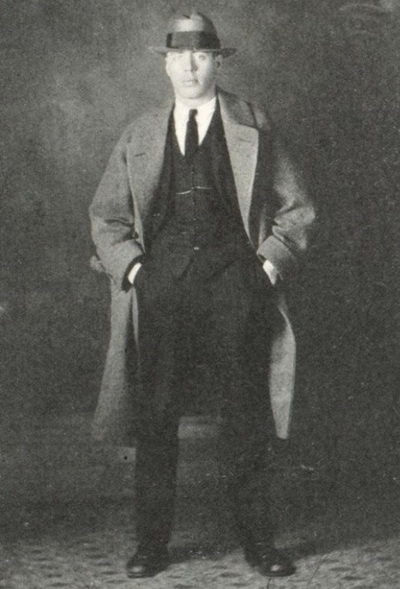
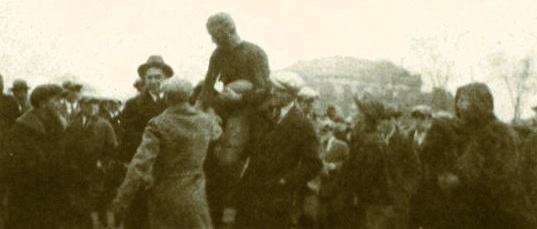
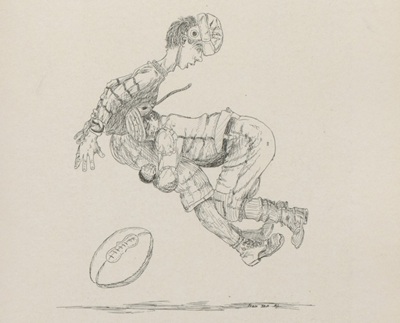
PHOTOS (Top) The Ironwood Daily Globe announces the local team’s win over Detroit Redford as the paper’s lead headline. (2) Ironwood’s John Cavosie. (3) Ironwood football coach R.O. Black, from the school’s 1925 yearbook. (4) Ironwood fans celebrate after the win over Redford. (5) A drawing of two students playing football, from Ironwood’s 1926 yearbook. (Photos gathered by Ron Pesch.)