

Writer-Turned-Coach Enjoys Debut
November 3, 2016
By Dennis Grall
Special for Second Half
ESCANABA — Sam Eggleston has seen high school football from two drastically different viewpoints. Now, even though he is an unpaid volunteer, he enjoys being on the sideline as a coach.
 Eggleston just completed his first season as a high school head coach, with Eben Superior Central winning its final three games to finish 4-5 in 8-player football. The Cougars were among the first teams in the state to join the 8-player format in 2010, their first year of football.
Eggleston was a sportswriter before becoming a coach, giving him different perspectives to watching the same event.
The 1998 Rock Mid Peninsula High School graduate worked at newspapers in Escanaba, Kenai, Alaska; Northville and Novi, and Marquette before becoming a freelance writer and website blog editor in 2008. He started the writing phase of his career in 2000 with the Daily Press in Escanaba, under my direction.
He served as a volunteer assistant football coach in Northville, then moved back to the Upper Peninsula and became a volunteer coach at his alma mater in 2011 when the Wolverines went to 8-player football. He joined Superior Central in 2014 and spent two seasons as a volunteer aide until landing the head job just two weeks before the 2016 preseason began.
“In both careers … you took a shot on me and I ran with it, and the same with coaching; they gave me a shot and I’ve run with it as best I can,” he said.
In addition to his unpaid position at Superior Central, in rural Alger County, Eggleston is responsible for fundraising for the self-funded football program, a major priority for his offseason.
“My coaching is over (for the season) now and the majority of my time will be spent on raising funds so we can get new helmets, get new pads to replace ones that are broke, spending money we don’t have so we’ve got to make that up now,” he said. “We have to win now to have successful fundraisers.”
As a sportswriter, Eggleston would simply switch gears and move on to coverage of the next athletic season, for instance once fall sports moved into winter. He also never had to worry about how coaches managed off-field X’s and O’s once their seasons concluded.
Life was totally different as a reporter. “I had a different approach, different viewpoint, different mindset to a game as a writer,” said Eggleston, who still has the heft of when he was a lineman but now looks like a lumberjack with his bushy beard and build.
“Now I have to worry about every kid and every position,” he said. “Sometimes I don’t even see the end result of the play because I’m watching the line play. I don’t even know how well my running back did until I see where they moved the stick.”
He may also be working on an injured player while the game goes on, trying to make play calls and other decisions at the same time.
As a sportswriter, he would be jotting down notes between plays or perhaps checking the result of a picture he took of the previous snap, totally unaware the coach was monitoring several assignments.
“I look back at the writer I was and as a coach now, and I would hate the type of writer I was,” he said.
Eggleston would analyze why a coach would switch to running a sweep rather than the counter that had been working, all while the coach may be working on an injured player that caused a change in offensive plans.
“As a writer I never had the insight to see everything. I just saw the overall game and kept track of every yard,” he said. “As a coach I can’t even tell if the play went five yards because I have three plays stacked up as the game goes on.”
While he was writing sports in the metro Detroit area, his weekly paper often covered games also being covered by the Detroit Free Press or the Oakland Press, with those stories appearing the next day. Eggleston’s story would appear maybe five days later, after everyone knew what happened.
 “I had to come in with a different angle. I tried to be a little more analytical and focus on strategy versus the flourish and try to get the meat of the game rather than get to the flowery parts,” he recalled. “I tried to take a different approach and make my stuff more interesting.”
His style apparently worked as the paper received several journalism awards and subscriptions remained strong.
Writing also provided some interesting backdrops. He had to use small charter planes to see some games in Alaska, or get to Nome to handle features about the Iditarod sled dog race.
He recalls covering a high school hockey game on an outdoor rink in Alaska and said “it was the first time I saw wind shear affect a hockey game.”
Eggleston also covered a football game where a kicker booted the ball off the uprights, then off a fence, and it bounced into the ocean in Homer.
He reported on a murder trial at that paper, where he would work the news desk in the morning, take time off and then handle sports at night. “It was super stressful,” he said.
Now walking the sidelines as a coach, he said “it definitely does feel like I’ve seen both sides of the coin, and I understand both sides of them better.”
He remembers just giving “little more rounded answers and (to) give both sides of the story” in postgame interviews. “A lot of coaches give canned answers. I try to be a little more in-depth and help try to write the story.”
In his early days as a sportswriter, he said “I would see the game unfold and see the pressures and why a coach would make a decision to go for it (on fourth down). I was a bit more critical of the coach and their decision,” he said, adding “I would probably have been a little more biting about it when I wrote the story.”
He admits in those days “I thought I knew everything there was to know about football. I played it,” he said. “I always approached the game like I was the professional and knew everything about the game. Now as a coach there are a host of responsibilities during every game. I am in completely different waters now. The hardest thing is keeping the kids pointed in the right direction as things go wrong.
“You’ve got the entire team and you’ve got to keep moving in a positive direction, keep the focus going forward. Forget the last play and work on the next one and get the kids to buy into that philosophy.”
He also compares his first writing assignment at the Daily Press with his first game this season at Ontonagon. “I did a (men’s baseball) story about the Escanaba Polecats, and you read my first line and said, ‘Did Yoda write this?’ I thought, oh my God, I don’t know what I’m doing.”
The Cougars lost their opener this fall 36-8, and Eggleston said “after being an assistant for four years, I still wasn’t prepared going into that Ontonagon game. We lost, and as I look back, if we played them right now I think we would beat them.
“I had no clue coming into that first game and didn’t have any idea how to get us back on track.”
He eventually figured enough out to finish 4-5 and found plenty of ways to enjoy being a coach.
Eggleston tries to eat lunch with his players every day, and he pays for his own meal.
“I want a family environment there; we all sit at the same table,” he said. “What I get back is relationships I never had before. I feel like I have 21 kids, and I love every minute of it.”
 Denny Grall retired in 2012 after 39 years at the Escanaba Daily Press and four at the Green Bay Press-Gazette, plus 15 months for WLST radio in Escanaba; he served as the Daily Press sports editor from 1970-80 and again from 1984-2012. Grall was inducted into the Upper Peninsula Sports Hall of Fame in 2002 and serves as its executive secretary. E-mail him at [email protected] with story ideas for the Upper Peninsula.
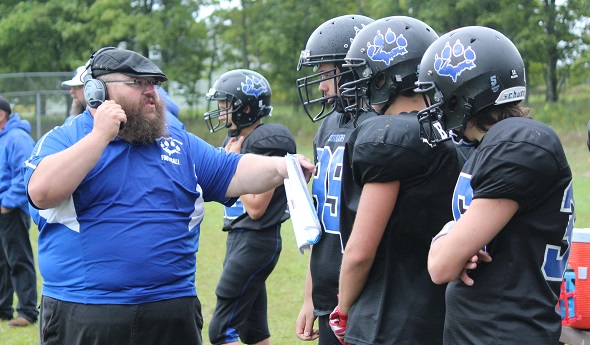
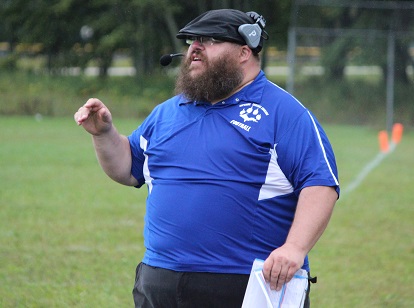
PHOTOS: (Top) Eben Junction Superior Central football coach Sam Eggleston speaks with some of his players during a game this season. (Middle) Eggleston monitors the action on the field. (Photos by Dennis Grall.)
Drive for Detroit: Playoff Week 3 Review
November 18, 2019
By Geoff Kimmerly
Second Half editor
Only 36 teams remain from the original 602 that opened this fall with hopes of reaching the biggest stages in Michigan high school football.
 Suttons Bay, Colon, Pickford and Portland St. Patrick earned the first championship opportunities with 8-Player Semifinal wins over the weekend. And 32 more 11-player teams are one more victory from booking Thanksgiving trips to Detroit.
Below is a glance at all 36 games played during the third round of the MHSAA Playoffs. There’s plenty coming up on Second Half later this week as well as we’ll preview both 8-Player Finals and all 16 11-Player Semifinals, followed by coverage of both Saturday championship games from The Superior Dome.
"Drive for Detroit" is sponsored by MI Student Aid.
8-Player
Division 1
HEADLINER Suttons Bay 45, Kingston 14 The Norsemen (12-0) earned their first trip to the MHSAA Finals since 2004, putting up their most points since Week 6 while holding the Cardinals (9-3) to their fewest since Week 1. Suttons Bay scored 33 unanswered points to close the game, while holding Kingston scoreless during the second half. Click for more from the Traverse City Record-Eagle and see below for highlights from MI Sports Now.
Suttons Bay Defeats Kingston, Heading To State Finals https://t.co/9tZZ82gSyT pic.twitter.com/YVCPxejZOW
— MISportsNow (@MISportsNow) November 16, 2019
HEADLINER Colon 27, Morrice 8 The Magi (12-0) are headed to the MHSAA Finals for the first time. As expected, Colon got its toughest challenge this season from the reigning Division 1 champion Orioles – but still managed to extend its season-long streak of all 12 wins by double digits while holding Morrice (10-2) to its fewest points since the 2017 Regional Final. Click for more from the Battle Creek Enquirer and see below for highlights from JoeInsider.com.
Recap/audio from Colon's 27-8 semifinal win vs Morricehttps://t.co/xdtAVuedfo@JoeInsider #MHSAAFB @ColonFootball @Snooze2you
— Jordan Slocum (@JordanSlocum) November 16, 2019
Division 2
HEADLINER Pickford 40, Hillman 8 The 2018 Division 1 runner-up Panthers (11-1) earned another chance to play for a first championship with one of their best defensive showings of the fall. Quarterback Jimmy Storey ran for two touchdowns and threw for another score, and the Panthers held Hillman (10-2) to its fewest points since Week 2 of its final season of 11-player in 2017. Click for more from the Sault Ste. Marie Evening News and see highlights below from State Champs Sports Network.
Check out the highlights of Pickford High School vs. Hillman Community Jr/Sr High School from Friday Night's State Semifinal.
Presented by @HungryHowies pic.twitter.com/MNWNuSyYNk— STATE CHAMPS! Michigan (@statechampsnet) November 16, 2019
HEADLINER Portland St. Patrick 49, Climax-Scotts 6 The Shamrocks (12-0) have put up at least 42 points in every game this season. But the story Saturday may have been the defense, which gave one of its best showings of the fall in locking down a Climax-Scotts offense averaging 34 points per game. The Panthers finished their first season of 8-player 9-3. Click for more from the Lansing State Journal.
VIDEO: Check out the highlights of the Portland St. Patrick (@PortlandStPats) vs. Climax-Scotts | Division 2 @MHSAA 8-Player Football Semifinal. @WLNSAlexSims reporting.
Brought to you by @MHSAA pic.twitter.com/JAE91yZtAM— STATE CHAMPS! Michigan (@statechampsnet) November 17, 2019
11-Player
Division 1
HEADLINER Belleville 27, West Bloomfield 22 These two were seen as Division 1 favorites before the first kickoff this fall, and as anticipated the Lakers gave Belleville one of only two single-digit games of an otherwise dominating run this season. West Bloomfield (10-2) scored the game’s first 15 points and led into the third quarter, but the Tigers (12-0) came back and then held off a final rally to advance to the Semifinals for the second straight season. Click for more from State Champs Sports Network.
VIDEO: Check out the highlights of the Belleville (@BHS_Sec1) vs. West Bloomfield - Division 1 @MHSAA Football Regional Final from this afternoon. @JermainCrowell.
Brought to you by @hungryhowies pic.twitter.com/GTDcCud9ze— STATE CHAMPS! Michigan (@statechampsnet) November 17, 2019
Regional Roundup Brighton 35, Hudsonville 20 The Bulldogs (10-2) are headed to the Semifinals for the first time since 2005. Brighton got up 21-0 early, and the Eagles (8-4) were unable to catch up. Davison 35, Utica Eisenhower 7 The Cardinals (10-2) will play in their first Semifinal since 2008 after holding Eisenhower (9-3) to its first single-digit scoring output since Week 1. Sterling Heights Stevenson 9, Detroit Cass Tech 7 Both entered the playoffs as additional qualifiers, but Stevenson (8-4) is carrying a five-game winning streak into its first Semifinal since 2009 after ending a five-game winning streak for the Technicians (7-5).
Division 2
HEADLINER Muskegon Mona Shores 28, Portage Northern 23 The Sailors (10-2) have had to defeat three league champions to get within another win of returning to Ford Field after finishing Division 2 runners-up a year ago. Portage Northern (10-2) led into the third quarter before a Mona Shores comeback brought the Huskies’ first double-digit wins season to a close. Click for more from the Muskegon Chronicle and see highlights below from WZZM.
13 On Your Sidelines Game of the Week: Mona Shores vs. Portage Northern https://t.co/P9EzE7Qe0C
— 13 On Your Side (@wzzm13) November 16, 2019
Regional Roundup Walled Lake Western 21, Livonia Churchill 14 A Warriors defense giving up only 14 points per game held on through a late rally to end a six-game winning streak for Churchill (7-5) and get Western back to the Semifinals for the third time in five seasons. Detroit Martin Luther King 49, Detroit U-D Jesuit 21 This matchup of league champions went to the Detroit Public School League’s Crusaders (10-2), who won their fifth straight Regional title in ending the winningest season for Jesuit (8-4) since 2001. Birmingham Seaholm 44, Port Huron 28 The Maples (9-3) are headed back to the Semifinals for the first time since 1997 after jumping out to a big lead and holding off the Big Reds (8-4), who closed their winningest season and longest playoff run since 2011.
11-Player
Division 3
HEADLINER DeWitt 35, Edwardsburg 14 As a set, Division 3 might have had the most captivating games in the state this weekend. DeWitt (10-2) earns the “headliner” by ending a 25-game winning streak for the Eddies (11-1), who won Division 4 a year ago. Edwardsburg had given up only 69 points over its first 10 games on the field (not counting a 2-0 forfeit win Week 5), but DeWitt’s defense also earned some of the spotlight holding the Eddies to their fewest points since a 2016 Semifinal. Click for more from the Lansing State Journal.
See video highlights from DeWitt's regional championship win over Edwardsburg.https://t.co/QClZDZlmr5 via @LSJNews
— Brian Calloway (@brian_calloway) November 17, 2019
Regional Roundup Muskegon 49, East Grand Rapids 10 After getting past East Grand Rapids just 28-23 in Week 3, the Big Reds (12-0) held the Pioneers to their season-low points total and scored the most that EGR (8-4) gave up this fall. Chelsea 28, Allen Park 27 A blocked extra point followed by a late score and conversion sent Chelsea to 12-0 for the first time and the Semifinals for the second-straight season, while Allen Park ended 9-3 for the second-straight year. River Rouge 49, Orchard Lake St. Mary’s 14 The Panthers (11-1) are headed to the Semifinals for the fourth time in five seasons after scoring the most points the Eaglets (10-2) had given up since Week 2 of 2018.
Division 4
HEADLINER Detroit Country Day 24, Milan 6 The Yellowjackets (12-0) won this matchup of undefeated contenders on the strength of a defense that has held every opponent this season to 12 points or fewer and lowered its average with this win to 5.6 points allowed per game. Milan (11-1) hadn’t been held to single-digit scoring since Week 5 of 2017. Click for more from the Oakland Press.
VIDEO: Check out the highlights of the Detroit Country Day (@DCDSAthletics) vs. Milan - Division 4 @MHSAA Football Regional Final from this afternoon. @DCDSchool
Brought to you by @MHSAA pic.twitter.com/pa4HDy3Mf2— STATE CHAMPS! Michigan (@statechampsnet) November 17, 2019
Regional Roundup Grand Rapids Catholic Central 42, Cadillac 7 The Cougars (11-1) are in the Semifinals for the fourth-straight season after a fifth-straight game giving up seven points or fewer, as Cadillac (7-5) closed its longest playoff run since 2013. Hudsonville Unity Christian 38, Paw Paw 17 Last season’s Division 5 champion Unity (9-3) is one more win from playing for the Division 4 title this time after putting up the second-most points Paw Paw (10-2) had surrendered this fall while giving up only 11.9 per game. Flint Powers Catholic 12, Pontiac Notre Dame Prep 9 The Chargers (10-2) won their first Regional title since 2015 with the go-ahead touchdown midway through the fourth quarter, ending Notre Dame Prep’s first 10-win season since 2011 at 10-2.
Division 5
HEADLINER Detroit Denby 40, Dearborn Heights Robichaud 18 The Tars (10-2) reached double-digit wins and won a Regional title both for the first time, continuing a run that has seen them lose this season only to Division 2 contender King (twice). Robichaud (9-3) closed its winningest season since 2012. Click for more from the Dearborn Press & Guide.
VIDEO: Check out the highlights of the Denby vs. Robichaud - Division 5 @MHSAA Regional Final from tonight. Brought to you by @hungryhowies pic.twitter.com/aZ0fljemc7
— STATE CHAMPS! Michigan (@statechampsnet) November 16, 2019
Regional Roundup Kingsley 43, Freeland 21 The Stags (12-0) are headed to the Semifinals for the first time since 2005 after scoring the most Freeland (9-3) gave up in a game this fall. Kingsley has won all of its games by 12 or more points. Lansing Catholic 40, Kalamazoo United 13 The Zac Gillespie-to-Alex Watters connection played a major part in getting the Cougars (11-1) back to the Semifinals for the first time since 2015, as they connected for three of Gillespie’s four touchdown passes. The 40 points tied the most United (7-5) had given up this season. Almont 25, Saginaw Swan Valley 14 After opening the playoffs with two road games, Almont (12-0) came home to earn its first Regional title since 2014 as Swan Valley (8-4) was seeking to make the Semifinals for the third-straight season.
Division 6
HEADLINER Onsted 12, Hillsdale 0 This no doubt was the biggest stunner statewide of the weekend, as Onsted (10-2) – which three weeks ago won a playoff game for the first time since 2008 – avenged a Week 4 loss to unbeaten Hillsdale to claim its first Regional title since 1993. The Hornets (11-1) hadn’t been shut out since Week 2 of 2016 and won that first meeting with Onsted this fall 28-19. Click for more from the Adrian Daily Telegram.
Check out the highlights of Friday night's Regional Final game between Onsted (@OnstedAth) and Hillsdale (@HillsdaleHornet).
Presented by the @MHSAA pic.twitter.com/xGVMN5iFML— STATE CHAMPS! Michigan (@statechampsnet) November 16, 2019
Regional Roundup Maple City Glen Lake 15, Calumet 14 The Lakers (11-1) are headed to the Semifinals for the second time in four seasons after winning by the slimmest of margins, with a second-quarter 2-point conversion run the eventual decider. Calumet (10-2) suffered its two defeats this season both by 15-14 scores against teams still alive in the playoffs. Montague 48, Sanford Meridian 14 The reigning Division 6 runner-up Wildcats (10-2) have won six straight since back-to-back close league defeats, and the 14 points scored by Meridian (8-4) tied the most given up during Montague’s current run. Monroe St. Mary Catholic Central 36, Montrose 7 After Regional Finals losses the last two years by a combined three points, St. Mary (10-1) is headed back to the Semifinals for the first time since 2014 after handing Montrose (10-2) its first loss since Week 4.
Division 7
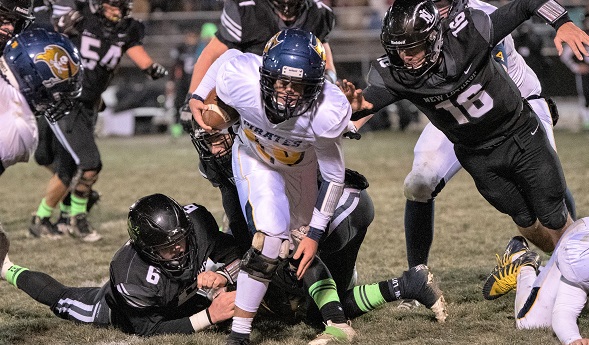
HEADLINER Pewamo-Westphalia 36, New Lothrop 35 In what might be remembered as the top non-Finals matchup of these playoffs, the Pirates (12-0) – Division 7 champions in 2016 and 2017 – got out to a three-touchdown lead and held on to edge last season’s champion New Lothrop (11-1). The Hornets had won 11 straight games and defeated P-W 26-14 in last year’s Regional Final. Click for more from the Lansing State Journal and see below for highlights from FOX 17.
"I'm proud of our guys for weathering through the adversity and the storm," head coach Jeremy Miller said after the win. The Pirates advance to face the winner of Iron Mountain and Traverse City St. Francis. https://t.co/UzPh02yVcy
— FOX 17 Blitz (@FOX17Blitz) November 16, 2019
Regional Roundup Iron Mountain 21, Traverse City St. Francis 7 The Mountaineers (12-0) won their first Regional title since 2011 and reached 12 wins for the first time since 2000 by ending St. Francis’ quest for a third straight Semifinals berth. Iron Mountain held the Gladiators (8-4) scoreless into the fourth quarter. Jackson Lumen Christi 35, Schoolcraft 30 The Eagles (10-2) rallied from more than three scores down but couldn’t catch up to the reigning Division 6 champion Titans (11-0), who ran their winning streak to 24. Cass City 6, Detroit Loyola 0 The Red Hawks’ fifth shutout this season came with historic rewards as Cass City (11-1) added its first Regional title to its most successful season, with a fourth-quarter score the difference against the defensively-tough Bulldogs (6-5).
Division 8
HEADLINER Reading 26, Adrian Lenawee Christian 21 The reigning Division 8 champion Rangers were trailing into the fourth quarter before scoring the go-ahead points with just over eight minutes to play. Both teams’ defenses bent just a bit: Reading (11-1) hadn’t given up more than 14 points all season, and Lenawee (10-2) hadn’t given up more than 14 since its Week 2 loss to Sand Creek. The Cougars concluded their winningest season, which included their first playoff victory two weeks ago. Click for more from the Hillsdale Daily News.
VIDEO: Check out the highlights of the Reading vs. Lenawee Christian - Division 8 @MHSAA Regional Final from tonight.
Brought to you by @hungryhowies pic.twitter.com/6yq3nbMUdH— STATE CHAMPS! Michigan (@statechampsnet) November 16, 2019
Regional Roundup Beal City 27, Ishpeming 14 The Aggies (11-1) won their first Regional title since 2014, scoring all of their points before Ishpeming (9-3) got on the board. The Hematites were making a second-straight Regional Final appearance. Ubly 56, Saginaw Nouvel 36 The Bearcats (10-2) went over 50 points for the fifth time this season to win their second Regional title in four years and despite giving up a season-high point total to Nouvel (7-5). Fowler 33, Royal Oak Shrine 0 The Eagles (11-1) won their first Regional title since 2011, continuing a bounce-back run after two straight 4-5 finishes. Shrine finished 9-3, also with more wins than the last two seasons combined.
Second Half’s weekly “Drive for Detroit” previews are powered by MI Student Aid, a part of the Office of Postsecondary Financial Planning located within the Michigan Department of Treasury. MI Student Aid encourages students to pursue postsecondary education by providing access to student financial resources and information. MI Student Aid administers the state’s 529 college savings programs (MET/MESP), as well as scholarship and grant programs that help make college Accessible, Affordable and Attainable for you. Connect with MI Student Aid at www.michigan.gov/mistudentaid and find more information on Facebook and Twitter @mistudentaid.
PHOTO: Pewamo-Westphalia's Ethan Thelen (10) breaks multiple New Lothrop tackles during Friday's Division 7 Regional Final win. (Click to see more from HighSchoolSportsScene.com.)