

All-time Hoops Winner Leads Another
By
Tim Robinson
Special for MHSAA.com
March 20, 2018
HARTLAND — When asked how many seasons he’s coached basketball, Don Palmer always is up front.
 The reactions are variations of shock and awe.
“How many seasons? 104?” a reporter asked after his most recent victory March 8.
“Seventy,” Palmer said.
“Seventy?” said the reporter, not suspecting a number that high.
Told the same number, Hartland senior Graysen Cockerham could only giggle in disbelief.
“That’s crazy,” sophomore Whitney Sollom said, joining in the laughter.
Seventy is quite a number at first blush, considering Palmer is only 67 years old.
But he coached boys and girls at Milford for 29 years and has been a head coach for 41 overall, the last nine at Hartland.
He has won 935 games, 588 with the girls, which has enabled him to become the winningest overall basketball coach in state history. The old record, 922, is believed to have been held by Ed Mehlberg of Auburn Hills Oakland Christian. As it turns out, both Palmer and Mehlberg were inducted into the Michigan High School Coaches Association Hall of Fame last September.
Palmer has coached countless players and their children as well as against coaches and their sons. On this year’s team he coached Sollom, whose mother, Dianne Hall, played against Milford while at Walled Lake Western; and Kamryn Gerecke, whose mother, Lori Montante, is Milford’s second-leading scorer all-time.
He’s won with and without talent on offense. And on defense, opposing coaches have learned to prepare in advance.
“I learned to do some prep work for those games,” former Brighton coach Jason Piepho said. “We would mix in different defenses in practice throughout the year. You couldn’t prepare for him for just two games a year, because you didn’t know what he would throw at you.”
Piepho learned that first-hand while playing for Howell a quarter-century ago.
“I remember the first time I played against him,” he said, laughing. “I was Howell’s point guard, and they threw a box-and-one against me. It was frustrating. It was the first time I’d seen that defense.”
Coach to the core
His Hartland girls finished 20-6 this winter, advancing to last week’s Class A Quarterfinals before falling to Wayne Memorial.
Palmer started coaching at Milford in 1974, the year he graduated from Michigan State University.
“I coached football a couple of years, freshman football,” he said. “I liked it, but I always wanted to be a head coach, so when the (girls basketball) job became open at Milford, I applied and got it. About a year later, the boys job came open and I applied and got it.”
For the next 29 years, until girls basketball moved to the winter beginning with the 2007-08 season, Palmer coached both sports.
 “It became a lifestyle,” he said. “We had girls in the fall and boys in the winter. We would do our boys (offseason) stuff in June and the girls stuff in July, and it just kept going.
“When they switched the seasons, I had to make a choice,” he said. “I chose girls because that’s where I started. It gave me a chance to be a coach at a young age. So that’s where my allegiance was. As I grow older, I could never do two seasons back-to-back.”
Palmer’s Milford teams of both genders were known for defense and an offense that could be described as patient or painfully slow, depending on one’s perspective.
“When we started out with the boys, it was a program that struggled mightily,” he recalled. “We would do whatever we had to do to stay in games, whether that be ball control or setting the tempo.”
“I think the biggest thing that Don has done is that he adapts how he plays the game to his talent,” said Lee Piepho, who coached girls basketball at Howell. “Sometimes you don’t like what he does in terms of his strategy, but his idea is, ‘I’m going to play whatever strategy on the court to help my team win the game. If that’s standing out there and holding the ball, putting my arm under it and go into the quarter tied at zero or leading 2-0, I’m going to do that.’”
Last season, Palmer adjusted to a team than loved to run up and down the floor and was good at it.
“I don’t mind the running game,” he said. “You weren’t holding (that team) back. You were doing a disservice if you did.”
Both Piepho and Palmer are fiery competitors, but Palmer once made Piepho laugh during a game.
“One night we were playing Milford with Sara (Piepho’s daughter, a point guard at Howell),” Lee recalled. “I got a little upset with Sara and I pulled her out of the game and was talking to her and Don hollered over, ‘If you don’t want her, I’ll take her.’
“We had her graduation party and invited Don over, and he brings Sara a pair of Milford practice shorts.”
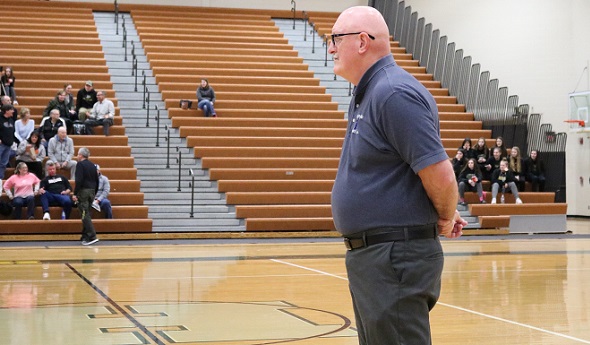
Palmer, at 6-foot with a shaved head and glasses, is an intimidating presence on the sideline during games. HIs players soon learn to look beyond that persona.
“I think most people, from a distance, see him and think he’s crazy,” Cockerham said. “But as players, we know he cares and wants us to be the best we can be. We appreciate it, because we need a coach to push us, and that’s exactly what he does. He expects nothing but the best for us, and that’s the way he gets it out of us.”
Mike McKay coached under Palmer at Milford for many years. He now is the varsity coach at Grand Blanc.
“He can be intense,” he said. “But off the court he does things he doesn’t want recognition for but does them for the betterment of his players. He takes care of the whole program.”
New challenge, no let up
After 32 seasons coaching at the only place he’d ever worked, Palmer’s contract was not renewed at Milford after the 2008-09 season.
He wasn’t out of coaching for long.
“When I left Milford, the Hartland coach, Brian Ives, had to leave because of work obligations,” Palmer said.
After years of struggling, the Hartland program was on the rise.
“We could beat them at the varsity level, but just barely,” Palmer said of coaching against the Eagles near the end of his Milford tenure. “The lower levels were just getting murdered. So we could see it coming.
“I told my coaches, ‘There’s going to be no excuse for not winning. None,’” Palmer recalled.
The Eagles have thrived under Palmer. In his nine seasons, his teams have won 20 or more games three times and got to the Quarterfinals twice over the last four seasons. He won 62 percent of his games at Milford. In nine seasons at Hartland, the Eagles have won 78 percent of their games.
“There just doesn’t seem to be any let up for a while,” he said, referring to the talent stream at Hartland. Indeed, five sophomores and two freshmen saw extensive time during the postseason for the Eagles this year.
But, he jokes, some old habits die hard.
“Even now, frequently, I’ll still write ‘Milford’ in a scorebook or something like that,” Palmer said. “I’m much, much better now. I’m a Hartland guy and a Livingston County guy, but it took a while. I coached 61 seasons over there. That’ll always be my school, but I do think that getting hired at Hartland was the best thing that happened to me under those circumstances. It’s been fabulous.”
Palmer’s coaching tree is expansive, and his list of admirers much more so.
“When we were winning and making runs in the state tournament, he went to all of our games,” Jason Piepho said. “He was always a coach you could call and talk to about things in your program. He’s an open book, willing to help and mentor. He’s what you want in a high school coach.”
“There are a lot of challenges that come with coaching,” McKay said. “A lot of people don’t like hearing the truth, and it’s hard to tell them. But he’s always honest and up front with his players and staff. He’s a first-class person and coach, and I admire him and try to emulate what he does.”
McKay just finished his second season with the Bobcats, and they beat Hartland in December in a key victory.
 “I didn’t like losing, but losing to him took the sting away a little bit because he was so happy and it was a big win for his program,” Palmer said. “So that helped. I’m proud of him, and he’s turning it around and he’ll be fine.”
Told this, McKay replied, “That tells you all you need to know about Don. He’s a class act. It was a great win for our program, but bittersweet for me. I look on him as a second father, and you always want to please your father. I know how badly he wanted to win and compete and how much I do, too.”
Howell girls coach Tim Olszewski had previously coached the Howell boys against Palmer’s Milford teams. In his last regular-season game as Howell coach, Olszewski’s Highlanders beat Milford 97-86.
“He was so mad at me,” Olszewski said, laughing. “He and his players were all red-faced, for different reasons.
“He’s a great coach and I love listening to him talk and pick his brain for things. He’s very well deserving of the record. Hopefully he’ll be around a lot longer.”
March continues
A lot has changed since Palmer’s first season as a varsity coach with the Milford girls back in 1977.
“As we kind of march on in time, you’ve got people playing 60 games in the summer,” Palmer said. “I think if we get in 30 games, that’s plenty. I do think this: More than ever, you’ve got to let kids be kids a little bit. We’re going to that specialization stuff, and I don’t think that’s great.
“People love to go to the next level, but it becomes a job,” he continued. “So this is the time to be a kid. This is the time to enjoy sports. Basketball is always my love, but I enjoyed football. I enjoyed track, and I think kids, well, it’s just how it is. There are outside forces. Everyone says they have a college athlete, and the percentages say they don’t.”
Specialization, he adds, not only cuts into individual opportunities to learn, but also hurts teams that could use those athletes.
“Unless you have a gigantic high school, all of your athletes have got to play a couple of sports, or you don’t survive,” he said.
As he gets older, Palmer sees the end of his career approaching, although he’s not there yet.
“I just go year-by-year,” he said. “Part of the compromise my wife and I made for me to continue (coaching) is that we’re going to travel a little bit more. She likes that, and so we’ve got some plans. After the season is over, we’re going to take a trip to Dallas. I’m a Kennedy assassination buff, and she just wants to see Dallas.”
Asked if he will be back next year, he nods his head.
“Right now, that’s the feeling, I guess,” he said. “If everything works out, I would like to at least finish with Whitney. That’s a gift, to coach a kid like that. But eventually you have to make a decision. Right now, my energy is up, but when the season is over, I go into a meltdown for a month where I don’t do much. Just don’t have the energy. It takes more and more out of you every day.
“But it’s still fun when you’re in the heat of battle. It’s still fun.”
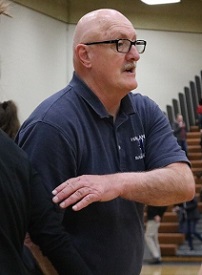
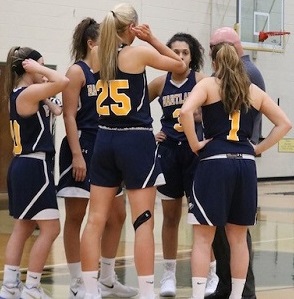
PHOTOS: (Top) Hartland girls basketball coach Don Palmer stands for the national anthem before a game at Howell last month. (Middle) Palmer, also during the game against the Highlanders. (Below) Palmer talks with his team during a timeout. (Photos by Tim Robinson.)
Breslin Bound: 2025-26 Girls Quarterfinal Preview
By
Geoff Kimmerly
MHSAA.com senior editor
March 17, 2026
The return of winter – in a massive way – has made getting into this final week of the MHSAA girls basketball season a little complicated, to put it more lightly than the snow has been falling.

But plans are set, and all Quarterfinals are a go – to be played tonight and Wednesday – with one more win needed to keep the road trip going all the way to East Lansing.
Below are quick glances at all 16 matchups. Games tip off at 7 p.m. today unless noted. Details on tickets, brackets and more can be found on the Girls Basketball page. To watch all 16 games online, visit the NFHS Network.
“Breslin Bound” is powered by MI Student Aid and based on results and schedules posted for each school at MHSAA.com. (Abbreviations below denote ppg - points per game, rpg - rebounds per game, apg - assists per game, and spg - steals per game.)
Week in Review
The countdown of last week’s five most intriguing results:
1. Cass City 54, Sandusky 30 Cass City (19-5) in Division 3 clinched its first Regional championship in this sport while avenging a regular-season loss to Sandusky (23-2).
2. Onekama 49, Mount Pleasant Sacred Heart 47 A last-second basket over the Irish (19-6) gave the Portagers (18-7) this Division 4 win and their first Regional title since 1997.
3. Detroit Renaissance 62, Wayne Memorial 60 (2 OT) Renaissance (21-2) advanced to this week by winning this Division 1 thriller, avenging a 22-point regular-season loss to the Zebras (21-3).
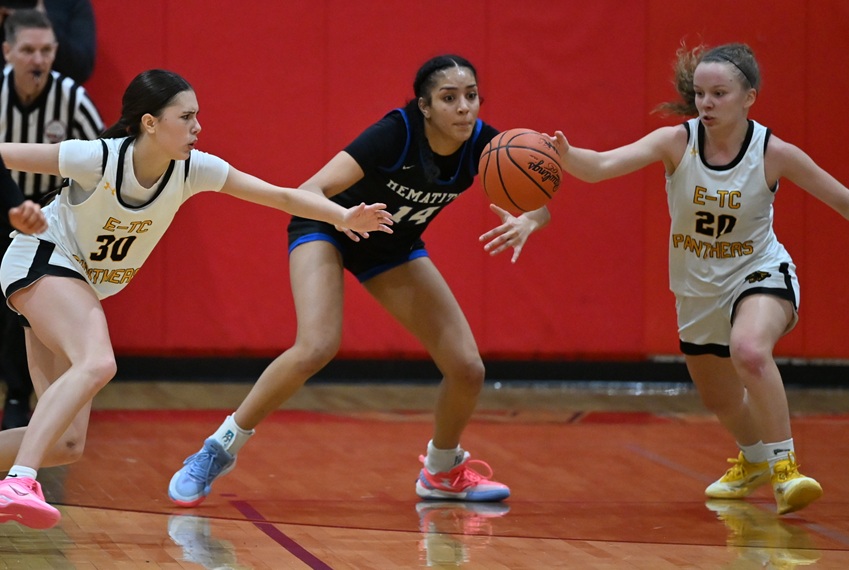
4. Ishpeming 40, Ewen-Trout Creek 29 The Hematites (22-3) clinched their Regional title by downing last season’s Division 4 runner-up in E-TC (22-4).
5. Fraser 47, New Baltimore Anchor Bay 43 Fraser (24-2) claimed its first Regional title since 2006 by coming back from 11 points down to catch Anchor Bay (23-3).
Quarterfinals at a Glance
DIVISION 1
Muskegon (23-2) vs. Grand Haven (23-3) at Hudsonville
These two met Jan. 28, with Grand Haven winning 47-46. The Big Reds haven’t lost since, and they have a big-time scorer in senior guard and Miss Basketball Award finalist Marian Sain (20.2 ppg, 42 3-pointers) – who is making nearly 48 percent of her 3-point tries. Grand Haven does damage in the post led by 6-foot-4 junior center Mallory Woiteshek (15.3 ppg, 6.9 rpg, 3.3 bpg), one of the state’s top volleyball players.
Utica Eisenhower (23-2) vs. Fraser (24-2) at Detroit Mercy
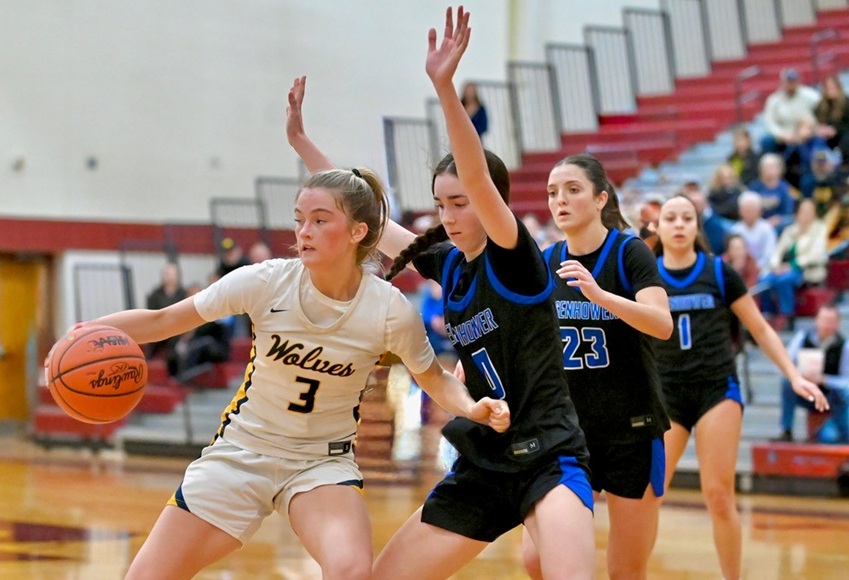
Eisenhower is playing in its first Quarterfinal since 1982, and Fraser in its first since 2006. Guard Janielle Turner is one of three sophomore Eisenhower starters and leads four Eagles scoring in double figures at 13 ppg. Senior forward Brynn Norbeck (13 ppg, 9.1 rpg) and 6-3 freshman center Nylah Bell (11.3 ppg, 11.3 rpg, 3.1 bpg) are a powerful pair in the post for the Ramblers.
DeWitt (21-4) vs. Belleville (25-1) at Mason
This is a rematch from a year ago, when Belleville won 59-54. The reigning Division 1 champion Tigers this winter have avenged their lone loss to Howell with a 58-44 Regional Semifinal win last week and again boast Miss Basketball Award finalist Se’Crette Carter and 2027 favorite Sydney Savoury. DeWitt graduated two 1,000-point scorers after last season but has made it all the way back with senior forward Carly Dennis (12.1 ppg) leading a balanced lineup.
Dearborn (14-11) vs. Detroit Renaissance (21-2) at Detroit Mercy, 5:30 p.m.
Dearborn is coming off its first Regional championship and notably achieved that starting four sophomores and junior, with that junior – 6-2 center Zeinab Homayed – leading the way at 14 points, 11 rebounds and 2.5 blocks per game. Renaissance got past Wayne Memorial 62-60 in overtime to advance, avenging a 22-point loss from December. Senior forward Jaebri’an Autry sets the pace at 15 points, 7.5 rebounds and 3.3 assists per game.
DIVISION 2
Petoskey (22-3) vs. Flint Powers Catholic (23-3) at Lake City, Wednesday at 6 p.m.
Petoskey won its second Regional title this week and will play in its first Quarterfinal since 1999. Three Northmen – all underclassmen – score between 10-13 points per game, with freshman guard Elaina Flynn tops at 13 ppg and joined by sophomore guard Lyla Janes (10.3 ppg) and freshman forward Ella Sulitis (10 ppg). Two of Powers’ losses came to teams playing in Division 1 Quarterfinals. Senior guard Kendyl Smith was a Miss Basketball Award finalist and averages 17.8 points, 4.7 assists and three assists per game.
Tecumseh (24-2) vs. Carleton Airport (24-2) at Chelsea
Reigning Division 2 champion Tecumseh has given up more than 39 points only once over its last 14 wins and has five players scoring at least nine points per game led by sisters freshman Avery (13.3 ppg) and junior Addi Zajac (13.2). Airport is making its first trip to the Quarterfinals and riding a 16-game winning streak. Junior Sophia Mator (16.7 ppg) and senior Olivia Gratz (15.4) are the lead scorers from a potent guard-driven attack.
Detroit Country Day (15-9) vs. Goodrich (26-0) at St. Clair County Community College
Goodrich is playing in a Quarterfinal for the fourth-straight season and hasn’t lost since last year’s against Tecumseh. Junior guard Baylor Lauinger scores a team-high 15.5 ppg with a team-best 4.2 assists per contest for the Martians. After losses the last two seasons to Detroit Edison – including in last season’s Quarterfinal – and another in December, Country Day defeated the Pioneers 51-43 in a Regional Semifinal on the way to this week. Senior guard Naiya Krispin scores a team-high 14.9 ppg and is a strong outside shooter.
Grand Rapids West Catholic (20-5) vs. Grand Rapids South Christian (26-0) at Hudsonville Unity Christian
This will be the third meeting this season between the Ottawa-Kent Conference Gold champion Sailors and runner-up West Catholic, with South Christian winning the first two by 11 and six points. The Sailors have four players scoring between 10-13 points per game, and also four who have made at least 30 3-pointers this season – senior guard Lizzie Wolthuis is on both lists at 12 ppg and 64 3s. Sophomore guard Kenley Slanger is the top perimeter threat for the Falcons at 16.8 ppg while making 35 percent of her 3-point attempts.
DIVISION 3
Cass City (19-5) vs. Pewamo-Westphalia (24-2) at Millington
After taking its only loss last season in its Regional Final, P-W has advanced a step farther. Sophomore forward Adrianna Eklund (12.8 ppg) and senior guard Elly Bengel (12) lead a balanced lineup with several strong 3-point shooters. Cass City won its first Regional title last week, avenging a 17-point loss to Sandusky from the regular-season finale. Sophomore Skylar Ignash (19.2 ppg) and freshman Isabella Bennett (13.5) are a talented one-two scoring punch who make the future bright as well.
Roscommon (20-3) vs. Morley Stanwood (22-3) at Lake City
Roscommon is playing in its first Quarterfinal since 1996 and has advanced by winning all of its postseason games by at least 16 points. Morley Stanwood is back for the first time since winning the Class C title in 2012, with senior forward Katelynne Nawrot (17.3 ppg, 7.6 rpg) setting the pace in the post and potentially matching up with Roscommon senior forward Alex Carper (11.4 ppg, 9.0 rpg) near the basket.
Jackson Lumen Christi (22-3) vs. Plymouth Christian Academy (21-5) at Ypsilanti Lincoln
The Titans are playing in a Quarterfinal for the second-straight season, with sophomore point guard Kenna Hunt (19.9 ppg, 3.8 spg) continuing to establish herself among the top players in her class statewide. PCA has made a nice jump this season from 12-12 a year ago, paced by four senior starters and leading scorer Lauren Scott, a freshman guard averaging 16.1 ppg with 58 3-pointers.
Hart (16-9) vs. Niles Brandywine (25-1) at Kalamazoo Loy Norrix
Hart won its first Regional title since 2023 and rebounded from a few stumbles at the end of the regular season, avenging losses to Shelby and Kent City along the way. Junior guard Rilynn Porter leads at 15.3 ppg with 59 3-pointers and also more than three assists and three steals per contest. Brandywine is seeking to reach Breslin for the third-straight season and with two starters back from a year ago in junior Lily Gill (13.7 ppg) and senior Karleigh Byrd (9.3).
DIVISION 4
Morenci (25-1) vs. Kingston (26-0) at West Bloomfield
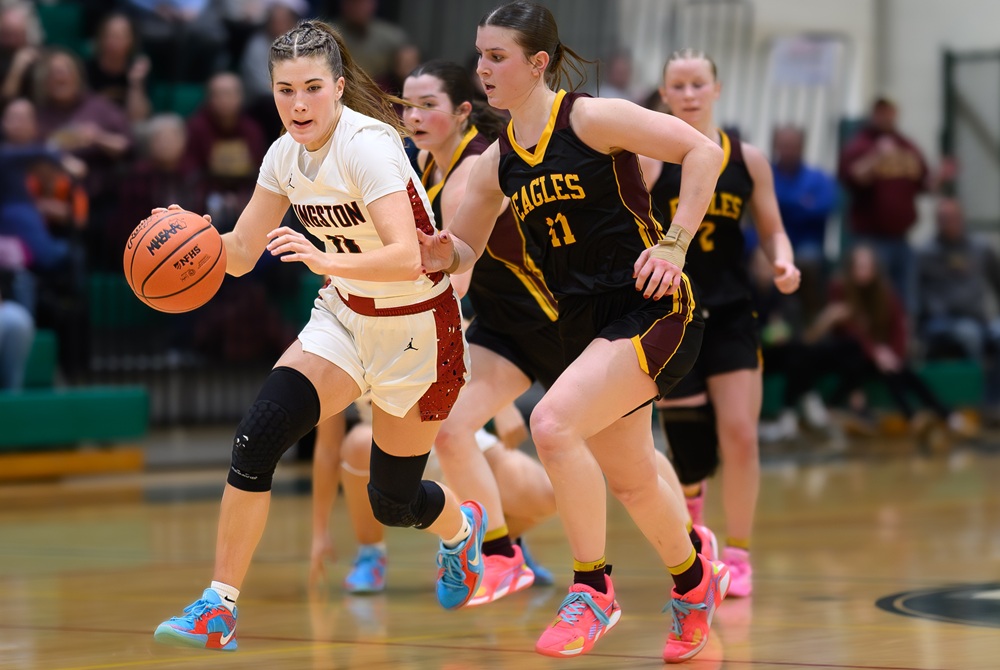
This may be the most intriguing Quarterfinal of all, with the only loss between these teams Morenci’s to Brooklyn Columbia Central two months ago. Kingston fell a game short of reaching the final week last season but is back led by senior guard Molly Walker (29.1 ppg, 71 3-pointers), who went over 2,000 career points in the team’s Regional Final win. Morenci has a top perimeter scorer as well in senior guard Emersyn Bachelder (18.1 ppg).
Ishpeming (22-3) vs. Indian River Inland Lakes (22-3) at Gaylord, Wednesday at 6 p.m.
Ishpeming is just two years removed from winning the Division 4 title and is one game away from playing at Breslin again, with senior guard Jenessa Eagle (24.4 ppg) and senior center Mya Hemmer (16.6) starters from that previous run. Inland Lakes is playing in its first Quarterfinal after playing into Regionals the last three seasons. Senior forward Chloe Robinson leads a balanced attack at 13.1 ppg.
Frankfort (17-7) vs. Onekama (18-7) at Cadillac
Both posted some of last week’s biggest headlines, Frankfort downing Mio and then handing Gaylord St. Mary just its second loss and Onekama winning its first Regional title since 1997. Frankfort defeated Onekama by six and four in their meetings this season. Senior forward Addie Jarosz (11.4 ppg, 8.8 rpg) is a stat-sheet filler for the Panthers, and junior guard Ava Mauntler leads a balanced Portagers lineup in scoring (10.5 ppg) and assists.
Portland St. Patrick (21-5) vs. Concord (24-2) at Mason
Concord is playing to reach the Semifinals for the second-straight season as it seeks a first championship to go with that won by its boys team Saturday. Senior guard Cieara Barrett (18.7 ppg) and junior guard Bradie Lehman (18.6) have both reached 1,000 career points this season. Portland St. Patrick is playing its first Quarterfinal since 2012, with junior guard Gracelyn Rockey (15.5 ppg) a force leading the team in scoring, 3-pointers, rebounds (6.8), assists, steals (3.4) and blocks.
MHSAA.com's weekly “Breslin Bound” reports are powered by MI Student Aid, a division within the Department of Lifelong Education, Advancement, and Potential (MiLEAP). MI Student Aid encourages students to pursue postsecondary education by providing access to student financial resources and information. MI Student Aid administers the state’s scholarship and grant programs that help make college Accessible, Affordable and Attainable for you. Click to connect with MI Student Aid and find more information on Facebook and X @mistudentaid.
PHOTOS (Top) Kingston senior Molly Walker (left) leads a rush up court during her team’s Regional Final victory over Deckerville on Wednesday. (Middle) Utica Eisenhower’s Madison Repicky (0) walls off the lane during her team’s Regional Final win over Clarkston. (Below) Ewen-Trout Creek's McKayla Basel (30) and Bree Besonen (2) and Ishpeming's Mya Hemmer go after a loose ball during their Division 4 Regional Final. (Kingston/Deckerville photo by Kolleth Photo. Eisenhower/Clarkston photo by Terry Lyons. Ishpeming/Ewen-Trout Creek photo by Cara Kamps.)