

Arbor Prep Earns Another Title Game Trip
March 15, 2018
By Geoff Kimmerly
Second Half editor
GRAND RAPIDS – Ypsilanti Arbor Prep calls its championship pursuit a “4-mile run.” And the Gators got through about 3.9 a year ago.
They’ll get another chance to finish the final leg after a 53-35 Class C Semifinal win over Maple City Glen Lake on Thursday at Van Noord Arena.
The Gators, who won Class C in 2016 and then finished Class B runner-up a year ago, will face reigning Class C title winner Detroit Edison in Saturday’s 4 p.m. championship game.
Arbor Prep was the only team this season that defeated Edison, downing the Pioneers 54-49 on Jan. 11.
“Considering what happened with us last year, and the type of players we are and the type of team we have this year, we’re anxious that way,” Arbor Prep senior Jala Petree said. “We’re ambitious to get what we deserve. And I think we’re going to keep working. It isn’t over yet.”
Junior Mahri Petree – Jala and senior Lasha’s younger sister – said after she can feel “a different type of energy in our locker room and practices.”
Arbor Prep (21-5) came out with that drive, opening the Semifinal on a 12-1 run. Glen Lake (23-3) – a semifinalist last season as well – pulled to within four points with two minutes to go in the first half, but the Gators finished with another 7-0 surge.
“It’s like a roller coaster,” Glen Lake coach Jason Bradford said. “The first couple of buckets, (our) first two layups were in and out.
“We’ve been behind before, and the girls know how to work through the runs. We say it’s a roller coaster and just keep on fighting. We have confidence since these girls are used to fighting back, since freshman year, each tournament run … (they have) a lot of composure and a lot of heart.”
 The Lakers played Arbor Prep even in the third quarter – notable especially because senior forward Jennifer LaCross, who scored 10 points during the first half, didn’t play at all during the second because of a broken nose.
But the Gators got rolling again in the fourth quarter, closing on a 12-5 run to earn the third straight championship game berth.
Jala and Mahri Petree both scored 12 points, Mahri grabbing seven rebounds with five assists and three steals. Lasha Petree, a Miss Basketball Award finalist this season, had eight points, five assists, five steals and four blocks.
“Last year, losing, that pain is still in my heart,” Lasha Petree said. “I want to avenge it, and I’m ready for it and want to help my teammates do whatever to win.”
Freshman Hailey Helling led Glen Lake with 11 points and five rebounds. LaCross, despite not playing the second half, was the second-leading scorer. The Lakers’ 35 points total were 10 fewer than their previous season low.
Guard Savannah Peplinski and forward Allie Bonzelet joined LaCross finishing four-year careers that included two league titles and two Semifinal trips – and many more memorable moments.
“As a team, it’s just fun the memories we make – not even during the games, but like at the hotel (during Finals weekends),” LaCross said. “I’ll probably be thinking about it when I’m missing basketball the rest of my life.”
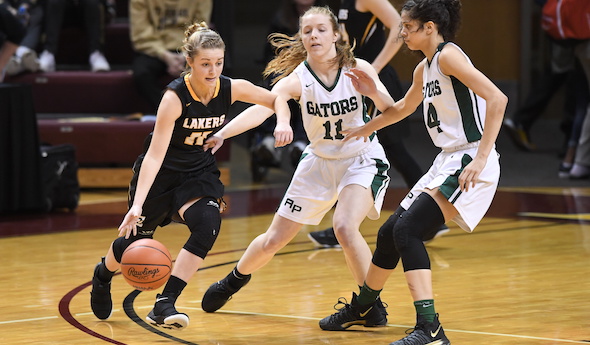
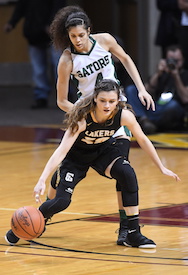
PHOTOS: (Top) Maple City Glen Lake’s Allie Bonzelet (11) works to get past Arbor Prep’s Karli Waddell (11) and Lasha Petree. (Middle) Petree defends against Savannah Peplinski.
Time Still Now for Reigning Champ
By
Tom Markowski
Special for Second Half
February 28, 2018
DETROIT – Twelve months ago Detroit Edison was considered an up-and-coming program.
 With all underclassmen in the starting lineup, any success the Pioneers would achieve during the 2017 MHSAA Tournament would be considered a bonus and a building block for this season.
Success for coach Monique Brown and her team arrived sooner than most predicted. Edison won the Class C title, the school’s first. And at that time, a repeat, possibly even a three-peat, was in the back of the minds of most who watched Edison’s tournament run.
Not only is Edison favored to repeat as champion in three weeks, there are many who say this team could be the state’s best regardless of class. One glance at the Pioneers’ schedule and results this season, and it’s easy to understand why.
Edison was 17-1 during the regular season with its only loss to Ypsilanti Arbor Prep, the Class B runner-up last season and considered one of the top teams in Class C this winter. The Pioneers moved to 18-1 with their District win over Detroit Cristo Rey on Wednesday.
As an independent, Edison played a variety of teams and some of the best including reigning Class B champion Detroit Country Day and Class A elite Ann Arbor Huron, Saginaw Heritage and Wayne Memorial to name a few.
Brown stopped short of saying this team is better than her team last season, and wisely so. Until this team wins another Class C title, one can rest assured Brown won’t make that claim.
“I’ve been pleased with the growth and maturity they’ve shown,” Brown said. “They’ve grown up. Just the patience they’ve shown has been great. We’ve had some games this season that have gone to overtime, where we’ve been down late and have come back. In these situations last season we would have lost by 12 points or so.”
The most recent game where Edison trailed late before coming back to win played out at Heritage on Feb. 20. The Hawks (20-1), considered top contenders for the Class A title, entered the contest undefeated and coming off an impressive 59-49 victory at Country Day just three days earlier.
Edison trailed Heritage by five points with less than a minute to play and came back to win, 57-55, in double overtime.
“That was the best crowd we’ve ever had to face,” Brown said. “When we played Blissfield in the tournament last season, they brought a lot of fans but they were back, up in the stands. Heritage fans were so close to the floor. They were so close they could touch the players. Their student section was packed.”
Edison has star power in 6-foot-3 junior Rickea Jackson and 5-10 sophomore Gabrielle Elliott, both considered among the top players in their respective classes. But more than that, Edison has exceptional depth.
At the point is freshman sensation Damiya Hagemann. Sophomore Shaulana Wagner, who shared time at the point with Daija Tyson last season, is again sharing time at the point but this time with Hagemann. Tyson, a sophomore, recovered well after suffering a knee injury last season and is more at home on the wing.
 Brown has two seniors, Ashley Primas and Oretha Humphries. This is Humphries’ fourth season in the program. And Primas, though not a prolific scorer, is the type of player every good program needs. Whatever is asked of her, she’ll do – she’s the player who will dive for loose balls, set screens and defend players on the wing and in the post.
“Both are quiet, almost like freshmen,” Brown said of her seniors. “Leadership? You get that from Jackson. During a timeout, she’ll get them going.
“Even during practice she’s a leader. At one practice, there was one of our of post players she wasn’t happy with. She texted her and said that she wasn’t working hard enough. I didn’t even know she did that. She’s matured so much. Last year I called her our “sophomore-senior,” but she didn’t know how to lead. Me not throwing that on her this year, she’s stepped into that role.”
Brown has received more consistent play from her reserves, especially since the loss to Arbor Prep on Jan. 11 Brown said her players weren’t as focused for that game as they need to be and got ahead of themselves, perhaps a bit too overconfident.
“That loss helped,” she said. “That’s why we were able to win other games later in the season. We trailed Arbor Prep the whole game and came back to tie it, and then relaxed.”
Brown knew she could count on players like Jackson, Elliott and Hagemann. But throughout the season others have emerged to contribute. Keiarra Jennings played sparingly as a freshman last season and has gradually earned more playing time. It was Jennings’ 3-pointer that sent the game against Heritage into overtime.
“Sometimes she’s too aggressive,” Brown said. “I’ll have to take her out and tell her to slow down. You wouldn’t believe how she’s progressed from last year. She’s a threat coming off the bench. She doesn’t play a whole lot of minutes, maybe 10 in a game, but she can get you seven quick points.”
Edison is a team where every player has accepted her role and is working toward the same goal, from seniors like Primas to freshman like Hagemann.
“It’s not that were better than last year,” Primas said. “We’re more mature. Mentally, we’re tougher this year. It’s the experience. We were in so many games last year where we were down late and would lose.
“There is a difference between last year and now. Last year we didn’t know what to expect. Our mindset this year is to dominate every game. We realize our roles. We have so many players and if one isn’t on their A game, we know we can step up and fill that void.”
 Tom Markowski is a columnist and directs website coverage for the State Champs! Sports Network. He previously covered primarily high school sports for the The Detroit News from 1984-2014, focusing on the Detroit area and contributing to statewide coverage of football and basketball. Contact him at [email protected] with story ideas for Oakland, Macomb and Wayne counties.
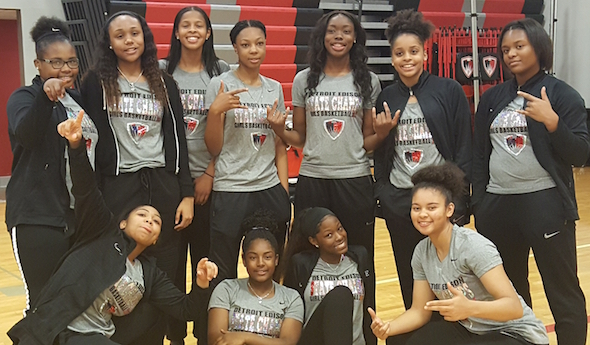
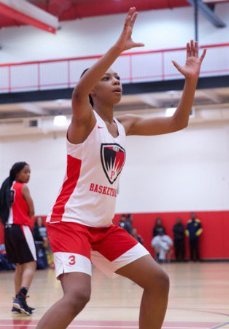
PHOTOS: (Top) This season’s Detroit Edison team, off to an 18-1 start as it pursues a second straight Class C title. (Middle) Gabrielle Elliott readies for a pass during a scrimmage. (Photos courtesy of the Detroit Edison girls basketball program.)