


Bowers Finds Shot Just in Time to Lead Kent City Back to D3 Finale
By
Dean Holzwarth
Special for MHSAA.com
March 17, 2022
EAST LANSING – Kent City junior guard Lexie Bowers didn’t waste any time breaking out of a rare shooting slump.
After struggling offensively in her team’s Quarterfinal, Bowers redeemed herself with an impressive shooting performance two days later.
Bowers scored a game-high 22 points to help lead the Eagles to a 47-30 win over Madison Heights Bishop Foley in Thursday’s second Division 3 Semifinal at the Breslin Center.
The unbeaten Eagles (26-0) with return to the Finals for the second consecutive year and play Ypsilanti Arbor Prep at 4 p.m. Saturday.
The Gators (24-2) defeated previously-unbeaten Glen Lake in the other Semifinal, 57-44.
“I haven't had a good shooting night in a while, and I knew coming in that I was going to have to pick up my shooting because that’s what I am, a shooter,” said Bowers, who had a season-low six points in a one-point win over Schoolcraft in the Quarterfinal.
“I was more calm (today), which is weird because I'm in the Breslin, but I set my feet more and I just had a lot more confidence in myself. I just let it go.”
Bowers drained three of her five 3-pointers during the second quarter as Kent City shrugged off a slow start to lead 30-13 at the half.
“We started hitting shots in the second quarter, and our offense started moving,” Eagles coach Aleah Holcomb said. “Our shooting percentage was great in the first half, and I was very happy with how well we played tonight. We hit a lot of shots, and defensively we shut them down and played good team defense.”
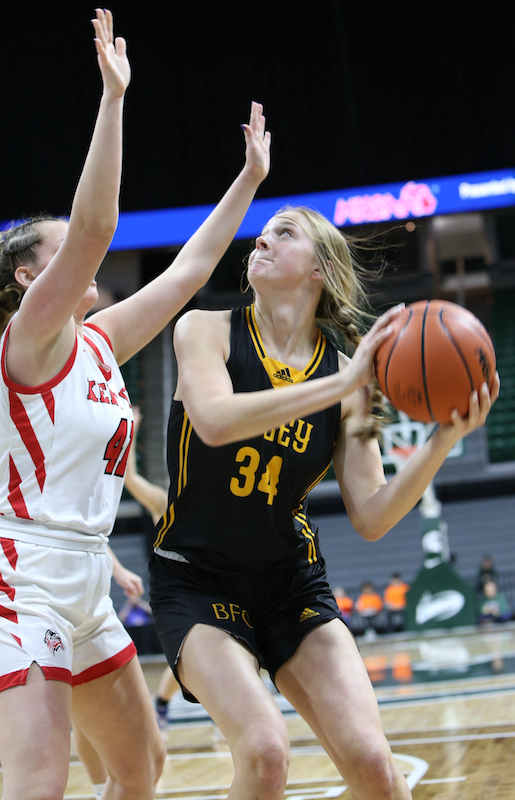 Bishop Foley coach Ray Joseph was impressed by Bowers’ shooting prowess.
“She was on fire, and she was hitting all kinds of shots,” Joseph said. “We put someone on her to try and slow her down, and it worked for a little bit. She didn’t score that much more in the second half than the first. She’s a good player.”
One of Bowers’ most memorable moments in the game happened in the fourth quarter when she was knocked down attempting a 3-pointer.
“No, I didn't see it go in,” Bowers said. “I just got hit and then everybody was around me and I was like, ‘What, did I make it?’ Yeah, it was crazy, but it was a good shot.”
Bowers converted the free throw for a four-point play to give the Eagles a commanding 42-23 lead.
“We all played really hard, and it's taken a lot of hard work to get to this point and we are just really glad to be back,” Bowers said. “The two-point loss in the state finals last year has been motivation and made us work even harder.”
Kent City sophomore Madelyn Geers played well on both ends of the court. She made 7 of 13 shots and finished with 16 points, a game-high 14 rebounds and four blocked shots.
Bishop Foley, which was led by Ryan Moorer’s seven points and 10 rebounds, made its first trip to the Semifinals in school history.
The Ventures (20-4) weren’t able to recover from being outscored 20-7 in the second quarter.
“It was a tough game, and in the first half we really didn't play our game,” Joseph said. “In the second half we played them pretty evenly, but they had the height on us and got a lot of rebounds. We didn't quit, and we fought till the end.”
PHOTOS (Top) Kent City’s Emmalyn Geers (41) sets a screen on Bishop Foley’s Ryan Moorer (23) as the Eagles get into their offense Thursday at Breslin Center. (Middle) Bishop Foley’s Melanie Moore (34) works for position against Geers. (Click for more from Hockey Weekly Action Photos.)
Breslin Bound: Girls Report Week 1
December 3, 2012
By Geoff Kimmerly
Second Half editor
More than 700 girls basketball teams hope to be playing at Michigan State University's Breslin Center when this season ends.
That may be fourth months away. But those quests began last week.
Each Monday, Second Half will tell you about 10 teams and individuals who jumped out the week before. What's below isn't any sort of statewide ranking – merely a top-10 list of notables for fans no matter where they live and who they will cheer on this winter.
I fully admit I won't be able to catch every team that does something special. That's where you come in. Post below and let us know which teams did what, or who we should watch coming up.
1. Brownstown-Woodhaven (1-0) – Much is expected this season out of the Warriors, who finished 22-2 last season. And Detroit Country Day is replacing an all-state backcourt that graduated a year ago. But a win over Country Day is still a win over Country Day, and Brownstown-Woodhaven got one Saturday, 54-52.
2. Goodrich (1-0) – The reigning Class B champion beat the reigning Class C runner-up, Grosse Pointe Woods University Liggett, 51-42. Goodrich still has a number of key pieces from last season’s run, while University Liggett has a few too, but is replacing Miss Basketball Madison Ristovski.
3. AuGres-Sims (2-0) – Welcome to high school basketball, Cassidy Boensch. AuGres’ 6-foot-2 freshman had 29 points, 17 rebounds, 16 blocks and 13 steals in her team’s 55-16 win over Whittemore-Prescott, and then 28 points, 12 rebounds and 10 blocks in a 51-42 win over Fairview. Click to read more from the Bay City Times.
4. East Lansing (1-0) – The Trojans and Lansing Waverly regularly have been the Lansing area’s best over the last decade and regularly face each other on the first Friday. This time the Trojans won big, 72-44.
5. West Bloomfield (1-0) – West Bloomfield got off to a good start with a 52-44 win over a team that has finished the last three seasons with victories. Waterford Our Lady has won the last three Class D championships.
6. Hartland (2-0) – The Eagles returned to the court after their 21-win season and second straight District title with a pair of close victories. Hartland beat Holly 36-31 and then Fenton 49-48.
7. Saginaw Michigan Lutheran Seminary (2-0) – The Cardinals showed perhaps some of the poise they learned during last season’s run to the Class D Quarterfinals. They won two close ones over Class B teams, 49-47 over Standish Sterling and 33-31 over Hemlock.
8. Oxford (2-0) – The Wildcats won 10 games last season, and are 20 percent of the way to equaling that total thanks to a pair of close wins. Oxford edged Rochester 35-34 on opening night, then Farmington Hills Harrison 30-27.
9. Leroy Pine River (1-1) – The Bucks rebounded from an opening-night loss to Reed City to double up the reigning Class C champion, Morley-Stanwood, 57-25.
10. Shepherd (2-0) – The Bluejays opened with wins against both teams that call Mount Pleasant home. They beat Class D Sacred Heart 46-37 and Class A Mount Pleasant High 36-23.
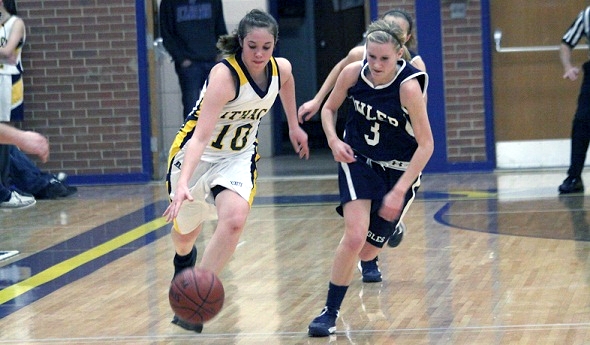
PHOTO: Fowler defeated Ithaca 51-37 on Tuesday. The Eagles are among teams that have begun 2-0 this season. (Click to see more at HighSchoolSportsScene.com.)