

Breslin Bound: Girls District Review
March 10, 2015
By Geoff Kimmerly
Second Half editor
The first week of the MHSAA Girls Basketball Tournament is done, and what do we know so far?
There will be a new Class B champion this winter, and a number of emerging contenders could shake things up in all four classes.
See below for our take on four District champs from each class that especially stuck out during last week’s action; click to follow this week’s Regional Tournament. Next week’s Breslin Bound report will preview all 16 Quarterfinals.
Class A
Byron Center (18-5) – The Bulldogs have steadily climbed the last four seasons from sub-.500 in 2011-12, with this District title a nice crowning achievement no matter what happens this week. Byron Center opened with a five-point win over East Kentwood (11-10), then avenged last season’s District Final loss by beating Grand Rapids Christian (17-5) in this Semifinal, 48-44. Byron Center then downed Caledonia (15-7) in the championship game, 39-27.
Marquette (23-0) – The Redettes pushed their sphere of domination further downstate, extending their perfect run against some of the biggest and best from the northern Lower Peninsula. Marquette first beat Big North Conference champion Traverse City West (17-4), which had eliminated Marquette the last two seasons. The Redettes then beat Traverse City Central (9-12) in the Semifinal before finishing the run with a 65-41 win over Big North runner-up Gaylord (18-5).
Muskegon Mona Shores (20-3) – Mona Shores shared the Ottawa-Kent Conference Black title with Muskegon Reeths-Puffer (16-5) because it lost to the Rockets – twice – during the regular season. But the Sailors won with the season on the line, beating Reeths-Puffer 50-46 in the District opener. They then beat Grand Haven in the Semifinal and won the championship against Muskegon, which eliminated Mona Shores last winter.
Salem (19-4) – The Rocks followed up their Kensington Lakes Activities Association overall championship with three wins including two over familiar opponents. Salem opened with a three-point victory over Plymouth (17-4), which had eliminated the Rocks the last two seasons, and then beat Northville (13-8), which finished second to Salem in the KLAA Central. The Rocks moved on with a 42-29 win over Canton (11-11), last season’s Class A runner-up.
Class B
Midland Bullock Creek (23-0) – Arguably the favorite for the entire tournament, Bullock Creek had to survive an early scare and another strong opponent to advance. After beating Pinconning (8-11) in the opener, the Lancers just edged Bay City John Glenn (15-4) by a point, 40-39, in the Semifinal. Bullock Creek came back big in the Final with a 65-30 win over Gladwin (16-7).
Haslett (18-5) – The Vikings are looking again like the contenders they were expected to be at the start of this winter. They opened by avenging a regular-season loss against Williamston (19-2), downing the Hornets 53-43, and then beat Perry (15-6) by 28 in the Semifinal. Haslett finished with a 66-30 win over Lansing Catholic (12-11) in the championship game.
Jackson Northwest (19-4) – The Mounties opened by ending the season for the reigning Class B champion, Eaton Rapids (7-14), by beating the Greyhounds 48-44 in overtime after falling to them in last season’s District. Northwest moved on with double-digit wins over Leslie (14-7) and then Olivet (17-5).
Macomb Lutheran North (20-3) – The Mustangs took a step farther than last season after falling in the District championship game a year ago. After eliminating Algonac and Marine City (12-8) by double figures, Lutheran North beat Marysville 42-40 on a put-back with 10 seconds to play in the Final. Marysville shared the Macomb Area Conference Gold title this season, while Lutheran North won the Detroit Catholic League AA.
Class C
Laingsburg (23-0) – The undefeated Wolfpack kept their perfection going against two of their toughest regular-season opponents and then the team that eliminated it last season. Laingsburg opened with a 32-26 win over league rival Pewamo-Westphalia (17-4), then beat Bath (12-7) by 10 before avenging last season’s District Final loss to Carson City-Crystal (20-3), beating the Eagles this time 28-17.
Napoleon (16-6) – The Pirates advanced in impressive fashion with an upset and then a little bit of vengeance. After downing Jackson Lumen Christi (8-12) in the opener, Napoleon – runner-up in the Cascades Conference – downed Big 8 Conference champion Concord (18-3) by nine. The Pirates finished the week by defeating Cascades third-place finisher Michigan Center (18-5) which had beaten Napoleon by 10 on Jan. 29.
Reese (17-5) – The Rockets followed up on their shared Greater Thumb Conference West championship with a pair of wins over tough District opponents – Millington (13-9) by 30 points and then New Lothrop (18-5) by 35 in the championship game.
Traverse City St. Francis (21-2) – After a quick first-game exit last season, the Gladiators won a strong District that included a pair of league runners-up. St. Francis, co-champ in the Lake Michigan Conference, opened by beating Ski Valley Conference runner-up Johannesburg-Lewiston (18-3) by 12 points, 52-40, and then defeated Mancelona in the Semifinal and Northwest Conference runner-up Maple City Glen Lake (15-7) in the Final, 47-38.
Class D
Bellaire (22-1) – The Eagles claimed their second straight District title with three wins over teams .500 or better. Bellaire opened by doubling up Boyne Falls (11-10), tripled up Ellsworth (10-10) and then downed rival Gaylord St. Mary 46-32. Bellaire beat the Snowbirds (18-5) by a nearly identical score in last season’s District Final as well.
Kingston (19-3) – The Cardinals also won their second straight District title with a pair of double-digit wins over North Central Thumb League rivals. Kingston, the league champion, beat third-place Carsonville-Port Sanilac (12-7) in the Semifinal and then second place Deckerville (16-5) in the championship game, 38-21.
Pickford (16-7) – The Panthers finished second in the Eastern Upper Peninsula Athletic Conference this winter, but avenged a pair of losses to league champion Cedarville (16-6) to advance last week. Pickford opened with a win over EUPAC third-place Brimley (11-9), then downed Kinross Maplewood Baptist (11-5) before edging Cedarville 59-54 in the Final.
Pinckney Livingston Christian (14-5) – LCS claimed its first girls basketball District title with a series of wins including two over similarly-successful teams. After opening with a victory over Ann Arbor Central, Livingston Christian downed Ann Arbor Rudolf Steiner (13-7) and then Adrian Lenawee Christian (14-5) by a bucket, 27-25, in the Final.
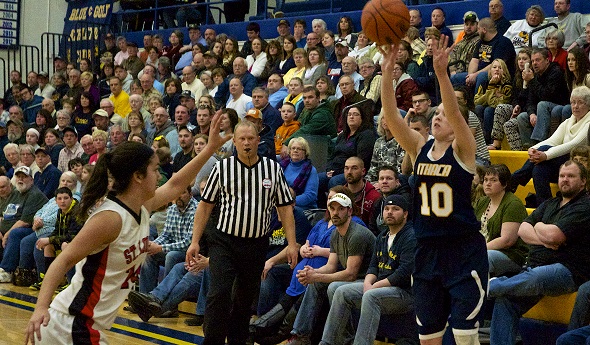
PHOTO: Ithaca defeated St. Louis 61-32 in a Class C District Final last week to advance to the MHSAA Regionals for the first time since 2000. (Click to see more at HighSchoolSportsScene.com.)
Breslin Bound: Girls Report Week 3
December 17, 2012
By Geoff Kimmerly
Second Half editor
As a general rule, basketball teams evolve plenty between the first games of December through the final regular-season contests in February.
But these pre-break matchups matter just as much in the win-loss columns. And a number of games are being played right now that will surely make a difference as this season draws to a close.
This week's report includes some of the teams that have came out on the winning ends of key December battles. (Results and records based on those reported to Score Center at MHSAA.com)
1. Inkster (4-0) – The Vikings are a regular at Breslin Center and made the Class A Semifinals last season, so another great start is hardly surprising. But it's proof why Inkster remains a force – last week’s wins were 51-45 over improved Detroit Mumford and 57-51 over always-powerful Detroit Pershing.
2. Waterford Our Lady (3-1) – The reigning Class D champion has bounced back quickly from an opening-night loss to West Bloomfield. Last week, Our Lady beat Livonia Ladywood 50-38 and Mount Pleasant Sacred Heart by the same score.
3. Detroit Martin Luther King (3-0) – This is another team always in the Class A mix, and it got a big win Saturday – 56-48 over returning Class A Semifinalist Ann Arbor Huron, which earlier in the week had defeated Detroit Country Day 65-58. King also beat Detroit East English 61-7.
4. Johannesburg-Lewiston (5-0) – The Cardinals lost only two regular-season games last season, both times to Ski Valley Conference rival Gaylord St. Mary. But they got a little bit of revenge last week with a 50-48 win over St. Mary after also beating East Jordan 57-43.
5. Holt (5-0) – The Rams are again setting up nicely to contend in the strong Capital Area Activities Conference Blue. They beat nonleague foe St. Johns 52-48 and then Lansing Everett 48-39 to keep early pace with other frontrunners Grand Ledge and East Lansing.
6. Napoleon (5-1) – Napoleon’s 15-7 finish in 2011-12 included splits against Michigan Center and Grass Lake. The Pirates got an early upper hand on both last week, beating Michigan Center 49-45 and Grass Lake 47-42.
7. Traverse City St. Francis (4-1) – The Gladiators opened last season 14-1, with that lone loss to Cadillac – which they beat last week 55-50. St. Francis also defeated Kalkaska 44-36 on Friday.
8. Pewamo-Westphalia (3-2) – The Pirates got off to a rough start with opening-week losses to Class B Williamston and Lakewood. But back in familiar territory in the Central Michigan Athletic Conference, they've won three straight – including 51-42 last week over returning Class D Semifinalist Portland St. Patrick.
9. North Farmington (3-1) – The Raiders are coming off a 10-12 season that included a pair of losses to Pontiac. But North Farmington earned the early edge this time with a 59-58 win over Pontiac, followed by a 58-48 win over West Bloomfield.
10. Powers North Central (5-1) – After opening with a 13-point loss to returning Class D Semifinalist Crystal Falls Forest Park, North Central hasn't fallen again. The Jets beat Stephenson 62-51 and Munising 50-22 to get nearly halfway to last season’s win total of 11.
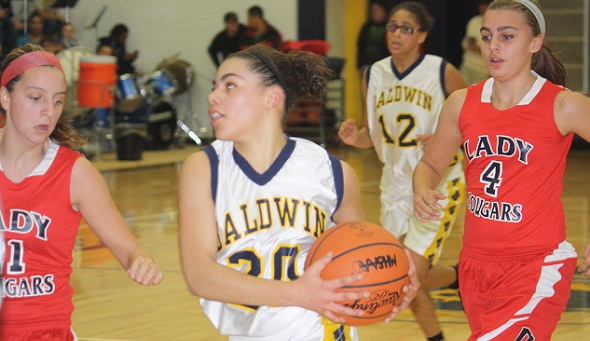
PHOTO: Big Rapids Crossroads (in red) defeated Baldwin on Thursday to move to 4-0 this season. (Click to see more at HighSchoolSportsScene.com.)