

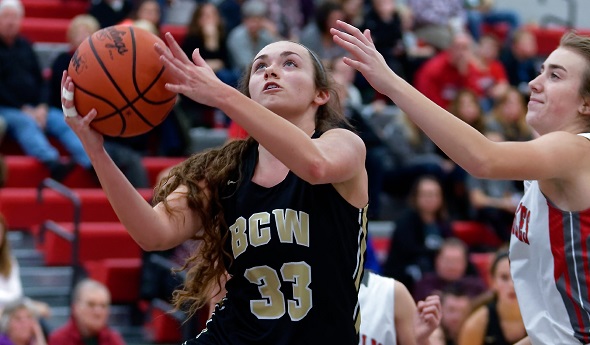
Built for this Moment, Western Arrives
By
Paul Costanzo
Special for MHSAA.com
January 16, 2018
McKenna Walker was a fourth grader when her dad, Tim, returned for his second stint as coach of the Bay City Western girls basketball team.
 At that point, she didn’t realize what she and her friends were building. She simply was having fun playing basketball.
But her dad saw the future of his program.
“They were successful at a young age,” Tim Walker said. “I could see the athletic ability. I could see they were competitive and willing to learn at a young age. You could kind of see it coming with putting these pieces together.”
Now, as McKenna enters the second half of her senior season, she and her teammates are proving her father right. The Warriors are coming off their first back-to-back winning seasons since 1998-99, and were 9-0 heading into Tuesday night’s matchup with rival Midland. They’re ranked No. 6 in Class A by The Associated Press, and No. 8 by the Detroit Free Press.
“We have some really strong leadership with my daughter, McKenna – she’s been a big part of the turnaround since her freshman year,” said Tim Walker, who took over the program five games into the 2009-10 season, and also coached the Warriors from 1994-2004. “Also, we have kids in her class that have stuck with it and have been very committed since third and fourth grade. We have a strong group of juniors that have also been committed. They’re all competitive athletes, and I’ve been blessed to have kids who are dominant in other sports and have really meshed well together, accept their roles and play hard. It’s been very enjoyable to be a part of.”
This season, Bay City Western is winning with an uptempo style, sometimes driven by a five-guard lineup. McKenna Walker, who signed with Northwood University in November, leads that charge. She averaged 19 points and 8.4 rebounds per game as a junior, and started this season with 1,120 career points. In a recent game against Saginaw, she set a career high with 39 points.
She is one of two four-year players on the team, as Kylie Lukowski also has been playing varsity ball since her freshman year. Lukowski stands at just 5 feet, 6 inches tall, but she finds a home in the post when it’s asked of her.
“I try my hardest because I’m not very tall, obviously,” she said. “So I just have to push them around a little bit and see if it bothers them at all.”
Despite the lack of size, things seem to be working, as the Warriors are keeping teams off balance and taking advantage of the matchups their smaller lineup creates.
“Let’s just say if there were a shot clock, we would not have a hard time getting a shot off,” Tim Walker said. “It’s not that we’re making them all, but we’re playing uptempo and forcing turnovers.”
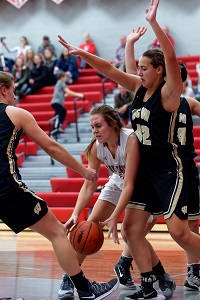 The hope is that style can translate to victories in the postseason, which have been elusive for Bay City Western. The school won District titles in 1997 and 1998, but none since.
“(Winning a District title) would just be so cool,” McKenna Walker said. “It’s been one of my goals since coming in, because it’s been such a long time, and I just wanted to change that.”
When looking at the competition for a District title, one easily can forgive the Warriors’ current drought.
This season, like most, the bracket includes Bay City Central, Midland, Midland Dow, Mount Pleasant and Saginaw Heritage, which would be a tough path for any team.
“As these kids (were) developing at a young age, we’ve been having to set the bar awfully high,” Tim Walker said. “Because the Midlands have always been good, the Saginaw teams have always been good. You really have to get the kids to buy into the offseason work and just work hard.”
Two seasons ago, Western found itself leading Saginaw Heritage at halftime in a District Semifinal. Heritage came back to win the game, however, and eventually advanced to the Regional Final.
It was a tough loss, but also served as a confidence builder and teaching moment for the young Warriors.
“We definitely learned that every team is beatable,” McKenna Walker said. “Even if we’re playing a team that we’re supposed to beat, you never know, because every team is beatable. You never want to think that it’s UConn playing you. We’re all high school girls. We’re all the same age. Anything can happen.”
The Saginaw Valley League helps prepare the Warriors for this postseason gauntlet, although it’s preparing everyone else in the District as well. The league includes the six teams from the District, plus Davison, Flint Carman-Ainsworth, Bay City John Glenn, Flint Powers Catholic, Saginaw, Saginaw Arthur Hill, Flint and Lapeer all forming one division this winter.
The schedule can be a grind, but it also helps the team stay focused on the day-to-day routine needed to be successful and reach the goals it set at the beginning of the season – and the promise Tim Walker saw in this group so long ago.
“What I have noticed is, mentally, each night they’re in a pretty good place right now,” Tim Walker said. “They just have a really good grasp on what it takes to play with effort, team play and execution.”
 Paul Costanzo served as a sportswriter at The Port Huron Times Herald from 2006-15, including three years as lead sportswriter, and prior to that as sports editor at the Hillsdale Daily News from 2005-06. He can be reached at [email protected] with story ideas for Genesee, Lapeer, St. Clair, Sanilac, Huron, Tuscola, Saginaw, Bay, Arenac, Midland and Gladwin counties.
PHOTOS: (Top) Bay City Western’s McKenna Walker gets to the basket during Bay City Western’s opener against Frankenmuth. (Middle) The Warriors defend the post against the Eagles. (Photos by Chip DeGrace.)
Breslin Bound: Girls Report Week 8
January 22, 2013
By Geoff Kimmerly
Second Half editor
With 20 games to play and most teams seeing at least half their opponents twice, finishing the regular season perfect is truly an incredible accomplishment.
The number of teams with the opportunity to do so this season is getting smaller by the week. Keep an eye on the teams topping this week's list of recent high performers as they go for that rare feat – plus the rest of this 10 if they get chances to play spoiler.
1. St. Ignace (11-0) – The Saints haven’t allowed an opponent within 20 points since Dec. 1, and none this season have gotten closer than 14.
2. Detroit Martin Luther King (11-0) – King has been the favorite all season to win Class A in March, and solidified that status further by beating highly-regarded Southfield Lathrup by 18 last week.
3. Niles Brandywine (11-0) – The Bobcats remained perfect in part by handing Mendon its first loss of the season, 51-47 on Thursday.
4. Midland Dow (13-0) – Dow is the team to beat in either division of the Saginaw Valley Association and next week will face Midland for the first time after being swept by its rival last season.
5. Benton Harbor (8-3) – Two of the Tigers losses were by a combined five points, and they won big against expected Big 16 West favorite St. Joseph, 66-37 on Tuesday.
6. Saginaw Nouvel (10-1) – The Panthers make a quick return to this list after beating fellow Class C contender Saginaw Valley Lutheran, 60-50, plus Class A Saginaw.
7. Wayland (8-3) – The Wildcats have won five straight and handed Grand Rapids South Christian its first loss of the season, 57-38 on Friday.
8. Mendon (11-1) – The Hornets may have lost to Brandywine last week, but they also beat 2012 Class D runner-up Athens, 42-27.
9. Fenton (8-3) – The Tigers have won seven of their last eight and are the team to chase in the Flint Metro League after beating Holly 38-27 on Friday and Clio 56-49 on Monday.
10. Hamilton (11-1) – The Hawkeyes have taken another step after losing five games last season, with their only loss this winter to Grandville during a holiday tournament.
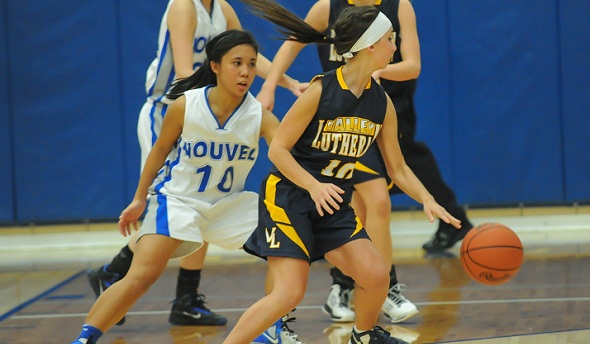
PHOTO: Saginaw Nouvel (white jerseys) edged Valley Lutheran 60-50 last week in a battle of Class C powers. (Click to see more at HighSchoolSportsScene.com.)