

Class A: Comeback Classic
March 17, 2012
EAST LANSING – Shar’Rae Davis had one thought when she received the ball with only a few seconds remaining and Grand Haven’s first championship on the line in Saturday’s MHSAA Class A Final.
She saw the rim on Breslin Center’s north basket. And she knew she had 12 seconds to reach it.
“I didn’t even see the rest of my team. So I was like, I’ve got to score,” Davis said. “That was my mentality.
Not only did Davis race the length of the court; she drove to finish the third-longest comeback in MHSAA Girls Basketball Finals history.
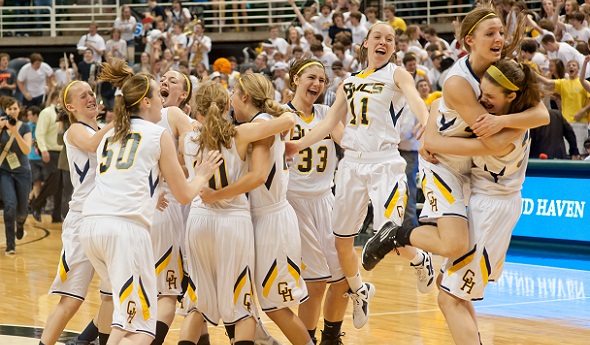
Davis completed her lay-up with six seconds to play. Grosse Pointe South couldn’t connect on its final last-second attempt. And the only thing Davis was a second late for was the start of the celebration: Grand Haven 54, Grosse Pointe South 53.
“When I made the basket, I thought it was tied or something. I was looking around for the timeout. Nothing was happening,” she said. “Then I saw Abby (Cole) jump, everyone run at me. I still didn’t believe it. I had to look at the score.”
Believe it: Grand Haven won its first MHSAA championship after surviving a harrowing double-overtime Quarterfinal against East Lansing, and a late rush by 2011 champion Inskter in Friday’s Semifinal.
But Saturday’s comeback topped them both.
Starting at the end of the first quarter, Grosse Pointe South led for 24 minutes, 5 seconds straight. The Blue Devils’ advantage reached 18 points with 1:51 to go in the third quarter.
“Obviously things weren’t looking good for us down 18. It was another nightmare,” Buccaneers coach Katie Kowalczyk-Fulmer said. “But there was a lot of time left on the clock. And we just talked about getting back into it one possession at a time. You can’t get it all at once. We couldn’t foul just to foul because we knew if the game was going to come down to free throws and we put them at the line, we wouldn’t have a chance.”
Instead, she directed her players to deliver the ball repeatedly to Cole.
The 6-foot-5 junior scored nine of her 18 points over the final 9:38 of the game, including seven straight free throws as the Devils tried to keep her from getting any closer to the hoop (she also had eight rebounds and eight blocks). Davis scored 14 of her game-high 19 points during that 27-10 run.
But those efforts still nearly weren’t enough.
Reeling a bit after giving up the big lead, Grosse Pointe South got a jolt of hope from freshman guard Cierra Rice. Grand Haven took its first lead in two quarters with 1:10 to play, and held a two-point advantage with 24 second to go when Rice dropped in a lay-up, was fouled, and made the free throw to give the Devils back a one-point edge.
But after Davis’ ensuing full-court scoring run, the last attempt by the Devils didn’t fall.
Only Farmington Our Lady of Mercy in 1982 (19 points) and Detroit Cass Tech in 1987 (20) made bigger championship game comebacks than Grand Haven – both to win Class A titles as well.
“We knew we could do anything because of that Quarterfinal game,” Grand Haven senior Alex Law said of the 42-40 win over East Lansing. “It was crazy, but that gave us so much confidence. I was like, ‘Let’s go, we can do this. We’ve got this. It’s our last game. Let’s do it right.’”
Grand Haven finished 27-1, losing only to East Kentwood – a loss the Buccaneers avenged later in the season. They were ranked No. 1 heading into the postseason.
Grosse Pointe South (23-4) was only an honorable mention heading into playoffs. But that didn’t make Saturday any less heart-breaking.
Four Blue Devils scored at least 10 points, led by Rice with 14 and junior Claire DeBoer with 13. Three grabbed at least 10 rebounds – Senior Caitlin Moore had 12 to go with her 12 points, and senior Catherine Palazzolo had 10 to go with her 10 points as Grosse Pointe South outrebounded the taller Buccaneers by 19.
But nine of the Blue Devils 19 turnovers also came during that final Grand Haven run, caused in large part by the Bucs’ “monster” press defense, as they call it. It produced monstrous – and championship – results.
“The past couple of games when the pressure got on, we haven’t always handled it well. And they making the adjustment and really going inside, throwing into the big girls, definitely hurt,” Blue Devils coach Kevin Richards said. “What can you say? We made plays all but right at the very end. We had a great effort and the gameplan worked. We just need to have a little bit better ball security.”
Click for the box score. Watch the game and both teams' postgame press conferences at MHSAA.tv.
PHOTOS: (Top) Grand Haven celebrates its first MHSAA championship. (Photo courtesy of Terry McNamara Photography.)
P-W Earns Shot to Add to Title Collection
March 16, 2017
By Geoff Kimmerly
Second Half editor
EAST LANSING – Pewamo-Westphalia is enjoying a championship-caliber school year.
And now the Pirates girls basketball team wants its piece of MHSAA title success.
P-W can claim its third Finals title of 2016-17 on Saturday, thanks to the hoops team's 64-51 win over Maple City Glen Lake in Thursday’s second Class C Semifinal.
The Pirates girls can join the football and boys cross country teams as champions when they take on Detroit Edison Public School Academy in the 4 p.m. championship game. The Semifinal was P-W’s first since 2002, and the title game appearance will be the program’s first since finishing Class C runners-up in 1983 and 1984 – making it seem like all of this recent winning might be contagious.
“I think it’s just the community. Our community is so supportive, as you can see at any game and any championships – our community is there,” said P-W senior guard Brenna Wirth, herself a main cog on the school’s girls track & field Division 3 title winner in 2015. “I think we feed off that, and it keeps us going.
“I’ve been playing basketball for several years now, longer than I’ve been running, and basketball is really important to me and the community.”
How much it means to Wirth and her teammates came out especially over Thursday’s final 19 minutes.
Glen Lake (23-4) entered the regular season unranked but had already eliminated No. 2 Traverse City St. Francis and No. 7 St. Ignace before taking the floor against the No. 6 Pirates. The Lakers didn’t waste time going after another giant, taking as much as a nine-point lead into the final three minutes of the first half.
“Throughout the season, we tend to say the same thing over and over – you never win the game in the first four minutes,” P-W coach Steve Eklund said. “They were outhustling us; I’d say for the first 8 to 10 minutes they were outhustling us. Sometimes you have to adjust to your opponent. I think it took us a little time tonight to settle into the environment.”
“Obviously we had to fight back every little run they had,” junior forward Emily Spitzley added. “We just had in our minds to keep fighting. It’s just about confidence.”
 If the all-state second-teamer was lacking any, she found it as the comeback began.
Spitzley scored 20 of her game-high 24 points and grabbed eight of her 12 rebounds – and also blocked three shots – as the Pirates forced a 22-point swing.
P-W (24-2) closed the second quarter on an 8-0 run to get within 25-24 of Glen Lake by halftime. The Pirates then opened the third quarter on a 7-0 run to take a six-point lead.
Glen Lake got the advantage back twice with just under four minutes left in the third quarter, and after the Pirates rebuilt an eight-point lead got the deficit down to one again with 6:33 to play. But another P-W 8-0 run over the next three minutes finally put the game out of reach.
“We’ve had a lot of games where we had slow starts, but we’ve worked hard on coming out (strong) in the third quarter,” Glen Lake coach Jason Bradford said. “We just came out kinda slow on our heels and got away from what we usually do – pushing the ball, kicking it out. We were spinning our heels a little bit, and we got a little shell-shocked when the score started going the other way.”
Wirth added 13 points, and junior forward Kate Hengesbach added nine points, 12 rebounds and six steals off the bench in 20 minutes of play.
Junior guard Allie Bonzelet led three Lakers scoring in double figures with 14 points, and junior forward Jennifer LaCross had 13 and seven rebounds. Senior guard Kelly Bunek added 11 points and senior forward Sarah Carney finished her career grabbing nine rebounds.
P-W fans had about a 30-minute drive to fill their side of the Breslin stands Thursday, but Glen Lake had nearly as many fans – including three spectator bus loads – make a nearly four-hour trek.
“It’s just great to be able to put our name out there and show people all the hard work we’ve been putting in,” Carney said. “To just see the community come out and support us … it’s very rewarding to see the support we have.”
The Girls Basketball Finals are presented by Sparrow Health System.
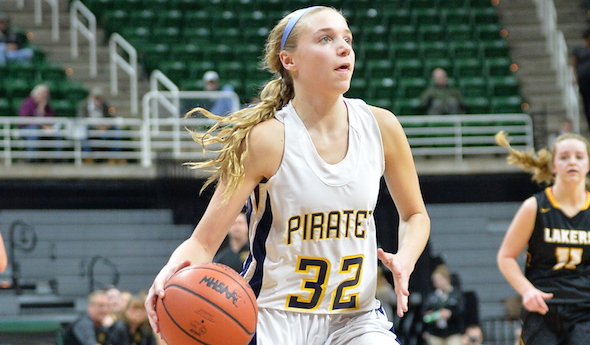
PHOTOS: (Top) P-W’s Emily Spitzley drives to the basket during Thursday’s Class C Semifinal win. (Middle) Glen Lake’s Savannah Peplinski (24) works to get past the Pirates’ Ellie Droste.