

Coach Leads with Same Drive, New Perspective
February 20, 2019
By Steve Vedder
Special for Second Half
Colleen Nagel can only shake her head when one of her former Grand Rapids Catholic Central basketball players offers an observation after dropping by a Cougars practice.
Now in her 30th year of coaching, and first season of her second stint at Catholic Central, the former Colleen Lamoreaux-Tate admits to the subtle changes that three decades on the bench have brought.
Those changes don't include the lessening of competitive fires which still burn bright or the importance of the relationships with the players or teaching of the game.
But make no mistake, there are differences – changes that have only come through self-reflection. Known as one of the most fiery coaches in Grand Rapids, Nagel still has high expectations for her teams. But time, a shuffling of personal priorities and the wisdom of age has changed Nagel, who surpassed the career 360-win total last week.
"I'll have some of my former players stop by, and they say I'm nicer," Nagel laughs. "You get older and slow down, and it's a different kind of time now. I've always said if you can't evolve with time, you need to get out."
A case in point came a couple weeks ago when the Cougars, on the verge of taking charge of the Ottawa-Kent Conference Blue championship race, suffered a crushing one-point loss to Coopersville after inexplicably falling behind by 23 points at the half. The team also dropped a one-point decision to West Catholic after hammering the Falcons by 30 in the teams' first meeting.
Nagel said her reaction to those losses differs from how she would have handled them during her first seven-year coaching stint at Catholic Central. During that tenure, the Cougars went 167-19, including notching arguably the greatest win in Grand Rapids girls basketball history when the Cougars stunned then 10-time (now 13-time) MHSAA Finals champion Detroit Country Day 51-43 in the 2010 Class B championship game.
Instead of driving her teams even harder after such losses, Nagel said she has the wisdom to use them as a teaching tool.
It's all about age and reflection, she said. The combination of a second marriage, a new job outside basketball, the responsibility and joy of coaching her daughter, the experience of three years coaching at Ferris State University and the recognition that teenage athletes and their parents have changed over the years have caused Nagel to take a hard second look at how she coaches.
Nagel said her conclusions may have left her a better coach, but definitely a person who finds herself examining the big picture over her own immediate surroundings.
Which isn't to say the drive to win has passed her by. What she will say is that 30 years after her first bench position as West Catholic's freshmen coach in 1989, the game remains as fun as ever.
"Kids change, and I'm not saying that's a bad thing at all," she said. "I probably don't yell in practice and in the games like I used to. But I've always said you have to evaluate yourself, and I'm absolutely still having fun."
 While winning still ranks near the top of her priorities, Nagel said what drives her now – both on the court and off – is the quest for balance. While still possessing a love of coaching, Nagel said family and professional happiness off the court is what she seeks. As for winning, that candle still burns – but it's no longer consuming.
"I will never think winning isn't important. I'll always think my team needs to be in it until the end," she said. "But you can be consumed with things when you should be trying to find a balance in your life. (College) was 24/7 for me, and because of that I began to reflect and I realized life should be a balance. My priority should be my family."
That's probably the No. 1 lesson that came out of coaching three years at Ferris State after leaving Catholic Central in 2012.
"You're always thinking the grass might be greener," Nagel said of making that move.
What she found was the grass wasn't greener. Nagel said the endless fundraising, the long recruiting trail and the year-round duties of a college coach wound up being more than she wanted.
Nagel was content to be out of the game while watching her daughter, Katie, play on the Catholic Central varsity as a freshman a year ago. But when then-coach Trevor Hinshaw decided to devote more time to his family and athletic director duties after going 120-28 in the six seasons after replacing Nagel, she saw an opportunity to return to a familiar post.
She had turned down the job once when she didn't want people thinking Katie had made varsity as a freshman because her mother was the coach. But Nagel couldn't pass on the opportunity when Hinshaw asked again.
"She's such a great competitor, coach and teacher," Hinshaw said of Nagel, who as a member of the search committee recommended Hinshaw for the job after leaving for Ferris State. "The relationship she builds with players is one of the keys why her teams excel on the court. It's the combination of a lot of things which make her a good coach."
Because she recognizes the growth in herself over the last few years, Nagel said she enjoys coaching as much as ever, particularly in the MHSAA Tournament. In addition to the win over Country Day in 2010, Catholic Central had a pair of Class B runner-up finishes in 2009 and 2012. Her 2002 East Grand Rapids team also finished second.
This season’s team is 11-5 overall and tied for first in the O-K Blue, with a chance at another postseason run when Districts begin in two weeks.
"It's the backbone of everything I coach for," she said of the postseason. "I want my teams to be as ready for the tournament like I always did.
"But you can drive yourself crazy in saying, 'This is what we should be doing. How can I create what we need to do?' You evolve with time. I'm not saying I still won't yell at referees or whomever. But like a parent, you should become smarter.
"You need to see that times change. There's still a right way to play – you hustle, have a good attitude and if you knock someone down you pick them up. But you evolve."
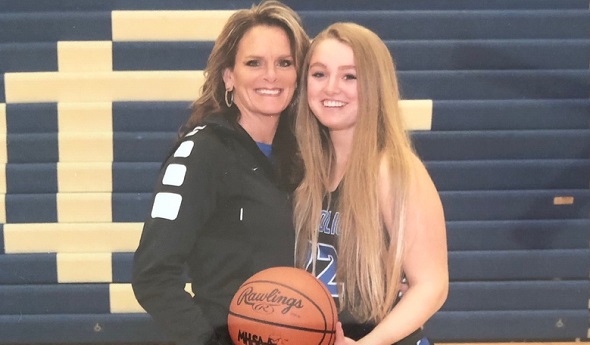
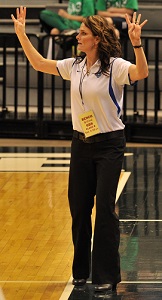
PHOTOS: (Top) Colleen Nagel returned to coaching Grand Rapids Catholic Central this season, including her sophomore daughter Katie Tate. (Middle) Nagel guides her team during the 2012 Class B Final. (Top photo courtesy of the Nagel family.)
Breslin Bound: Girls Report Week 1
December 3, 2012
By Geoff Kimmerly
Second Half editor
More than 700 girls basketball teams hope to be playing at Michigan State University's Breslin Center when this season ends.
That may be fourth months away. But those quests began last week.
Each Monday, Second Half will tell you about 10 teams and individuals who jumped out the week before. What's below isn't any sort of statewide ranking – merely a top-10 list of notables for fans no matter where they live and who they will cheer on this winter.
I fully admit I won't be able to catch every team that does something special. That's where you come in. Post below and let us know which teams did what, or who we should watch coming up.
1. Brownstown-Woodhaven (1-0) – Much is expected this season out of the Warriors, who finished 22-2 last season. And Detroit Country Day is replacing an all-state backcourt that graduated a year ago. But a win over Country Day is still a win over Country Day, and Brownstown-Woodhaven got one Saturday, 54-52.
2. Goodrich (1-0) – The reigning Class B champion beat the reigning Class C runner-up, Grosse Pointe Woods University Liggett, 51-42. Goodrich still has a number of key pieces from last season’s run, while University Liggett has a few too, but is replacing Miss Basketball Madison Ristovski.
3. AuGres-Sims (2-0) – Welcome to high school basketball, Cassidy Boensch. AuGres’ 6-foot-2 freshman had 29 points, 17 rebounds, 16 blocks and 13 steals in her team’s 55-16 win over Whittemore-Prescott, and then 28 points, 12 rebounds and 10 blocks in a 51-42 win over Fairview. Click to read more from the Bay City Times.
4. East Lansing (1-0) – The Trojans and Lansing Waverly regularly have been the Lansing area’s best over the last decade and regularly face each other on the first Friday. This time the Trojans won big, 72-44.
5. West Bloomfield (1-0) – West Bloomfield got off to a good start with a 52-44 win over a team that has finished the last three seasons with victories. Waterford Our Lady has won the last three Class D championships.
6. Hartland (2-0) – The Eagles returned to the court after their 21-win season and second straight District title with a pair of close victories. Hartland beat Holly 36-31 and then Fenton 49-48.
7. Saginaw Michigan Lutheran Seminary (2-0) – The Cardinals showed perhaps some of the poise they learned during last season’s run to the Class D Quarterfinals. They won two close ones over Class B teams, 49-47 over Standish Sterling and 33-31 over Hemlock.
8. Oxford (2-0) – The Wildcats won 10 games last season, and are 20 percent of the way to equaling that total thanks to a pair of close wins. Oxford edged Rochester 35-34 on opening night, then Farmington Hills Harrison 30-27.
9. Leroy Pine River (1-1) – The Bucks rebounded from an opening-night loss to Reed City to double up the reigning Class C champion, Morley-Stanwood, 57-25.
10. Shepherd (2-0) – The Bluejays opened with wins against both teams that call Mount Pleasant home. They beat Class D Sacred Heart 46-37 and Class A Mount Pleasant High 36-23.
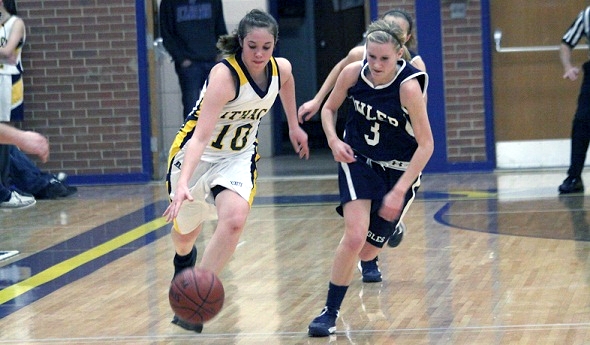
PHOTO: Fowler defeated Ithaca 51-37 on Tuesday. The Eagles are among teams that have begun 2-0 this season. (Click to see more at HighSchoolSportsScene.com.)