

Contenders Hope to Follow Saints' Path
March 14, 2016
By Dennis Grall
Special for Second Half
The St. Ignace girls basketball team is obviously quite familiar with the Mackinac Bridge.
 The Saints live at the Upper Peninsula's eastern connection to downstate, and they seem to make regular trips across the bridge in quest of MHSAA championships.
The Newberry and Stephenson girls basketball teams are virtual strangers to the glorious span that connects the two peninsulas. That is about to change, as Tuesday they face each other in a Class D Quarterfinal at Negaunee in hopes of earning a first downstate trip in decades.
Newberry has not crossed the bridge for girls basketball since 1990, while Stephenson's last trip to the mitten came in 1982. Newberry (23-1) claimed its Class D Regional title Thursday by clipping Pickford 44-34 while Stephenson (23-2) captured its Class D Regional by shelling Crystal Falls Forest Park 60-36.
St. Ignace, meanwhile, nudged Calumet 53-52 in a classic – and rare – showdown of reigning MHSAA champions. It was the first loss of the season for Calumet, which won the Class C title in 2015. The Saints won the Class D banner a year ago, then returned to Class C this season.
The Saints also won the Class D championship in 2013 and took Class C titles in 1999, 2000 and 2011. All five titles came with Dorene Ingalls as head coach. St. Ignace (23-2) faces Traverse City St. Francis on Tuesday in Gaylord.
St. Ignace edged Calumet when Natalie Lee hit a free throw with 1.1 seconds left to play at Marquette High School. Lee scored 10 points and had six assists, while all-state candidate Abby Ostman had 22 points and nine rebounds and Linnie Gustafson had 10 assists, 10 rebounds, five blocked shots and four steals.
Ingalls said Gustafson and Jade Edelman have been "stepping up" down the stretch. Ostman, who signed to accept a basketball scholarship to Michigan Tech University, is averaging 19.9 points and 8.9 rebounds this season.
"We have a different group of kids this year," said Ingalls, admitting to some roller-coaster performances this season. "They had to step up in different roles and they have been learning and learning. It's been a fun year, but it has been challenging at times. We've had to walk them through a lot of stuff. We really have been re-inventing the wheel some times."
Under Ingalls since 1999, the Saints are a lofty 360-67. That success continued this year because, as the 2016 Upper Peninsula Sports Hall of Fame inductee said, "We try to raise the bar at a high level. How good do we want to be? We want to get to a certain level every day."
Ingalls said losses to Newberry and Sault Ste. Marie were beneficial. "They really made us dig deep. It was a good lesson for them," she said.
The Saints are accustomed to playing in pressure situations, and Ingalls said this year, "They put the pressure on themselves. I couldn't be more proud of this group. It's taken a while to click, and we're still clicking. We're getting closer together and becoming more of a family.
"I'm very proud of where we've been, where we've come from and where we're going."
She said slipping past Calumet was special, because the teams bonded last year at the bridge when the Saints greeted Calumet upon their trip back from East Lansing. She said it was hard to see Calumet lose "in a game that was played the right way, just a good basketball game, a clean basketball game."
While crossing the bridge is old hat for the Saints, none of the Newberry or Stephenson players were even alive the last time their schools made it downstate. "That is pretty cool," said Newberry coach Fred Bryant, who has been coaching these players since third grade and is in his second year with the varsity.
A member of that 1990 Regional title team was Chris Nance, perhaps the school's best player. She was at Thursday's game and talked to the team after the game. "She told the kids they were a lot of fun to watch and that they remind her of her team," said Bryant, who added that Nance said both clubs did it by "hard work and determination."
Bryant's daughter, junior point guard Taylor Bryant, averages 18.5 points, 10.2 rebounds, six assists and five steals per game. Senior Bridget Stoetzer averages 11.5 points and 5.5 rebounds.
The Indians lack size, with no one taller than 5-foot-7. They like to press and use an up-tempo offense, averaging 53 points while allowing 36. "We try to push the tempo as much as possible," said coach Bryant, noting they are used to playing against bigger teams, which will be the case again Tuesday.
Playing against St. Ignace over the years has helped this unit develop, highlighted by a split of the regular-season series this season and three losses by a total of 11 points last season.
 "They have learned how they (St. Ignace) carry themselves and they have learned how to finish games and not panic," Bryant said his team’s growth from the St. Ignace showdowns. "We've had five really good games with them. We've gotten as much from playing them as they have gotten from playing us."
The Indians learned those lessons well, persevering several times this season, highlighted by erasing a 10-point District deficit against Engadine, overcoming a couple of deficits to edge Posen in overtime and then coming back from a 10-point halftime deficit against Pickford on Thursday.
"I don't think it sunk in until after we left the restaurant in St. Ignace after the game Thursday," Bryant said, indicating the final 45 minutes on the bus were quite lively.
Bryant said the players have been working hard to reach this point. "It is nice to see them realize their potential. I hope this resonates through the program, I hope this lights a fire. We haven't had any sustained success in our program."
Although Stephenson has not been downstate since 1982, the Eagles have enjoyed more success than Newberry. They have taken five District titles since then, including in 2010 and 2014, and this year stunned favored Bark River-Harris 57-56 in overtime in a District test at BR-H.
"Our regular-season game (with BR-H at Stephenson) was the turning point of our season," said second-year coach Shanna Beal. Noting the Eagles had only six players available because of illnesses, she recalled having to finish with three players because of fouls. BR-H won 61-56 but Beal said, "They realized what they could do. Bark River is the team we tried to compare ourselves to."
The District game provided "a championship game atmosphere. It was just crazy," said Beal. "It was kind of shocking, and it was a great feeling (to win). Their kids had such high expectations, and we had such a good halftime lead (32-17).
"We had prepared for it so much and we used a different game plan to try to shut down their post players. We were fortunate to come out on top."
In the District finale, freshman Autumn Rasner hit six 3-point baskets and scored 21 points in the first half as the Eagles defeated Powers North Central. Rasner had 17 points and four triples against Forest Park in the Regional finale.
Beal said the team had a police and fire squad escort out of town Thursday and again when the team returned from the Regional finale.
She said she made more strategic adjustments this season and the Eagles "took it game-by-game. We weren't disappointed with our losses (to BR-H and Norway) because they played their hearts out."
The Eagles rely more on their senior-dominated size, with 5-8 center Tori Wangerin averaging 18 points and 12 rebounds per game. Twin sisters Kelsey Johnson (14 points, 10 rebounds, five assists) and Karley Johnson (11 points, five assists) share point guard duties and other spots, helping the Eagles average 60 points while yielding 40.
 Denny Grall retired in 2012 after 39 years at the Escanaba Daily Press and four at the Green Bay Press-Gazette, plus 15 months for WLST radio in Escanaba; he served as the Daily Press sports editor from 1970-80 and again from 1984-2012. Grall was inducted into the Upper Peninsula Sports Hall of Fame in 2002 and serves as its executive secretary. E-mail him at [email protected] with story ideas for the Upper Peninsula.
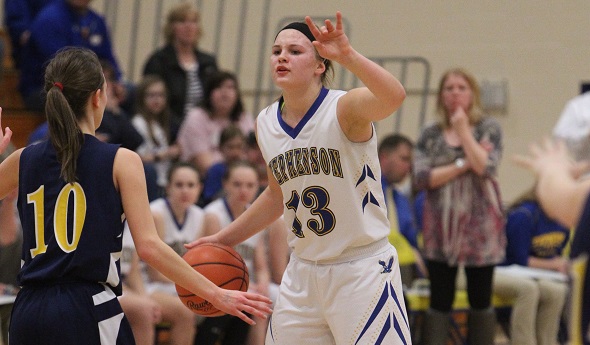
PHOTO: (Top) A Stephenson guard calls out a play during last week’s District game against Chassell. (Middle) Newberry and St. Ignace split a pair of regular-season matchups this season. (Photos by Paul Gerard.)
C-D Preview: Perfection & Possibilities
March 15, 2017
By Geoff Kimmerly
Second Half editor
One of the state’s most impressive winning streaks in any sport this decade will take the main stage again this weekend at Michigan State University’s Breslin Center.
Reigning Class D champion Pittsford will attempt to finish a second straight undefeated season and build on a run that has seen the Wildcats win 101 of their last 103 games over the last four winters.
Meanwhile, four of eight semifinalists in Class C and D are seeking their first championships ever, with a fifth playing for its first title in nearly four decades.
All four Class C and D Semifinals will be played Thursday, with all four championship games Saturday.
Semifinals - Thursday
Class C
Detroit Edison PSA (19-5) vs. Flint Hamady (19-5), 1 p.m.
Pewamo-Westphalia (23-2) vs. Maple City Glen Lake (23-3), 2:50 p.m.
Class D
Engadine (19-5) vs. Saginaw Michigan Lutheran Seminary (17-9), 6 p.m.
Pittsford (26-0) vs. Mount Pleasant Sacred Heart (25-1), 7:50 p.m.
Finals - Saturday
Class A - Noon
Class B - 6 p.m.
Class C - 4 p.m.
Class D - 10 a.m.
Tickets cost $8 per pair of Semifinals and $10 per two-game Finals session. All Semifinals will be streamed live on MHSAA.tv on a pay-per-view basis. All four Finals will be broadcast live on Fox Sports Detroit, the Class D, A and C Finals on the network’s PLUS channel and Class B on the primary channel. Free radio broadcasts of all weekend games will be available on MHSAANetwork.com.
And now, a look at the semifinalists in Class C and D. Click on the name of the school to see that team’s full schedule and results from this season. (Statistics are through teams' Regional Finals.) The Girls Basketball Finals are presented by Sparrow Health System.
Class C
DETROIT EDISON PUBLIC SCHOOL ACADEMY
Record/rank: 19-5, No. 5
League finish: Does not play in a league.
Coach: Monique Brown, sixth season (80-35)
Championship history: Has not appeared in an MHSAA Final.
Best wins: 58-42 over No. 10 Blissfield in the Quarterfinal, 43-39 over Flint Hamady 58-55 over Detroit Mumford, 57-56 over Class A No. 6 Southfield Arts & Technology, 57-45 over Chicago Whitney Young.
Players to watch: Gabrielle Elliott, 5-10 fr. G (17.5 ppg, 3.6 rpg, 3.2 spg); Rickea Jackson, 6-3 soph. G (17.3 ppg, 9.2 rpg, 3.1 apg, 3.4 spg, 2.3 bpg).
Outlook: It’s difficult to not point out immediately that Edison has no seniors, two juniors, one sophomore and nine freshmen – and that they’ve been tested this season against top teams from Classes A and B as well as C. All five losses came to larger schools, including two still alive this weekend. Elliott – one of three freshman starters – made the all-state first team and Jackson was named to the second, while Brown was named Coach of the Year by The Associated Press.
FLINT HAMADY
Record/rank: 19-5, unranked
League finish: First in Genesee Area Conference Blue.
Coach: Keith Smart, 15th season (332-44)
Championship history: Three MHSAA titles (most recent 2010), two runner-up finishes.
Best wins: 38-36 over No. 1 Sandusky in the Regional Final, 75-67 over Dearborn Heights Robichaud, 51-46 over Goodrich, 81-27 over Lake Fenton, 55-50 over Flint Beecher in the District Final.
Players to watch: Deajah Cofield, 5-7 sr. G (15 ppg, 5.0 rpg, 5.0 apg); Sasha Penn, 5-7 jr. G (statistics not available for Penn).
Outlook: Hamady was unranked after taking losses to one Class A and three Class B teams, plus Detroit Edison. But Cofield was named Class C co-Player of the Year by The Associated Press and Penn and senior Krystal Rice earned all-state honorable mentions (although Rice is out for the season with a knee injury). This is Hamady’s third Semifinal this decade; the Hawks were Class C runners-up in 2015.
MAPLE CITY GLEN LAKE
Record/rank: 23-3, unranked
League finish: First in Northwest Conference.
Coach: Jason Bradford, ninth season (146-58)
Championship history: Class D champion 1978, runner-up 1979.
Best wins: 63-52 over No. 7 St. Ignace in the Quarterfinal, 50-44 over No. 2 Traverse City St. Francis in the District Semifinal, 55-40 and 42-38 over Kingsley.
Players to watch: Kelly Bunke, 5-6 sr. G (10.3 ppg, 4,4 rpg, 2.9 apg); Jennifer LaCross, 5-8 jr. F (10.8 ppg, 6.1 rpg, 3.0 apg).
Outlook: Glen Lake has won 20 games two seasons in a row for Bradford, with two league titles, and has shown it belongs among the elite in the postseason with two wins over ranked opponents, including avenging its opening-night defeat to St. Francis. The only other losses were to eventual Class B quarterfinalist Cadillac and in overtime to McBain. This will be Glen Lake’s first Semifinal since 1995. Bunek earned an all-state honorable mention.
PEWAMO-WESTPHALIA
Record/rank: 23-2, No. 6
League finish: Second in Central Michigan Athletic Conference.
Coach: Steve Eklund, eighth season (154-33)
Championship history: Class C runner-up 1983 and 1984.
Best wins: 40-31 and 38-31 over honorable mention Laingsburg, 50-27 over Ithaca, 55-34 over Springport in the Regional Final, 44-28 over Bath in the District Semifinal.
Players to watch: Emily Spitzley, 5-10 jr. F (13.2 ppg, 3.4 rpg, 2.2 spg); Hannah Spitzley, 5-10 fr. F (8.7 ppg, 4.0 rpg, 2.5 spg).
Outlook: P-W is returning to the Semifinal for the first time since 2002, avenging its two losses by beating CMAC champ Bath to open the postseason. The Pirates start two seniors but also two freshmen – guard Ellie Droste adds 8.6 points and 2.5 steals per game. Defense is this team’s strong point; Schoolcraft (19) in the Quarterfinal marked the 15th time this season P-W held a team under 30 points, and the Pirates have given up more than 31 only twice (in those losses to Bath). Emily Spitzley made the all-state second team.
Class D
ENGADINE
Record/rank: 19-5, honorable mention
League finish: Second in Eastern Upper Peninsula Athletic Conference.
Coach: Roger French, seventh season (79-64)
Championship history: Has never played in an MHSAA Final.
Best wins: 44-41 over No. 8 Crystal Falls Forest Park in the Quarterfinal, 50-48 (Regional Final) and 40-39 over honorable mention Pickford in the Regional Final, 60-55 and 63-57 over No. 10 Cedarville
Players to watch: Olivia Vaughn, 5-9 sr. F (18.3 ppg, 6.0 rpg, 3.2 spg); Aubrey Simmons, 5-10 jr. C (12 ppg, 12.7 rpg).
Outlook: Engadine is playing in its second Semifinals after also making the final weekend in 2005. The Eagles were one of three Class D teams from their EUP conference to receive state poll votes and emerged with eight wins over their last nine games. Vaughn and starting forward Keely Fuller are the only seniors, while freshman guard Sophie Vaughn – Olivia’s sister – adds 8.7 points and 6.4 rebounds per game. Engadine won only four games four seasons ago, but has upped its win total every season since.
MOUNT PLEASANT SACRED HEART
Record/rank: 25-1, No. 2
League finish: First in Mid-State Activities Conference.
Coach: Damon Brown (ninth season (178-41)
Championship history: Class D champion 2014, runner-up 2016 and 2008.
Best wins: 48-37 over Frankfort in the Quarterfinal, 52-25 over Fruitport Calvary Christian in the Regional Final, 23-17 over Carson City-Crystal.
Players to watch: Scout Nelson, 5-9 soph. G (13.5 ppg, 4.1 rpg, 4.1 apg, 4.0 spg); Sophie Ruggles, 6-0 jr. F (14 ppg, 5.9 rpg, 3.4 spg).
Outlook: Few Class D teams would have this kind of success the year after graduating an all-state center and three-year starting guard. But the Irish rose again in a league featuring 19-win Class C Carson City-Crystal, and Frankfort was the only playoff opponent to score more than 30 points. Nelson and Ruggles made the all-state first team and with junior Hadyn Terwilliger (8.3 ppg) started in last season’s Class D Final.
SAGINAW MICHIGAN LUTHERAN SEMINARY
Record/rank: 17-9, unranked
League finish: Fifth in Tri-Valley Conference West
Coach: Brian Blaine, first season (17-9)
Championship history: Has never played in an MHSAA Final.
Best wins: 56-48 over Waterford Our Lady in the Quarterfinal, 44-39 over Portland St. Patrick in the Regional Semifinal, 56-34 over Bay City All Saints in the District Final, 45-39 over Hemlock.
Players to watch: Meghan Blaine, 5-10 soph. F (12.1 ppg, 7.8 rpg, 2.7 apg); Rylee Pankow, 5-10 sr. C (10.ppg, 9.1 rpg, 3.0 spg).
Outlook: MLS may not have been the pick to advance farthest from the mostly Class B-C TVC West that had four teams total win at least 16 games. But the Cardinals have won 10 straight games and did make the Quarterfinals as recently as 2012, although this will be the program’s first Semifinal. Meghan Blaine can also score from the outside, with 46 3-pointers entering the week, and total six players have scored at least 12 points in a game this season.
PITTSFORD
Record/rank: 26-0, No. 1
League finish: First in Southern Central Athletic Association East
Coach: Chris Hodos, fifth season (117-8)
Championship history: Class D champion 2016, runner-up 2015.
Best wins: 62-19 over No. 6 St. Joseph Michigan Lutheran in the Quarterfinal, 59-47 over Manchester, 59-33 over Bellevue, 57-39 over Grass Lake.
Players to watch: Maddie Clark, 5-9 sr. F (16.4 ppg, 11.8 rpg, 3.4 spg); Jaycie Burger, 5-9 sr. G (19.2 ppg, 5.3 apg, 3.2 spg, 62 3-pointers).
Outlook: Pittsford’s 53-game winning streak is just short of making the MHSAA record book list, and it’s four-season run of 101-2 can’t have many rivals although that statistic hasn’t been kept. Clark was named Class D Player of the Year by The Associated Press and Burger also a first-team all-stater as both continued to star in leading their team to Breslin for the third straight season. Junior guard Marissa Shaw adds another 8.6 points and 6.2 steals per game, and she’d made 56 3-pointers entering this week.
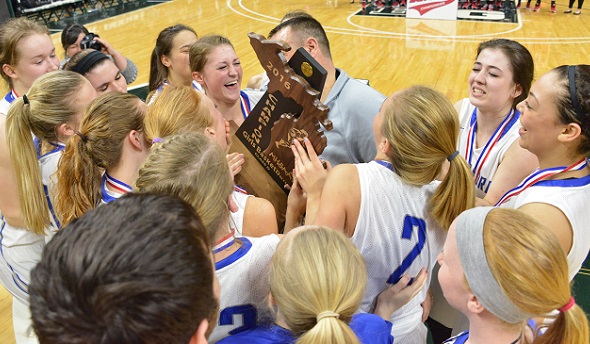
PHOTO: Pittsford celebrates last season's Class D championship at the Breslin Center.