

Countdown to Calvin: Girls District Preview
March 4, 2019
By Geoff Kimmerly
Second Half editor
The countdown to this season’s Girls Basketball Finals at Calvin College speeds up significantly beginning tonight.
 Teams all over Michigan will start District play culminating in 128 championships at the first level of the tournament this weekend. Check out “Tracking the Tournament” on MHSAA.com for every matchup from all of them, and see below for some of last week’s most eye-popping scores and three Districts in each division that could be especially important pieces to the final puzzle of this girls basketball season.
Countdown to Calvin is powered by MI Student Aid and based on results and schedules posted for each school at MHSAA.com. To offer corrections or fill in scores we’re missing, email me at [email protected].
Week in Review
The countdown of last week’s five most intriguing results:
1. Saginaw Heritage 55, East Lansing 53 – This rematch of last season’s Class A Final also went the Hawks’ way after they won by 21 at Calvin College a year ago.
2. Bloomfield Hills Marian 60, Detroit Mumford 47 – The Detroit Catholic League Tournament champ avenged last season’s loss to Public School League winner Mumford in the Operation Friendship game.
3. Ann Arbor Pioneer 41, Chelsea 39 – The Pioneers’ victory in this matchup of Southeastern Conference divisional champions also was Chelsea’s only loss of the regular season.
4. Wayne Memorial 61, Brighton 48 – East champ Wayne finished the Kensington Lakes Activities Association Tournament having beaten both co-champs of the KLAA West.
5. Stanton Central Montcalm 65, Kent City 42 – The Hornets finished a second straight 20-0 regular season against White Cloud two days later, but 16-win Kent City was one of the toughest obstacles to repeating perfection this winter.
Districts at a Glance
These could be among our most competitive brackets. Host sites are in bold:
DIVISION 1
Detroit Mumford
Detroit Mumford (15-4), Detroit Renaissance (13-6), Oak Park (5-9), Redford Union (13-5), Southfield Arts & Technology (18-1).
With only a Dec. 8 loss to last year’s Class A champion Saginaw Heritage – and by just two points at that – Southfield A&T has been considered a Division 1 favorite all season. Double-digit wins over Flint Carman-Ainsworth and Detroit Country Day, plus a league sweep of Royal Oak, have backed up that expectation. But the Warriors will have to go through the best of the Detroit Public School League West-Town to get through this week. On Wednesday, A&T will face West-Town co-champ Renaissance, which has a few more losses but against teams like Division 2 favorite Detroit Edison (twice) and Mumford (twice). On the other side of this bracket, Mumford shared the West-Town title because of a split with Renaissance in league play, but won the PSL Tournament. But the Mustangs can’t look past Redford Union tonight.
East Grand Rapids
Byron Center (15-5), East Grand Rapids (18-2), East Kentwood (15-4), Grand Rapids Ottawa Hills (5-15), Wyoming (8-12).
Five of seven teams in the Ottawa-Kent Conference Red had winning records this season, making it even more impressive that East Kentwood against finished on top for the third straight season. But one of the Falcons’ few losses this winter came by four Dec. 18 to East Grand Rapids, which went on to sweep the O-K Gold and has won 15 straight games. Those two would meet again in this District Final – but of course, it’s not that easy. Byron Center finished second only to unbeaten Hamilton in the O-K Green and would see EGR in a Wednesday District Semifinal showdown.
Lapeer
Davison (11-9), Flint Carman-Ainsworth (15-5), Flint Kearsley (16-4), Flint Southwestern (1-15), Grand Blanc (15-5), Lapeer (6-14).
One of tonight’s most intriguing openers matches up Saginaw Valley League Blue champ Carman-Ainsworth against runner-up Grand Blanc; the Cavaliers won the regular-season meetings by nine and 13. On the other side, Kearsley finished second in a similarly strong Flint Metro League and gets a test right away against Blue third-place finisher Davison. Kearsley’s losses this winter were to league champ Fenton twice, Macomb Dakota and last week to Edison. Carman-Ainsworth also has seen most of the best, falling to Saginaw Heritage, Southfield Arts & Technology, Midland Dow, Michigan Center, and Edison on Thursday by only seven.
DIVISION 2
Bay City John Glenn
Bay City John Glenn (15-5), Essexville Garber (15-5), Freeland (18-2), Midland Bullock Creek (6-13), Saginaw Swan Valley (8-11).
In addition to winning four straight Tri-Valley Conference Central titles, including this season’s, Freeland has won seven straight District championships. But this bracket threatens that streak. On Freeland’s side is Garber, the TVC East champion. Freeland did beat Garber by 25 on Jan. 8, and the Dukes won’t get another chance unless they win tonight against Swan Valley, which they beat by a point in their season opener. On the other side of the bracket, John Glenn finished fourth in the Division 1-strong SVL Red, with three of its five losses to Heritage, Dow and Bay City Western. John Glenn also owns an early two-point win over Garber.
Harper Woods
Detroit Denby (7-6), Detroit Edison (19-1), Detroit Osborn (9-5), Harper Woods (6-7), Harper Woods Chandler Park (16-4), St. Clair Shores South Lake (9-11).
As noted above, and all season many places, 2018 Class C champion Edison is a major favorite to win Division 2 with its only loss to Ohio powerhouse Columbus Africentric by five points Dec 15. The Pioneers spent the rest of the season beating many of the best across the Lower Peninsula. But Chandler Park, a Class C quarterfinalist last season, is an intriguing opponent should they meet Wednesday. The Eagles also have played many of the elite with some impressive results, including closing the regular season with successive wins over Detroit Cass Tech, Flint Hamady and Ypsilanti Arbor Prep.
Whitehall
Fruitport (3-17), Montague (11-9), Muskegon Oakridge (17-3), Muskegon Orchard View (3-13), Spring Lake (11-9), Whitehall (17-2).
Perhaps the most intriguing opener tonight, at least on the west side of the state, pits Oakridge against host Whitehall. Oakridge edged Whitehall by a win to claim the West Michigan Conference title, but Whitehall’s triple overtime victory in their first meeting Jan. 8 ended Oakridge’s 82-game league winning streak (Oakridge won the second meeting by 13 on Feb 8). Spring Lake finished fifth in a competitive O-K Blue and will be waiting Wednesday for whichever team comes out of what’s sure to be an emotional matchup, and Montague could be ready to play spoiler as well in the District Final.
DIVISION 3
Bloomingdale
Bloomingdale (16-4), Gobles (20-0), Kalamazoo Christian (12-6), Kalamazoo Hackett (9-10), Lawton (1-19), Schoolcraft (18-2).
Gobles won the Southwestern Athletic Conference Lakeshore and Schoolcraft won the SAC Valley, and they meet tonight in another of the biggest Division 3 openers statewide. Bloomingdale, which tied for second to unbeaten Centreville in the Southwest 10 Conference, awaits the winner. But because those three are on one side of the bracket doesn’t mean the District Final will be an easy victory for whichever team emerges. Hackett knocked Gobles out of the District the last two seasons, while Kalamazoo Christian finished third in the SAC Valley this winter and has won seven of its last 10 games with just a four-point loss to Bloomingdale on Thursday.
Elk Rapids
Elk Rapids (15-5), Grand Traverse Academy (7-5), Manton (16-3), Maple City Glen Lake (18-2), Traverse City St. Francis (10-9).
Manton from the Highland Conference and Glen Lake from the Northwest Conference are league champions, and host Elk Rapids finished second in the Lake Michigan Conference that St. Francis won just a year ago. Manton and Glen Lake get things started tonight in a rematch after Glen Lake won 37-34 on Feb. 6 and also knocked Manton out of the District last season. Elk Rapids awaits in the District Semifinal having lost to both this season. Glen Lake’s only defeat came Dec. 8 by four to Ypsilanti Arbor Prep.
Pewamo-Westphalia
Carson City-Crystal (17-3), Grand Rapids NorthPointe Christian (16-4), Ithaca (12-6), Pewamo-Westphalia (19-1), Saranac (4-16).
After reaching the Class C Final two years ago and Semifinals last season, P-W has been a major Division 3 favorite all winter. Its only loss was to Edison on Jan 21, and the Pirates came back a week later and beat Country Day, to go with an earlier impressive 20-point win over Dow. But again, there are obstacles this first week of the tournament. NorthPointe Christian awaits Wednesday after winning the O-K Silver. On the other side of the bracket, Mid-State Activities Conference champion Carson City-Crystal has won 15 straight including an 11-pointer over 18-2 Reese.
DIVISION 4
Athens
Athens (16-4), Battle Creek Calhoun Christian (16-4), Battle Creek St. Philip (8-12), Bellevue (20-0), Climax-Scotts (12-8).
Four of these five teams are in the Southern Central Athletic Association West, won by Bellevue with Athens finishing runner-up. Bellevue won their two regular-season games by one in double overtime and then last week by 16. They could meet again in this week’s District Final. Calhoun Christian faces Athens on their side of the bracket Wednesday, with a loss to Bellevue in December as well but a 20-point win over Athens in the season opener Dec. 4.
Chassell
Baraga (16-3), Chassell (13-6), Dollar Bay (0-18), Hancock (11-9), L’Anse (11-9), Lake Linden-Hubbell (7-13).
Chassell was last year’s Class D runner-up and hosts a competitive group this week with the chance for a third meeting in the District Final against Baraga. The Vikings won the Copper Mountain Conference Copper Country title with Chassell second this winter, downing the Panthers by 11 and three points in their regular-season matchups. Hancock and L’Anse finished tied for second and fourth, respectively, in the Western Peninsula Athletic Conference Copper and will try to play spoilers on their sides of the bracket. L’Anse handed Baraga one of its few defeats, by 12 on Dec. 14.
Morenci
Adrian Lenawee Christian (18-2), Britton Deerfield (6-13), Morenci (9-11), North Adams-Jerome (4-15), Pittsford (16-4), Waldron (13-5).
Lenawee Christian won Class D a year ago and has been considered a contender throughout this season. But only a few removed from its back-to-back title run in 2016 and 2017, Pittsford remains an opponent no one wants to face. They meet tonight, Lenawee’s only losses having come to Division 3 contenders Grass Lake and Michigan Center while Pittsford is riding a 10-game winning streak after suffering first-half losses to Hudson, Manchester, Bellevue and Athens before winning the SCAA East title. SCAA Central champion Waldron awaits the winner on Wednesday. Morenci on the other side of the bracket has bounced back from a 3-7 start this winter.
Second Half’s weekly “Countdown to Calvin” reports are powered by MI Student Aid, a part of the Student Financial Services Bureau located within the Michigan Department of Treasury. MI Student Aid encourages students to pursue postsecondary education by providing access to student financial resources and information, including various student financial assistance programs to help make college more affordable for Michigan students. MI Student Aid administers the state’s 529 savings programs (MET/MESP) and eight additional aid programs within its Student Scholarships and Grants division. Click for more information and connect with MI Student Aid on Facebook and Twitter @mistudentaid.
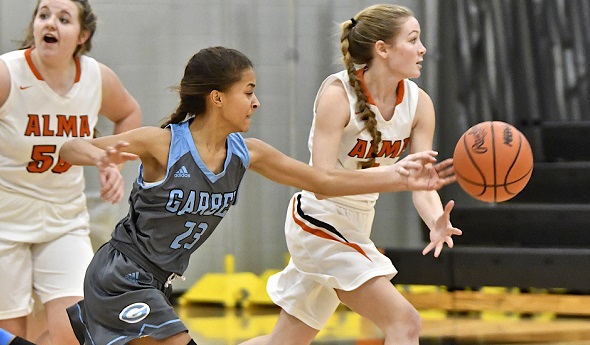
PHOTO: Essexville Garber took a 41-40 win over Alma on Dec. 14 and will look to add a District title this week to its league championship won this winter. (Click for more from HighSchoolSportsScene.com.)
Breslin Bound: Girls Report Post-Break
January 3, 2017
By Geoff Kimmerly
Second Half editor
We’ve returned for the start of 2017 – and with plenty to review from the holiday break that featured top teams facing off in multi-day tournaments or one-day showcases especially in the Detroit and Grand Rapids areas.
But our highlights this week powered by MI Student Aid aren’t reserved for teams from Michigan’s largest cities; high-performing squads from the southern border to Lake Superior’s shore gave us reasons to watch as we turned the calendar over to the new year.
Week in Review
The countdown of the holiday break's five most intriguing results:
1. Detroit Country Day 55, Detroit Martin Luther King 46 – The Detroit area’s best-known powers hadn’t played each other in at least six seasons; the Class B Yellowjackets moved to 7-0 in downing the reigning Class A runner-up Crusaders (7-1).
2. Northville 62, Warren Cousino 51 – After a one-point loss to Dearborn on opening night, Northville has dominated, most recently winning its holiday invitational with this victory over the reigning Class A champion.
3. Holland Christian 43, Hudsonville 33 – The Maroons improved to 6-0 and won their holiday tournament with this victory over Hudsonville, previously undefeated and a Class A semifinalist last season. CORRECTION: Hudsonville actually won this game 61-43 to win the tournament and move to 7-0.
4. Detroit Martin Luther King 48, Muskegon Mona Shores 45 – The day after falling to Country Day, King came back with this close win over the Sailors, who are also expected to contend in Class A this season.
5. Dearborn Divine Child 54, Farmington Hills Mercy 39 – Mercy looks to be among the state’s best in Class A again, which is great news for a Divine Child program that also boasts plenty of tradition but is coming off a six-win season.
Watch List
With an eye toward March, here are two teams in each class making sparks:
CLASS A
Clarkston (8-0) – The Wolves boys get a lot of attention, but the girls have won at least 15 games four of the last five seasons (going 15-6 last winter) and are more than halfway there after Motor City Roundball Classic victories over River Rouge (66-41) and Detroit Cass Tech (63-54).
Detroit East English (7-1) – The Bulldogs have dominated for the most part and already are closing in on equaling last season’s win total; their only loss was by four to one-loss Detroit Collegiate Prep, and they’ve won all over their other games by at least 20.
CLASS B
Manistee (6-2) – A Class B quarterfinalist last season, Manistee took losses to neighbors Big Rapids and Cadillac over the first two weeks but came back with a six-point win over Traverse City West and a two-pointer over Shelby during the break.
Olivet (5-1) – Save for an 84-80 shootout loss to Battle Creek Pennfield, the Eagles are again riding high after falling off just a bit to 13-9 last season. They dealt Galesburg-Augusta its only loss, 67-40, on Dec. 20.
CLASS C
Carson City-Crystal (4-2) – These Eagles might have one of the strongest two-loss records in the state, with those defeats by two to one-loss Merrill and six to undefeated and reigning Class D runner-up Mount Pleasant Sacred Heart; they kicked off the break with a 51-29 win over Saginaw Nouvel.
Ishpeming (5-0) – The Hematites, 10-9 a season ago, have opened with five double-digit wins including 61-49 over Calumet, the 2015 Class C champion, and 43-33 over rival Westwood last week.
CLASS D
Athens (4-1) – Regardless of a one-point overtime loss to Centreville on Dec. 12, Athens is more than on pace to equal its back-to-back 16-win seasons and most recently handed a 41-22 loss to Mendon – winner of 17 games a year ago.
Wyoming Tri-unity Christian (4-2) – The Defenders are another girls team often in the shadow of a boys program that has had statewide success, but coming off a Quarterfinal appearance last season they’re looking to make their name again and beat Class B Montague 48-42 to finish 2016.
Can't-Miss Contests
Be on the lookout for results of these games coming up:
Tuesday – Charlevoix (4-0) at St. Ignace (3-1) – Charlevoix is taking major strides led by a freshman standout, and will get a good gauge of that progress against the Class C-contending Saints in a preview of a possible postseason matchup.
Wednesday – Warren Cousino (4-2) at Port Huron Northern (7-0) – The Macomb Area Conference Red is loaded, with six teams including these two starting at least 4-2.
Thursday – Warren Cousino (4-2) at Grosse Pointe North (5-1) – See above; reigning Class A champion Cousino will take on strong league rivals on back-to-back nights.
Thursday – Ishpeming (5-0) at Norway (6-0) – First place in the Mid-Peninsula Conference as well as two perfect records will be on the line in the first of two matchups between these two this winter.
Friday – Merrill (6-1) at Mount Pleasant Sacred Heart (5-0) – These two look to be the best of a strong Mid-State Activities Conference, won last season by the Irish while Merrill played in the Tri-Valley Conference West.
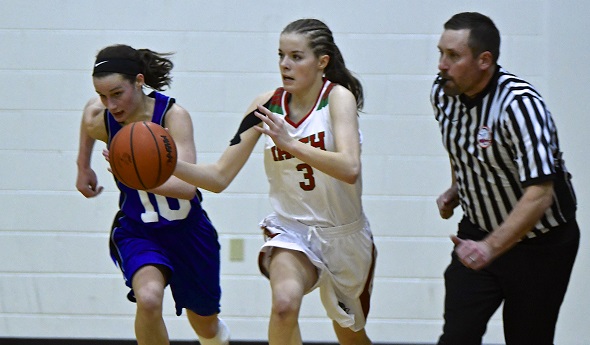
PHOTO: Mount Pleasant Sacred Heart pushes the ball upcourt during a 62-17 win over Beal City on Dec. 19. (Click to see more from HighSchoolSportsScene.com.)