Country Day Two-Time Champ Moore Building Perennial Winner at Harvard
By
Keith Dunlap
Special for MHSAA.com
July 16, 2026
Carrie Moore says her high school sports experience in Michigan has “left a lifetime impression on me.”
 Back in the early 2000s, Moore certainly had a fulfilling one while starring as a two-sport standout at Detroit Country Day.
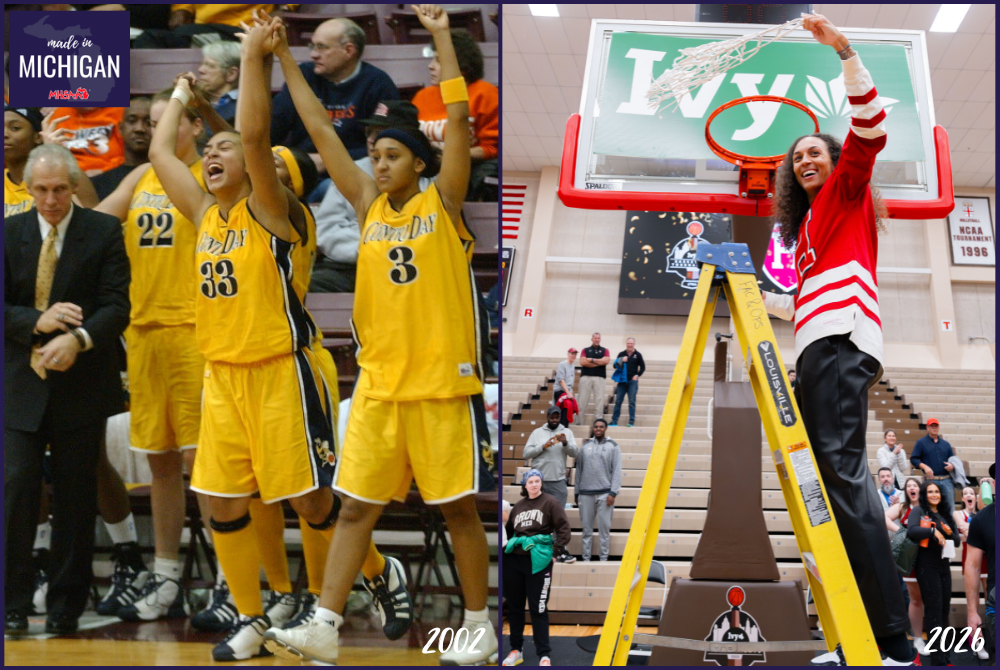
In basketball, she was a four-year varsity performer for legendary head coach Frank Orlando, helping guide Country Day to Class B titles in 1999 as a freshman and 2002 as a senior. During the latter, she was a first-team all-state performer and scored a team-high 18 points in a Semifinal win over Flint Powers Catholic.
Moore also was a standout soccer player on that Country Day varsity powerhouse for three years.
“Who I am as a leader, as a competitor, and a team player is because of what I learned about the process in high school as a student-athlete,” Moore said. “The pursuit of excellence isn’t always easy, but I learned at such a young age that I can do hard things. I was challenged because I was surrounded by the best on the court and in the classroom, but ultimately it brought out the best version of myself and I was so prepared for what came next after graduation.”
Make no mistake about it, Moore has continued to do great things since graduating from Country Day in 2003.
She is currently the head women’s basketball coach at Harvard, where she just completed her fourth season and has amassed an 80-41 record with the Crimson. This past season, she helped guide her team to a 20-12 record and the Women’s Basketball Invitational Tournament.
Moore was a terrific college player at Western Michigan, finishing as the school’s all-time scoring leader with 2,216 points and earning Mid-American Conference Player of the Year in 2007 after averaging 25.4 points per game. But she initially wasn’t planning on being a coach once her time at Western was over.
After playing one season professionally in Poland and then being cut twice by WNBA teams during training camp, Moore had an opportunity to join the coaching staff at Princeton in 2010.
From there, the coaching bug bit her, so to speak.
“Being a part of that program allowed me to see the lasting impact I could have on young women in growing them as people and players, and ultimately, give back to the game that gave me so much,” Moore said.
Moore was on the staff for two seasons at Princeton, and then moved on to Creighton, where she spent five years as an assistant coach.
Following a second stint as an assistant coach at Princeton that lasted four years, Moore moved on to North Carolina, where she spent two years as an assistant coach and recruiting coordinator for the program.
 A native of Lathrup Village, Moore then briefly returned to her home state for the 2021-22 season, serving as an assistant coach and recruiting coordinator for University of Michigan’s team that went 25-7.
After that season, the opportunity at Harvard came about, and Moore has proved she can be successful running a program as well.
In her first season, Moore set a program record for most wins by a first-year head coach (20). Two years later, she guided the Crimson to its first Ivy League Tournament title and back to the NCAA Tournament for the first time in 18 years.
Even to this day, Moore is influenced by her time at Country Day and in Michigan. She speaks regularly to Orlando, picking his brain for advice or an answer to any other question that might come up.
“I keep in touch with Coach O as often as I can,” Moore said. “He reaches out after big wins or tough losses and always reassures his belief in me as a leader of young women. His mantra ‘Believe It’ is living on within our program at Harvard, and I hope he feels deeply connected to it because of it. I will always honor him in any way that I can, as he has shaped me greatly as a human and coach.”
Moore hasn’t had a player from her home state on her Harvard roster. But she said Michigan is an important recruiting area, and she’s keeping an eye out for prospects.
“I’m very hopeful that it will happen one day,” Moore said.
2026 Made In Michigan
July 9: Multi-Sport Career at TC West Helps Gillis Thrive as Pro in Game She Once Left Behind - Report
July 2: Inspired by Home, Eager to Give Back, Spencer Hosts Hoop City Alumni Games - Report
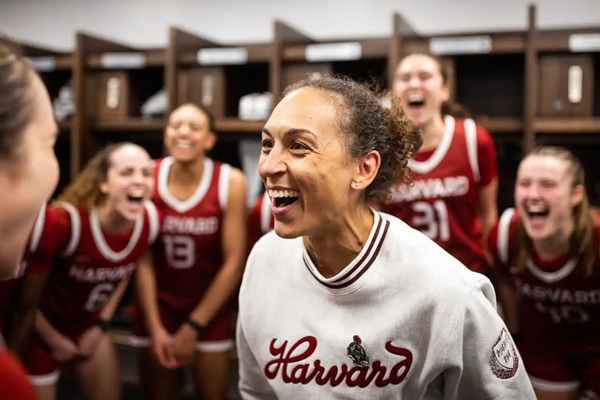
PHOTOS (Top) At left, Detroit Country Day’s Carrie Moore (33) celebrates with her teammates at the end of a Class B Semifinal win over Flint Powers Catholic in 2002. At right, Moore holds up the net after making the last cut this past season to celebrate Harvard’s Ivy League Tournament championship. (Middle) Moore enjoys a moment with her Crimson players. (Harvard photos courtesy of the Harvard athletic department.)

MHSA(Q&)A: Beal City volleyball coach Kelly David
October 6, 2012
By Geoff Kimmerly
Second Half editor
 When people in Michigan’s volleyball community hear the name Kelly David, they might think first of the standout from just a few seasons ago. A four-sport standout for the Aggies, she set the volleyball team into the 2009 Class D Semifinals before going on to play at St. Clair Community College.
David, 20, graduated from high school a little more than two years ago, but is continuing to have an impact on the volleyball court – although now from the sideline as coach of the No. 3-ranked team in Class D. She took over the Beal City program this fall from her former coach, Randy Gallagher and has the Aggies 26-5-1.
Coaching has come naturally for the former floor leader, who already has gained valuable experiences and knowledge to share with her players. She previously coached at the junior high and club levels, the former for her aunt Sue Frederiksen – who coaches Almont’s varsity and is a member of the Michigan Interscholastic Volleyball Coaches Association Hall of Fame.
David is majoring in elementary education at Central Michigan University and sees teaching and coaching in her future for many years to come.
Why did you decide to become a coach?
I played at St. Clair (Community College) for two years, and my aunt had always been into coaching. I ended up coaching her seventh grade volleyball team for two years, and I coached in the Skippers AAU program over there. I found out I liked coaching more than playing.
How have you approached coaching a team that includes players who were freshmen when you were a senior in high school?
Going into it, I knew I wasn’t their friend; I was their coach. I wasn’t close to any of the girls except my sister (Monica, a senior). The people who coached me or were my teachers, (who said) go to class, do this, and you knew they received ultimate respect. I had helped out in previous years, and I knew what I had to do to gain that respect. And (my players) have listened to me.
Did you anticipate questions about you taking over the program only a few years out of high school?
I knew in my head, but I didn’t think it would be a problem in people’s minds. "She’s young, her sister is on the team;" that’s the stuff people might second guess. But I knew how to control the team, and having my sister on it wasn’t a big teal. So far (issues) haven’t happened. I’ve coached teams in previous years, and I’d always been the leader when I did play. I think that helps.
What were your goals coming into the season?
I had a lot of goals. Obviously, I wanted us to go far, like in the past. The biggest thing I noticed playing college from high school, the players knew the game of volleyball. They were smart. They had the same athletic ability as those I played against in high school, but they were just smarter. Knowing how to position the ball on the court, knowing the game, and I wanted to teach (my players) the game of volleyball. It’s important to know the game, and then we can work around the obstacles.
What did you learn by watching your aunt coach?
Just how strong you have to be. When I watch her coach, she’s very enthusiastic. But when someone does something wrong, she lets them know. That’s an important thing.
When did you first know you were interested in coaching?
When I was in high school, when I played, I’d help the other players. I noticed that was something I liked to do. I’d watch someone and pick up things they could fix. I thought about it in high school, and once I actually did it with the seventh graders, it wasn’t a job for me. It’s fun. Coaching is something I want to do. They want to be playing volleyball – that’s why they’re on the team. Everyone wants to be there, and we’re trying to accomplish the same thing.
What has been the biggest challenge during your first season?
The biggest challenge is handling the pressure. I know the team can do well. We’re ranked third in the state right now. But it’s getting them to perform the way they can perform, getting them to come together at the right time.
I’d also like to mention that Beal City (already) had a great program, from (former coaches) Randy Gallagher and before I came, Kelly Knuth. I’m just happy to step in and try to continue what they did.
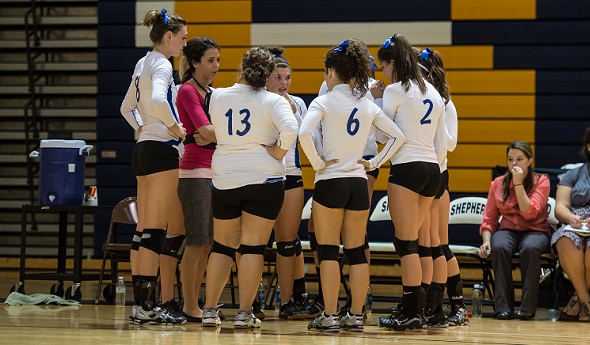
PHOTO: Beal City huddles during a break in its match against Shepherd this season. (Click to see more from HighSchoolSportsScene.com).