

Dowagiac Superintendent Continues Connection to Hoops as MHSAA Game Official
By
Scott Hassinger
Special for MHSAA.com
January 8, 2025
DOWAGIAC – It was about three years ago that Greg Blomgren, a former high school boys basketball coach, realized he needed to find a niche that allowed him to stay connected with the game he grew up loving.
 Blomgren, who took over as Dowagiac Community Schools' superintendent July 1, has found the perfect way to fill that void as a registered basketball official for the Michigan High School Athletic Association.
Now in his fourth season working varsity boys and girls games in the Southwestern Michigan area within a 45-mile radius of his home in Sister Lakes, Blomgren enjoys the opportunities officiating has provided him to help bridge the gap between coaches and game officials and continue improving the game of basketball.
“Having been a coach in the past, I am able to better understand things from the coaches' perspective, and that is an advantage for me. I really believe that all coaches should officiate and all officials should coach,” Blomgren said. “It brings about a better level of communication and understanding because you've experienced both sides.
“Back when I was coaching, I know I was sometimes tough on officials. My appreciation of officials grew though in my latter years of coaching. I just really enjoy being part of this game again.”
In January 2021, Blomgren contacted Kalamazoo Officials Association assigners Rob King and Chuck Rawsthorne regarding the process to become a registered MHSAA basketball official. The KOA is responsible for assignors for primarily the Southwestern Michigan Athletic Conference, Wolverine Conference and the Southwestern Athletic Conference.
After completing his training and necessary exams, Blomgren was assigned four games during his first week that January. He officiated mostly freshman and junior varsity contests in 2021 but was assigned one varsity girls game between Lawton and Vicksburg that season.
"I was really nervous calling my first varsity game, but it went pretty well," Blomgren recalled.
 Blomgren steadily increased his officiating schedule to 35 games his second season, then 85-90 games during the 2023-24 campaign at various levels. Since taking the superintendent's job in Dowagiac, Blomgren has reduced his schedule for this season to around 55 games.
"I'm really thankful to Rob and Chuck. They have both done a great job working with me and finding a schedule that works with mostly varsity games that take place later in the evening," Blomgren said.
Blomgren is a 1991 graduate of Des Moines Lincoln High School (Iowa) where he played multiple sports, with a passion for basketball, at the largest school in the state.
He also grew up during the explosion era of the AAU basketball circuit. From age 11 through his high school years, Blomgren had the opportunity to compete on several Iowa state title teams in national tournaments.
"Those teams were a fun and rewarding experience. We went to nationals and faced some competitive teams, including the Michigan Super Friends, a team with future Michigan and NBA standouts Chris Webber and Jalen Rose," Blomgren said. “There were other star players on other teams from various states we faced like Grant Hill, Penny Hardaway, Eric Montross and Damon Bailey.”
After graduating high school, Blomgren attended the University of Nebraska-Kearney before transferring to Grandview College, an NAIA school, in Des Moines where he earned a bachelor's degree in biology in 1996.
Upon moving to Milwaukee in 1997, Blomgren began substitute teaching and got into coaching basketball at the middle school level. He returned to school around that time and completed his teaching certification from Wisconsin University-Parkside.
Blomgren began his coaching career as a volunteer assistant at Kenosha St. Joseph (Wisconsin) followed by a similar job at nearby Wilmont High School. Shortly after those two stops, Blomgren landed his first head coaching job at Clear Lake High School in Iowa, where he spent two years.
Blomgren and his wife Angie, a Niles native and daughter of former Niles Brandywine band director Jay Crouch, moved to Michigan after Greg was hired as a science teacher and replaced Al Westendorp as Dowagiac's varsity boys basketball coach. Blomgren served as Dowagiac's boys coach from 2002-09 and spent three years as the head girls basketball coach as well.
Blomgren accepted the position of Dean of Students in St. Joseph, where he replaced Greg Schaffer as the Bears' varsity boys coach and served from 2009-16. Blomgren resigned after the 2015-16 campaign to concentrate on his administrative duties as the assistant high school principal before eventually taking over as the district's high school principal.
"Eventually I had to resign from coaching. There are too many evening activities that you have to be present at and supervise, so I stepped down," Blomgren said. "People don't understand the amount of time you must spend to do it right with practice planning, scouting, watching film and all the time you spend in the offseason trying to give the kids the best opportunity to compete. It’s more time spent than what you become accustomed to seeing from coaches on Tuesday and Friday nights. I don't think I'll ever return to coaching. Right now, it just doesn't fit my schedule."
 Blomgren and his wife have three grown children – daughters Alyssa (24) and Avery (20) and 22-year old son Andy, along with one granddaughter Aria.
Blomgren is enjoying his new role as Dowagiac's superintendent and is pleased with the positive things that have taken place during his first few months leading the school district.
"The time we spent here a few years back when I was at Dowagiac helped us develop a lot of good relationships," Blomgren said. “There's a lot of pride that people take in small towns like ours. I knew the people here, and I believe they thought I was someone who could bring some of that culture back to the district. I'm looking forward to the opportunity to do that and make this a district everyone is proud to be a part of.”
The MHSAA has seen a decline in recent years in the number of registered game officials, due in part to poor sportsmanship particularly among adult spectators. But the organization has worked hard in recent years to change that, and participation is on the rise once again.
As an administrator and basketball official, Blomgren sees himself playing a major role in promoting good sportsmanship.
"Good sportsmanship in a school district depends on the leadership in the building. A good athletic director will make sportsmanship a top priority. He or she will make sure their school is going to represent themselves and the school district appropriately," Blomgren said. “If you do that it sets an expectation and tone with the parents, players and people in the community.
“Good sportsmanship is something I believe needs to constantly be improved upon in every district. The $7 you pay at the gate doesn't give you the right to say whatever you want after you walk into the gym. That isn't what high school athletics are about. When I was coaching in St. Joe and Dowagiac, it was always about how we conducted ourselves on the court rather than the number of wins or losses.”
Even in today's age of high technology, Blomgren believes high school athletes still desire to work hard and succeed as a team.
"Kids today want to be good, but they need to realize the time and effort you must put in to be successful," he said. “Schools that win consistently are the ones where everyone on the team shows up and puts in the work both during (the season) and in the offseason. The successful programs have good feeder programs with at least three or four good players in each class who have played a lot of games with one another. Those factors are what breeds success.”
 Scott Hassinger is a contributing sportswriter for Leader Publications and previously served as the sports editor for the Three Rivers Commercial-News from 1994-2022. He can be reached at [email protected] with story ideas for Berrien, Cass, St. Joseph and Branch counties.
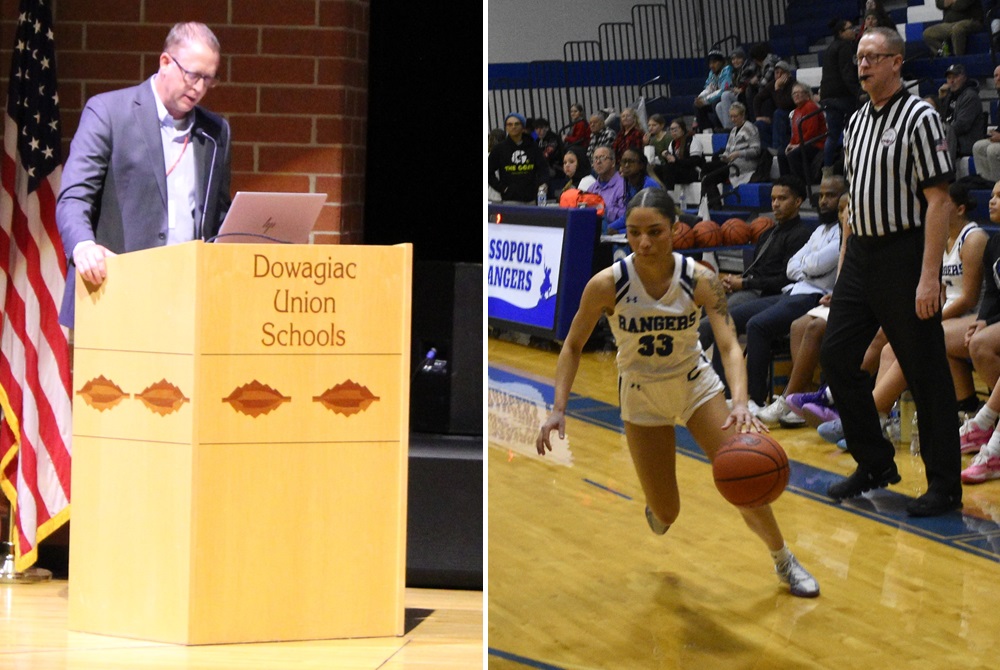
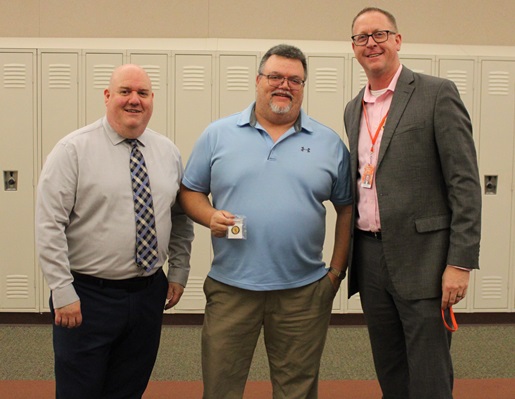
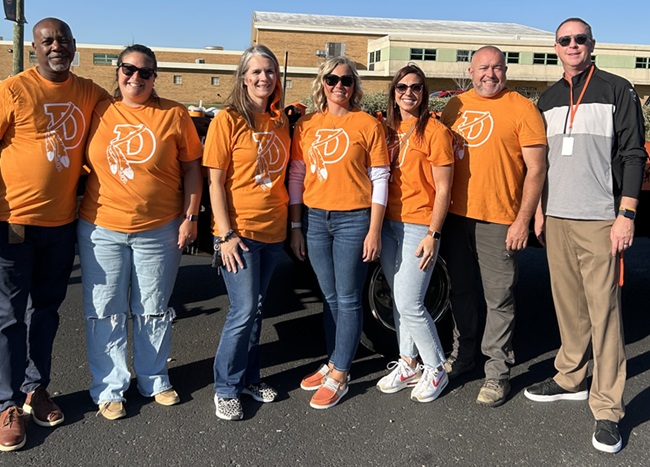
PHOTOS (Top) At left, Dowagiac superintendent Greg Blomgren addresses an audience during his first day in the position, July 1. At right, Blomgren officiates a girls basketball in December between host Cassopolis and White Pigeon. (Middle) Dowagiac assistant superintendent Michael Dunn, left, and Blomgren present Dowagiac Middle School science teacher Pat Lyle with a pin for 30 years of service. (Below) Blomgren, far right, is pictured with members of the Dowagiac Board of Education before the start of the 2024 Homecoming Parade. (Basketball photo by Scott Hassinger. All others provided by Dowagiac Community Schools.)
'Scott Hancock Court' Celebrates JV Coach's 50 Years Building Up Cheboygan Hoops
By
Tom Spencer
Special for MHSAA.com
December 19, 2025
It’s been a remarkable season so far for the Cheboygan boys basketball players and coaches.
 The undefeated varsity Chiefs are looking ahead to the new calendar year and their next opponent, Northern Shores Conference rival Elk Rapids. They also have the District tournament they’ll be hosting in February in their sights.
But Scott Hancock is already looking ahead to the classes of 2035, 2036, 2037 and 2038. And nobody can blame him.
Hancock, a 1976 graduate of Cheboygan, has no intentions of ending his coaching career soon. He’d like to make it long enough to coach his youngest grandson Lincoln Hancock, who is already playing youth basketball in Cheboygan.
And while the Chiefs are finding success this year with the foundation Hancock helped build, the veteran coach can’t help but dream about his youngest grandson playing at Cheboygan High School.
“As a kindergartner he’s in Saturday basketball, and he loves the game,” Hancock said. “God willing, I plan to be there for him.”
Hancock is his 50th season in Cheboygan program. He enjoyed the opportunity to coach his two sons Nick and Brian, both school record holders. He’s also enjoyed coaching his grandson, Landon Gahn, the Chiefs’ junior point guard. Gahn played junior varsity for Hancock his freshman year and moved up to the varsity his sophomore season.
All but two of Hancock’s season were spent as the JV coach. He took the varsity job on an interim basis when current Cheboygan varsity coach, Jason Friday, was playing for the Chiefs in the late 1990s.
On Dec. 9, the Chiefs officially named their home court the Scott Hancock Court. His family was on hand as well as current and former Northern Michigan coaches.
Hancock’s JV team lost that night to Alpena in overtime. The score was 50-50 when the fourth quarter buzzer sounded.
“Looking back, we should have just called the game at the end of regulation,” Hancock admitted. “I got a bunch of great kids this year. and it was a tough loss because it was an overtime loss.”
 It was the only loss the Chiefs’ JV team has encountered so far this year. But wins and losses are not the focus of Hancock’s level of the program.
“I don't get too carried away with the wins and losses — I know what I'm there for,” Hancock explained. “I'm there to teach the kids to get them ready for the varsity.”
Hancock is considered by many to be the best coach in Cheboygan history. No counter argument can be found among the current varsity players and their head coach.
“He's the best coach that I've ever had — no bias because he's my grandfather,” acknowledged Gahn, who was found cheering from the bench as the Chiefs secured the victory earlier this week at Kingsley. “He teaches everything about basketball, but he doesn't really preach as much as he demonstrates being a good person. Just looking at him and what he does every day, you can just tell he's the guy that's doing everything right, even though nobody's watching.”
Senior Carson Kiefer helped lead the way for Cheboygan's varsity at Kingsley. He scored 12 points, with two 3-pointers. Kiefer credits Hancock for helping him improve his confidence on the court.
“I think he cares more about the person individually outside of sports,” said Kiefer, who is averaging 16 points per game. “It's fitting that he's a JV basketball coach, helping build players’ skills and confidence.”
Kiefer’s twin brother, Andrew, singled out Hancock’s commitment to the school.
“He's not just a school figure,” said Andrew Kiefer, who is averaging just under 12 points per game. “He is not just the coach. He is a community guy all-around.”
The Chiefs varsity is getting strong contributions from their juniors this season. Nolan Schley is averaging 12 points per game, and he’s second on the team in rebounding. And Gavin Smith is leading the team in rebounds and assists, collecting almost 10 boards and four dishes per game.
The Kiefers, Smith and Schley are part of the reason Friday is not surprised by the 6-0 start and seeking a District title for the first time since 2015. The last time Cheboygan won a conference championship was 2020, playing in the Straits Area Conference during Friday’s first season as boys head coach after previously coaching the girls varsity.
 “We knew that our junior and senior classes had some talent in there,” Friday noted. “The boys really want to win a District championship, as well as a conference championship. The boys put a ton of time in the offseason to do everything they can to get over that hump and get both a conference and District championship.”
Cheboygan will host a Division 2 District tournament this season after falling 50-48 in last year’s Division 3 District Final – also at home. The Chiefs face a field including league foes Grayling, Kalkaska and Kingsley as well as Ogemaw Heights and Sault Ste. Marie. Cheboygan topped the Sault 67-43 earlier this year and will play a home-and-home series with Grayling in January.
For now, though, the Chiefs are thinking only about Elk Rapids. Cheboygan started 7-0 last year before falling to the Elks to start the new year.
“We're approaching 7-0 again, so having them coming up here on the schedule, we’re definitely going to be practicing a little harder and watching maybe a little more film and just preparing for the game more seriously,” Gahn said. “Coach Friday was saying last year that he can't remember the last time the team started off 8-0, and it was our eighth game that we lost to Elks. So we're hoping to beat them next time we play.”
The court naming did not come as a surprise to Hancock. He was informed in a meeting with Marty Mix, Cheboygan principal. He thought he had some papers to sign and was surprised his family was waiting in the office.
“He was completely shocked, and Coach Hancock doesn't like attention,” said Friday, who is also the school’s athletic director and was in the notification meeting. “Scott always likes to be in the background, and he handled it quite well.”
And while his signature was placed on the court opening day this year, he points out the Hancock legacy started way before him.
“I'm more proud of the Hancock name on there more than the Scott part of it,” said Hancock, who also serves as the city’s as the parks and recreation director. “Believe me, my dad was a Chief through and through. He passed in 2006. I know he was there in spirit with us looking down.”
 Tom Spencer is a longtime MHSAA-registered basketball and soccer official, and former softball and baseball official, and he also has coached in the northern Lower Peninsula area. He previously has written for the Saginaw News, Bay County Sports Page and Midland Daily News. He can be reached at [email protected] with story ideas for Manistee, Wexford, Missaukee, Roscommon, Ogemaw, Iosco, Alcona, Oscoda, Crawford, Kalkaska, Grand Traverse, Benzie, Leelanau, Antrim, Otsego, Montmorency, Alpena, Presque Isle, Cheboygan, Charlevoix and Emmet counties.
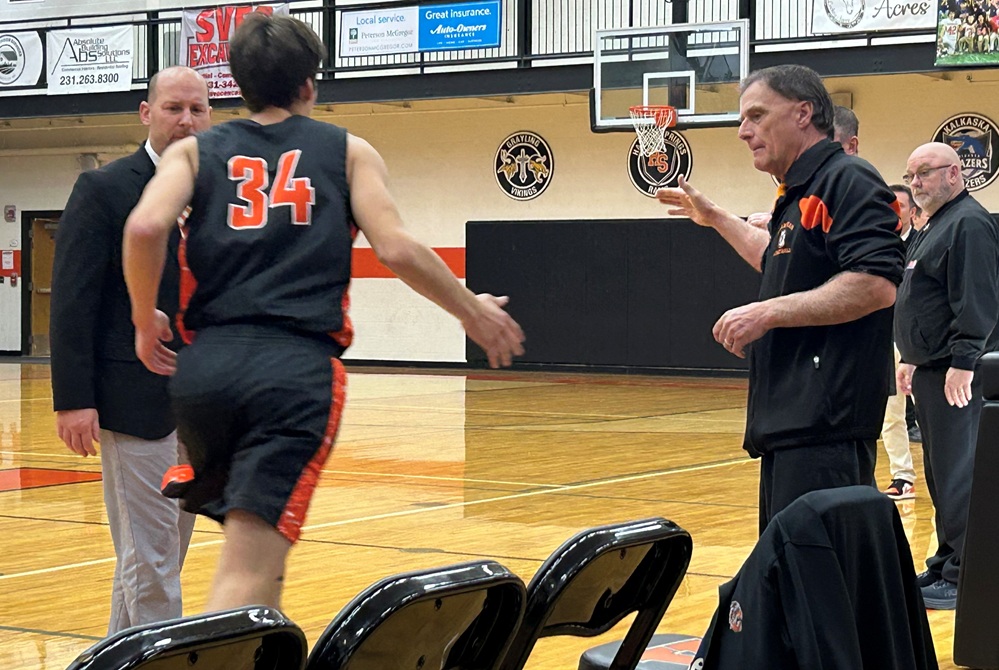
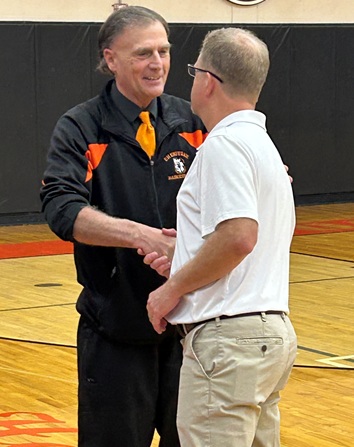
PHOTOS (Top) Longtime Cheboygan boys basketball JV coach Scott Hancock sends Andrew Kiefer (34) onto the floor during introductions before a game against Kingsley. (Middle) The Hancock family takes a photo with Scott’s newly-added signature on the floor. From left: Landon Gahn, Brian Hancock, Olwyn Hancock, Scott Hancock, Marjean Hancock, Lincoln Hancock and Nick Hancock. (Below) Scott Hancock shakes hands with Kingsley assistant coach Steve Acre. (Family photo courtesy of Chris Murdick. Other photos by Tom Spencer.)