

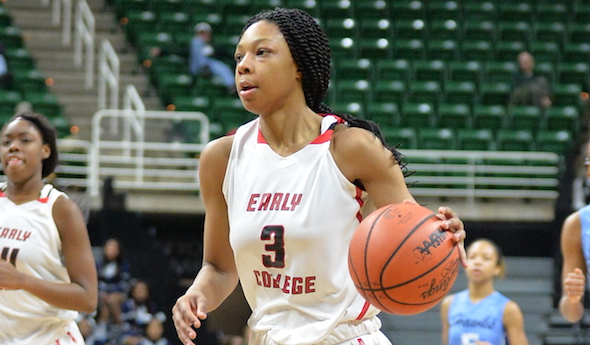
Edison Advances to 1st Hoops Final
March 16, 2017
By Geoff Kimmerly
Second Half editor
EAST LANSING – When Monique Brown heard voices as she walked past her players’ hotel rooms late Wednesday night, she was a little concerned.
Maybe she’d made a mistake bringing her young team to East Lansing the night before the biggest game in school history.
But as they have other times before, Detroit Edison Public School Academy’s players proved their coach wrong, coming out Thursday afternoon anything but sluggish in earning an even more memorable opportunity.
DEPSA – with nine freshman, a sophomore and two juniors on its roster – looked neither tired nor inexperienced in handing annual Breslin visitor Flint Hamady a 54-31 defeat in the day’s first Class C Semifinal.
“We got there late, and we couldn’t sleep. We were just talking about what we can do,” Pioneers sophomore guard Rickea Jackson said. “They came knocking on our doors … they took our phones. We couldn’t do anything but talk.”
DEPSA (20-5) will face Pewamo-Westphalia in Saturday’s Class C Final at 4 p.m. It will be the Pioneers' first appearance in an MHSAA girls basketball championship game.
As much as they had to discuss after midnight the evening before, Jackson and her teammates made a loud statement with their play to tip off this Finals weekend.
They held Hamady to 8.3-percent shooting from the floor during the first half in building a 28-8 lead. The Hawks did recover to shoot an improved 36 percent during the second half, but DEPSA made 49 percent of its shots for the game – and freshman Gabrielle Elliott had nine field goals, only one fewer than Hamady as a team.
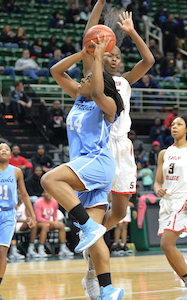
Elliott finished with 24 points and Jackson had 16 and eight rebounds as they combined to drop 16 of 26 shots from the floor – not bad for a couple of underclassmen on the biggest stage for the first time.
 “We’ve never done that to a team like Flint Hamady, and I really commend my young group,” Brown said. “They’ve been preparing for this, we’ve talked about it, and as we’ve went through the season … I told them it was all in preparation for today. I always told them I don’t want to hear people say we’re talented; I want to hear them say how hard we play.”
Brown, also the school’s athletic director, had to know what she had coming this winter and scheduled appropriately. DEPSA opened 9-0, with a one-point win over Southfield Arts & Technology, a Class A semifinalist this weekend.
But the No. 5-ranked Pioneers then ran into a tough spot, losing three of its next five to Class A power Detroit Martin Luther King and Class B contenders Detroit Country Day and Ypsilanti Arbor Prep. Sandwiched among those defeats, however, was a 43-39 win over Hamady, which made its third Semifinal appearance of this decade Thursday and finished Class C runner-up in 2015.
That first Hawks loss to DEPSA on Jan. 31 was Hamady’s third straight after losing senior guard Krystal Rice for the season to a knee injury. Without Rice – who will continue her career at Indiana State University – the Hawks still managed to navigate a tournament run that included handing top-ranked Sandusky a 38-36 loss in the Regional Final.
“We didn’t give up on the season,” Hamady coach Keith Smith said. “We spent a lot of time watching film, spent a lot of time drilling on fundamentals, trying to tweak the little things we were not doing well and trying to be concerned on the details. (But) it caught up with us today to not have her, that extra senior who had played in a state final.”
Senior guard Deajah Cofield and freshman center Aryana Naylor both scored 10 points to lead Hamady, Cofield also totaling five steals and Naylor grabbing 10 rebounds.
With Rice out, Cofield was the only senior starter for Hamady, which finished the regular season unranked but ended up with a final record of 19-6.
Smith said he hadn't seen a team as talented as DEPSA with that many young players since his 2009 Class C championship team.
The Pioneers didn’t play like mostly underclassmen Thursday, just a team with a little bit of a chip on their collective shoulders and the talent to dominate the next two to three seasons as well.
“(People) said we’d lose to Sandusky, and they didn’t make it to us, and they said we’d lose to Blissfield by two,” Jackson said, noting the 16-point Quarterfinal win over the No. 10 Royals. “We’re just tired of people doubting us. We’re so young, we don’t have any seniors, and we just want to prove everyone wrong.”
The Girls Basketball Finals are presented by Sparrow Health System.
PHOTOS: (Top) DEPSA's Gabrielle Elliott pushes the ball upcourt during her team's Class C Semifinal win. (Middle) Rickea Jackson works to get a hand on a shot by Flint Hamady's Danielle Tipton.
House's Letters Spell R-E-C-O-R-D
By
Pam Shebest
Special for MHSAA.com
December 18, 2018
COMSTOCK — As a freshman, Abby House could not decide whether to play volleyball or golf, so she compromised and did both.
 Little did she know that first dual-sport fall season would put her on track to Comstock High School history.
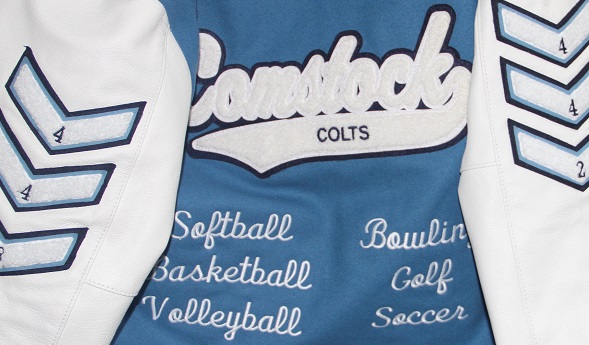
She will graduate in May with a school-record 22 varsity letters — 21 for sports and one for band.
The previous record, set by Robert Bellisle in 1943, was 17. Bellisle was inducted into the Comstock Hall of Fame in 2011.
“I just really like sports and starting freshman year with five, I didn’t really know there was a record for it,” House said.
She has four letters each in bowling, golf, basketball and softball, three in volleyball, two in soccer and one in band.
The school supports dual-sport athletes under specific conditions, athletic director Justin Ansel said.
“Primary and secondary coaches have to agree on the details before it can happen,” he said. “If we don't have their agreement along with the player understanding of expectations, we don't allow it.
“I think it's important to just give the kids opportunity. It works best with picking a team sport as the primary sport and then an individual sport as secondary.”
House’s father, Rich House, said he and his wife have no problem with their daughter playing six sports a school year.
“It wasn’t really ever a plan; it just kinda happened,” he said. “She was always good at it and has always been a good student.
“We always told her as long as she could handle it and keep up – the school work is most important. She always seemed to do a good job at that.”
Schoolwork has not been a problem for House, who carries a 3.88 grade-point average.
 This year, she has just one class at Comstock – band – but took psychology, physics and accounting at Kalamazoo Valley Community College. Next semester, she will study sociology, chemistry and medical terminology at KVCC, working toward a degree in nursing.
Although House plays sports for fun, her dad said his daughter is a high-level competitor in all of them.
“She has multiple conference titles, qualified for state twice in golf, once in bowling, all-District catcher two years in a row,” Rich House said.
This year, she was Comstock’s top golfer and is the team’s top female bowler, carrying a 150 average.
Decisions, decisions
As a freshman, House earned varsity letters in golf, basketball, bowling and softball.
She played the same sports the next year, but also was moved up to varsity in volleyball, giving her five letters.
Her junior year, House added soccer, and is continuing to play six sports her senior year.
She chose volleyball because “I played (volleyball) with my teammates since middle school and I’ve enjoyed it when I played in season,” House said.
Golf is a family affair for the House family, including her brother, Mason.
“My parents are big golfers and we’re a big golf family and the coach was really into wanting me to golf, so she talked me into it and I thought it would be fun to try,” Abby House said.
Since she started playing basketball in elementary school; it was a no-brainer to continue in high school. She was called up to varsity after a month during her freshman year.
The bowling coach had an inside track to recruiting her – it’s her dad.
Softball was her only spring sport until her junior year.
“When I was younger, I played softball and soccer, but I chose softball because I liked it more,” House said.
“We had a softball coach who wanted us to concentrate only on softball, so I didn’t play soccer.”
Her junior year, the softball coach left and House decided to add soccer, giving her two sports in each of the three seasons.
Everything falls into place
House is an expert at time management.
“In school, whenever teachers get done with notes and we have homework I try to do it,” she said. “Or with any free time I’ll do it and what’s left, I do after practices.
 “Freshman, sophomore year I did a lot on the bus.”
Choosing a favorite sport is not possible.
“Everybody asks me that,” she said. “I can choose one per season, but not one overall.
“Basketball, golf, softball have always been my top.”
House has stepped up this year, helping lead the basketball team to a 3-0 overall record, 2-0 in the Berrien-Cass-St. Joseph Conference Red as a point guard, her fourth position in four years.
As a freshman she was a post player, as a sophomore she shifted to forward, and then to shooting guard last winter.
Last season, she averaged seven points and seven rebounds per game. This year, it’s 18 points, eight rebounds and nearly six assists on average, she said.
“Abby has always been a solid player even since fourth grade when (she and Daisy Ansel) started playing some travel ball together,” said Justin Ansel, who also coaches the girls basketball team.
“I think Abby has always been a very coordinated athlete, and it doesn't surprise me that she does so well in so many different things. She has contributed at a high level in a lot of sports.”
Ansel said he thinks House could be extremely good if she focused on a particular sport, but “I think she just loves competing so much that she would rather play all kinds of sports all the time.”
Ansel said House complements leading scorer Daisy Ansel well.
“Abby's start to this season from an offensive standpoint has been tremendous,” he said. “Both girls are shooting very well from the outside, and both girls are able to attack so defenses can't just key on one of them – which is amazing for Daisy.”
House will not go into sports withdrawal once she graduates.
She hopes to continue to play in college, but just one sport, either basketball or golf, she said.
 Pam Shebest served as a sportswriter at the Kalamazoo Gazette from 1985-2009 after 11 years part-time with the Gazette while teaching French and English at White Pigeon High School. She can be reached at [email protected] with story ideas for Calhoun, Kalamazoo and Van Buren counties.
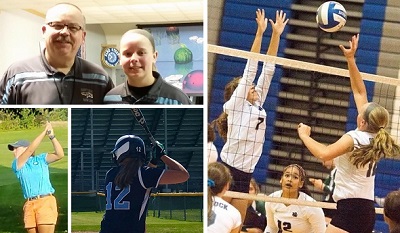
PHOTOS: (Top) Abby House’s varsity letter jacket shows off many of her accomplishments over her first three-plus years of high school. (Middle) Abby House and her father Rich House. (Below) Abby House takes part in some of her sports – with her dad at the bowling center, golfing, and hitting in softball and volleyball. (Action photos courtesy of the House family. Head shots by Pam Shebest.)