

Experience, 'D' Fuel Arbor Prep's Rise
By
Chip Mundy
Special for Second Half
January 27, 2017
By Chip Mundy
Special for Second Half
YPSILANTI – The message for girls basketball players at Ypsilanti Arbor Prep is clear: If you don't play defense with a passion, you're not going to get on the court very often.
 “They've bought into it,” coach Rod Wells said. “Anybody who comes into our system, they tell them, 'You've got to play D, or you're not going to play.'”
It is paying off in a big way. Arbor Prep, a charter school which opened just six years ago, is coming off a Class C championship and currently is 13-0 and ranked No. 1 in Class B by The Associated Press. Three years ago, Arbor Prep was a quarterfinalist in Class B, and the following year it lost in the Class C semis.
Five of the six players who have started this season are seniors, and the Gators are allowing just 26.5 points per game while scoring 66.9.
“We press a lot, but to win a state championship we knew we had to change,” Wells said. “Last year, we pressed, but we understood you have to play great half-court defense. Our girls know how to play half-court defense.
“Some teams can handle the press, and some can't – most teams can't – but we understand some of the good teams are going to be able to break us. We really work on our half-court defense, which a lot of people don't give us respect for. They just think we're a pressing team, but we play a sagging man-to-man defense. We got it from Wisconsin. We don't let people get into the paint. We put pressure on the ball.”
Senior guards Adrienne Anderson and Ro'zhane Wells are the sparks to the defense. Anderson typically guards the opponent's top scorer, while Wells – a point guard - draws the opposing point guard. Anderson leads the team with 3.8 steals per game, and Wells checks in with 3.1. Additionally, forward/center Cydney Williams is averaging 3.2 steals per game, and senior forward Lauryn Carroll is at 2.6.
“Ro'zhane and Adrienne are the two best defenders on the ball in the state of Michigan,” Wells said. “They put so much pressure on the ball that teams can't get into their offense. The rest of the girls play their roles. I brag about those two girls, and now the other girls love defense so much they say, 'What about us, Coach? We're doing it, too.' It's true, they are getting a lot better, but those two are special.
“Our defense is what makes us go. The tenacity and working hard – they work so doggone hard. They have fun, but they understand that we don't want to give up baskets. Our thing is that if you play great defense and give everything you have on defense, on offense I'll let you do your thing. We run a structured offense, but I give you freedom to shoot the ball. If we play great defense, we'll get it back.”
New school, new program
Arbor Prep, a charter school, opened in the fall of 2011 for students from ninth through 12th grades. Wells, who previously had coached at Milan and Ann Arbor Skyline, started the girls basketball program that season. And it was an instant success, although many did not see it that way.
The Gators won their first 15 games with mostly sophomores and freshmen, but the schedule was not overly competitive, and Arbor Prep finished 17-2.
“It was a real challenge,” Wells said. “We made up our schedule at the last minute, and that was a challenge right there. People were saying that we weren't for real and not playing anybody.
“What we did do was get the girls to believe and play hard. We had no expectations. We didn't know we would end up 17-2; we just wanted to play basketball. When we went 17-2, the girls saw that hard work can pay off.”
Respect was soon to follow.
“The next year we beat Benton Harbor, and the following year we beat Country Day,” Wells said. “I think when we beat those two schools, people believed we were for real. Then I looked in the paper. Whoever was ranked or was a big-time school in girls basketball, I called them up and asked if they wanted to play.
“Inkster was the state champs the year before, and we lost by five to them at our place. Their coach was like, 'I can't believe this; you have all freshmen and sophomores.'”
As the program progressed, it seemed to take a step every season. And Wells said each step was a learning process, especially the season-ending losses in the Quarterfinals and Semifinals.
“We learned something from each loss,” Wells said. “One year I thought we weren't strong enough physically. The team had a big girl, and she killed us, but we didn't play team defense. We let our big go against her. The next year, we scheduled teams that had bigs, and we learned to play team defense against that big, and we got better. That was our lesson.
“The following year we lost to Flint Hamady. We had a bad first quarter and a bad second quarter, and we outplayed them the last two quarters. We made six of 16 free throws. Our lesson from that is we break things down every quarter. We want to win every quarter. You can have all the good work all year and then get behind 10 in one quarter, you waste your whole season. If we play a good team or a bad team, we concentrate on winning each quarter. We've lost two quarters this year.”
On the run to the Class C title last year, the Gators lost twice. Wells said lessons were learned in both losses.
 “We lost to Ann Arbor Huron, and my girls just didn't play well, and we lost to Country Day after having a 16-point lead,” he said. “Both of those losses helped to get the girls right. The loss to Country Day was the turning point. They thought I was going to run them in practice and all that, and no, let's just bounce back and do what we do. We blew it, so let's move on.”
And the Gators moved on to the Breslin Center. They had been there the year before in the Semifinals, and Wells believes that 2015 experience was vital to their success.
“I knew that they were going to win that day,” he said. “They had that look in their eye, and they felt the pain from the year before. They saw the (Detroit Martin Luther) King girls crying after the Class A Finals, which were right before us. I didn't even need to have a speech.
“They had been there before. You walk into the Breslin, and it's a different experience. This time, they were like, 'This is our locker room, this is where we're going, there's the pictures on the wall, let's play ball.' No surprises. They were absolutely ready.”
Senior forward/center Cydney Williams remembers feeling overwhelmed with her first visit to Breslin and how it changed on the second trip.
“It was like, 'Wow, this is a big arena,'” she said. “All the lights were on us, we were on live TV, there was a whole bunch of noise, and we couldn't hear coach on the sideline. We had to talk to each other more on the court and zone out of the crowd.
“Last year, we just had that one goal that we weren't going to feel like we felt the year before.”
Arbor Prep is no longer that new program that plays a weak schedule and has its doubters.
It has a winning resume, and this year so much experience and talent that no individual player can put up eye-popping numbers because of the balance. In fact, a recent Ann Arbor News article listed three Arbor Prep players among the top six in the area: Anderson (No. 1), Wells (No. 3) and Williams (No. 6).
“We have six seniors, and five have been with me since the ninth grade,” Wells said. “That group has lost 10 games in four years.”
Another sidenote on those seniors: the lowest grade-point average among them is a 3.8, and despite a rigorous academic load.
While the Gators have not really been tested this season, that will change Saturday night when they travel to Ann Arbor Huron. Arbor Prep has lost to the River Rats in each of the past two seasons.
“It's a measuring stick and a neighborhood battle,” Wells said. “The girls are laser-focused, but they understand the whole season doesn't depend on it.
“They need to be challenged, and that will be the fun part. They need to understand how it feels to be behind this year. I'm not saying I want to be behind, but I want to face that and see how they react to it. This is going to be a great experience, and they are looking forward to it.”
Talent and experience
The Gators return all but one player from last year's championship team. Five seniors are regulars in the starting lineup: Wells at point guard, Anderson at shooting guard, Carroll and Kayla Knight at forwards and Williams as a forward/center.
Junior Lasha Petree, who led Salem in scoring a year ago, came to Arbor Prep with her two sisters and also has cracked the starting lineup while embracing the attitude of her new teammates.
“Everyone has the same goal,” she said. “Everyone wants to win, and they hate losing more than they like to win. It is all-around a great atmosphere because everyone is on the same page.”
Anderson leads the team in scoring at 12.2 points per game, Petree is right behind her at 12.1 with Wells at 11.2 and Williams at 9.8.
But all of them are asked to put defense ahead of offense.
“I love being a defender, but my goal this year is to be known as an offensive and defensive player,” Anderson said. “I've been in the gym a lot working on it, but I wanted to be sure that as much as I worked on offense, I didn't want to weaken my defense. It was important to work on both at the same time to accelerate my game.
 “In middle school, we weren't that big on defense, but here it's our bread and butter. The transition was really hard.”
Wells has a unique situation as she is the coach's daughter. She grew up knowing her father stressed defense, but playing for him certainly had a transition period.
“When I first came to high school, it was the hardest,” she said. “I have to make a difference between seeing him as my dad and as my coach. I try not to take it personally, and I'm just another player on the team. I think I've grown from that, and I'm easier to coach.
“In my sophomore year, I figured out that it's just what he's saying and doesn't intend to hurt you. He just wants to make you better. We used to knock heads a lot because we're so much alike, but not as much now. I have gotten more used to it. We make sure to keep it more toward the family side at home and the basketball side at school.”
Wells is third on the team in scoring, first on the team in assists and third on the team in steals.
“She's the one who sets the tone offensively and defensively for us,” her father said. “She's really improved her jump shot. She used to be just a driver, but now she makes her jump shot.
“Her and Adrienne, whoever they guard are usually the two best players. She is excellent at moving her feet and not fouling. When you think pressure, we teach them to play people full-court but not foul. We just want pressure, and she's one of the best at it. She ends up with two fouls a game after all that pressure.”
In the middle, the Gators have Williams, who leads the team with 8.5 rebounds per game.
“She's my center/forward,” Wells said. “We don't have a center, and she's my biggest rebounder. Very physical, and she can shoot threes. She is quick as I don't know what, and she plays the back end of the press. She reads like a linebacker back there, and she is really agile.
“She has made 100 percent improvement. She was stiff as a freshman just getting around, but something came into her and she is so mobile.”
Williams is another player who would have greater numbers on another team, but she is pleased with her situation.
“I love my role,” she said. “It makes it easier for the team if I can get the outlet and push it up the floor. I use my quickness to get around the bigger people and get under them and push them back so I can get the rebound.”
Carroll and Knight round out the top six.
“Carroll is our shooter,” Wells said. “She was our sixth man last year. She is a phenomenal shooter, and she is our zone buster. When teams play zone, they have to pay attention to her. She has gotten a lot better defensively, too. She asked what she had to do to play more, and I told her she had to play defense better. She made a commitment to do that, and now she plays defense very well.
“Kayla is a 6-foot wing, another great defender with long arms. She has improved a lot scoring this year, too. When guards run a pick-and-roll against us, she can switch and guard a guard at 6-foot. My guards are strong enough to handle the switches.
“She has a great attitude. When she came here, she didn't have a big name or big credentials and didn't expect to make varsity the first year, but she's just always in the gym, and it ended up paying off for her.”
That could be said for the entire team.
“The unity that they have and sacrifices each have made to the program make me the most proud,” Wells said. “If any of them were to go to another local school, they would be averaging 20 points a game. But they are totally OK with averaging between 10 and 13 points a game and winning.
“They have a will to win, and I like that.”
 Chip Mundy served as sports editor at the Brooklyn Exponent and Albion Recorder from 1980-86, and then as a reporter and later copy editor at the Jackson Citizen-Patriot from 1986-2011. He also co-authored Michigan Sports Trivia. E-mail him at [email protected] with story ideas for Jackson, Washtenaw, Hillsdale, Lenawee and Monroe counties.
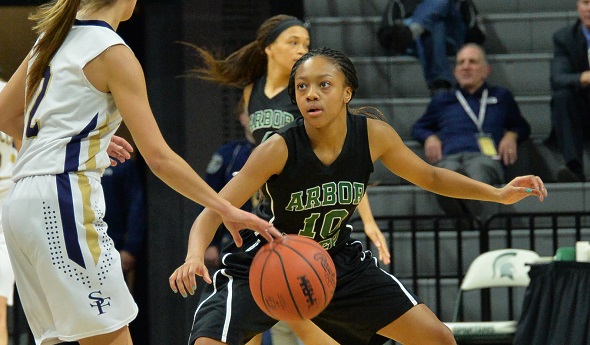
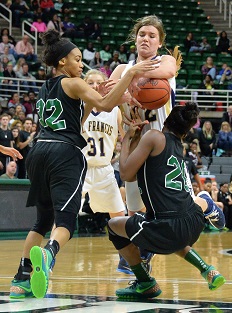
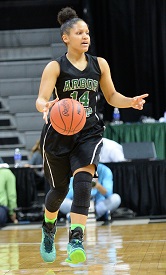
PHOTOS: (Top) Ro’zhane Wells (10) anticipates a Traverse City St. Francis player’s next move during last season’s Class C Final. (Middle) Adrienne Anderson (32) and Cydney Williams work to tie up a loose ball against the Gladiators. (Below) Lauryn Carroll brings the ball up the court during last season’s Semifinal win over Ithaca.
Countdown to Calvin: Girls Report Week 10
February 5, 2018
By Geoff Kimmerly
Second Half editor
Three weeks remain in this girls basketball season, and the Countdown to Calvin is starting to get louder.
 League tournaments are either underway or will start this week in the Detroit Public School League, Detroit Catholic League, Charter School Conference or Macomb Area Conference. And while every team gets a fresh start with MHSAA Districts, those single-elimination league competitions definitely set a postseason mood.
Countdown to Calvin is powered by MI Student Aid and based on results and schedules posted for each school at MHSAA.com. To offer corrections or help us fill in missing scores, email me at [email protected].
Week in Review
The countdown of last week’s five most intriguing results:
1. Flint Carman-Ainsworth 57, Bay City Western 52 – All Saginaw Valley League teams are in one division this year, and this created a three-team jam in second place behind Saginaw Heritage as Carman-Ainsworth handed Western its first loss of the season.
2. East Lansing 63, Williamston 43 – These teams entered both undefeated and among the highest-ranked in Class A and B, respectively; they enter this week a combined 30-1.
3. Pittsford 49, Athens 32 – Bellevue’s upset of Athens two days earlier stole some of the excitement (more on that below), but the Wildcats did win their 70th straight game over another Class D power that had entered the week undefeated.
4. Macomb Dakota 53, Port Huron Northern 51 – The Macomb Area Conference Red continues to be one of the state’s most competitive leagues, and at least a share of this season’s title went to Dakota with this close win over Northern, which faces the other possible co-champ Grosse Pointe North on Wednesday.
5. Flint Beecher 58, Flint Hamady 48 – While both are still chasing Class B Goodrich in the Genesee Area Conference Red, Beecher can claim a regular-season sweep of its frequent Class C-contending rival.
Watch List
With an eye toward March, here are two teams in each class making sparks:
CLASS A
Hartland (10-4) – The Eagles can’t catch Howell and repeat as a league champion, but they did hand the Highlanders their first league loss and second of this winter on Friday, 41-37. The win was the fourth straight for Hartland, which is 7-2 over its last nine games and had fallen to Howell in overtime Jan. 9.
Walled Lake Western (13-1) – The Warriors sit atop the Lakes Valley Conference in the league’s first year, with a key matchup against second-place South Lyon East coming up Tuesday. Western on Jan. 26 avenged its lone loss with a 51-43 win over Waterford Kettering – those two shared the Kensington Lakes Activities Association North title last season.
CLASS B
Ida (13-1) – The Bluestreaks have already claimed a share of the Lenawee County Athletic Association championship thanks to a three-game lead on the field. They haven’t lost since falling in the opener to Adrian Lenawee Christian, which is also 13-1. Ida finished second in the league last year to Blissfield, its opponent Friday.
Muskegon Oakridge (12-3) – The Eagles’ West Michigan Conference winning streak is up to 75 games and stretches most of this decade. They downed second-place Shelby 61-43 on Thursday and can clinch a share of another league title Tuesday against Scottville Mason County Central. Oakridge will look to improve next month on last season’s District title and has taken good losses against Class A Grand Haven, Muskegon and Muskegon Reeths-Puffer.
CLASS C
Charlevoix (10-3) – The Rayders scored the final 13 points over the final 1:13 to beat Traverse City St. Francis on Friday, creating a two-way tie between the rivals atop the Lake Michigan Conference. Keep in mind Charlevoix was only 3-19 two seasons ago before improving to 18-7 in 2016-17. The losses this winter came to Manton, St. Ignace and Kalkaska, which all have at least 10 wins.
Hartford (12-2) – The Indians trail only Centreville (14-1) in the Southwest 10 Conference, and both have at least four more wins than the rest of the league. While Centreville won their first meeting Jan. 12 by 41, Hartford deserves this recognition; it’s already surpassed last season’s 11-11 finish.
CLASS D
Bellevue (12-2) – The Broncos, last season’s Southern Central Athletic Association West champion, gave themselves a chance to catch newcomer Athens for at least a shared title this winter by handing the Indians their first defeat, 40-39 on Thursday. Bellevue had fallen to Athens by two points on Dec. 12 and also has lost to Pittsford (see note on 70-game winning streak above).
Gaylord St. Mary (14-1) – The Snowbirds have won every game since falling to Clare in their season opener, and only Bellaire on Jan. 17 has come within single digits of catching them. That 41-39 win put Gaylord St. Mary in first place in the Ski Valley Conference, but the rivals meet again Tuesday.
Can't-Miss Contests
Be on the lookout for results of these games coming up:
Tuesday – Bellaire (12-2) at Gaylord St. Mary (14-1) – The first meeting, and first place in the Ski Valley Conference, went to St. Mary 41-39. Both are likely Class D contenders as well.
Tuesday – Flushing (13-2) at Goodrich (10-3) – The reigning Class A champion and a regular Class B contender are leading their respective leagues this winter.
Tuesday – Freeland (13-2) at Alma (11-3) – The Falcons won the first meeting 47-38 and continue to hold a one-game lead on the Panthers in the Tri-Valley Conference Central along with a 37-game league winning streak.
Tuesday – Saginaw Heritage (13-0) at Midland (9-4) – Heritage won big the first time around, but this meeting counts in the league standings – and a Midland win would make the SVL at least a four-team race.
Wednesday – Detroit Renaissance (10-6) vs. Detroit Communication Media Arts (12-1) at Detroit East English – This PSL tournament second-round game pits a league champion in CMA and a runner-up in Renaissance.
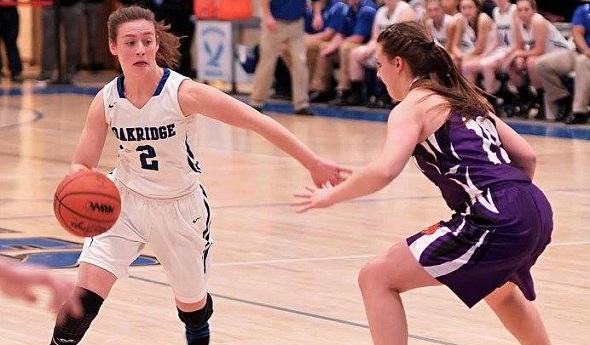
PHOTO: Muskegon Oakridge's Sophia Wiard works to get past a Shelby defender during Thursday's win. (Photo by Sherry Wahr.)