


Girls Basketball Finals Returning to Breslin
September 30, 2019
By Geoff Kimmerly
Second Half editor
The Michigan High School Athletic Association’s Girls Basketball Semifinals and Finals weekend could return to the Breslin Student Events Center as quickly as this upcoming 2019-20 season, with Michigan State University hosting the event this winter and in future seasons when the Spartans women’s basketball team is not selected as an opening-round host for the NCAA Tournament.
Breslin hosted the Girls Basketball Semifinals and Finals from 2004-06 and 2010-17. However, the potential for a conflict with the NCAA Division I Women’s Basketball Tournament led to the MHSAA moving the event for the past two seasons. The NCAA awards top-four seeded teams an opportunity to host the first two rounds of its Division I tournament, and the NCAA event falls almost annually on the traditional dates of the MHSAA girls basketball championship weekend – setting up the possible conflict of both events being scheduled to play at Breslin at the same time.
During an initial three-year contract beginning this winter, Breslin tentatively will be the host of the MHSAA Girls Basketball Semifinals and Finals. If, beginning in 2021, the Spartans are seeded fourth or higher for the NCAA Tournament and selected to host first and second rounds, the MHSAA Girls Semifinals and Finals will be played at Read Fieldhouse’s University Arena on the campus of Western Michigan University. Hope College’s DeVos Fieldhouse in Holland will serve as the alternative site if Breslin is not available in 2020, as Read is hosting the Mid-American Conference Gymnastics Championships during the weekend of the MHSAA Girls Semifinals and Finals.
“We are thankful for the graciousness of all parties involved to allow for this opportunity to bring the Girls Basketball Semifinals and Finals back to the Breslin Center,” MHSAA Executive Director Mark Uyl said. “From the Breslin Center staff, to coach Suzy Merchant and the MSU women’s basketball program, to MSU law enforcement, ticketing and hospitality and then Western Michigan and Hope College and their facilities people for agreeing to reserve their arenas for us in case it’s needed – this agreement happens only because of the immense cooperation by everyone involved.”
The MHSAA Girls Basketball Semifinals will be played this upcoming season March 19-20, 2020, with all four championship games March 21. The NCAA Division I Women’s Basketball Tournament’s opening weekend is March 20-23, with the bracket and seeds to be announced Monday, March 16.
The MHSAA Boys Basketball Semifinals and Finals traditionally are played at the Breslin Center the following weekend, this upcoming season March 26-28. All games for the NCAA Men’s Basketball Tournament are played at neutral sites, and there is no possible conflict between the two events.
Read Fieldhouse, home to Broncos teams including the women’s and men’s basketball programs, unveiled a new basketball court at the start of the 2015-16 season among a variety of improvements to the facility over the last five years. The MHSAA Girls Basketball Finals were played at Read from 1983-85, and WMU also hosted the MHSAA Girls Volleyball Finals from 1996 through the 2007 winter season, the last before the MHSAA season for the sport moved to the fall.
DeVos Fieldhouse, the 2020 provisional site, is home to Hope’s hoops teams among other athletic programs and previously hosted the 2013 NCAA Division III Women’s Basketball Final Four.
Be the Referee: Basketball Measurements
By
Sam Davis
MHSAA Director of Officials
January 4, 2023
Be The Referee is a series of short messages designed to help educate people on the rules of different sports, to help them better understand the art of officiating, and to recruit officials.
Below is this week's segment – Basketball Measurements - Listen
If you’ve seen the movie “Hoosiers,” you know that a basketball rim is 10 feet above the ground. That’s the same if you are in the gym at Beaver Island High School or at Little Caesars Arena. But what are the other court dimensions?
To start – courts are typically 84 feet long but can be up to 94 feet long. They are 50 feet wide.
The free throw line is 15 feet from the face of the backboard and the high school 3-point line is 19 feet, 9 inches from the basket.
Each hoop is a circle, 18 inches in diameter.
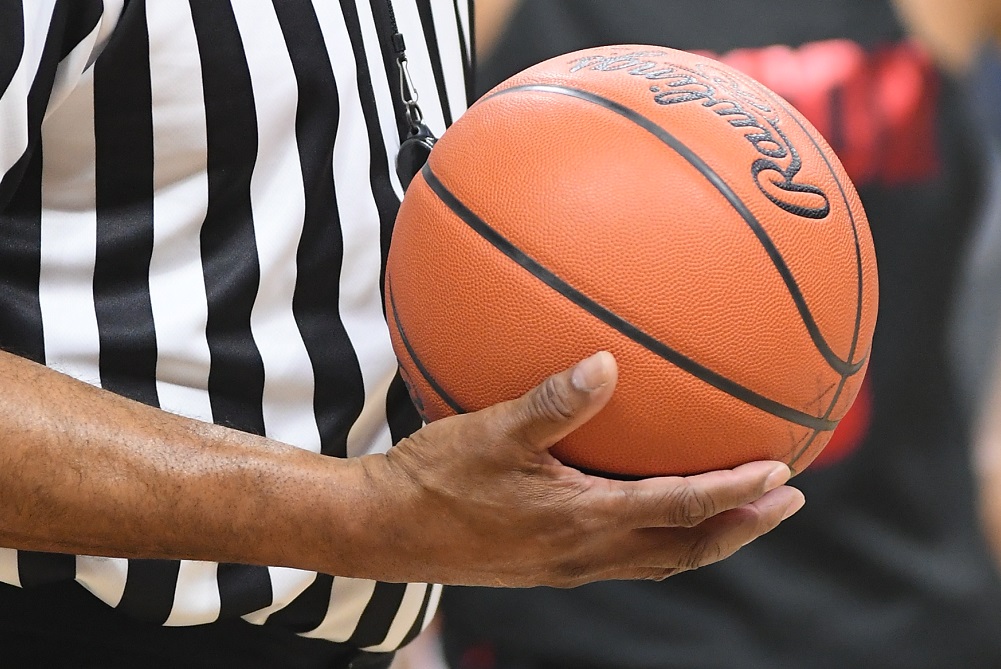
The boys play with a basketball 29½ inches in circumference, the girls with one 28½ inches in circumference.
And believe it or not, two girls balls will go through a standard rim at the same time.
Previous Editions:
Dec. 13: Pregame Dunks - Listen
Dec. 6: Gymnastics Judges - Listen
Nov. 22: Football Finals Replay - Listen
Nov. 15: Back Row Illegal Blocker - Listen
Nov. 8: Swim Turn Judges - Listen
Nov. 1: Soccer Referee Jersey Colors - Listen
Oct. 25: Cross Country Tie-Breaker - Listen
Oct. 18: Soccer Shootouts - Listen
Oct. 11: Safety in End Zone - Listen
Oct. 4: Football Overtime Penalty - Listen
Sept. 27: Kickoff Goal - Listen
Sept. 20: Soccer Timing - Listen
Sept. 13: Volleyball Replays - Listen
Sept. 6: Switching Sides - Listen
Aug. 30: Play Clock - Listen
Aug. 23: Intentional Grounding Change - Listen