


Girls Basketball Finals Returning to Breslin
September 30, 2019
By Geoff Kimmerly
Second Half editor
The Michigan High School Athletic Association’s Girls Basketball Semifinals and Finals weekend could return to the Breslin Student Events Center as quickly as this upcoming 2019-20 season, with Michigan State University hosting the event this winter and in future seasons when the Spartans women’s basketball team is not selected as an opening-round host for the NCAA Tournament.
Breslin hosted the Girls Basketball Semifinals and Finals from 2004-06 and 2010-17. However, the potential for a conflict with the NCAA Division I Women’s Basketball Tournament led to the MHSAA moving the event for the past two seasons. The NCAA awards top-four seeded teams an opportunity to host the first two rounds of its Division I tournament, and the NCAA event falls almost annually on the traditional dates of the MHSAA girls basketball championship weekend – setting up the possible conflict of both events being scheduled to play at Breslin at the same time.
During an initial three-year contract beginning this winter, Breslin tentatively will be the host of the MHSAA Girls Basketball Semifinals and Finals. If, beginning in 2021, the Spartans are seeded fourth or higher for the NCAA Tournament and selected to host first and second rounds, the MHSAA Girls Semifinals and Finals will be played at Read Fieldhouse’s University Arena on the campus of Western Michigan University. Hope College’s DeVos Fieldhouse in Holland will serve as the alternative site if Breslin is not available in 2020, as Read is hosting the Mid-American Conference Gymnastics Championships during the weekend of the MHSAA Girls Semifinals and Finals.
“We are thankful for the graciousness of all parties involved to allow for this opportunity to bring the Girls Basketball Semifinals and Finals back to the Breslin Center,” MHSAA Executive Director Mark Uyl said. “From the Breslin Center staff, to coach Suzy Merchant and the MSU women’s basketball program, to MSU law enforcement, ticketing and hospitality and then Western Michigan and Hope College and their facilities people for agreeing to reserve their arenas for us in case it’s needed – this agreement happens only because of the immense cooperation by everyone involved.”
The MHSAA Girls Basketball Semifinals will be played this upcoming season March 19-20, 2020, with all four championship games March 21. The NCAA Division I Women’s Basketball Tournament’s opening weekend is March 20-23, with the bracket and seeds to be announced Monday, March 16.
The MHSAA Boys Basketball Semifinals and Finals traditionally are played at the Breslin Center the following weekend, this upcoming season March 26-28. All games for the NCAA Men’s Basketball Tournament are played at neutral sites, and there is no possible conflict between the two events.
Read Fieldhouse, home to Broncos teams including the women’s and men’s basketball programs, unveiled a new basketball court at the start of the 2015-16 season among a variety of improvements to the facility over the last five years. The MHSAA Girls Basketball Finals were played at Read from 1983-85, and WMU also hosted the MHSAA Girls Volleyball Finals from 1996 through the 2007 winter season, the last before the MHSAA season for the sport moved to the fall.
DeVos Fieldhouse, the 2020 provisional site, is home to Hope’s hoops teams among other athletic programs and previously hosted the 2013 NCAA Division III Women’s Basketball Final Four.
Class C Preview: Revved Up For Rematches
March 14, 2018
By Geoff Kimmerly
Second Half editor
The most exciting basketball played at Van Noord Arena this weekend could feature a foursome of Class C powerhouses.
All four semifinalists making the trip to Calvin College in Grand Rapids played in Semifinals last season as well. Today’s first game features a rematch of last season’s Class C championship game – which Detroit Edison won 46-44 over Pewamo-Westphalia.
The second game features two more tournament veterans, Maple City Glen Lake and Ypsilanti Arbor Prep. The Gators finished runner-up in Class B last season and are the only team to beat Edison this winter.
Class C Semifinals – Thursday
Detroit Edison (22-1) vs. Pewamo-Westphalia (25-0), noon
Ypsilanti Arbor Prep (20-5) vs. Maple City Glen Lake (23-2), 2 p.m.
Class C Final – Saturday, 4 p.m.
Tickets cost $10 per pair of Semifinals and $10 per two-game Finals session (Class C and Class B). All Semifinals will be streamed live on MHSAA.tv and viewable on a pay-per-view basis. All four Finals will be broadcast live on Fox Sports Detroit and streamed live on FoxSportsDetroit.com and the FOX Sports Go! app. Free radio broadcasts of all weekend games will be available on MHSAANetwork.com.
Below is a glance at all four semifinalists. Click on the name of the school to see that team’s full schedule and results from this season. (Statistics are through teams' Regional Finals.)
DETROIT EDISON PUBLIC SCHOOL ACADEMY
Record/rank: 22-1, No. 7
League finish: Does not play in a league.
Coach: Monique Brown, seventh season (101-36)
Championship history: Class C champion 2017.
Best wins: 88-56 over No. 2 (tie) St. Ignace, 57-55 (OT) over Class A No. 3 Saginaw Heritage, 71-69 and 64-50 over Class A No. 10 Wayne Memorial, 66-40 over Class A No. 5 Ann Arbor Huron, 62-46 over Class B No. 2 Detroit Country Day.
Players to watch: Rickea Jackson, 6-3 jr. G (22.3 ppg, 10.4 rpg, 1.5 bpg); Gabrielle Elliott, 5-10 soph. G (16.4 ppg, 4.0 rpg).
Outlook: Despite its relatively low final regular-season ranking in Class C, Edison is considered by many to be the top team in Michigan regardless of Class. Nearly all of its in-state wins during the regular season were against Class A or B teams, including as well a 70-42 defeat of annual power Detroit Martin Luther King. Jackson likely will be a Miss Basketball candidate next season; Elliott could be the same in 2020. Nine of 12 players are underclassmen, and freshman Damiya Hagemann is another intriguing talent averaging 9.1 points and 8.4 assists per game.
MAPLE CITY GLEN LAKE
Record/rank: 23-2, No. 10
League finish: Second in Northwest Conference.
Coach: Jason Bradford, 10th season (155-54)
Championship history: Class D champion 1978, runner-up 1979.
Best wins: 60-56 over No. 2 (tie) St. Ignace in Quarterfinal, 66-35 over Charlevoix in Regional Final, 52-47 (District Semifinal) and 60-49 over Traverse City St. Francis, 55-48 over Manton in District Final, 53-36 and 48-40 over Benzie Central.
Players to watch: Savannah Peplinski, 5-8 sr. G (15.6 ppg, 5.3 rpg, 3.0 apg, 3.9 spg); Jennifer LaCross, 5-8 sr. F (11.6 ppg, 5.7 rpg, 3.1 spg).
Outlook: Glen Lake is back in the Semifinals for the second straight season, its only losses this time to Class B semifinalist and Northwest Conference rival Kingsley. Peplinski, LaCross, junior center Kaitlyn Schaub (9.0 ppg, 5.9 rpg) and senior forward Allie Bonzelet (10.2 ppg) also started last season. Glen Lake beat league champions in St. Francis (17-4), Manton (18-4) and St. Ignace (23-2) during the tournament, while Charlevoix (19-5) and Houghton Lake (15-8) rounded out a tough postseason slate that should have the team plenty prepared for this weekend.
PEWAMO-WESTPHALIA
Record/rank: 25-0, No. 1
League finish: First in Central Michigan Athletic Conference.
Coach: Steve Eklund, ninth season (180-34)
Championship history: Three runner-up finishes (most recent 2017).
Best wins: 45-30 over Kent City in Quarterfinal, 45-29 over Hemlock in Regional Final, 48-33 (Regional Semifinal), 44-20 and 53-19 over Laingsburg, 59-36 over honorable mention New Lothrop, 64-41 over Detroit Renaissance.
Players to watch: Emily Spitzley, 5-10 sr. G (17 ppg, 4.3 rpg, 65 3-pointers); Hannah Spitzley, 5-10 soph. F (10.5 ppg, 5.1 rpg, 3.1 spg).
Outlook: After falling by a basket to Edison in last season’s Final, P-W has been all but unstoppable beating opponents by an average of 40 points and with only Springport (18-5) in the District Final coming closer than 15. Laingsburg’s only losses this season in going 20-3 were to the Pirates. Kent City (22-4), Hemlock (21-4) and New Lothrop (20-3) all were league champions, and Class A Renassiance (16-8) was runner-up in the Detroit Public School League tournament. P-W makes 40 percent of its 3-point attempts; sophomore guard Ellie Droste (9.5 ppg) is another of six players with at least 15 makes from beyond the arc.
YPSILANTI ARBOR PREP
Record/rank: 20-5, honorable mention
League finish: Does not play in a league.
Coach: Scott Stine, first season (20-5)
Championship history: Class C champion 2016, Class B runner-up 2017.
Best wins: 61-55 over No. 2 Schoolcraft in Quarterfinal, 54-49 over No. 1 Detroit Edison, 66-65 over Class B No. 2 Detroit Country Day, 48-45 over Clarkston, 60-39 over Goodrich.
Players to watch: Lasha Petree, 6-0 sr. G (20.2 ppg, 5.8 rpg, 5.4 spg, 42 3-pointers, Mahri Petree, 5-11 jr. G (10.8 ppg, 5.7 rpg).
Outlook: In addition to being the only team to hand Edison a loss this season, the Gators faced a schedule of nearly all Class A and B opponents. Class A Clarkston (18-5) and Class B Goodrich (20-5) were league champs, and Arbor Prep also avenged an earlier loss to another Class B league champ in Harper Woods Chandler Park (17-7). Lasha Petree was a Miss Basketball finalist this season and scores more than 40 percent of her team’s points, on average. Junior forward Kashyra Jackson is another contributor, averaging 6.1 points and 4.9 rebounds per game with a team second-best 16 3-pointers.
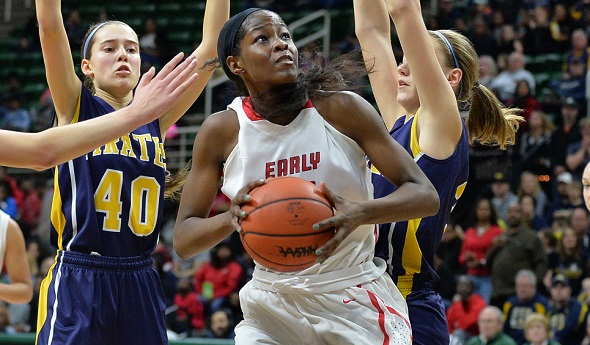
PHOTO: Detroit Edison's Rickea Jackson works for an open shot surrounded by Pewamo-Westphalia defenders during last season's Class C Final.