

Hamady Holds On in Semifinal Return
March 19, 2015
By Geoff Kimmerly
Second Half editor
EAST LANSING – For the first time in what seemed like a long time, Flint Hamady coach Keith Smith brought a group of players to the Breslin Center on Thursday who had never played in an MHSAA Semifinal.
But this season’s Hawks had heard from past standouts who contributed to the team’s back-to-back Class C championships in 2009 in 2010. And the advice they received boiled down to a few clear points:
This is what to expect at Michigan State. This is how to play when the spotlight is brightest. Make sure to box out. And most importantly, listen and do whatever Coach Smith tells you, no matter how excitable he might be in the huddle.
He said Thursday to calm down. He told his players to be patient, even as Ypsilanti Arbor Prep was cutting a 16-point lead to two. Smith knew that his team, composed, would be just fine.
And he was right. The No. 5 Hawks did hold off No. 3 Arbor Prep, 50-46, and will play Saturday for their fourth MHSAA title.
"I love it. It shows me he wants it as well as we do," Hamady senior center Aaliah Hill said her coach's energy. "Everything he does with his composure and his reaction, we're with it too.
"He knows what it takes to get here, and we're just going to keep on listening to him and trusting him."
Hamady (26-1) will face Calumet (23-2) in the Final at 4 p.m. Calumet was unranked at the start of the postseason and will make its first championship game appearance.
 But as noted, this also will be the first championship game for a talented Hamady group that fell in its Regional last season and the Quarterfinals in 2013.
On Thursday, the Hawks came out aggressively in pursuit of returning to the Final.
They led by 10 two minutes into the second quarter and pushed the advantage to 16 points with two minutes to play in the second quarter.
But with the game rolling so smoothly, Hamady began to rush – and Arbor Prep went on a 16-3 run, creating havoc with its defensive press and taking advantage of six Hawks turnovers over an eight-minute period.
“That pressure is something different. I never thought I could see the day when someone would bring the same type of heat we bring,” Smith said. “We lost our composure a little bit.”
Which is what Arbor Prep coach Rod Wells said put his team down by so much during the first half. The Gators (22-4), in their fourth year with a program, won Regional titles this season and last and played ranked teams from Class A and B this winter – but didn’t seem to find their groove until the third quarter.
“We didn’t play with a lot of intensity in the first half, got beat on the offensive boards, and just didn’t move our feet very well,” Wells said. “We just kinda got caught up in the moment in the first half, just didn’t have the energy for whatever reason. By the time we made adjustments and got energized, we used a lot of energy to come back.”
As Arbor Prep’s energy ran low, Hamady’s rhythm returned. The Hawks played the Gators just about even over the final seven minutes – good enough to hold on for the four-point win.
Hill led three on her team in double-digit scoring with 16 points to go with 13 rebounds. Sophomore guard Krystal Rice added 11 points and 10 rebounds, and Terry had 14 points.
Junior guard Nastassja Chambers scored 14 points to lead Arbor Prep. Senior guard Payton Sims added eight points and four rebounds.
Hamady’s last two teams did break 20 wins – with 22 in 2012-13 and 23 last season – despite not reaching the final weekend either year. This team raised its level this winter even without senior guard Raasheedah Harris, the team’s third-leading scorer and second-leading rebounder who was injured midseason.
The Hawks suffered their lone loss on the court, to Class B semifinalist Detroit Country Day, soon after Harris was hurt. But “that’s when we woke up,” Smith said.
“This is something the girls can go on and take on the rest of their lives,” he added. “When they get a chance to play at a place like the Breslin Center, and the seniors hear from girls who come back from our championship teams, they hear their experiences and they want the experience as well.
“And now they have it.”
Click for the full box score and video of the press conference.
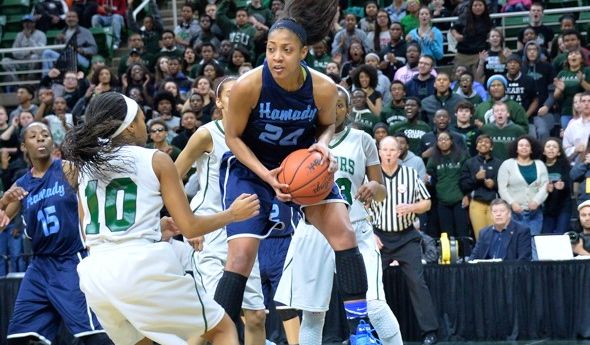
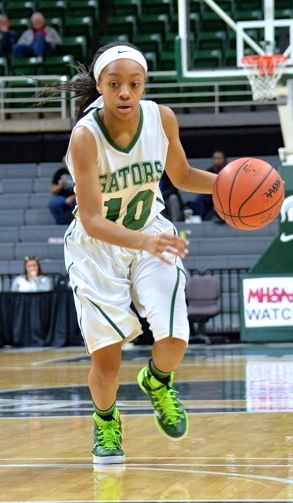
PHOTO: (Top) Flint Hamady's Aaliah Hill pulls down a rebound during Thursday's Class C Semifinal. (Middle) Arbor Prep's Rohzane Wells brings the ball upcourt.
Countdown to Calvin: Girls Report Week 10
February 5, 2018
By Geoff Kimmerly
Second Half editor
Three weeks remain in this girls basketball season, and the Countdown to Calvin is starting to get louder.
 League tournaments are either underway or will start this week in the Detroit Public School League, Detroit Catholic League, Charter School Conference or Macomb Area Conference. And while every team gets a fresh start with MHSAA Districts, those single-elimination league competitions definitely set a postseason mood.
Countdown to Calvin is powered by MI Student Aid and based on results and schedules posted for each school at MHSAA.com. To offer corrections or help us fill in missing scores, email me at [email protected].
Week in Review
The countdown of last week’s five most intriguing results:
1. Flint Carman-Ainsworth 57, Bay City Western 52 – All Saginaw Valley League teams are in one division this year, and this created a three-team jam in second place behind Saginaw Heritage as Carman-Ainsworth handed Western its first loss of the season.
2. East Lansing 63, Williamston 43 – These teams entered both undefeated and among the highest-ranked in Class A and B, respectively; they enter this week a combined 30-1.
3. Pittsford 49, Athens 32 – Bellevue’s upset of Athens two days earlier stole some of the excitement (more on that below), but the Wildcats did win their 70th straight game over another Class D power that had entered the week undefeated.
4. Macomb Dakota 53, Port Huron Northern 51 – The Macomb Area Conference Red continues to be one of the state’s most competitive leagues, and at least a share of this season’s title went to Dakota with this close win over Northern, which faces the other possible co-champ Grosse Pointe North on Wednesday.
5. Flint Beecher 58, Flint Hamady 48 – While both are still chasing Class B Goodrich in the Genesee Area Conference Red, Beecher can claim a regular-season sweep of its frequent Class C-contending rival.
Watch List
With an eye toward March, here are two teams in each class making sparks:
CLASS A
Hartland (10-4) – The Eagles can’t catch Howell and repeat as a league champion, but they did hand the Highlanders their first league loss and second of this winter on Friday, 41-37. The win was the fourth straight for Hartland, which is 7-2 over its last nine games and had fallen to Howell in overtime Jan. 9.
Walled Lake Western (13-1) – The Warriors sit atop the Lakes Valley Conference in the league’s first year, with a key matchup against second-place South Lyon East coming up Tuesday. Western on Jan. 26 avenged its lone loss with a 51-43 win over Waterford Kettering – those two shared the Kensington Lakes Activities Association North title last season.
CLASS B
Ida (13-1) – The Bluestreaks have already claimed a share of the Lenawee County Athletic Association championship thanks to a three-game lead on the field. They haven’t lost since falling in the opener to Adrian Lenawee Christian, which is also 13-1. Ida finished second in the league last year to Blissfield, its opponent Friday.
Muskegon Oakridge (12-3) – The Eagles’ West Michigan Conference winning streak is up to 75 games and stretches most of this decade. They downed second-place Shelby 61-43 on Thursday and can clinch a share of another league title Tuesday against Scottville Mason County Central. Oakridge will look to improve next month on last season’s District title and has taken good losses against Class A Grand Haven, Muskegon and Muskegon Reeths-Puffer.
CLASS C
Charlevoix (10-3) – The Rayders scored the final 13 points over the final 1:13 to beat Traverse City St. Francis on Friday, creating a two-way tie between the rivals atop the Lake Michigan Conference. Keep in mind Charlevoix was only 3-19 two seasons ago before improving to 18-7 in 2016-17. The losses this winter came to Manton, St. Ignace and Kalkaska, which all have at least 10 wins.
Hartford (12-2) – The Indians trail only Centreville (14-1) in the Southwest 10 Conference, and both have at least four more wins than the rest of the league. While Centreville won their first meeting Jan. 12 by 41, Hartford deserves this recognition; it’s already surpassed last season’s 11-11 finish.
CLASS D
Bellevue (12-2) – The Broncos, last season’s Southern Central Athletic Association West champion, gave themselves a chance to catch newcomer Athens for at least a shared title this winter by handing the Indians their first defeat, 40-39 on Thursday. Bellevue had fallen to Athens by two points on Dec. 12 and also has lost to Pittsford (see note on 70-game winning streak above).
Gaylord St. Mary (14-1) – The Snowbirds have won every game since falling to Clare in their season opener, and only Bellaire on Jan. 17 has come within single digits of catching them. That 41-39 win put Gaylord St. Mary in first place in the Ski Valley Conference, but the rivals meet again Tuesday.
Can't-Miss Contests
Be on the lookout for results of these games coming up:
Tuesday – Bellaire (12-2) at Gaylord St. Mary (14-1) – The first meeting, and first place in the Ski Valley Conference, went to St. Mary 41-39. Both are likely Class D contenders as well.
Tuesday – Flushing (13-2) at Goodrich (10-3) – The reigning Class A champion and a regular Class B contender are leading their respective leagues this winter.
Tuesday – Freeland (13-2) at Alma (11-3) – The Falcons won the first meeting 47-38 and continue to hold a one-game lead on the Panthers in the Tri-Valley Conference Central along with a 37-game league winning streak.
Tuesday – Saginaw Heritage (13-0) at Midland (9-4) – Heritage won big the first time around, but this meeting counts in the league standings – and a Midland win would make the SVL at least a four-team race.
Wednesday – Detroit Renaissance (10-6) vs. Detroit Communication Media Arts (12-1) at Detroit East English – This PSL tournament second-round game pits a league champion in CMA and a runner-up in Renaissance.
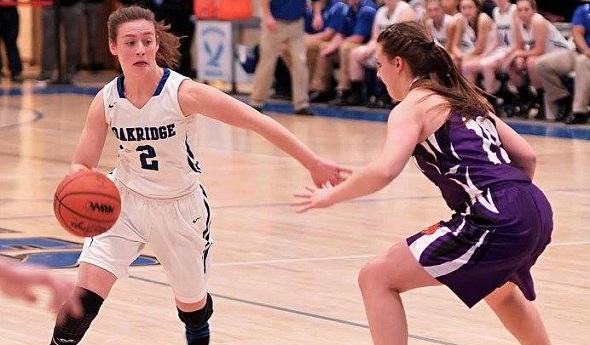
PHOTO: Muskegon Oakridge's Sophia Wiard works to get past a Shelby defender during Thursday's win. (Photo by Sherry Wahr.)